It’s Not That Biden Is Too Slow. It’s That He’s Going Too Small.

•

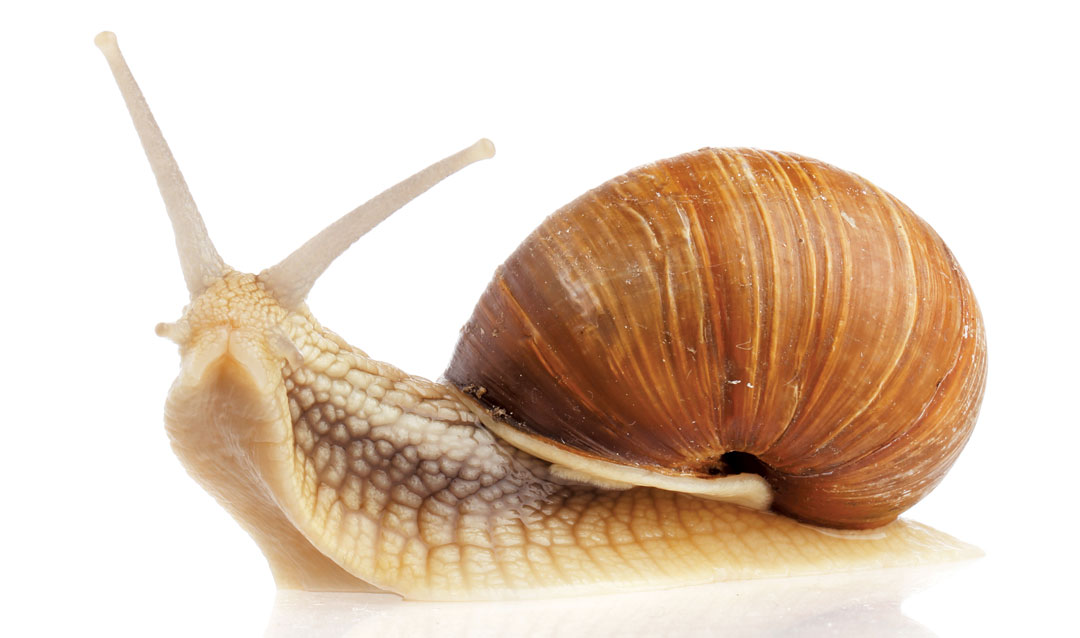
Image result for snail

           In the intraparty Democratic war between progressive leftists and corporate centrists, each side speaks a different language. The two factions’ takes on Joe Biden’s first weeks as president starkly demonstrate that inability to communicate.

            Biden’s base is his centrist supporters, those who backed him against Bernie Sanders during the primaries on the grounds that his moderate demeanor and years of wheeling and dealing would allow him to find common ground with Republicans who would probably continue to control the Senate. Centrists’ response to criticism of Biden is that Donald Trump’s mishandling of the coronavirus crisis, the shattered economy and the deep wound to our national psyche caused and embodied by the January 6th Capitol insurrection will require a long time to fix. Impatience, they say, is unrealistic and unfair.

The same principle applies to Biden’s response to longer-standing policy issues that predate Trump, like climate change and the healthcare system. They say, he just moved into the White House. Chill.

But progressives aren’t complaining that Biden is too slow—although they obviously feel a sense of urgency. They are complaining that his policy prescriptions are too small.

Biden came out of the gate fast with dozens of executive orders. But policy-obsessed progressive populists weren’t impressed by their close-to-nonexistent impact.

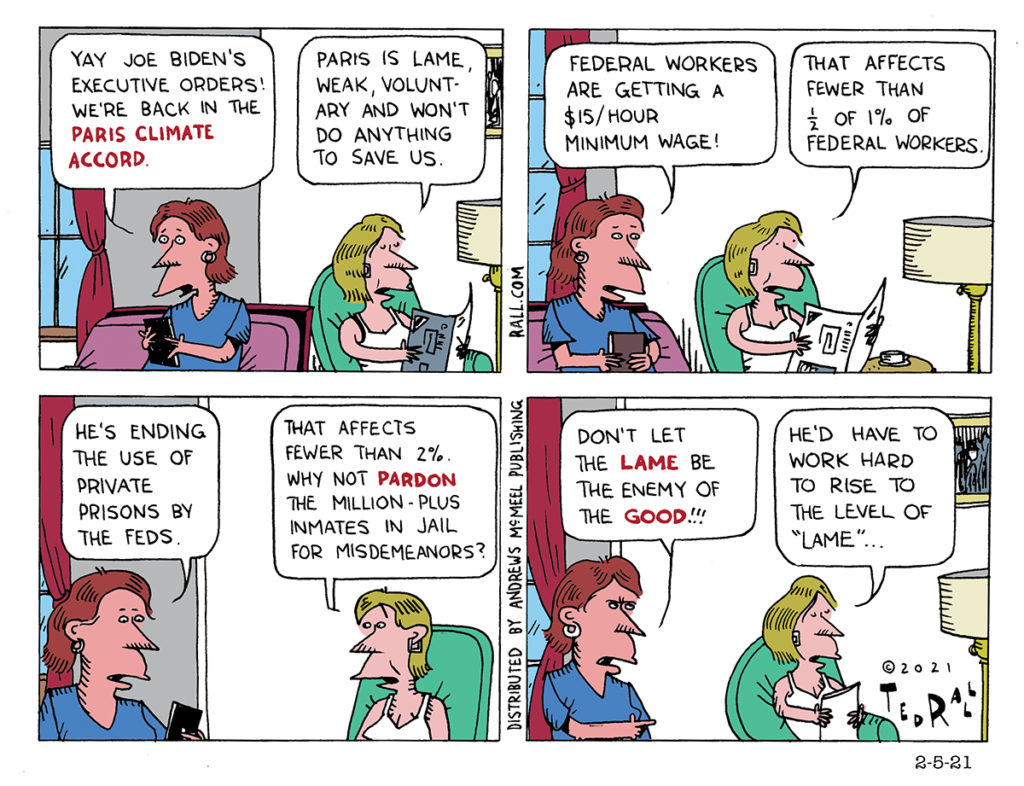
            On January 22nd the president issued a mandate that federal workers become subject to a $15-an-hour minimum wage. Given that the “Fight for $15” movement began in 2012, satisfying that progressive demand would require $17 after adjusting for inflation. More vexing is that Biden’s order doesn’t do anything. According to the U.S. Office of Personnel Management fewer than 20,000 of the nation’s 2.1 million federal government employees—fewer than one percent—currently earn less than $15 an hour. The administration made a splash but 99% of federal workers won’t see an extra penny.

Biden claims that he wants to reform American prisons, an idea for which progressives have been fighting and where common ground with Republicans may be achievable. But his executive order, which tells the Department of Justice not to renew contracts with privately-operated, for-profit prisons, affects only 14,000 out of nearly 152,000 federal inmates currently incarcerated, or fewer than 10% of federal prisoners. There were 1.8 million people in American prisons as of the middle of last year. Biden’s executive order will lead to the transfers of fewer than 1% of the total prison population.

“When it comes to private prisons, the impact of this order is going to be slight to none,” Fordham law professor John Pfaff tells NBC News. Because it fools us into believing in a nonexistent improvement it might even make things worse. “The symbolism carries the very real risk of making us blind to the nearly identical incentives of the public prison sector, and the public side is so much vaster in scope,” Pfaff warns.

One Biden order promises to replace the federal government fleet of 645,000 vehicles with electric ones. The catch is, he doesn’t say when. Unless it happens before 2035 and no future administration issues another executive order reversing this one, companies like General Motors will render the issue moot. The automaker has announced that it will stop making gas-powered passenger cars and SUVs that year.

I was pleasantly surprised by Biden’s decision to push his $1.9 trillion COVID-19 stimulus package through Congress using the budget reconciliation process, which only requires 50 votes rather than a 60-vote supermajority in the Senate. Democrats finally seem to be waking up to the reality that Republicans really, really hate them and aren’t going to cooperate with their initiatives. But here’s the thing: neither the one-time $1400 per person payout nor the $15/hour minimum wage can lift us out of the deep coronavirus depression. The American workforce has lost at least 10 million jobs over the last year. Millions of people face eviction or foreclosure. There is widespread consensus among economists that Biden’s plan, assuming it passes intact, is insufficient and will fail to provide long-lasting relief.

If Biden has big plans in mind, now—while Democrats control the Senate and he enjoys high approval ratings—is the time to tee them up.

First, the president should communicate to the public that sizable coronavirus relief packages will be an ongoing part of fiscal policy until the pandemic is over, recovery is at hand and the rising tide has already begun to lift most boats. The current ad hoc approach inherited from Trump is woefully inadequate and creates unnecessary anxiety among individuals and in the securities markets. Stimulus in fits and starts doesn’t work. We need a Universal Basic Income.

Second is the environment. Long neglected by both major parties, the climate change crisis represents both an enormous opportunity as well as an existential threat to humanity. Auto manufacturers that are rapidly moving toward electric vehicles and big energy companies that already understand the future lies outside fossil fuels prove that the marketplace is ahead of government when it comes to the Green New Deal. Biden deserves credit for talking about the problem but he wants to do way too little way too late.

He should work to push through a comprehensive plan to radically reduce the emission of greenhouse gases within the next few months.

There are, of course, a myriad of other policy challenges ahead—militarism, immigration, an increasingly authoritarian Silicon Valley—but if I were Biden I would tackle racism and particularly racist policing quickly. American police are vicious, stupid and predatory. They make communities more dangerous, not safer. Cops should get out of the revenue enhancement business. Protecting the public must take priority over protecting themselves. Harassing people based on ethnicity and other demographic profiles must end. Biden can use the threat of withholding federal funding to force states and cities to reinvent policing from the ground up.

We want Biden to be fast. More than that, though, we want him to be bold.

(Ted Rall (Twitter: @tedrall), the political cartoonist, columnist and graphic novelist, is the author of “Political Suicide: The Fight for the Soul of the Democratic Party.” You can support Ted’s hard-hitting political cartoons and columns and see his work first by sponsoring his work on Patreon.)
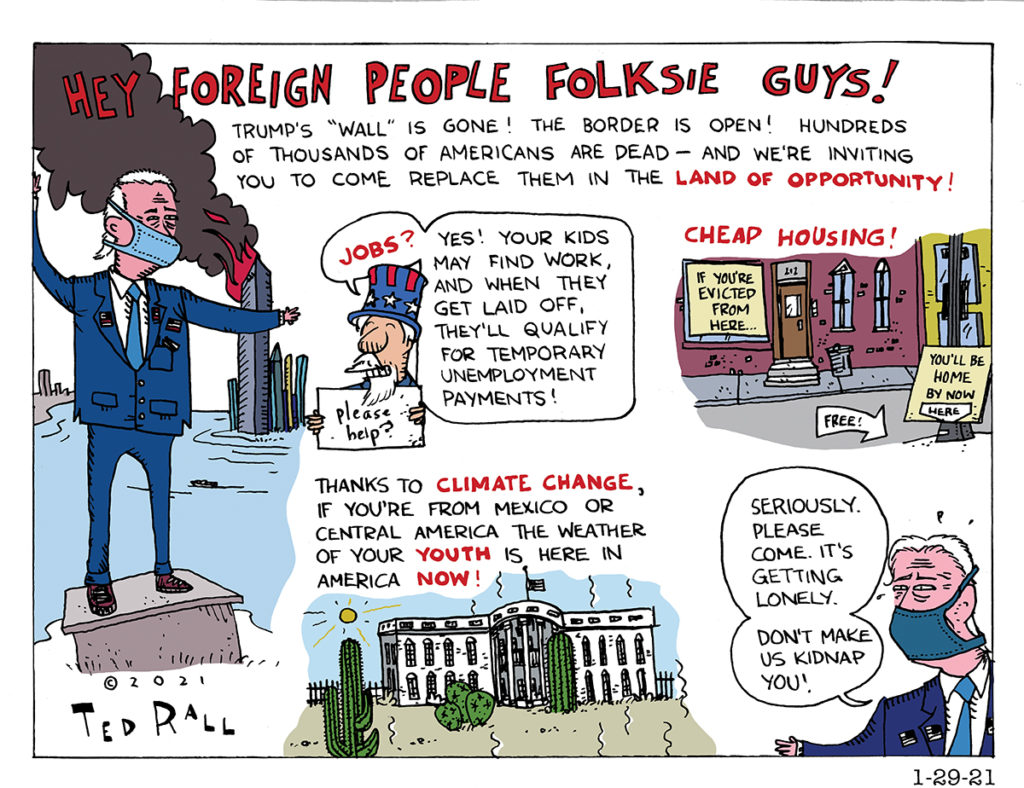


The Border is Open Again!

•

Comprehensive immigration reform is here. Construction on the wall, to the extent that it ever happened, is ending. Joe Biden wants you to know that you can come to America anytime you want. But why would you want to?

In a Crisis, a Compromise Solution Is Worse Than No Solution at All

•

LTC Plan Design: Half a Loaf is Better Than None - Financial Abundance

            The raging argument on the left between progressives who argue for radical change and centrists who advocate incrementalism is hardly new. Nearly a century ago, progressive titan and Wisconsin governor Robert La Follette and FDR were often at loggerheads over the same question.

Roosevelt, La Follette complained, was too quick to compromise with reactionaries. FDR insisted that “half a loaf is better than no bread.” While that might seem intuitively obvious, La Follette had a ready reply. “Half a loaf, as a rule, dulls the appetite, and destroys the keenness of interest in attaining the full loaf.” That can be dangerous. The average adult male requires approximately 2500 calories of nutrition per day. 1250 is better than 0, but 1250 is still malnutrition that would eventually kill him.

Even in a long-running crisis, the sustained agitation necessary to pressure the political classes into granting concessions doesn’t usually occur before people’s suffering has become acute. If the powers that be provide partial relief in the form of a half-measure that partly alleviates a problem, angry citizens can be persuaded to put down their pitchforks and go home peaceably. Yet the problem persists.

The Affordable Care Act is a perfect example. Obama became president at the peak of a major economic crisis, the subprime mortgage meltdown of 2007-09. With hundreds of thousands of people losing their jobs every month, the need for government intervention in the healthcare system was obvious to most Americans. So Obama campaigned on major change that included a public option. Two out of three people, including many Republicans, favored a single-payer system similar to those in many other countries.

Instead, we got the watered-down ACA.

As COVID-19 has made clear, the for-profit American healthcare system is even more scandalously dysfunctional than it was prior to the passage of Obamacare. The ACA “marketplace” has collapsed; many places only offer one “take it or leave it” insurance plan. Nevertheless, healthcare is no longer a top political issue. Support for a public option or Medicare For All has dropped to about 50%. The Democratic Party chose to nominate someone who promised to veto Medicare For All even if both houses of Congress were to pass it.

Tens of thousands of people are still dying every year because they can’t afford to see a doctor. But in too many people’s minds, healthcare was partly solved. So they are no longer demanding improvements. Though it might seem counterintuitive, the politics of the healthcare crisis would be vastly improved had the compromise ACA never been enacted. More people would be suffering. But the absence of an existing, lame, plan would add urgency (and supporters) to the fight for a real, i.e. radical, solution.

Half a loaf is killing us.

As Joe Biden fills his cabinet with Obama-era centrists and corporatists, many Democrats say they are satisfied with the improvement over Trump: officials with government experience replacing crazies and cronies, pledges to reverse the outgoing administration’s attacks on the environment, fealty to science. They are falling into La Follette’s “half a loaf” trap. Especially on existential issues like climate change but also regarding the precarious state of the post-lockdown economy, compromise will sate the appetite for meaningful change without actually solving the problems. As with the ACA, voters will be deceived into thinking things are getting better when in fact they will still be getting worse, albeit perhaps at a slightly slower rate.

Climate scientists are divided between those who say we might be able to save human civilization if we achieve zero net carbon emissions within a decade (which is the goal of the Green New Deal pushed by progressives), and those who say it’s already too late. A widely reported study predicts that human civilization will collapse by 2050, yet that’s the year Biden is promising to begin zero net carbon emissions. So if we do what Biden wants, we are going to die.

Trump denied climate science, deregulated polluters and pulled the U.S. out of the Paris Accord. Biden appears to be an improvement. He talks about the urgency of the problem, promises to restore Obama-era regulations and to rejoin the Paris Agreement. Pro-environment Democratic voters are breathing a sigh of relief.

But if the goal is to slow the rate of global warming as much as we reasonably can, both Obama’s regulations and the Paris Agreement are woefully inadequate. “Marginal cuts by the U.S. don’t have a long-term overall big effect on the climate,” Michael Oppenheimer, professor of geosciences and international affairs at Princeton University, told Scientific American in 2014.

            A 2017 report by the United Nations Environment Program found that “if action to combat climate change is limited to just current pledges, the Earth will get at least 3°C (5.4°F) warmer by 2100 relative to preindustrial levels. This amount of warming would vastly exceed the Paris Agreement’s goal, which is to limit global warming by the end of the century to 2°C (3.6°F),”­ reported National Geographic.

            “[3°C increase] would bring mass extinctions and large parts of the planet would be uninhabitable,” the UNEP warned in 2019.

            If liberals head back to brunch in a month thinking that the Biden Administration will move the needle in the right direction, if they stop being terrified, we are doomed. For as bizarre as it sounds, Donald Trump provided a valuable service when he scared the living daylights out of us.

Consider a more modern analogy than the loaf of bread: if a two-pill dose of antibiotics is required to cure an illness, taking one instead doesn’t make you half better. It actually makes you worse because not only do you not get better, you destroy your immune system’s ability to fight the disease.

            This country is teetering on the verge of collapse. We can’t afford to settle for the single-pill solutions of incremental Bidenism.

(Ted Rall (Twitter: @tedrall), the political cartoonist, columnist and graphic novelist, is the author of “Political Suicide: The Fight for the Soul of the Democratic Party.” You can support Ted’s hard-hitting political cartoons and columns and see his work first by sponsoring his work on Patreon.)
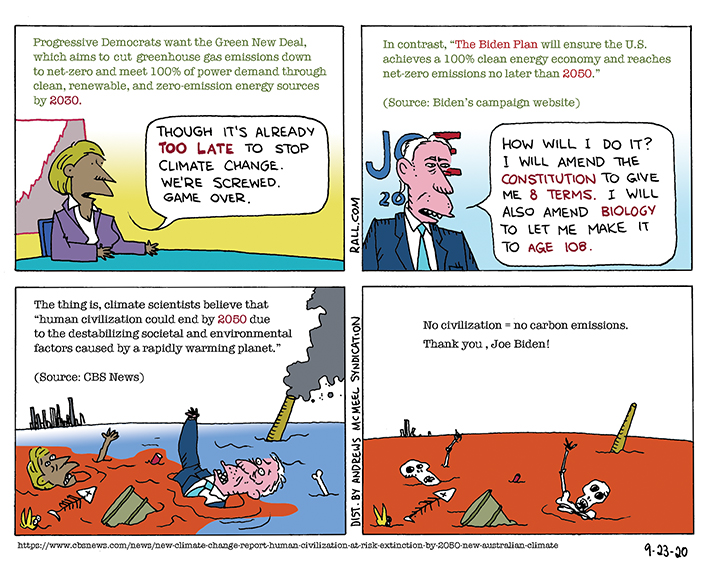
 

Climate Change Is Pass Fail

•

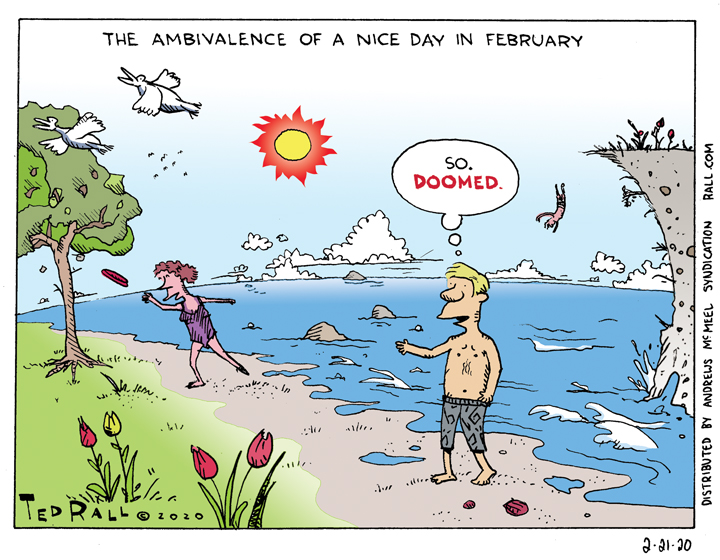
Although Joe Biden’s website hat-tips the Green New Deal, he is opposed to it. Instead, he wants to achieve zero greenhouse gas emissions by 2050. The problem is, scientists project the end of human civilization by 2050. So it’s a moot point. The environment is pass-fail. Incrementalism is doomed.

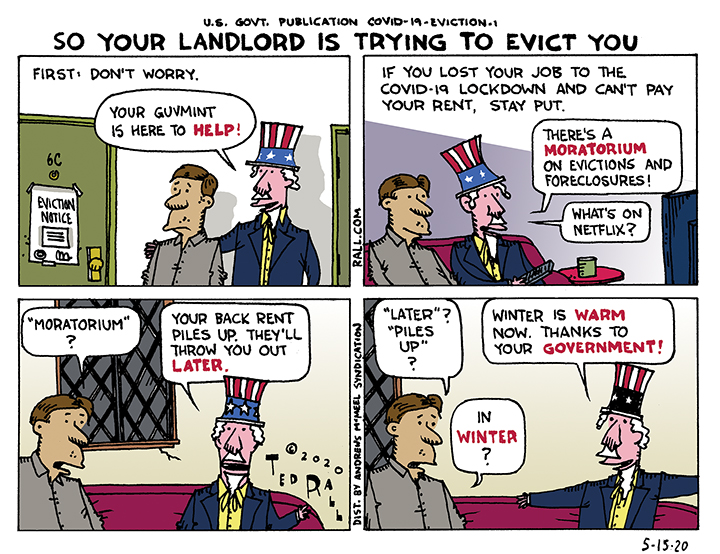
So Your Landlord Is Trying to Evict You

•

Millions of Americans have lost their jobs, aren’t able to pay rent or their mortgages, and therefore face eviction or foreclosure. Yet the best that even “liberal” politicians are offering is a moratorium on evictions until some future point in time.

Signs of Impending Doom

•

The Democratic establishment is freaking about the fact that Bernie “democratic socialist” Bernie Sanders is now the frontrunner for the Democratic presidential nomination.

Who Was That Greta Girl Again?

•

People who comment on Greta Thunberg’s personality, demeanor and looks should instead focus on the fact that she is right that we face an existential environmental crisis.

A Grim New Definition of Generation X

•

Image result for climate apocalypse

            People born in the 1960s may be the last human beings who will get to live out their full actuarial life expectancies.

            “Climate change now represents a near- to mid-term existential threat” to humanity, warns a recent policy paper by an Australian think tank. Civilization, scientists say, could collapse by 2050. Some people may survive. Not many.

            Some dismiss such purveyors of apocalyptic prognoses as hysterics. To the contrary, they’re Pollyannas. Every previous “worst-case scenario” prediction for the climate has turned out to have understated the gravity of the situation. “Paleoclimatologists have shown that past warming episodes show that there are mechanisms which magnify its effects, not represented in current climate models from the Intergovernmental Panel on Climate Change to the Paris Accords,” reports The Independent. It’s probably too optimistic to assume that we’ll make it to 2050.

            Gives new meaning to Generation X.

            Millennials and the children we call Generation Z face the horrifying prospect that they will get stuck with the tab for humanity’s centuries-long rape of planet earth, the mass desecration of which radically accelerated after 1950. There is an intolerably high chance that today’s young people will starve to death, die of thirst, be killed by a superstorm, succumb to a new disease, boil to death, asphyxiate from air pollution, be murdered in a riot or shot or blown up in a war sparked by environmentally-related political instability long before they survive to old age.

            Long threatened, never taken seriously, not even now that it’s staring us right in the face, human extinction is coming for the children and grandchildren we claim to love but won’t lift a finger to save.

            Shelves sag under the weight of books that have been written arguing that we still have a chance to save ourselves. I wish I could believe that. Human population has tripled since the 1950s. More than a million species have gone extinct. Ninety percent of the fish in the ocean have vanished, replaced by one billion tons of plastic. Two-thirds of the trees have been cut down. The polar ice cap is gone; it’s never coming back.

            We can’t stop global warming. An increase of four degrees Celsius over the baseline set at the beginning of the Industrial Revolution means game over. We’re well on our way there. It doesn’t make sense to think that we can avoid extinction.

            What if we woke up and demanded action from our political leaders? Radical problems require radical solutions; only the most radical of solutions could resolve the most radical problem of ruining our planet’s ability to sustain us: revolution. We would have to rise up and abolish—immediately—consumer capitalism in all the major greenhouse gas-producing nations, prioritize cleaning the environment as the human race’s top concern, and pivot to an economic mindset in which we extract the bare minimum from the ecosystem that we need in order to survive and nothing more.

            Voting might achieve some incremental reforms but reform falls far short of what we require. Saving our young people (and their children, should they be foolish enough to have any) would require global revolution, the violent overthrow of the ruling elites and replacing them with people who understand what must be done. It would need to happen today. Fifty years ago would be better. Got a time machine?

            None of this is going to happen. We are going to sleepwalk to our doom in a haze of social media and corporate entertainment distraction.

            So it’s time for people who are younger than I am to start thinking about how they want to spend the rest of their likely-to-be-truncated lives, and how they plan to face mass premature death.

            Pending human extinction destroys the answers provided by religion and philosophy. Knowing that there won’t be anyone to know that we were ever here raises the question: why bother to do anything? This column, this year’s “important” presidential election, love, hate, everything will lose its meaning when the last member of our species draws her last breath. Earth is unlikely to be visited by an alien archaeologist, much less uncover everything we’ve made and created (assuming any of it survives), much less figure out what any of it meant, before the sun expands into a red giant and ends it all.

            Much is to be said for hedonism: eat, drink, have sex, and don’t bother to sort your recycling, for tomorrow we die. Stoicism has its advantages too; go out with dignity rather than weeping and gnashing your teeth and making your fellow survivors miserable.

            Nihilism is about to become the best worst possible life strategy. Life is meaningless. That will soon become obvious. Moral principles, relics of a time with a future, will blow away like the irradiated dust we leave behind.

            None of this will have mattered.

(Ted Rall (Twitter: @tedrall), the political cartoonist, columnist and graphic novelist, is the author of “Francis: The People’s Pope.” You can support Ted’s hard-hitting political cartoons and columns and see his work first by sponsoring his work on Patreon.)
keyboard_arrow_up
css.php