Survival of the Fittest

•

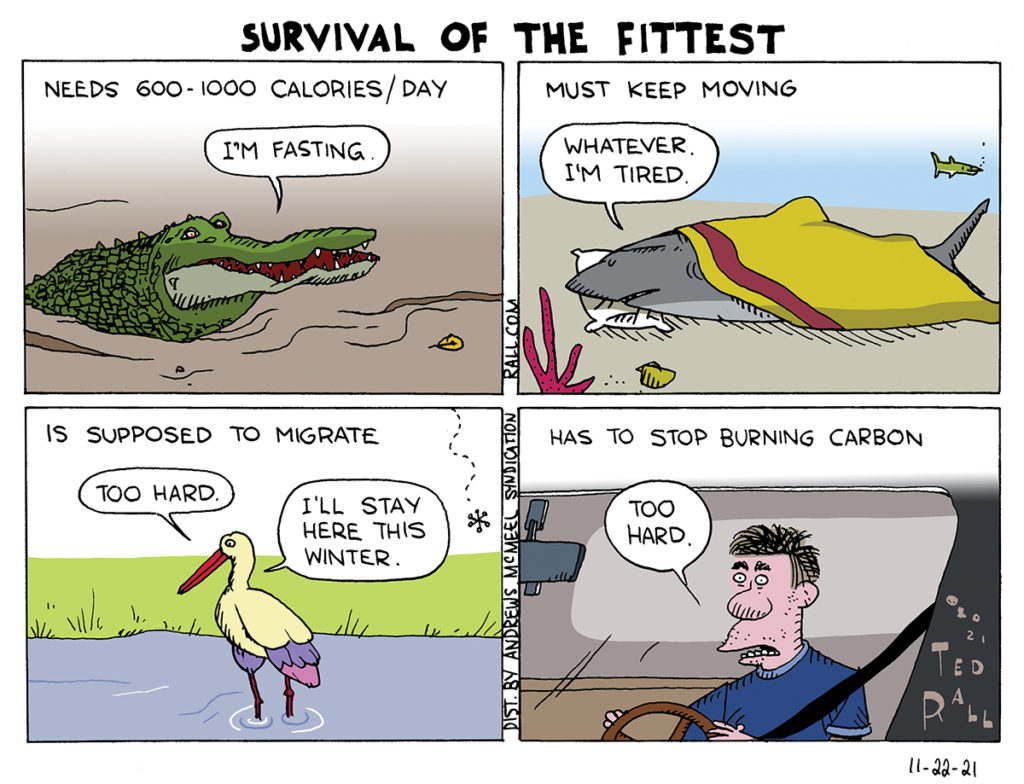
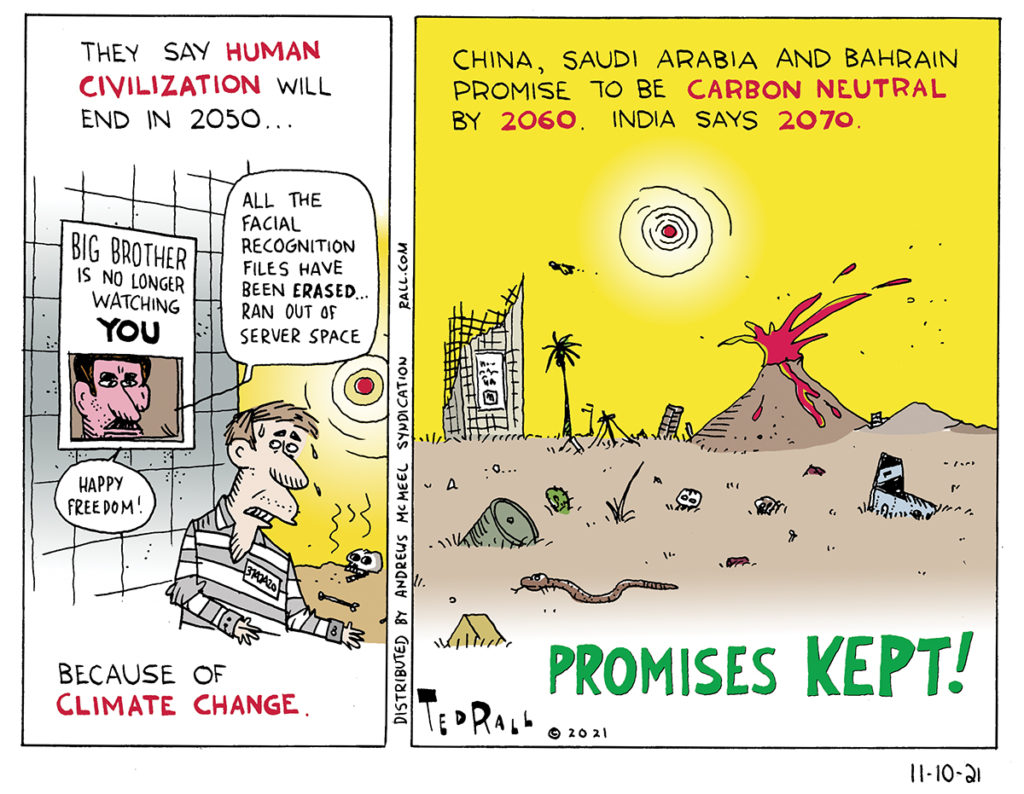
No animal would choose not to do what it needs to survive. No animal is that stupid, except human beings. The failed COP26 climate conference provides more proof that we’re too stupid or lazy to stop killing the planet’s environment we need to live by transitioning to sustainable energy sources.
Promises Kept

•

An Australian study famously predicted that human civilization could totally collapse due to climate change by the year 2050. No one knows the precise time when that could happen, but it’s a pretty good guess. Feels like whistling past the graveyard when major emitters of greenhouse gases are promising merely to become carbon neutral after the end of civilization.

Infrastructure but with No Place to Put It

•

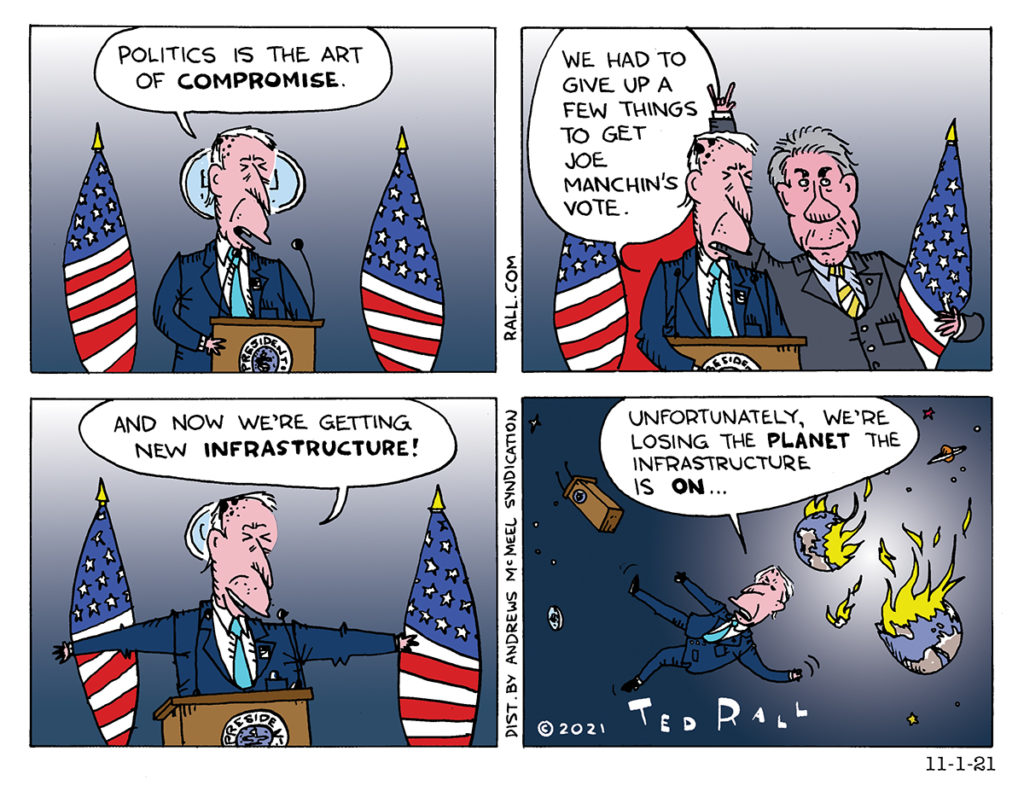
Democrats had to give up a few things to get a vote from West Virginia Senator Joe Manchin. One of them was planet earth. Because he is from a major coal-producing state, they had to water the climate change initiative down to nothing.

Episode 9 | September 6, 2021: Is It Too Late to Save the Planet from Climate Change Apocalypse?

•

It’s another free-wheeling discussion between right-wing cartoonist Scott Stantis and left-wing cartoonist Ted Rall. It’s another 9/11 week—what, if anything, have we learned? Scott responds to a listener. Ted and Scott clash on climate change: Ted thinks we’re doomed because it’s probably too late to save ourselves and Scott supports incremental action based on self-interest: pollution sucks for all concerned.


The Good News about the Ecological Disaster

•

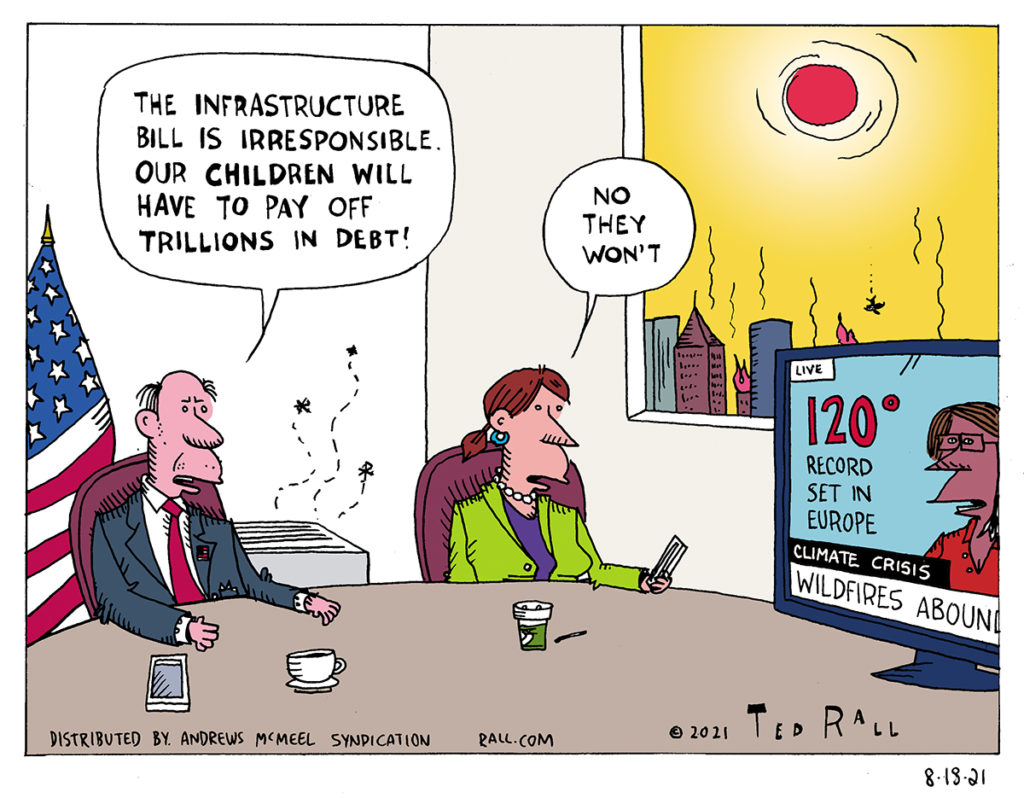
An all-time record 120°F high temperature was set for all of Europe in Sicily. July is the hottest month on record in the United States. No one can argue that climate change isn’t accelerating rapidly.

Nobody Knows What They’ve Lost

•

On a recent trip to Mexico I noticed that the sea life has been absolutely decimated since the last time I had been there. Nobody knows what they’ve lost.

Lost in the Supermarket

•

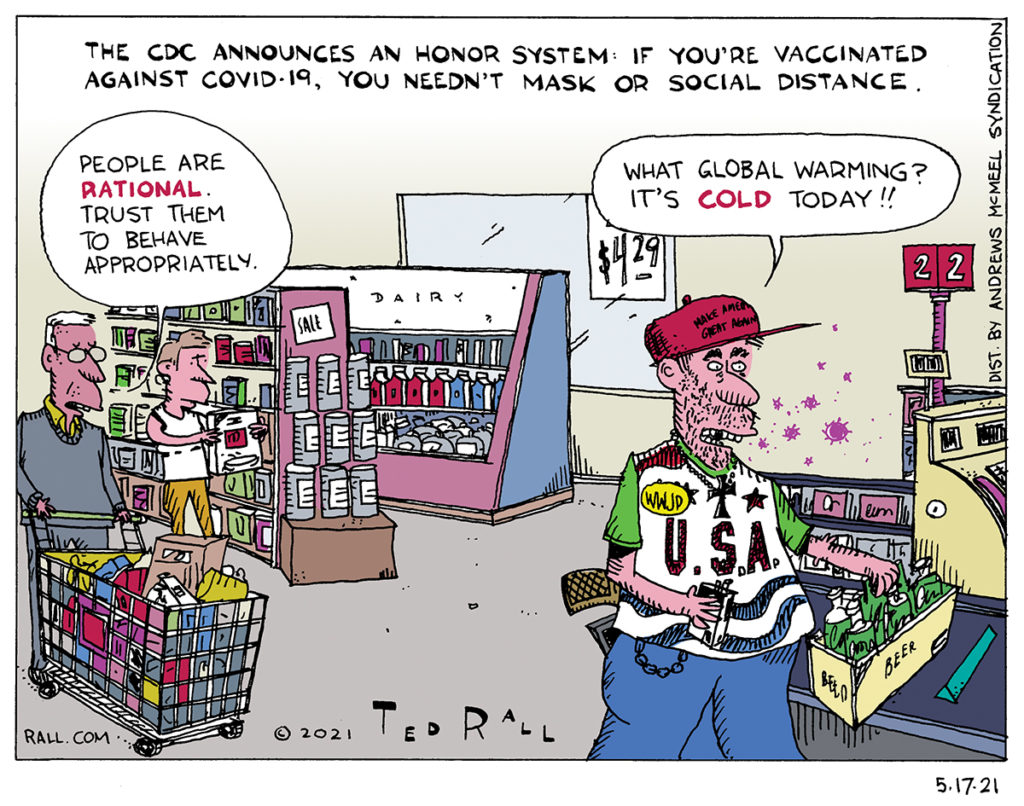
The Centers for Disease Control made big news by announcing that people who are fully vaccinated for COVID-19 no longer have to socially distance or wear masks, even indoors.

Parting Shot

•

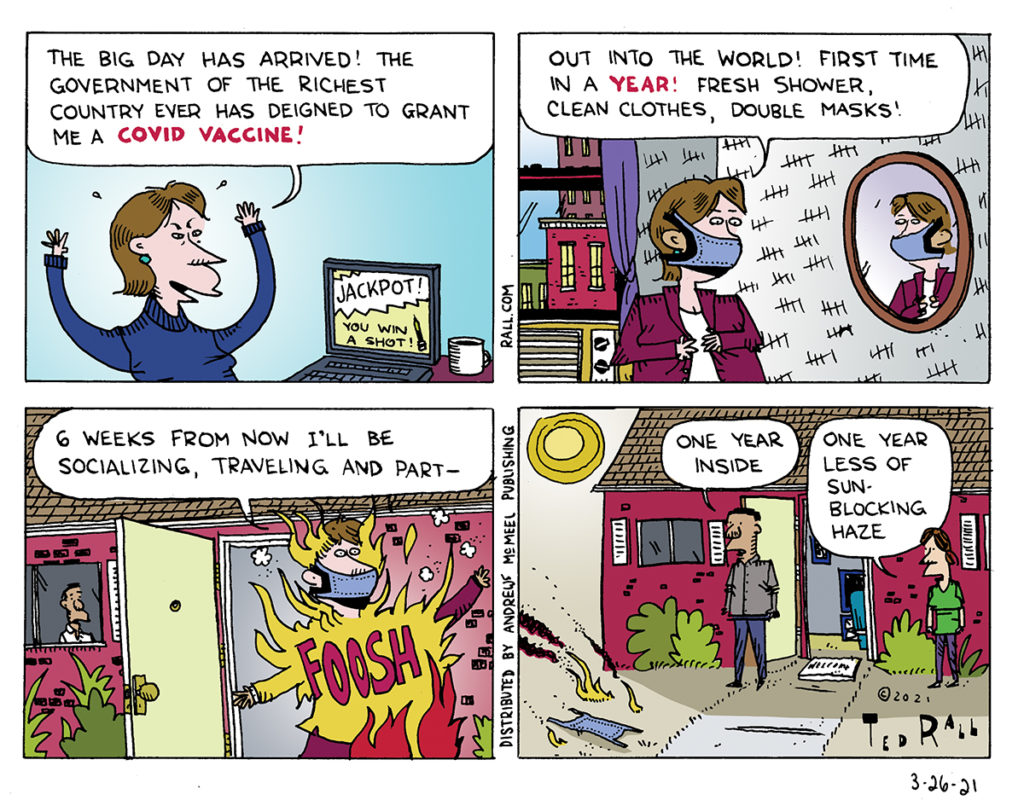
Getting vaccinated for COVID-19 naturally gives you a sense of feeling liberated. But be careful what happens the first time you go outside.

In Praise of Bad Weather

•

A bright sunny day on the farm. | Sunrise photos, Background hd wallpaper,  Sunny pictures

            There is joy in the air. That joy is misplaced.

            For that joy might kill us.

            I set down these words on the 9th of March in Manhattan. Historically, the average temperature on this day of the year is 40°. If the weather forecast for today, March 9, 2021, is correct, and at this writing it looks like it will be, the temperature will hit 61°.

            “Today is going to be a beautiful day,” the radio said this morning.

            Everyone is happy. People are making plans to eat outside, go running, walking, whatever, everyone in New York who can break away from work or other obligations is determined to enjoy today’s “good weather.”

            I feel it too. I have a meeting after I finish writing this. The sun will feel sweet on my face. More people will be smiling; even if I have to surmise that from the twinkle in their eyes above a mask, their pleasure in this good weather will be infectious.

            We have got to stop thinking about warm, sunny, hotter-than-usual weather as positive. Weather isn’t climate. But hotter-than-usual weather multiplied out, repeated as it has been for years, reflects the existential threat of climate change. Hotter-than-usual weather repeated over time is killing coral and plants, extinguishing species of animals. It will ultimately kill us, and if not us, our children, and if not them, our grandchildren. I have not yet met my grandchild, but I don’t want my grandchild, or yours, to die before he or she has his or her own grandchildren.

            We’ve been greeting “beautiful days,” i.e. hotter-than-usual days, by pulling on tank tops, grabbing picnic baskets and heading to the park. This is understandable. This is insane.

            Celebrating a hotter-than-usual day makes as much sense as a Frenchman jumping for joy at the sight of invading German troops. Sparkling blue, cloudless skies are harbingers of doom. The soft scent of your own sweat under a gentle sun in mid-winter is a death sentence handed down by a judge whose rulings cannot be appealed. When you hear that it’s going to be 61° in Manhattan in March, you should be scared to death.

            There are, if you pay attention, signs that everything is wrong. Trees whose first buds appeared in late April now pop out in February, fresh leaves frozen off as the weather turns cold again, though not as cold nor for as long as it should. Asthmatics, those human canaries, suffer from “spring” allergies all “winter” long. There are so few birds.

            The proper response to one too many hotter-than-usual days in mid-winter — for that matter, it is also an appropriate way to greet a series of hotter-than-usual days in summer — is fear. We are on the way out. We are killing ourselves. This is seriously messed up.

            Anger follows fear. We should hate the ecocidal maniacs who are too greedy and stupid to see that their relentless quest for short-term corporate profits is murdering us. We should despise the politicians who sell us out to these psychos. We should be ashamed of ourselves for tolerating both sets of crazies.

            Unless we are idiots, action should come next, and damned soon. The truly great thing about a 61° day in New York City in March (in March!) is that it makes it more enticing for hundreds of thousands of New Yorkers together in public spaces to protest and demand sanity from their overlords. There are no winter coats or cold-stiffened bones to stop demonstrators from hurling teargas canisters back at the cops.

            Saving ourselves must begin with a mental shift.

There is, as an older gentleman who drove me in his taxi told me a couple of years ago, no good weather or bad weather. There is only weather. To a farmer, rain is often welcome. To which I would add, given the context of global warming, there is only appropriate weather — appropriate to its time and place and based on the assumption, which needs to become true if we want to live, that the human race is no longer affecting that weather.

            An 80° day at the South Pole might be pleasant for sunbathing scientists. But it would be radically inappropriate regardless of the time of year. A 20° day in Bali might be fun for Indonesians who’ve never been in a snowball fight. But it would be wildly wrong, allowing for normal variations of high and low.

            I come to you in praise of “bad” weather. On the 9th of March, New Yorkers ought to be happy to see sleet. They should smile at their neighbors as they tiptoe through filthy slush puddles pooled at the street corners. Climate change has turned the world topsy-turvy; in a topsy-turvy world, good weather is bad and bad weather is good.

(Ted Rall (Twitter: @tedrall), the political cartoonist, columnist and graphic novelist, is the author of “Political Suicide: The Fight for the Soul of the Democratic Party.” You can support Ted’s hard-hitting political cartoons and columns and see his work first by sponsoring his work on Patreon.)


Biden Offers Moderate Solutions to Radical Problems

•

Image result for chinese revolution

“Radical problems require radical solutions,” I wrote in my 2010 book “The Anti-American Manifesto,” a polemic that calls upon us to save ourselves from imminent social, economic and political collapse by overthrowing the system and rebuilding society from the ground up. We currently face several radical problems. But we’re not likely to rise to the challenge, because the Biden Administration’s adherence to the Democratic Party’s cult of militant moderation ensures that their proposed solutions will mitigate these grave issues—at best—with zero chance of avoiding disaster.

There is a time and a place for tweaks and minor adjustments. You don’t amputate a leg to cure a sprained ankle. Extreme situations require going big; if your oncologist suggests removing half your tumor and then waiting to see how it goes, fire her.

Our planet has cancer. Exponentially increasing temperatures have killed most of the world’s reefs and threaten widespread food shortages and thus political stability. Garbage, toxins and other pollutants are clogging the oceans and poisoning the air. We can debate the specifics but when studies predict the possible collapse of human civilization within 30 years and “a ghastly future of mass extinction,” environmental degradation has obviously become a radical problem.

Despite calling climate change “the number one issue facing humanity,” Joe Biden clearly doesn’t grasp the seriousness of the situation. His plan aims to achieve net-zero carbon emissions by 2050, the same year his plan calls for the elimination of fossil fuels. Grant him this: his plan is achievable. If human civilization vanishes, who in the hellscape will be left to burn fossil fuels?

Biden’s approach to the climate change crisis recalls my metaphorical oncologist, the one who counsels half-measures. Ban fracking on federal lands though most oil and gas comes from elsewhere. Improving fuel economy standards; Detroit is moving quickly to an all-electric car future anyway. Seal off leaking oil and gas wells. It’s good stuff. It moves in the right direction. But it’s like taking out half the tumor. Half of it is still inside you, multiplying.

You’re still going to die.

You could even argue that Biden is making things worse. Democrats are breathing a sigh of relief that Trump, a science denialist who wants to mine coal even though energy companies do not, has been replaced by a president who acknowledges the issue. But Biden’s half-measures are no likelier to fix the problem of rising temperatures fueled by greenhouse gas emissions than Trump’s overt sabotage. Catastrophe is inevitable either way.

From geoengineering to synthetic trees that absorb carbon dioxide more efficiently to whitening the surface area of the earth to reflect the sun’s rays to actively promoting algae blooms, science offers a number of Hail Mary passes that might stave off environmental apocalypse. Many sound wacky. They might be counterproductive. But at least they’re radical. Which means that, unlike tweaking MPGs, they might work.

The COVID-19 pandemic reiterated what anyone who ever gets sick has long known: America’s healthcare system is hobbled by rapacious for-profit insurance companies. I have a “silver plan” (Anthem BlueCross BlueShield) purchased via New York State’s Affordable Care Act marketplace. When I arrived at the hospital two weeks ago for a hernia repair operation that I definitely needed—I was losing feeling in my upper legs—I was informed hours before surgery that I would have to cough up $6500 between the deductible and the co-pay. I am due for a colonoscopy but now I can’t afford one. And I’m relatively lucky; I’m not one of the one out of four Americans who routinely skip seeing a doctor because they are too poor.

As with climate change, healthcare in the United States is a radical problem in need of a radical solution. Studies consistently show that Americans rank last or close to last among industrialized nations in terms of access to medical care, quality of care and cost. Average life expectancy in the United States has been falling over the last three years — a radical reversal of 20th century trends that recalls Russia after the collapse of the Soviet Union. Nothing Biden has in mind would put us where we belong: number one.

Biden’s moderate sales pitch famously defeated Bernie Sanders, for whom a major platform plank was Medicare for All. During the campaign Biden repeated Obama’s 2008 pledge to add “a public option” to Obamacare (Obama reneged). But the scheme recently unveiled by the White House downplays the public option and would allow Americans to spend up to 8.5% of their annual income on healthcare.

The new president is inheriting big, long-neglected problems that require big dramatic solutions.

The average young college graduate leaves with over $32,000 in student loan debt. Default rates hover around 10%; even bankruptcy doesn’t allow people to discharge these debts. Hobbling our best and brightest minds shrinks the consumer economy and discourages entrepreneurship. Yet Biden only wants to forgive up to $10,000 — and it doesn’t seem to be a top legislative priority. Even if he gets what he wants, the problem will remain extreme.

According to the Economic Policy Institute, the U.S. labor market is 9.9 million jobs smaller than pre-pandemic levels. New York City alone lost 1 million jobs to the COVID-19 lockdown. Millions of families face destitution, eviction or foreclosure. By any measure, this is a huge problem that could slow recovery for a long time. Biden’s solution is a one-time payment of $1400. Better than nothing but a rounding error compared to what would be required to keep people in their homes while they’re waiting for employment opportunities to return.

As Democrats bask in the glow of impeaching Donald Trump for a second time with some bipartisan support, they may want to consider how he got elected. Desperate workers in flyover country suffered from deindustrialization for years. It was a radical disruption. But Democrats ignored them, exacerbated the problem with poorly-written free trade agreements or satisfied themselves with half-measures.

Here we go again.

(Ted Rall (Twitter: @tedrall), the political cartoonist, columnist and graphic novelist, is the author of “Political Suicide: The Fight for the Soul of the Democratic Party.” You can support Ted’s hard-hitting political cartoons and columns and see his work first by sponsoring his work on Patreon.)


keyboard_arrow_up
css.php