
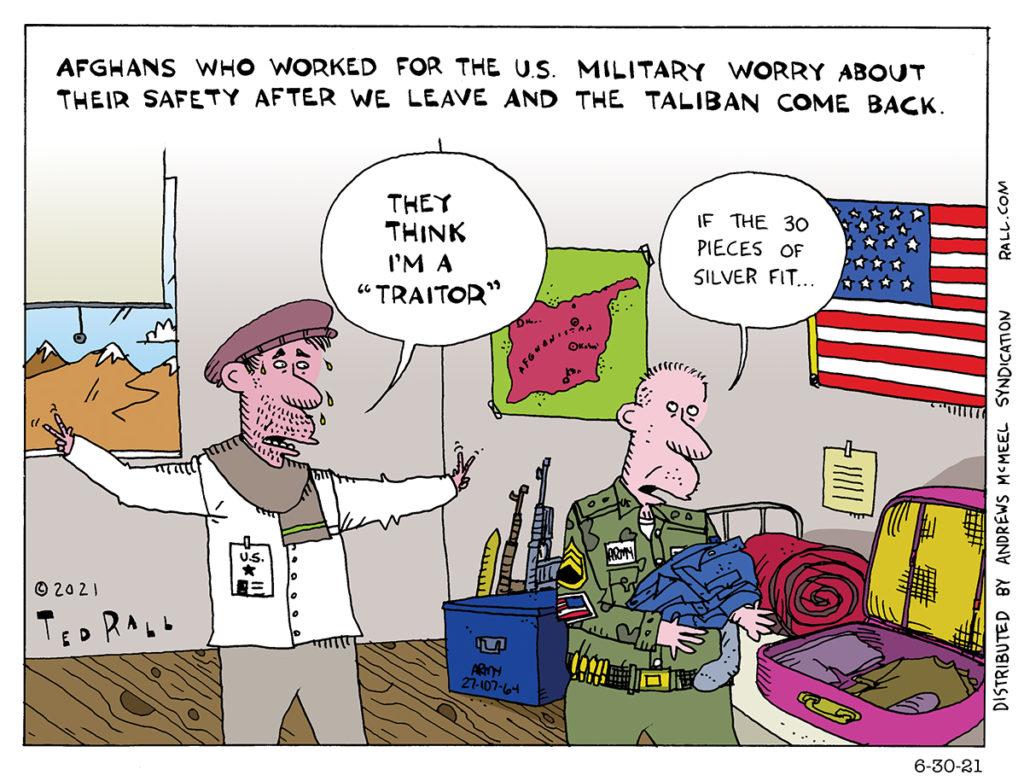
Afghans who worked for the U.S. military in U.S.-occupied Afghanistan are understandably worried about their safety now that their employers are pulling out and the Taliban are poised to recapture control of the country.
Afghans who worked for the U.S. military in U.S.-occupied Afghanistan are understandably worried about their safety now that their employers are pulling out and the Taliban are poised to recapture control of the country.
Riding in the back of a truck into Afghanistan during the 2001 U.S. invasion, a journalist colleague from Russia who served in the Red Army during the 1980s asseverated that he was happy to be back in country. “Because this time,” he said, swinging his hands to indicate the swarms of refugees, bombed-out villages and nearby artillery fire, “all this shit belongs to you.” He pointed at me, the American. I looked around and immediately drew the obvious conclusion: we should get the hell out of Afghanistan.
That was 20 years ago. We were just getting in. But us being us—trying to win hearts and minds with corrupt proxies—and the Afghans being the Afghans—only able to agree on one thing, their intolerance of foreign domination—humiliating defeat and withdrawal were inevitable from the start.
It would be impossible to overstate the advantages of not doing something, of not playing any role, of standing aside and allowing a situation to evolve or devolve without any involvement on your part. Like in the movie “War Games,” you win by doing nothing.
This is a lesson that American foreign policy makers need to internalize more than any other. So do American voters, constantly tricked into lesser-of-two-evils conundra. We don’t have to vote for either lousy candidate. We don’t have to get involved in other countries’ politics or their wars. When all the options in a given situation stink to high heaven, the morally-correct choice is to sit on your hands and let someone else wallow in the morass.
The latest ebullition of violence between Israel and Palestine makes the case for isolationism. Militant right-wing Jewish settlers encouraged and protected by the government of corrupt Prime Minister Benjamin Netanyahu are trying to evict hundreds of Palestinian families from homes they have owned for decades in East Jerusalem, the Arab-dominated future capital of a Palestinian state if one is ever established. The settlers argue in court that the land in question was originally owned by a Jewish trust and should revert accordingly. However, as The New York Times notes, the apartheid regime treats people differently depending on their ethnicity: “Israeli law allows Jews to reclaim ownership of land they vacated in 1948, but denies Palestinians the right to reclaim the properties they fled from in the same war.”
The Israelis are brutalizing protesters and bombing Gaza; the Hamas government of Gaza is firing rockets into Israel. As usual, Israel is deploying disproportionately more violence: 67 Gazans and 7 Israelis have died so far.
The United States government sometimes pretends to be an “honest broker” in the Middle East crisis. Truth is, we have our fat thumbs on the scale and everyone knows it. The abyss between our yay-peace-and-democracy rhetoric and the reality of our foreign policy is a steaming pile of hypocrisy.
The U.S. turns a blind eye to Israeli violence and theft of Arab land, rarely lifting a finger to move toward a two-state solution while loudly decrying Arab violence against Israelis. The U.S. sends $4 billion a year to Israel—enough to give free healthcare to 1.4 million Americans if we wanted to. Joe Biden recently restored $235 million in assistance to the Palestinian Authority that had been cut off by Trump—less than one-sixteenth of the package to Israel.
When the Israeli Air Force bombs apartment buildings full of civilians in densely-populated Gaza City, Palestinians get blown to bits using guided bombs and missiles fired from F-16s and F-35s made in Texas and California. The IDF targets street demonstrators in the West Bank with teargas canisters and stun grenades fired from launchers manufactured by a company based in Pennsylvania.
Israel’s mayhem is brought to you by America. Few Americans are aware of that. But Palestinians and Muslims around the world are.
Even if you support the existence of the Jewish state, and even if you think the Boycott, Divestment, Sanctions (BDS) movement against Israel goes too far, you should be able to view ending U.S. military aid to Israel (without boycotts or other sanctions) as a moral imperative. It would also be a smart foreign policy choice that would reduce global anti-Americanism as well as the chances of a future 9/11-type terrorist attack.
Contrary to Likud propaganda, cutting off military assistance would not create an imminent existential threat. Between the $85 billion of U.S. aid to Israel since 1949, its robust economy and closer ties to many of its Arab neighbors, there is little danger that this tiny, ferocious country would get pushed into the sea. And if that were to change, we could reevaluate the situation and resume funding—assuming Israel decided to try to make peace and were to cooperate with the establishment of a free and independent Palestine.
It is hardly surprising that Israel’s right-wing government cashes the blank check to do whatever the hell they feel like that we send them every year. The only way we can hold Israel accountable for repeated escalations, land grabs and ongoing brutality is to stop sending the gravy train. Will cutting off the cash change their behavior? Maybe. Whatever Israel decides to do on its own, however, it will do without our blessing and without our funding.
Often the best thing to do is nothing at all.
(Ted Rall (Twitter: @tedrall), the political cartoonist, columnist and graphic novelist, is the author of a new graphic novel about a journalist gone bad, “The Stringer.” Now available to order. You can support Ted’s hard-hitting political cartoons and columns and see his work first by sponsoring his work on Patreon.)
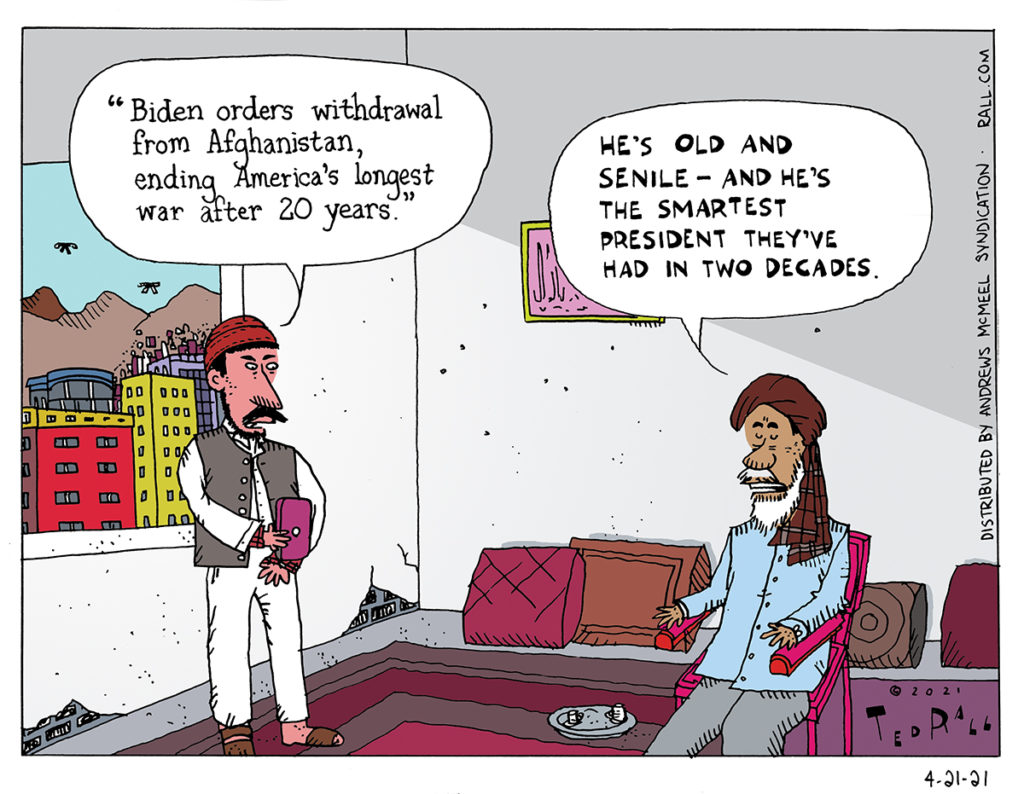
President Joe Biden has ordered complete withdrawal of American troops from Afghanistan, without conditions, on or before September 11, 2021. Better 20 years late than never.
We’ve been in Afghanistan 20 years, Joe Biden’s generals told him. All we need is a little more time. The president overruled them, ordering a complete withdrawal of American troops by September 11th.
Madiha Afzal and Michael O’Hanlon of the Brookings Institution articulate the opposition to Biden’s decision to call it quits. Remove the U.S. occupation forces that have maintained stability, they worry, and civil war will soon follow, culminating in the overthrow of the U.S.-backed government in Kabul and the return of the Taliban. They think it will be the late 1990s all over again: women back under burqas, stonings, 14th century Islam providing a safe haven for anti-Western terrorist groups like Al Qaeda.
“The most likely outcome of any quick troop exit this year is very ugly, including ethnic cleansing, mass slaughter, and the ultimate dismemberment of the country,” Ms. Afzal and Mr. O’Hanlon write in USA Today. “No one can see the future, of course, but this type of outcome seems much more likely than any smooth transition to a new government run by a kinder, gentler, more moderate Taliban.” They urge a slower long-term drawdown.
I think they’re wrong.
I’m not clairvoyant. Yet I did foresee that the U.S. would follow the British and Soviet armies and meet defeat in the Hindu Kush: “We’ve lost this war, not because they’re good or we’re not, but because of who we are,” I wrote from Afghanistan in December 2001, where I worked as an unembedded reporter for The Village Voice. “The American Empire can’t spend the bodies or the time or the cash to fix this crazyass place, because in the final analysis, election-year W. was right—we’re not nation builders.”
Unlike the Brookings authors I’m more optimistic about Afghanistan without U.S. occupation forces than with them. First, whatever stability the U.S. and its allies have brought to Afghanistan is as artificial as the finger of the Dutch boy plugging the hole in the dike. The rural-based Taliban are like the sea, an inevitable force waiting to pour in. Whether or not we care for the end result, we can’t forestall the inevitability of a people’s self-determination at the cost of American and Afghan lives.
More importantly, the coalition presence has changed Afghanistan forever. When the Taliban ran most of the nation from 1996 to 2001, their draconian measures satisfied a desperate need for security in a place overridden with banditry, opium trafficking and addiction. Infrastructure was nonexistent: no phones, no electricity, no paved roads, no central monetary system. Afghans asked me to take their photos with my digital camera because no one owned a mirror; this was the first time in their lives they could see themselves.
Though security remains an issue, the coalition has built roads and highways throughout the country. We haven’t built a nation. But we have installed stuff. Cellphone service is more reliable and affordable than in the U.S. Cities like Kabul, Mazar-i-Sharif and Herat are bursting at the seams with new construction. Access to the Internet is widespread in urban areas. Mineral and oil reserves, previously untapped due to lack of capital investment, are beginning to come online thanks to China and other countries.
Two decades of occupation have changed culture in surprising ways. Herat, in the northwest near the borders with Turkmenistan and Iran, was dotted with pizzerias when I was there in 2010. Young men in Mazar brazenly ignored strictures against drinking and eating during the daytime during Ramadan. I saw a couple making out in a park in Kabul.
The Taliban, or more precisely the neo-Taliban who have replaced them, are more moderate because they operate in a modernized environment.
Though they share their name and religious fundamentalism with their ascetic forebears who grew up in the madrassas lining Pakistan’s tribal areas, today’s neo-Taliban are sophisticated cynics, men more concerned with making money then enforcing sharia law. The Taliban burned poppy fields. The neo-Taliban profits from them. The Taliban first gained popular support in 1996 by killing kidnappers. The neo-Taliban runs checkpoints and ambush points where they seize victims and hold them for ransom. So while the world has just cause for concern about what happens next, we should understand that forthcoming evils will be new ones, not a simplistic replay of Taliban 1.0.
In a country where every gunman is for hire, the regime installed by the United States in 2001 relies far more on funding than direct military defense. With more than $12 billion in aid pouring in from last year through 2024, the government led by Ashraf Ghani could easily outlive most expectations. Still, it’s not hard to imagine the U.S. and its Western allies losing interest and cutting the cash flow after 2025, opening a power vacuum that the Taliban—which either fully controls or vies for control of 67% of Afghan districts—would fill.
Concern that Afghanistan will return to the barbarism of the late 1990s and that Afghan women will suffer dramatic setbacks is misleading because, in the rural majority of the country, the politics and culture of the late 1990s never disappeared. Women never stopped wearing the burqa and continue to be stoned to death, most recently last year in Ghor Province. Young boys are routinely raped, a practice to which American troops were ordered to turn a blind eye. Were the Taliban to return to national power, life in most of Afghanistan wouldn’t change.
Nor would the more liberal cities be greatly affected. Afghanistan’s economy generates nearly $20 billion in annual GDP. An incoming national government run by the profit-oriented neo-Taliban would be hesitant to interfere with the engine of that economic activity, the big cities and the “ring road” highway network that connects them. We would probably see a crude version of the “one country two systems” form of governance that China uses in Hong Kong: girls schools and tolerance for personal freedoms in central Kabul, sharia law and grinding poverty out in the sticks.
As demonstrated by their engagement in the Doha peace process overseen by the Trump Administration, the neo-Taliban want trade and formal diplomatic ties with other countries, something the Taliban could not obtain from 1996 to 2001, when they were totally isolated from the rest of the world. The need to maintain international connections would be a moderating influence, making worst-case scenarios like harboring extremist groups, ethnic cleansing and disintegration unlikely.
None of this is to say that Afghanistan will become a Central and South Asian paradise if and when the neo-Taliban come to power in Kabul. The corrupt and dogmatic neo-Taliban will likely function as an authoritarian narcostate with trappings of rough religiosity, like a hardscrabble Saudi Arabia that exports heroin. Afghanistan will present new challenges. But it will be mostly up to the people of Afghanistan—traumatized, energetic and influenced by 20 years of Western values—to address them.
(Ted Rall (Twitter: @tedrall), the political cartoonist, columnist and graphic novelist, is the author of the upcoming graphic novel about a journalist gone bad, “The Stringer.” Now available to order. You can support Ted’s hard-hitting political cartoons and columns and see his work first by sponsoring his work on Patreon.)
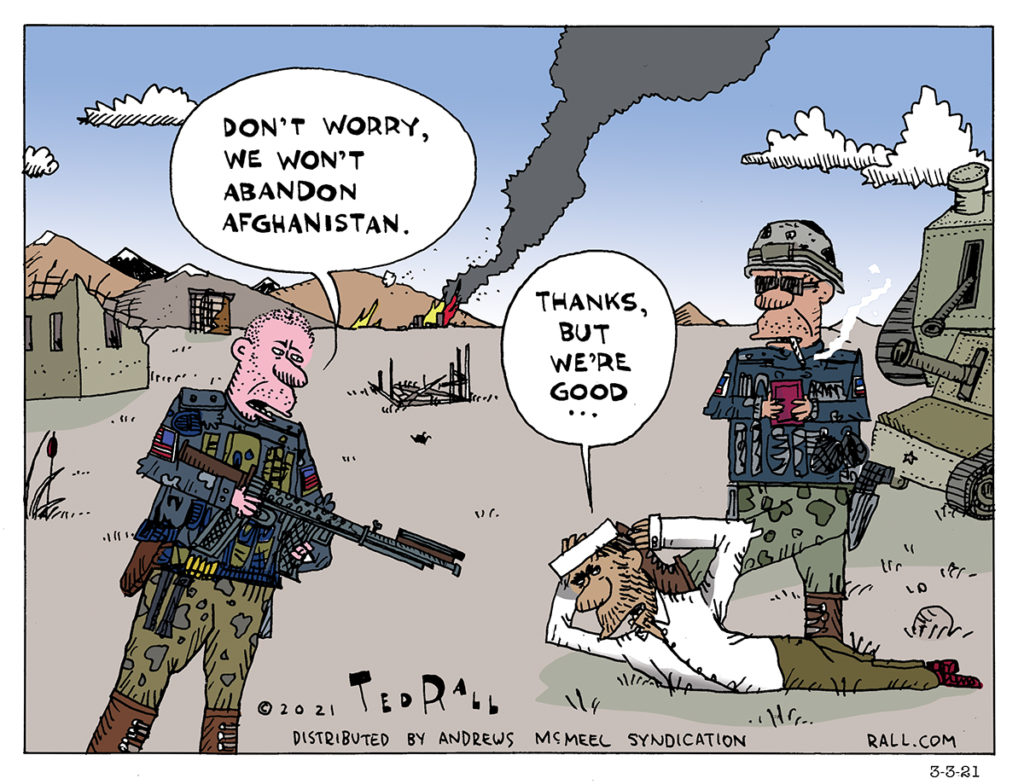
Warmongers in both major political parties say that we shouldn’t “abandoned” Afghanistan as if a violent occupation that brutalizes the population is something that anyone who lives there wouldn’t want to see come to an end.
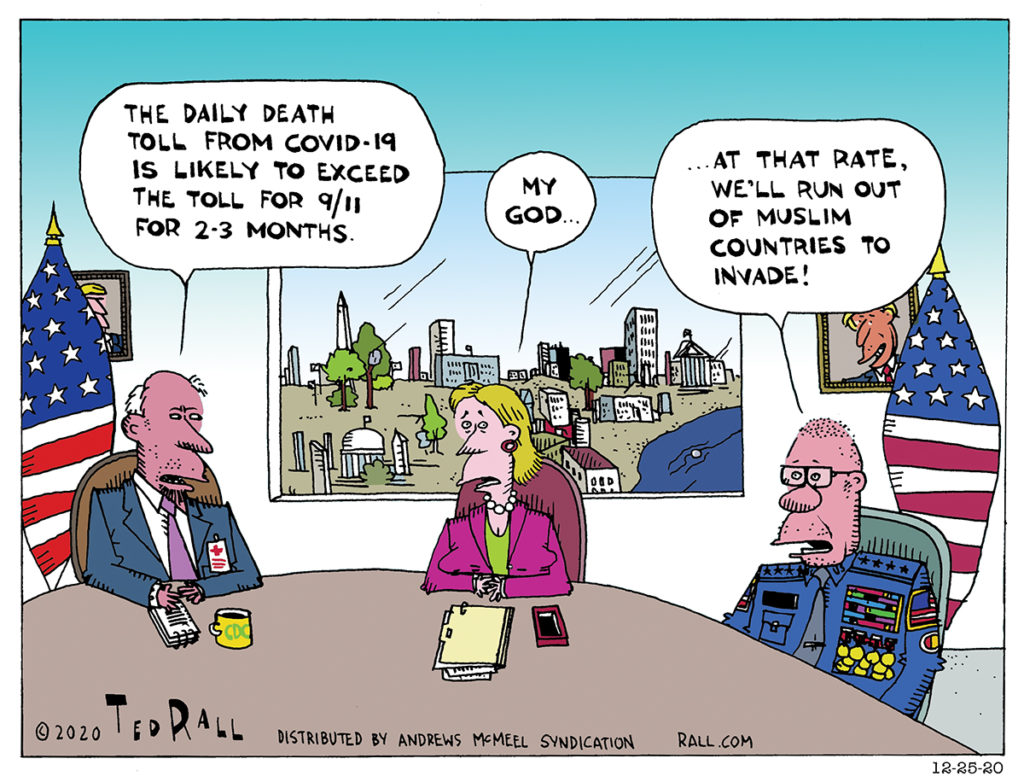
According to the Centers for Disease Control, the daily death toll from COVID-19 is likely to exceed the total from the September 11 terrorist attacks for the next 2 to 3 months. Good thing we’re not responding to the coronavirus the same way that we responded to 9/11.
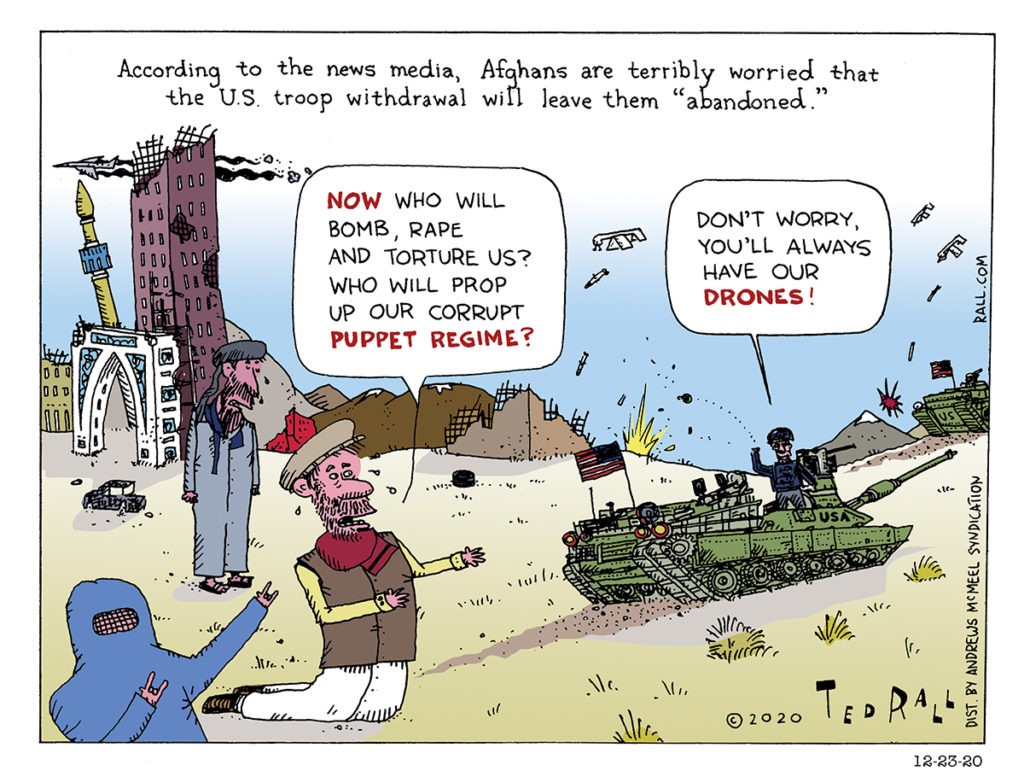
President Donald Trump has ordered the evacuation of all but 800 United States troops from occupied Afghanistan, which the United States invaded 19 years ago. As usual, the media is repeating shibboleths about how the Afghans will feel “abandoned” by the US departure.
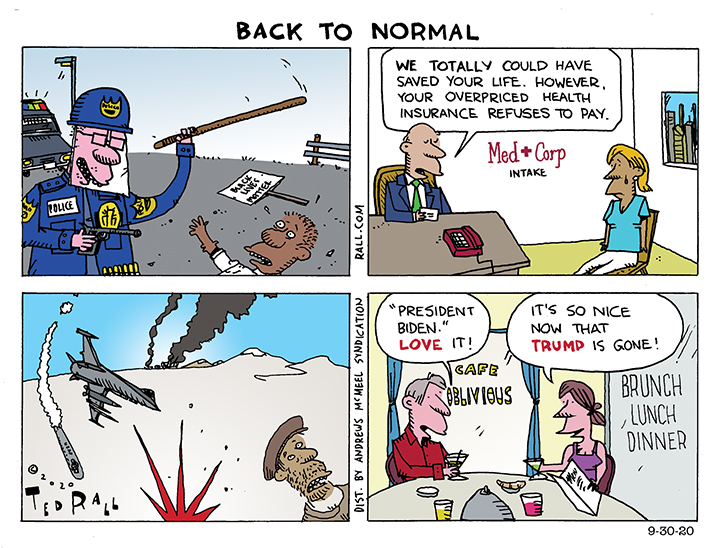
One of the more persuasive arguments in favor of supporting Joe Biden is that things would go back to normal after Donald Trump leaves office. For those of us who remember what normal was, and is, that’s not necessarily appealing.
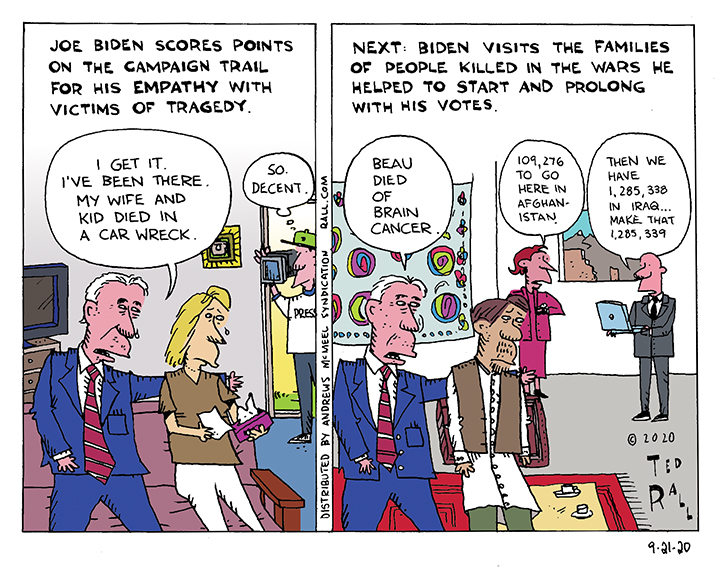
Joe Biden scores big points for appearing to be empathetic with victims of tragedy. Considering all the tragic wars to which he contributed, perhaps he should go on an empathy tour of the over 1 million survivors of the people he helped kill in Iraq and Afghanistan.
Jeffrey Goldberg wrote an article for The Atlantic that could harm Donald Trump’s chance to win re-election. Setting aside the controversial content of the remarks attributed to the president, it is important to note that this is an atrocious example of journalism.
You could almost call it “fake news.”
And corporate media is taking it at face value.
You may think Trump is a turd—I do. You may want him to lose the election—I do. (I also want Biden to lose, but that’s another column.) You may believe that Trump probably said what Goldberg reports—I think there’s a good chance. But everyone who cares about journalism ought to be deeply disturbed by the nonexistent sourcing for this story and its widespread acceptance by media organizations that ought to know better.
It’s easy to see why Democratic-leaning media corporations jumped all over Goldberg’s piece: it hurts the president and it reinforces militarism. But they’re degrading journalistic standards to manipulate an election.
According to Goldberg, four anonymous sources told him that Trump called American marines who died in World War I “losers” and repeatedly questioned why anyone smart would join the military or be willing to risk their life by fighting in one of America’s wars.
Anonymous sources have their place. I have used them. But basing a news story entirely on accounts of people who are unwilling to go on the record is journalistically perilous and ethically dubious. There are exceptions, as when a Mafia source fears physical retribution.
There is no such claim here. Most media organizations’ ethical guidelines are clear: news without attribution is not news. It is gossip.
The Los Angeles Times, a publication my readers know that I hold in low regard, nevertheless takes a stance against anonymous sources. “When we use anonymous sources, it should be to convey important information to our readers. We should not use such sources to publish material that is trivial, obvious or self-serving,” the paper’s ethical standards say. “An unnamed source should have a compelling reason for insisting on anonymity, such as fear of retaliation, and we should state those reasons when they are relevant to what we publish.”
The Atlantic piece falls way short.
Likewise, writing that strips statements of necessary context is anti-ethical. Trump, writes Goldberg, “expressed contempt for the war record of the late Senator John McCain, who spent more than five years as a prisoner of the North Vietnamese. ‘He’s not a war hero,’ Trump said in 2015 while running for the Republican nomination for president. ‘I like people who weren’t captured.’” He goes on to note that Trump wanted to deny McCain the honor of lowering flags to half-mast after McCain died.
Goldberg frames Trump’s comments as part of a general bias against the military and portrays his attacks as unprovoked. Truth is, long before Trump made those comments he had been engaged in a well-documented, long-running feud with the Arizona senator. McCain based his political career on his military service and the five years he spent as a POW in Vietnam. McCain was Trump’s enemy, and there is considerable evidence that McCain—known for a sharp tongue—started the war of words. Trump gave back in kind.
“Nor did he set his campaign back by attacking the parents of Humayun Khan, an Army captain who was killed in Iraq in 2004,” Goldberg continues in another context-free passage. Khan’s father famously spoke against Trump at the 2016 Democratic National Convention. “You have sacrificed nothing and no one,” Khan said. In Trumpian terms, Khan started it. But Goldberg’s omission makes it look like Trump attacked a fallen soldier out of the blue.
Goldberg does this a third time: “When lashing out at critics, Trump often reaches for illogical and corrosive insults, and members of the Bush family have publicly opposed him.” Both sides have insulted each other; as far as the record shows, Trump is usually running offense, not defense—but Goldberg falsely portrays the enmity as a one-way street.
One of the praiseworthy aspects of this president is his relatively restrained approach to military interventionism, coupled with his willingness to directly engage adversaries like North Korea and the Taliban in Afghanistan, the latter which recently signed a peace agreement with the United States. It is logical for Trump, who is skeptical of illegal wars of choice like Afghanistan and Iraq, to question why people would volunteer to fight and possibly die in such a pointless conflict. For Goldberg, militarism is a state religion. Questioning it is intolerable.
Goldberg’s piece, the tone of which reads like the pro-war hysteria following 9/11, reflects the aggressively militaristic neoliberalism of the Democratic Party in 2020.
Goldberg references Trump’s 2017 visit to Arlington cemetery with then-Secretary of Homeland Security John Kelly. “A first lieutenant in the Marine Corps, Robert Kelly was killed in 2010 in Afghanistan … Trump, while standing by Robert Kelly’s grave, turned directly to his father and said, ‘I don’t get it. What was in it for them?’ Kelly (who declined to comment for this story) initially believed, people close to him said, that Trump was making a ham-handed reference to the selflessness of America’s all-volunteer force. But later he came to realize that Trump simply does not understand non-transactional life choices.”
Joining the military, of course, is hardly a non-transactional decision. Soldiers get paid. They get medals. They get free college. They are revered and thanked for their service. Military service gives you a leg up when you run for political office.
Moreover, Trump’s question is one Americans should be asking more often. Why would a 29-year-old man volunteer to travel to Afghanistan in order to kill the locals? No one in that country threatened the United States. No one there did us any harm. Afghans don’t want us there. Why did Robert Kelly go?
Goldberg seems obsessed with Trump’s description of fallen soldiers as suckers. “His capacious definition of sucker includes those who lose their lives in service to their country, as well as those who are taken prisoner, or are wounded in battle,” Goldberg writes. But is he wrong?
LBJ suckered us into Vietnam with the Tonkin Gulf incident, which historians of all stripes accept was a lie.
George H.W. Bush suckered us into the first Gulf War with a tale of Iraqi soldiers rampaging through a Kuwaiti hospital and pulling babies out of incubators. Another lie.
After 9/11 George W. Bush suckered us into Afghanistan by saying Osama bin Laden was there—he was not.
Of course Bush lied about Iraq having weapons of mass destruction. More suckering. (At the time, Goldberg spread the lie that Saddam Hussein was allied with his enemy Al Qaeda.)
Assuming that anything in Goldberg’s piece was true, Trump was right.
(Ted Rall (Twitter: @tedrall), the political cartoonist, columnist and graphic novelist, is the author of the biography “Political Suicide: The Fight for the Soul of the Democratic Party.” You can support Ted’s hard-hitting political cartoons and columns and see his work first by sponsoring his work on Patreon.)
