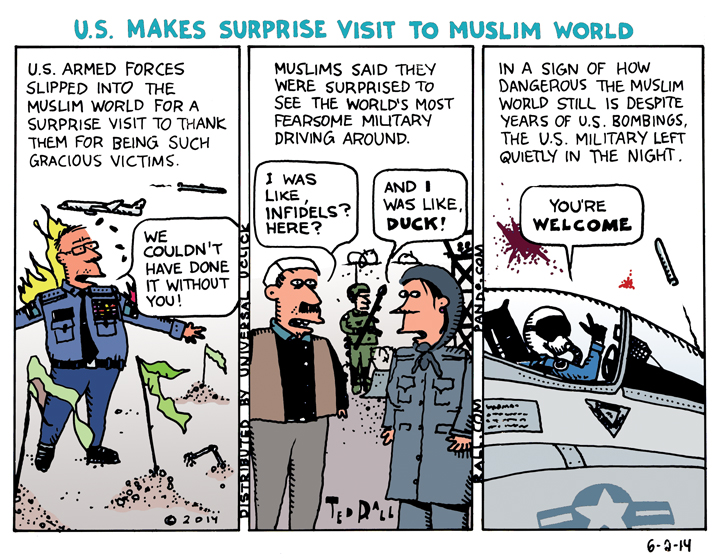
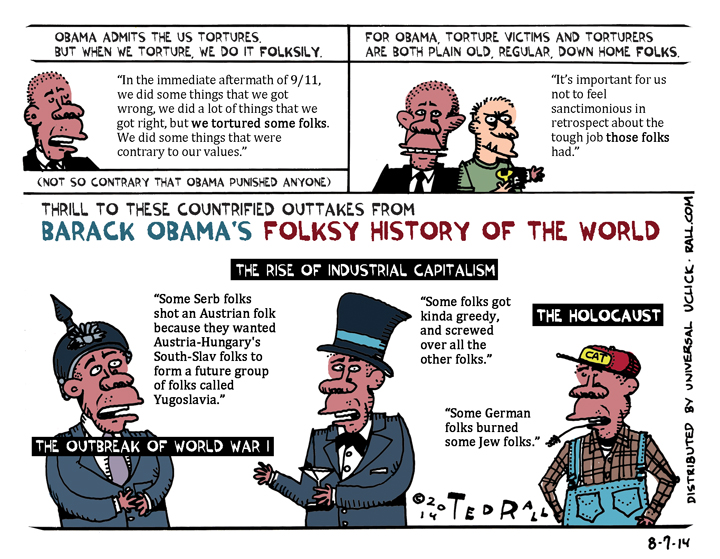
Obama’s Folksy History of the World

President Obama refers to both torturers and their victims as just plain “folks” in an effort to simultaenously be phony, inspid, and diminishing of the horrors inflicted by the United States government, an institution for which no single human being is as responsible.

SYNDICATED COLUMN: Never Trust a Realist

http://www.middleclassimpact.com/images/waitingroom.jpg

“There are those who look at things the way they are, and ask why,” Robert F. Kennedy famously said. “I dream of things that never were and ask, ‘why not?'”

RFK was an idealist — someone who views the world as a blank slate full of possibilities.

So am I.

Realists — people who strive to make improvements within the constraints of the current situation — are important. No society can live with its head in the clouds. But we also need people who look to the stars. Where are they now?

For as long as I can remember, American politics and media have been dominated by self-identified realists to the exclusion of idealists. In many cases, the “realists” are just bullies pushing agendas with no real grounding in reality (c.f., Bush’s neo-cons). Still, some of these Very Reasonable People, as Paul Krugman calls them, have achieved incremental victories that have made life somewhat better in some respects (c.f., Obamacare).

But no civilization can achieve greatness without idealists. If you’re looking for one big reason the United States seems to be on the wrong track, try the marginalization of idealism that coincided with the collapse of the peace movement and the American Left at the end of the Vietnam War in the early 1970s. The death of every strain of American Leftism from liberalism to revolutionary communism has left us with a nation that doesn’t know how to dream big.

If we’d been like we are now when Sputnik launched, it’s a fair bet we never would have gone to the moon. We couldn’t have justified the massive budget. Or it would have died in Congress. The money would have been spent, but on stuff no one needs — invading foreign countries, tax cuts for the rich and big corporations — with nothing to show for it.

America has become too small to fail.

In an excerpt from his upcoming book that appeared recently in The Atlantic, Michael Wolraich recently discussed the tendency of Robert La Follette, the Wisconsin senator and leading light of the Progressive movement of the late 19th and early 20th centuries, to hold out for radical progress over incremental, less satisfying gains. La Follette’s big-picture approach — so idealistic — was, in its way, more realistic than what passes for realism today:

“He might have passed more legislation by compromising [with his enemies], but he refused to dilute his proposals. There was that stubbornness again but also strategy. La Follette took a long view of political change. In contrast to Roosevelt’s pragmatic approach, he believed that temporary defeat was preferable to compromised legislation, which would sate public demand for reform without making genuine progress. ‘In legislation no bread is often better than half a loaf,’ he argued. ‘Half a loaf, as a rule, dulls the appetite, and destroys the keenness of interest in attaining the full loaf.’ Legislative defeat, on the other hand, served a useful political purpose. He would use the defeat of a popular bill to bludgeon his opponents in the next election, and he would keep assailing them with it until they yielded or lost their seats.”

Or, as the revolutionary “situationists” who took over Paris in May 1968 cried: “Be realistic: Demand the impossible!

When I read this, I thought: Yes! Here’s a perfect articulation of the politics we’re missing.

With USA Today recently joining the chorus of media describing Barack Obama, who championed realism in the form of diminished expectations, as a failed president and a “lame duck before his time,” and Hillary Clinton once again marketing herself a yet another drab uber-realist for 2016, a reminder of La Follette’s ambitious approach to politics is especially timely.

Consider, for example, Obamacare.

La Follette would see the Affordable Care Act as a classic case of the “half a loaf” that “dulls the appetite” for true reform — in this case, socialized medicine or at least European-style “single payer.” In 2007, before Obama and his ACA came along, 54% of Americans favored single-payer. Now, thanks to a system that’s better than nothing but not nearly good enough, it’s down to 37%. Hillary Clinton is endorsing Obamacare, and has officially come out against single-payer.

Democrats defended Obamacare to liberals and progressives as an imperfect, insurance company-protecting interim measure. Obamabots encouraged libs to support the conservative Democratic president because the ACA would move America closer to the single-payer ideal.

Now we see how wrong the “realists” were. As La Follette would have predicted, the appetite for the “full loaf” of single payer has diminished, partly sated by the “half loaf” of Obamacare. Regardless who wins in 2016, single-payer will be off the agenda for another four to eight years. Obamacare killed single-payer.

Imagine, on the other hand, where we’d be if Obama had gone the idealist La Follette route, proposing a single-payer healthcare reform bill that had suffered defeat at the hands of Congressional Republicans.

Six years after the beginning of the 2008 economic crisis, several more million of Americans would be uninsured. Hospital emergency rooms, bursting at the seams as it is, would be in a greater state of crisis — which would add to support for reform. You can easily imagine Obama and the Democrats beating up “Republicans who don’t care about sick and dying Americans” on the campaign trail. Sooner or later — I’d bet sooner — they’d have to cave in and vote for this big new social program, just as they did with the New Deal and Great Society, or face oblivion.

Of course, Obama’s appetite for single payer was never ferocious. He promised a single-payer “option” during the 2008 campaign — yet never tried — but the point remains, the American people allowed themselves to be “realistic.” Which left them with far less than they might have gotten had they held out for full-fledged single-payer.

As we head into the 2016 campaign, remember what “realism” really is: the siren song of mediocrity, written by the elite to make you settle for less than you deserve.

(Ted Rall, syndicated writer and cartoonist, is the author of “After We Kill You, We Will Welcome You Back As Honored Guests: Unembedded in Afghanistan,” out Sept. 2. Subscribe to Ted Rall at Beacon.)

COPYRIGHT 2014 TED RALL, DISTRIBUTED BY CREATORS.COM

SYNDICATED COLUMN: Clueless in Gaza – We Americans Support Democracy, But Only When the Elections Go Our Way

http://i2.cdn.turner.com/cnn/dam/assets/140326164134-abdel-fattah-al-sisi-story-top.jpg

“Rarely has a president been confronted with so many seemingly disparate foreign policy crises all at once,” The New York Times noted about Obama on July 23rd. What the paper didn’t/won’t/can’t say is: Rarely has a president caused so many of his own crises.

This summer, most of Obama’s problems follow from his unwillingness to respect democracy overseas.

The U.S. government supports democracy in other countries — but only if the elections go its way. If not, anything goes to obtain a favorable outcome: economic sabotage, backing violent coups d’état, installing dictators to replace democratically-elected leaders, even ginning up all-out war.

Three recent examples showcasing U.S. contempt for electoral democracy include Egypt, and two places making news this week, Palestine and Ukraine.

Egypt’s 2012 election, the first after the overthrow of U.S.-backed autocrat Hosni Mubarak, is a recent case of American perfidy that’s embarrassing going on tacky. Mohamed Morsi of the long-banned Muslim Brotherhood, an Islamist party, won the presidency in elections international observers called as fair and transparent as could be expected in a nascent democracy.

The thing to do, of course would have been to congratulate Morsi, the Brotherhood and the Egyptian people, and offer assistance upon request.

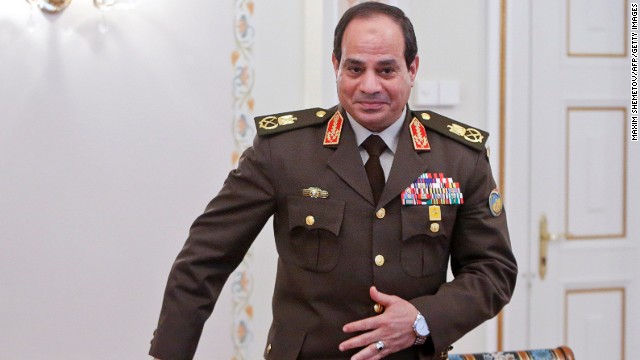
Rather than accept the results, however, the Obama Administration “channeled funding … [that] … vigorously supported activists and politicians who have fomented unrest in Egypt.” A year later, Morsi was overthrown by a coup that restored Mubarak’s military junta minus the ailing former tyrant. Ignoring American law, Obama continues to finance General Abdel Fata al-Sisi’s violent, oppressive regime, which many human rights groups describe as even more brutal than Mubarak’s. Morsi, a democratically-elected leader whom a principled American president should demand to be restored to power, rots in a prison whose jailers are paid by American taxpayers.

To add Orwellian insult to neocolonialist injury, Secretary of State John Kerry is still saying that Egypt’s post-Morsi junta is “transitioning to a democracy.” Kerry’s mouthfart came a day after al-Sisi sent three foreign journalists away for long prison terms.

Overshadowed by Israel’s latest brutal swat-a-fly-with-laser-guided-missiles invasion and bombing campaign against the Gaza Strip is the fact that, as in Egypt, the United States got the elections it demanded in Palestine, only to succumb to buyer’s remorse after the ballots were counted.

The Palestinian elections of 2006 are hardly the most thrilling story ever told, so I won’t be surprised if you decide to look at this story about the guy who sent his wife a spreadsheet detailing all the excuses she gave him for not having sex and never look back.

Still here? Here’s an abridged recounting of an episode that not only sheds some light on the current conflagration between Israel and Palestine, but reveals the methods used by Israel and its allies to undermine Palestinian self-governance — and belies America’s loudly proclaimed commitment to democracy to boot.

Israeli leaders like to complain that the Palestinian side doesn’t offer them a viable partner with whom to negotiate peace. Read the following, however, and Israel’s right-wing government’s real agenda becomes clear: to demoralize and divide the Palestinian people in order to sap their resistance to economic and military oppression.

In the Palestinian legislative elections of 2006, held both in the West Bank and Gaza in response to pressure from the United States, Hamas beat Fatah (Yasir Arafat’s more moderate party), 44.45% to 41.43%, entitling it to 74 seats in parliament over Fatah’s 45. (The current split, in which Hamas rules Gaza and Fatah has the West Bank, followed a later internal military clash.)

Israel’s interference with the 2006 elections began during campaign season, when it preemptively arrested and jailed 450 members of Hamas because they were involved in the elections as candidates or campaign workers. Despite this and other acts of sabotage, including trying to ban residents of East Jerusalem from voting, the elections went off well. The European Parliament’s spokesperson called the vote “extremely professional, in line with international standards, free, transparent and without violence.”

The thing to do would have been to congratulate Hamas and the Palestinians, and offer assistance upon request.

Instead, the Bush Administration and its allies cut off aid to the Palestinian Authority, ended diplomatic relations and imposed trade and other economic sanctions. Three months after Hamas formed its first government, in June 2006, Israel invaded Gaza and the West Bank, demolished and bombed civilian and government infrastructure, and arrested 25% of the members of parliament “because technically they were members of a terrorist organization although they may not be involved in terrorist acts themselves.” The U.S., which supplied the weapons used in the attacks, cited Israel’s “right to defend itself.”

Hamas, U.S. government-controlled media frequently reminds readers and viewers, is a U.S.-designated terrorist organization. So to people who don’t hold tickets to the Way Back A Decade Ago Machine, the actions of America, Israel and their allies vis-à-vis Hamas, which rules Gaza, seem reasonable. They’re terrorists! They shoot rockets at Israel! (Really lame rockets, but still.)

Hamas remains boxed in and desperate under Obama. Israel and Egypt’s al-Sisi regime, the two largest recipients of U.S. foreign aid military hardware, have shut the territory’s land crossings to Israel and Egypt and imposed a naval blockade on the Mediterranean coastline. Despite dozens of tunnels built to smuggle in goods, the West’s sanctions regime has been successful; Gaza’s economy has tanked, and unemployment among its 1.8 million people has risen to 38.5%. (The highest rate in the U.S. during the Great Depression of the 1930s was 25%.) Shooting rockets at civilians isn’t a great way to make friends — but desperation makes people do stupid things.

What the U.S. media doesn’t want you to know is: Hamas is popular. They won the last election, and they’d probably win again if one were held now. By pushing regime change in Gaza, therefore, the U.S. wants to replace a popular government with an unpopular one…in other words, subverting democracy.

Ukraine is yet another case of a democratically-elected ruler overthrown by a U.S.-backed coup.

Viktor Yanukovych won the Ukrainian presidency in 2010 elections that were widely believed to have conformed to international standards according to foreign observers. The thing to do would have been to congratulate him and the Ukrainian people on a fair election, and offer assistance upon request. But the U.S. was wary of Yanukovych, worried he might not easily be tamed. (Sample American punditry at the time: “The Ukrainians need to expand their relationship with the International Monetary Fund.”)

He didn’t. Finally, in November 2013, Yanukovych sealed his fate by siding with neighboring Russia over a pending EU association agreement — thus rejecting closer ties to the West and the United States. Street protests that led to Yanukovych’s ouster in February 2014 were likely indigenous, but would almost certainly not have succeeded in driving the president into exile without the flow of hundreds of millions of dollars in covert U.S. funding to the Maidan organizers.

Though more of a money-motivated oligarch than a creature of the far right, current Ukrainian president Petro Poroshenko has repeatedly demonstrated his willingness to accommodate right-wing factions, including neo-fascists, in Ukraine. Moreover, whatever you think of Poroshenko, he is not the legitimate ruler of the country. Nevertheless, President Obama has recognized him as such and offered economic and military hardware in his civil war against Russian-speaking separatists in the eastern part of the country.

I’ll close with a quote from Noam Chomsky: “For Washington, a consistent element is that democracy and the rule of law are acceptable if and only if they serve official strategic and economic objectives. But American public attitudes on Iraq and Israel/Palestine run counter to government policy, according to polls. Therefore the question presents itself whether a genuine democracy promotion might best begin within the United States.”

(Ted Rall, syndicated writer and cartoonist, is the author of “After We Kill You, We Will Welcome You Back As Honored Guests: Unembedded in Afghanistan,” out Sept. 2. Subscribe to Ted Rall at Beacon.)

COPYRIGHT 2014 TED RALL, DISTRIBUTED BY CREATORS.COM


SYNDICATED COLUMN: You Know Your Country Sucks When You Look Wistfully Back at Stalin

http://cdni.condenast.co.uk/646x430/k_n/Moscow15_CNT_27may10_646.jpg


You can tell a lot about the state of a country by comparing the state of its public and private infrastructure.

Take a look, if you can sneak past the gated community guard shack and peek through the privets without getting tackled by a rented goon, at the homes of the wealthy. Note the manicured lawns of the one percenters, fertilized the months recommended by experts depending on climactic zone, painstakingly controlled for weeds, irrigation calibrated by volume, on timers. Check out the garden: lines of shrubs that run a hundred bucks each, red-dyed mulch hiding the dirty brown dirt and tamping down unwanted dandelions before they get a chance to sprout. The driveway is flat, smooth, free of cracks. Stucco walls, if you live out West, are similarly crack-free; if you’re east of the Mississippi, bricks are framed by perfect pointing. Every detail, from the brass numbers on the mailbox to the baseboards to the perfect absence of cobwebs in high ceiling corners, reflects thorough, routine, frequent maintenance and repairs by a retinue of professional service providers.

Tasteful. New. Kept up.

Bear in mind: all this perfectly-maintained stuff houses a single family. At most, we’re talking two parents, four kids and a nanny or two. Certainly fewer than 10 people.

Now look at our public infrastructure.

Drive on a public highway in any major city: New York, Chicago, Los Angeles. It’s a disaster. Potholes so big you worry about breaking an axle. (And you should. In New York State, for example, a recent study estimated that bad roads and bridges cost motorists $20.3 billion in repairs annually.) Cracked concrete and asphalt everywhere. Missing guardrails, stolen signs, and everywhere you turn, garbage. Graffiti and vandalism take a toll but mostly it’s all just old. Old, rusted, worn out, years of “deferred maintenance” — i.e., none at all. Yeah, people throw crap out their car windows — but municipal governments don’t clean it up for days, weeks months at a time.

Connecting two of NYC’s biggest boroughs, the Brooklyn-Queens Expressway is used daily by 160,000 vehicles. It is hideous. It is narrow. It is literally falling apart. Constantly. “With its multitude of trucks and dangerous on-ramps, the BQE is a den of congestion at virtually all hours of the day,” The New York Times reported in 2012. “But one factor has condemned this antiquated 16.8-mile stretch of highway to a place of longstanding infamy in the New York metropolitan area, if not all of urban America: construction that never seems to end. As Gerry Michalowski, a truck driver who has traveled the BQE since 1978, put it, ‘It was under construction then, and it’s still under construction now.'”

Think again about that house I described at the beginning of this column.

It’s used by half a dozen people a year.

The BQE is used by 58 million vehicles a year.

If you don’t think there’s something wrong with this, if you defend the “right” of the wealthy to aggregate more and more until the point when they own everything including our bodies and souls, consider this: rich people have to drive on those roads too. By definition, 580,000 of those BQE users are one percenters.

America isn’t broke, but most Americans are. The reason is simple: too few people have too much of our national wealth. The pauperizing of our common property — the deliberate starving of public funding for roads, bridges, parks, schools, public hospitals, even hospitals charged with caring for veterans of America’s oil wars — reflects the economic and political system’s ass-backward priorities. It’s immoral. Because any society that spends more resources to maintain and upgrade private homes than public works is crazy stupid.

And it hurts the economy.

The American Society of Civil Engineers estimates that the United States needs to spend $3.6 trillion over the next six years to replace and repair the nation’s decaying dams, upgrade its parks and outdated schools, rusting water mains, and our crumbling airports, train and bus terminals, roads and bridges — many of which have deteriorated to Third World standards. (Although, to be fair to the Third World, I’ve seen U.S.-funded roads in Afghanistan in better shape than some in L.A.) The ASCE gives the U.S. a D+ on infrastructure.

The World Economic Forum ranks the U.S. 25th in the world in infrastructure, behind Oman, Saudi Arabia and Barbados.

It doesn’t have to be this way.

Josef Stalin, of all people, showed how infrastructure could be prioritized over private property. The dictator approved every extravagance — and why not? Obama signs off on every luxury the military can dream up.

Determined that his new Moscow Metro be a “palace of the people” for the Soviet capital’s subway commuters, Stalin ordered that no expense be spared to create a system that was not only fast and efficient, but beautiful. “In stark contrast to the gray city above,” The Times wrote as late as 1988, “the bustling, graffiti-less Metro is a subterranean sanctuary adorned with crystal chandeliers, marble floors and skillfully crafted mosaics and frescoes fit for a czar’s palace.” With good reason: first Stalin had chandeliers ripped out of the czar’s old palaces and moved underground; for future stations he had even more stunning ones designed from scratch using radically innovative techniques.

The Moscow Metro remains a showcase of what socialism could do at its best: prioritize the people and thus improve their daily lives.

Then there’s us.

Earlier this week President “Obama appeared at the I-495 bridge over the Christina River in Wilmington, Del., a span that has been closed since June, when engineers discovered that four of its columns were leaning to one side. That has created a traffic nightmare for the 90,000 vehicles that travel the major East Coast highway every day.”

The President went to Delaware to “announce new initiatives to encourage private-sector investment in the nation’s infrastructure, including the creation of a ‘one-stop shop’ at the Department of Transportation to forge partnerships between state and local governments, and public and private developers and investors.” In other words: the usual too little, too late, and even that probably won’t happen.

You know you’re in trouble when you look up to Stalin.

(Ted Rall, syndicated writer and cartoonist, is the author of “After We Kill You, We Will Welcome You Back As Honored Guests: Unembedded in Afghanistan,” out Sept. 2. Subscribe to Ted Rall at Beacon.)

COPYRIGHT 2014 TED RALL, DISTRIBUTED BY CREATORS.COM


SYNDICATED COLUMN: Those Kids Crossing the Border from Mexico Wouldn’t Be There if Obama Hadn’t Supported a Coup the Media Doesn’t Talk About

http://static.rogerebert.com/uploads/review/primary_image/reviews/sin-nombre-2009/hero_EB20090401REVIEWS904019992AR.jpg

If you’re reading this, you probably follow the news. So you’ve probably heard of the latest iteration of the “crisis at the border”: tens of thousands of children, many of them unaccompanied by an adult, crossing the desert from Mexico into the United States, where they surrender to the Border Patrol in hope of being allowed to remain here permanently. Immigration and Customs Enforcement’s detention and hearing system has been overwhelmed by the surge of children and, in some cases, their parents. The Obama Administration has asked Congress to approve new funding to speed up processing and deportations of these illegal immigrants.

Even if you’ve followed this story closely, you probably haven’t heard the depressing backstory — the reason so many Central Americans are sending their children on a dangerous thousand-mile journey up the spine of Mexico, where they ride atop freight trains, endure shakedowns by corrupt police and face rapists, bandits and other predators. (For a sense of what it’s like, check out the excellent 2009 film “Sin Nombre.”)

NPR and other mainstream news outlets are parroting the White House, which blames unscrupulous “coyotes” (human smugglers) for “lying to parents, telling them that if they put their kids in the hands of traffickers and get to the United States that they will be able to stay.” True: the coyotes are saying that in order to gin up business. Also true: U.S. law has changed, and many of these kids have a strong legal case for asylum. Unfortunately, U.S. officials are ignoring the law.

The sad truth is that this “crisis at the border” is yet another example of “blowback.”

Blowback is an unintended negative consequence of U.S. political, military and/or economic intervention overseas — when something we did in the past comes back to bite us in the ass. 9/11 is the classic example; arming and funding radical Islamists in the Middle East and South Asia who were less grateful for our help than angry at the U.S.’ simultaneous backing for oppressive governments (The House of Saud, Saddam, Assad, etc.) in the region.

More recent cases include U.S. support for Islamist insurgents in Libya and Syria, which destabilized both countries and led to the murders of U.S. consular officials in Benghazi, and the rise of ISIS, the guerilla army that imperils the U.S.-backed Maliki regime in Baghdad, respectively.

Confusing the issue for casual American news consumers is that the current border crisis doesn’t involve the usual Mexicans traveling north in search of work. Instead, we’re talking about people from Central American nations devastated by a century of American colonialism and imperialism, much of that intervention surprisingly recent. Central American refugees are merely transiting through Mexico.

“The unaccompanied children crossing the border into the United States are leaving behind mainly three Central American countries, Honduras, El Salvador and Guatemala. The first two are among the world’s most violent and all three have deep poverty, according to a Pew Research report based on Department of Homeland Security (DHS) information,” reports NBC News. “El Salvador ranked second in terms of homicides in Latin America in 2011, and it is still high on the list. Honduras, Guatemala and El Salvador are among the poorest nations in Latin America. Thirty percent of Hondurans, 17 percent of Salvadorans and 26 percent of Guatemalans live on less than $2 a day.”

The fact that Honduras is the biggest source of the exodus jumped out at me. That’s because, in 2009, the United States government — under President Obama — tacitly supported a military coup that overthrew the democratically elected president of Honduras. “Washington has a very close relationship with the Honduran military, which goes back decades,” The Guardian noted at the time. “During the 1980s, the US used bases in Honduras to train and arm the Contras, Nicaraguan paramilitaries who became known for their atrocities in their war against the Sandinista government in neighbouring Nicaragua.”

Honduras wasn’t paradise under President Manuel Zelaya. Since the coup, however, the country has entered a downward death spiral of drug-related bloodshed and political revenge killings that crashed the economy, brought an end to law, order and civil society, and now has some analysts calling it a “failed state” along the lines of Somalia and Afghanistan during the 1990s.

“Zelaya’s overthrow created a vacuum in security in which military and police were now focused more on political protest, and also led to a freeze in international aid that markedly worsened socio-economic conditions,” Mark Ungar, professor of political science at Brooklyn College and the City University of New York, told The International Business Times. “The 2009 coup, asserts [Tulane] professor Aaron Schneider, gave the Honduran military more political and economic leverage, at the same time as the state and political elites lost their legitimacy, resources and the capacity to govern large parts of the country.”

El Salvador and Guatemala, also narcostates devastated by decades of U.S. support for oppressive, corrupt right-wing dictatorships, are suffering similar conditions.

Talk about brass! The United States does it everything it can to screw up Central America — and then acts surprised when desperate people show up at its front gate trying to escape the (U.S.-caused) carnage. Letting the kids stay — along with their families — is less than the least we could do.

(Ted Rall, syndicated writer and cartoonist, is the author of “After We Kill You, We Will Welcome You Back As Honored Guests: Unembedded in Afghanistan,” out Sept. 2. Subscribe to Ted Rall at Beacon.)

COPYRIGHT 2014 TED RALL, DISTRIBUTED BY CREATORS.COM


SYNDICATED COLUMN: EXCLUSIVE! Why Are 6000+ Reporters Keeping the Government’s Non-Secret?

I know a secret.

I know the identity of the man who was CIA Chief of Station in Kabul until one month ago.

The name of the top spook in Afghanistan was disseminated via email to 6,000+ reporters as part of an attendance list of senior U.S. officials participating in a meeting with President Obama during his surprise visit with U.S. troops. The government spotted the error and asked journalists not to post it.

They agreed. Still, it’s all over the Internet.

What I found via Google during a few hours of searching made me 98% sure it was him; sources in Kabul covered the two percent of doubt.

Until last week I was working this story for Pando Daily, where I was a staff writer and cartoonist. We intended to publish the name — not to endanger him (which in any case would not have been possible since Langley had yanked him off his post), but to take a stand for adversarial media.

Journalists ought to publish news wherever they find it, whatever it is, damn the consequences. Credible media organizations don’t protect government secrets. They don’t obey spy agencies. Real journalists don’t cooperate with government — any government, any time, for any reason. My editor and I believed that, by demonstrating a little fearlessness, we might inspire other media outfits to grow a pair and stop sucking up to the government.

There is no longer a “we.” Pando fired me over the weekend, along with the investigative journalist David Sirota.

Stripped of the institutional protection of a media organization willing to supply legal representation and advice, I cannot move forward with our/my original plan to reveal the name.

Nevertheless, I think it valuable to draw attention to an absurdity: thousands of journalists representing hundreds of press and broadcast media outlets, all of whom agreed to keep a secret that wasn’t much of a secret in the first place, which ceased being secret the second they received it, which remains easily accessible to anyone with an Internet connection — in order to curry favor with a government that routinely lies to reporters like them.

On May 25th President Obama paid a visit to the U.S. airbase at Bagram, north of Kabul, which includes an expanded torture facility for Muslim detainees. Sixteen “senior” U.S. officials were invited to Bagram to give Obama a briefing on the military situation. Among them was the Kabul Chief of Station (COS) — the CIA’s top man in occupied Afghanistan.

An Obama Administration PR flack mistakenly included the COS’ name on a list of meeting attendees that was emailed to more than 6,000 journalists around the globe.

From The Washington Post:

The list was circulated by e-mail to reporters who traveled to Afghanistan with Obama, and disseminated further when it was included in a “pool report,” or summary of the event meant to be shared with other news organizations, including foreign media, not taking part in the trip.

In this case, the pool report was filed by Washington Post White House bureau chief Scott Wilson. Wilson said he had copied the list from the e-mail provided by White House press officials. He sent his pool report to the press officials, who then distributed it to a list of more than 6,000 recipients.

What happened next is notable both for farcicality worthy of the movie “Brazil,” and what it reveals about the slavishly submissive posture of reporters and their editors and producers to the U.S. government in general and the CIA in particular.

Though CIA Chiefs of Station are secret agents, in practice they often maintain such a high profile — working out of the local U.S. embassy, being seen at ex-pat hangouts and coming and going from major events (c.f., meeting with the president) that their identities are widely known in their host countries. They may be “secret” — but their names aren’t. The predecessor of the Kabul COS outted in May, for example, had previously been identified on Facebook.

The Taliban and other adversaries have superb access to intelligence throughout Afghanistan, including widespread infiltration among the police and Afghan military. They are sophisticated Internet users. They can target a COS any time they feel like it. But they probably won’t. Like other guerilla armies, tracking such figures reveals years of useful information that is far more valuable than the one-off propaganda value of assassinating him.

The CIA recognized that its Station Chief’s cover had been blown and pulled him out of Kabul. According to Senator Rob Portman, he is safe.

Now things get ridiculous: the White House asked 6,000+ reporters — reporters! — to forget what they’d learned. And all 6,000+ did.

“The name and title of the station chief were removed in a later pool report that urged reporters to ‘please use this list’ of attendees at the president’s briefing instead of the previous one,” reports The New York Times.

Such is the state of America’s fierce free press: All 6,000+ reporters and their media employers adhered to the White House request to redact the outted COS’ name from their reporting.

All.

It’s not that the former Kabul Station Chief’s name isn’t out there. It’s on a bunch of websites, particularly blogs that specialize in coverage of spy agencies.

Meanwhile, corporate media has spent the last month playing online Whack-a-Mole, censoring the outted COS’ name whenever it pops up. Whenever his name appears in an aggregated piece copied from an original version of the White House email by a bot, or in a comment thread, it stays up a few days before vanishing down the memory hole.

Why do they do it? Because the Obama Administration asked nicely. And in order to avoid offending the CIA.

Even though the name is not secret. In this case, kowtowing to the government has no practical effect. The guy is no longer in Kabul. Anyway, America’s enemies knew/know all about him.

They know, as I do, about the ex-COS’ previous postings. They know, as I do, about the cars he drives, the sports he enjoys, his address history in the States and overseas, the names of his family.

Everyone leaves a digital trail — even spies. No one has privacy — not even spies.

Anyone can find this stuff.

We should be holding the Fourth Estate accountable for their failure to hold government accountable. The Kabul Chief of Station fiasco exposes the subservience that shows why corporate media can’t be trusted to challenge the powers that be.

Why isn’t one journalist out of 6,000 — unlike me, protected by lawyered-up media organizations — willing to publish a government secret that the government gave away?

(Ted Rall, syndicated writer and cartoonist, is the author of “After We Kill You, We Will Welcome You Back As Honored Guests: Unembedded in Afghanistan,” out Sept. 2. Subscribe to Ted Rall at Beacon.)

COPYRIGHT 2014 TED RALL, DISTRIBUTED BY CREATORS.COM


Big Loss/Win for the President

Rather than news or politics, political cable news and network news cover the horse race: why this event is good for a politician and why that one isn’t. Ignored by the horserace are the real-world implications of the news, including how tragedies and triumphs affect actual real (but ordinary) citizens.

SYNDICATED COLUMN: Obama Starts Gulf War III — And His Pet Media Is Helping

http://i-cias.com/e.o/slides/gulf_war01.jpg


They can’t help themselves.

Whatever the situation, the reaction of U.S. policymakers is more war.

Weak economy? War will get things going. Strong economy? Military spending will cool it off.

Two wars in the Middle East (Afghanistan and Iraq) finally winding down (because we’ve lost and people are sick of them)? Time to ramp up secret arms sales to a pair of pipsqueak insurgencies (Libya and Syria).

Other superpowers love militarism. But only the United States would send troops, rather than aid workers, to people devastated by natural disasters like tsunamis and earthquakes…even within the United States.

As Joel Andreas put it in his seminal graphic novel-format comic, American politicians are addicted to war. And we — even those who identify with the antiwar left — are like an addict’s long-suffering spouse, trapped in a dysfunctional relationship where we enable the militarism we claim to deplore.

The ruling elite’s addiction to militarism is fully visible in President Obama’s announcement that he plans to re-invade Iraq. He’s starting small, with a few hundred military advisers and maybe (i.e., probably) airstrikes via the precise, never-fails, cares-so-much-about civilians technology of drones. Sending a few hundred military advisers was, of course, how JFK initiated America’s involvement in the Vietnam War.

But we’ve already been through all that in Iraq. We invaded. We propped up a wildly unpopular pro-U.S. puppet regime. We fought. We lost — and lost big. We withdrew. Now our pet autocracy is collapsing. In Vietnam time, it’s 1975 in Iraq. This is supposed to be the part where we burn stacks of $100 bills, push Hueys into the sea, shove desperate locals off the roof of the embassy in Saigon/Baghdad and get out. Twenty or so years later, we come back and invade the right way — as obnoxious tourists and predatory sneaker company executives.

What’s up with Obama? Why is he treating Iraq like it’s Vietnam in 1962 — as though this were one of those hey, let’s just send a little help and see what happens affairs, as in there’s no way, no how “combat troops” (as opposed to non-combat troops) are going in (again), unless they do?

Even by presidential standards, Obama’s behavior is bizarre. Somewhere in the multiverse there must be one version of this story in which a half-dozen cabinet members, steeled in their resolve by the support of the Secret Service, rush into the Oval Office and bundle the President off to an institution that can give him the treatment he seems to require.

Alas, we live here.

In this weirdass country, the President’s re-invasion of Iraq is supported by 320 million enablers — not least of whom is the media.

It’s not just the sickening worship of all things soldierly, as when so-called journalists say “thank you for your service” to armchair generals who will never be on the wrong end of a shot fired in anger. The media drowns us in so much misinformation that it’s impossible for all but the most dedicated between-the-lines readers to come to an intelligent assessment of the facts.

Consider, for example, The New York Times. Given how often the paper has gotten burned by its pro-militarist establishmentarianism (supporting the failed right-wing coup attempt against Hugo Chávez in Venezuela, supporting the 2003 invasion of Iraq, not returning Edward Snowden’s phone call), you’d think its editors would be reluctant to support Gulf War III.

And yet.

A June 17th piece bearing the headline “Your Iraq Questions, Answered,” in which Times reporters reply to readers, is illustrative.

One reader asks: “ISIS [the Islamic State of Iraq and Syria, the Islamist insurgent militia threatening the U.S. puppet regime of Nouri al-Maliki, currently in control of half the country] seems to have legit online following. Is this reflective of support on the ground?”

Rod Nordland, Kabul bureau chief but reporting from Iraq, replies: ISIS has a huge and very aggressive social media operation, but I don’t know how anyone could characterize that as a legitimate following. I suspect a lot of their followers, clicks and retweets are voyeuristic because the material posted is so bloody and savage, and ISIS is completely unapologetic about it. Hopefully, most of their following is aghast.”

So much for any smidge of journalistic objectivity.

Then things turn really stupid:

“Most people in the territory ISIS controls do not seem terribly supportive of them, but they hate the Shiite-dominated Iraqi government far more, and ISIS takes pains to treat the Sunnis in their dominions with consideration — at least at first. That is the central challenge that the Iraqi government faces, to convince people in ISIS-dominated areas that their government wants to include them, and has more to offer than the ISIS extremists.”

Anyone who has studied history or read Che Guevara — which you’d hope an employee of The New York Times might have done — knows that ISIS, as a guerilla army outgunned and outmanned by the central government it seeks to overthrow, would never have gotten as far as it has without substantial support among civilians.

Even more egregious than Nordland’s failure to convey this truism to Times readers is his closing combination of childlike naiveté and taking sides. Maliki has been in office for eight years. If he were interested in building a pluralistic post-sectarian political coalition, rather than ruthlessly excluding all but his own Shiites from positions of influence, he would have done so by now. Even with ISIS on the road toward Baghdad, he hasn’t shifted his Shiite-centric approach.

With the most respected news source in the United States spoon-feeding such nonsense, it’s no wonder we can’t break free of the militarist traps laid for Pentagon generals by defense contractors, for the President by his generals and for us by the President.

When’s the last time you read an uncompromising antiwar opinion on the op-ed page of a major newspaper? Have you ever seen someone completely against war interviewed on network television news — even on “liberal” MSNBC? Even the state radio for the intellectual elite, NPR, rarely grants airtime to experts who oppose militarism. I’m an addict — to news — and I can honestly say that it’s rare to see more than one antiwar talking head on TV in a year…and that’s on daytime shows with low viewership.

As long as the alternatives to war aren’t allowed a voice, our addiction to war is safe.

(Ted Rall, Staff Cartoonist and Writer for Pando Daily, is the author of the upcoming “After We Kill You, We Will Welcome You Back As Honored Guests: Unembedded in Afghanistan.” Subscribe to Ted Rall at Beacon.)

COPYRIGHT 2014 TED RALL, DISTRIBUTED BY CREATORS.COM


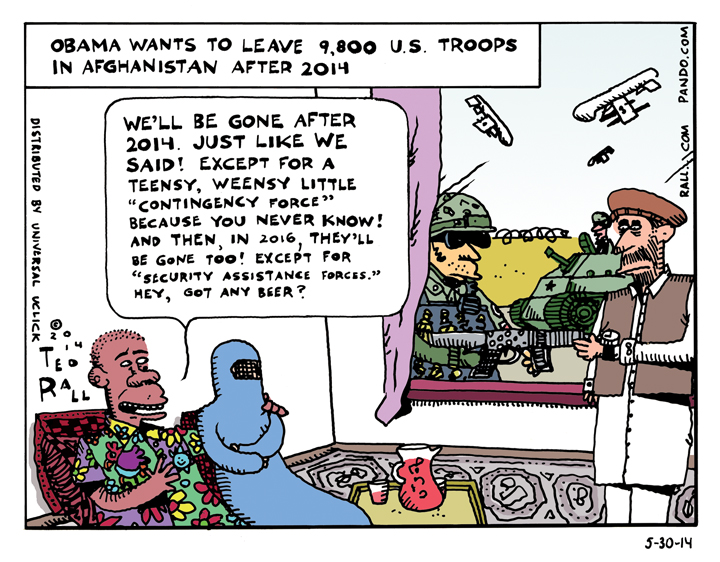
The Thing That Won’t Leave

Obama wants to leave 9,800 U.S. troops in Afghanistan after 2014. Except for a “contingency force,” which will stay longer. Then we’ll be gone. Well, not really.

keyboard_arrow_up
css.php