America’s Bizarro Take on Guantánamo: Punish the Victims, Reward the Criminals

           A country that loudly and repeatedly expresses what it purports to be its principles, yet cavalierly ignores them on a whim, rightly earns the contempt of its own citizens and those of other nations, especially when the hypocritical government of that nation criticizes others for failing to adhere to their pompously proclaimed rules-based international order.

            Guantánamo Bay concentration camp epitomizes this phenomenon.

            Now in its third decade of operation under four presidents, Gitmo still houses 30 men. None of them has ever been charged in a court of law. Indeed, none of them ever will. It is a bedrock principle of American jurisprudence that we are all, citizens and non-citizens alike, presumed innocent until proven guilty. Which makes all 30 prisoners, including Khalid Sheikh Mohammed, as innocent as a newborn child as far as the law is concerned.

            For whatever it’s worth, the Pentagon itself says it has no evidence that half of these people committed a crime. They are all cleared for release, but the U.S. refuses to admit them and no other country has issued an invitation.

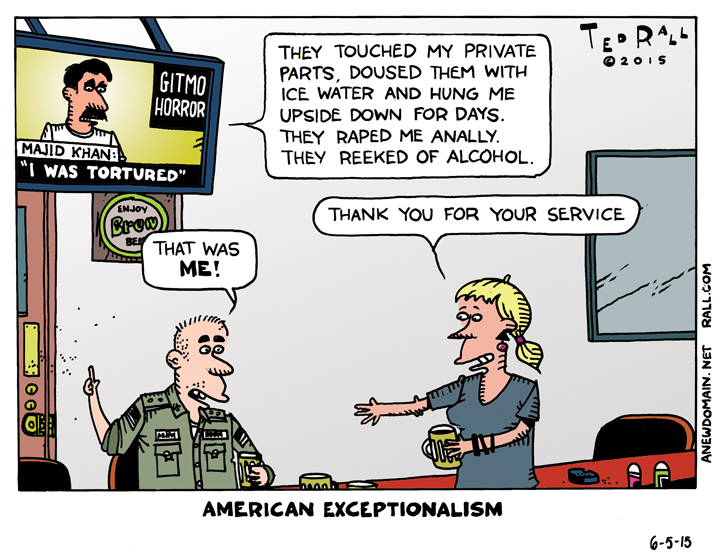
            These 30 innocent men and the 750 others who have cycled through and subsequently been released were kidnapped (after having been sold for a bounty in many cases), deprived of their constitutional right to a speedy trial and their right to legal counsel, tortured in order to deprive them of their right not to incriminate themselves, prohibited from receiving visits from family members and blocked from using a telephone. Unsurprisingly, the Red Cross has determined that these innocent men are “experiencing the symptoms of accelerated aging worsened by the cumulative effect of their experiences and years spent in detention.”

            According to The New York Times: “Lawyers for some of the prisoners, particularly those who spent years in harsh, secret CIA custody before Guantánamo, have said detainees have brain damage and disorders from blows and sleep deprivation, damaged gastrointestinal systems from rectal abuse and issues possibly linked to prolonged shackling and other confinement.”

            Linger on that: damaged gastrointestinal systems from rectal abuse. Nice rules-based international order you got there, Uncle Sam.

            Though he hasn’t made it a priority, President Biden would like to close Guantánamo. Toward that end, the military has talked to lawyers for some detainees. “Settlement talks are underway at the U.S. military court in Guantánamo Bay, Cuba, that would allow alleged 9/11 architect Khalid Shaikh Mohammed and his four co-defendants to plead guilty, avoid the death penalty, and serve life in prison—although some of them may try to negotiate lesser sentences,” NPR reported a year ago. There’s been no word since.

            This is an obscenity. A law-abiding society doesn’t negotiate a reduced sentence for innocent men. Innocent men are released. Innocent men released after having been mistreated are compensated financially and otherwise for having been abused and deprived of their rights.

            The Gitmo 30 should be released and brought to the United States if their home countries don’t want them or it’s dangerous for them to go back. They and the 750 former detainees should be housed, given healthcare and treatment for mental trauma, jobs if they want them, as well as generous financial compensation. The federal standard for compensating the wrongfully imprisoned is $50,000 per year of incarceration plus an additional amount for time spent on death row. Conditions at Guantánamo demand more.

            We do, however, need to punish those at Guantánamo—not the prisoners, who are innocent victims, but the guards and commanding officers. Anyone who has served at Guantánamo concentration camp is guilty of kidnapping, punishable by up to 20 years in prison under federal law. If two or more people conspire to commit kidnapping, which is plainly the case here, they face life imprisonment.

Everyone involved in keeping innocent people confined at Guantánamo should be prosecuted to the fullest extent of the law. This includes the last four presidents of the United States, generals, and others in the chain of command down to the guards, as well as lawyers like John Yoo, who authored convoluted legal opinions justifying kidnapping and torture. Let’s not forget the CIA agent-torturers who gleefully carried out “enhanced interrogation techniques” as well as their superior officers. Hey Democrats! Really want to get rid of Donald Trump? Here’s your chance.

Writing an essay like this annoys me. Calling for justice for the wronged and accountability for the evildoers, and pointing out that people are innocent until proven guilty, is kindergarten editorial commentary that takes away time and energy I ought to be devoting to complex policy issues. These concepts are so simple and self-evident that there should be no more need to express them than to announce in a newspaper that the sun will rise in the east tomorrow morning.

Yet I have to do it. No one else is talking about Gitmo. The American people don’t think, much less care, about what’s being done in their name and at their expense. Reality has been turned inside-out so thoroughly that seemingly otherwise sane journalists don’t see anything strange about America having its very own concentration camp, where 30 innocent people are trying to negotiate life imprisonment instead of execution, while those who actually committed crimes have suffered no punishment whatsoever. One torturer was subsequently appointed to run the CIA and is now a big-deal lawyer, while another is a top contender for the U.S. presidency!

The U.S. keeps talking about human rights—in other countries. People might start to pay attention if it closed Guantánamo, released its victims and prosecuted its employees.

(Ted Rall (Twitter: @tedrall), the political cartoonist, columnist and graphic novelist, co-hosts the left-vs-right DMZ America podcast with fellow cartoonist Scott Stantis and co-hosts “The Final Countdown” radio show Mon-Fri 10 am – 12 noon ET. You can support Ted’s hard-hitting political cartoons and columns and see his work first by sponsoring his work on Patreon.)
Jimmy Carter Was a Right-Winger

            Jimmy Carter will almost certainly be remembered as a liberal lion. That reputation, however, stems from his post-presidential work with Habitat for Humanity and his role attempting to mediate peace in the Middle East and elsewhere. His affable manner and trademark smile contributed to that impression.

            But Carter’s leading role was as President. Personal rebranding and the haze of history have obscured the fact that the peanut farmer from Plains, Georgia was conservative. As a right-wing “New Democrat,” he ushered in a radical shift of his party from champions of the working class and skeptics of foreign interventionism to the bellicose defenders of big business currently occupying the White House.

            Domestically, Carter was notable primarily for what he did not do. His inactions invariably leaned left.

Carter became the first Democratic president not to propose an anti-poverty bill since the realignment that brought FDR to power in 1932. A deficit hawk more concerned about inflation than unemployment, he broke his 1976 campaign pledge to push for a national healthcare plan. He considered, but rejected, proposals from fellow Democrats for a universal basic income and increasing welfare benefits. Though he personally favored and campaigned for decriminalizing cannabis, he backtracked and allowed the brutal War on Drugs to continue.

Empathetic statements bemoaning the ills and injustices of late-stage capitalism in the post-Vietnam era of deindustrialization, coupled with executive dithering, set the template for Clintonism: liberal rhetoric on the stump, conservative laissez faire in reality.

“Fundamentally, Jimmy Carter ended the New Deal and started America on the path of pushing wealth and power upward, a path dramatically accelerated by his successors,” Matt Stoller, author of “Goliath: The 100-Year War Between Monopoly Power and Democracy,” told The Washington Post.
“As just one simple example, one reason Americans today can’t sue airlines for consumer protection or safety violations is airline deregulation, passed in 1978 and signed by Jimmy Carter. Carter cut capital gains taxes in 1978, and under the term ‘deregulation,’ removed public rules from the banking, telecommunications, railroad, trucking, natural gas and airline industries.”

Carter was a man of peace—technically. He didn’t start any wars. He talked about human rights in international affairs, criticizing America’s coddling of dictators. He distanced the U.S. from apartheid-era South Africa and Nicaraguan dictator Anastasio “Tachito” Somoza. And he negotiated a peace deal between Israel and Egypt.

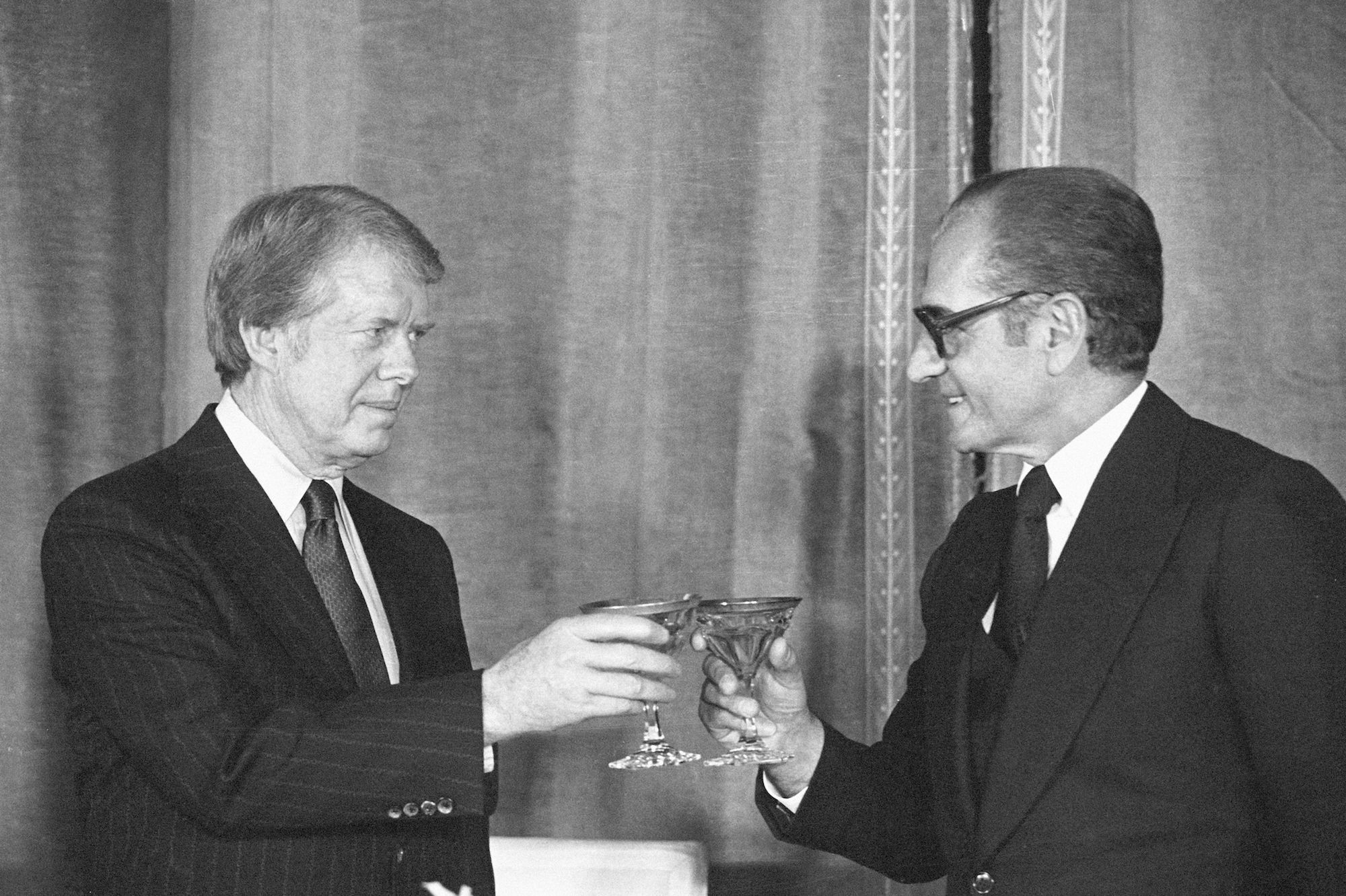
But his foreign policy hawkishness made the world more dangerous. The president’s highflying rhetoric was full of “built-in hypocrisy,” Foreign Policy magazine’s Jonathan Alter observed in 2020. “The president’s new policy was selective and inconsistent from the start, especially as applied to strategically important allies. Vital interests took priority over moral ones, most fatefully in the case of Iran, where Carter toasted the shah and raised the abuses of his secret police only in their private meetings. When the shah was driven from power in 1979 by the Ayatollah Ruhollah Khomeini, Carter’s support for the monarch led to the seizure of U.S. hostages in Tehran.”

Carter’s anti-communist national security advisor Zbigniew Brzezinski encouraged him to arm the radical Islamist mujahedin in Afghanistan, drawing the Soviet Union into a proxy war that helped set the stage for 9/11. He used the Soviet invasion as an excuse to politicize the 1980 Olympics by boycotting the Moscow games. In a transparently ridiculous attempt to look tough he restored draft registration, which remains in force despite the all-volunteer military.

And it was Carter who started the giant defense spending spree of the 1980s credited to Ronald Reagan. There may not have been any cash for infrastructure or healthcare or poverty, but when it came to nuclear saber-rattling against the Soviets, money was no object. “I am committed as a matter of fundamental policy to continued real increases in defense,” Carter told Congress in his 1980 State of the Union address. Reagan later acknowledged Carter’s massive defense spending. “My predecessor had proposed a five-year expansion of the defense budget,” Reagan said in 1986.

By 1979 the liberal voting base of the Democratic Party had had enough of Carter’s rightward shift. And then they had their champion: Massachusetts Senator Ted Kennedy challenged Carter from the left in the 1980 primaries, “trying to run on sort of FDR-type policies, the old-style liberalism, you know, trying to be a populist,” said journalist Jon Ward, author of a book about that race.

Kennedy’s defeat was fateful. 1980 marked the rise of the centrist-right Third Way/Democratic Leadership Council control over the Democratic Party apparatus, which went unchallenged until Bernie Sanders in 2016. Clinton continued Carter’s aggressive foreign policy and embraced right-wing domestic projects: NAFTA, the crime bill, welfare reform. Obama perfected Carter’s style, controlled and measured and calm in an effort to deliver a vaguely liberal impression rarely reflected by his policy decisions.

Carter is considered to be a great ex-president, mainly because his post-1981 life of humanitarian service contrasts with his presidential reputation as an incompetent, vision-free micromanager. But Carter did have a vision, one that was consequential if ignored. He sucked the liberalism out of the Democratic Party, rendering the American Left homeless, marginalized and alienated within electoral politics as the country spiraled into a half-century of rightward decline with no end in sight.

(Ted Rall (Twitter: @tedrall), the political cartoonist, columnist and graphic novelist, co-hosts the left-vs-right DMZ America podcast with fellow cartoonist Scott Stantis. You can support Ted’s hard-hitting political cartoons and columns and see his work first by sponsoring his work on Patreon.)
Saudi Arabia is a Bulwark against Iran. So Who’s the Bulwark against Saudi Arabia?

            The Washington Post recently published an op-ed purportedly written by President Joe Biden that tried to justify his visit with Saudi Arabian Crown Prince Mohammed bin Salman, the psychopath who ordered the murder, dismemberment and dissolution in acid of Jamal Khashoggi, a columnist for—wait for it—The Washington Post. Let’s hope MbS likes Biden’s “writing” better than Khashoggi’s.

            A publication whose motto is that “democracy dies in darkness” probably owes its readers the truth about who writes its articles. There is 1,000,000% no way in hell that Biden wrote that piece. Listen to him talk, then read it, you’ll see. Truth in advertising is important; accurate labeling more so. When I purchase a can labeled carrots, I don’t want to find pigs’ feet inside. Yet many newspaper opinion pieces and books bylined by high-ranking political figures and celebrities, like the piece that got Amber Heard sued, are ghostwritten. These are flagrant violations of journalistic ethical guidelines regarding attribution, a fraud against the readers, propaganda that elevates inarticulate fools into ersatz statesmen, and if editors won’t cut it out Congress should make it illegal.

            It is the underlying argument, however, that makes “Why I’m going to Saudi Arabia” interesting. “I know that there are many who disagree with my decision to travel to Saudi Arabia,” “Biden” “writes,” going on to “say” that human rights concerns must take a backseat because the kingdom can help the U.S. “counter Russia’s aggression” in Ukraine, “outcompete China” and serve as a bulwark against Iran.

            Even by the standards of the Beltway natsec Blob types whose “Risk” worldview considers countries and governments to be little more than pieces to be shuffled around a gameboard, “Saudi Arabia is a bulwark” is a shibboleth hard to top in its idiocy.

            A bulwark?

Against what?

            MbS rules the most notoriously barbarous, moronic and viciously violent regime on earth—one that by any metric is far worse than Iran, Russia or China. Torture, arbitrary arrests and political murders are commonplace. “Saudi courts have sentenced people to flogging for extramarital sex, drinking alcohol, and other offenses. While rarely, if ever, carried out, stoning sentences have been issued for adultery. The authorities have used and carried out sentences, albeit rarely, for amputation of limbs for theft,” according to Human Rights Watch. Saudi Arabia executes people, including children, for nonviolent drug offenses as well as witchcraft and sorcery.

            In a single day this past March, Saudi Arabia executed 81 people, including non-citizens, for a variety of crimes, including “disrupting the social fabric and national cohesion” and “participating in and inciting sit-ins and protests.”

            Saudi Arabia is one of the top destinations in the world for human traffickers, slave labor and sex trafficking.

            Saudi women are treated like children under the law by the nation’s male guardianship program. As a result, the kingdom has the lowest female worker participation rate in the world, 5%.
            Saudi Arabia finances countless radical Islamic terrorist groups around the world, including those who carried out the 9/11 attacks, and has spent an estimated $100 billion to spread its toxic brand of Wahhabi Muslim extremism to other countries. It has waged a brutal proxy war in neighboring Yemen, creating one of the worst humanitarian disasters on the planet.

The moral bankruptcy of American policy is exposed by the fact that Iran, which we target with sanctions, is a much more pluralistic and secular country than our frenemy Saudi Arabia. Iran has Jewish synagogues, Christian churches and Zoroastrian temples; its parliament has 14 non-Muslim members. Saudi Arabia, where anti-Semitism is widespread, required U.S. soldiers stationed there during the Gulf War to fly to international waters to observe Jewish services.

            Iran’s support of international terrorism pales next to the Saudis’.

            “For the past few decades,” Omar Bekdash wrote in the Cornell Diplomat in 2019, “women have enjoyed many more rights in Iran than in Saudi Arabia. In Iran, women are allowed to vote in every election and stand as candidates: six percent of Iran’s parliament is comprised of women, which is greater than the rate in cosmopolitan Lebanon, four percent.  Women work and open businesses in Iran without the need for male approval—either from their male elders or their husbands.”

            Iran has a vibrant opposition press; Saudi Arabia takes a zero-tolerance approach to dissent.

            Given the record, it would make much more sense to cozy up to Iran as a bulwark against Saudi Arabia. The truth, of course, is that we have more in common with Saudi Arabia—because they’re the worst.

(Ted Rall (Twitter: @tedrall), the political cartoonist, columnist and graphic novelist, is the author of a new graphic novel about a journalist gone bad, “The Stringer.” Order one today. You can support Ted’s hard-hitting political cartoons and columns and see his work first by sponsoring his work on Patreon.)
 

DMZ America Podcast #53: If I Were President! What We’d Do on Inflation/Economy, Human Rights/Foreign Policy & Guns/Red Flag Laws

Ted Rall and Scott Stantis believe that every political cartoonist should know what he or she would do if they became President of the United States. This week we put that question to the test. What, if anything, can the president do to combat inflation? As President Biden prepares to suck up to murderous Saudi Arabia, does he have an alternative? Are red-flag laws common-sense gun legislation or are they the first step down the path to dystopian authoritarianism?


Wars Make Bad Badfellows

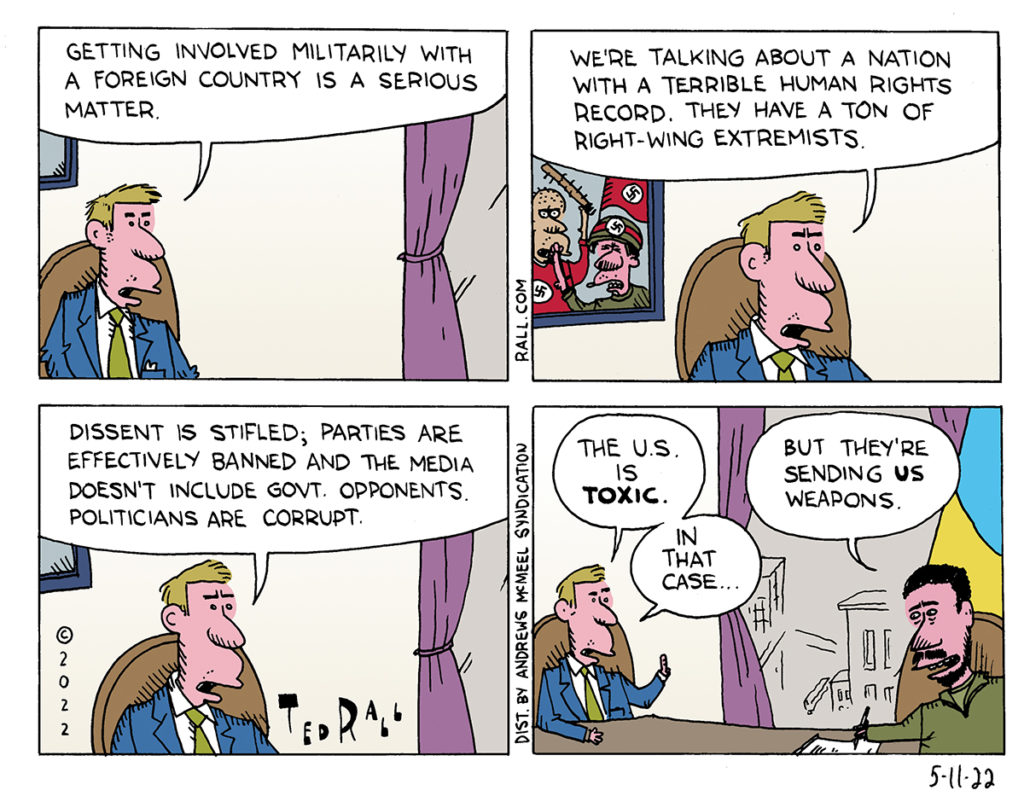
Many Americans are skeptical about military support for Ukraine given that country’s dismal human rights record and autocratic political system. One might also wonder why any other country would want to get into a relationship with the United States.

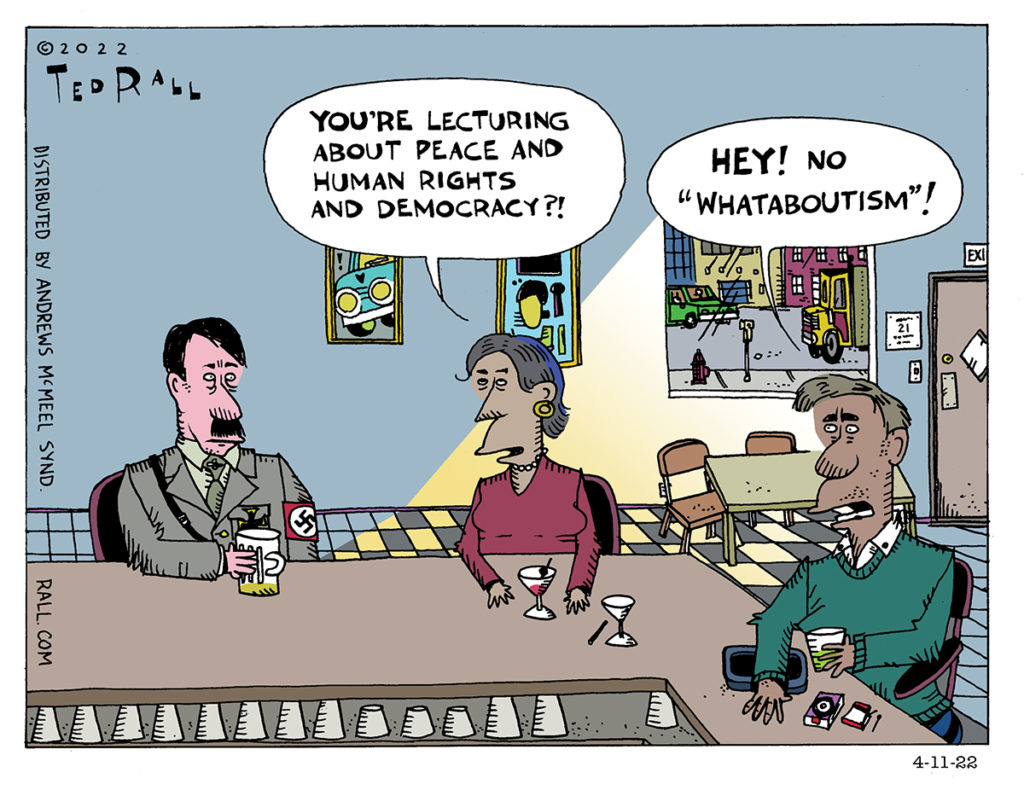
What About Whataboutism

Defenders of American imperialism cleverly use the slur “whataboutism” in order to denigrate anyone who points out that the United States doesn’t have the moral standing to criticize other countries in matters of war and peace.

The Secret Campaign for 2020: Where the Democratic Candidates Stand on Foreign Policy

Image result for bernie sanders and george w. bush

Americans vote their pocketbooks. It’s the economy, stupid. Absent a war or recent terrorist attack, conventional wisdom believes that voters prioritize domestic issues. Right now, conventional wisdom is correct. According to the latest Pew Research poll, the five most important issues for Democrats are healthcare, education, Medicare, poverty and the environment.

So it’s not surprising that the major Democratic presidential contenders’ campaigns are focusing on economic and other America-centric issues. Nor is it shocking that the news media, never more anemic or less willing to question the candidates, is ignoring their stances on foreign policy. You could watch 5 hours and read 50 pages of news every day and never learn where a top Dem stands on issues of war and peace, defense spending, assassination drones, Guantánamo, NSA surveillance of Americans, foreign adventurism or human rights. Trust me, I know.

Still, voters deserve to know the would-be presidents’ positions on issues that extend beyond U.S. borders. Here’s what I found.

The Democrats on Our Crazy Defense Spending

            The military sucks up 54% of discretionary federal spending. Pentagon bloat has a huge effect on domestic priorities; the nearly $1 trillion a year that goes to exploiting, oppressing, torturing, maiming and murdering foreigners could go to building schools, college scholarships, curing diseases, poetry slams, whatever. Anything, even tax cuts for the rich, would be better than bombs. But as then GOP presidential candidate Mike Huckabee said in 2015, “The military is not a social experiment. The purpose of the military is to kill people and break things.” If you’re like me, you want as little killing and breaking as possible.

Unfortunately, no major Democratic presidential candidate favors substantial cuts to Pentagon appropriations.

Current frontrunner Joe Biden (33% in the polls) doesn’t talk much about defense spending. He reminds us that his son served in Iraq (so he cares about the military) and that we shouldn’t prioritize defense over domestic programs. Vague. Though specific programs might get trimmed, Lockheed Martin could rest easy under a President Biden.

“Since he arrived in Congress, [runner-up] Bernie Sanders [19%] has been a fierce crusader against Pentagon spending, calling for defense cuts that few Democrats have been willing to support,” The Hill reported in 2016. “As late as 2002, he supported a 50 percent cut for the Pentagon.” Bernie is still a Pentagon critic but he won’t commit to a specific amount to cut. He wouldn’t slash and Bern. He’d trim.

Elizabeth Warren (8%) wants “to identify which programs actually benefit American security in the 21st century, and which programs merely line the pockets of defense contractors — then pull out a sharp knife and make some cuts.”

Neither Pete Buttigieg (8%) nor Beto O’Rourke (6%) have articulated any firm foreign policy positions whatsoever. Buttigieg brags about having served in the Navy Reserve. Unlikely that either man would change much.

Kamala Harris (5%) has not weighed in on military spending. She has received substantial campaign contributions from the defense industry, though.

The Democrats on Wars for Fun

            As senator, Biden voted for the optional wars against Afghanistan and Iraq. He lied about his votes so maybe he felt bad about them. He similarly seems to regret his role in destroying Libya.

Sanders voted to invade Afghanistan. His comment at the time reads as hopelessly naïve about the bloodthirsty Bush-Cheney regime: “The use of force is one tool that we have at our disposal to fight against the horror of terrorism and mass murder… it is something that must be used wisely…and with great discretion.” Sanders voted against invading Iraq, favored regime change in Libya (albeit nonviolently) and voted to bomb Syria.

There have been no major new wars since 2013, when Warren joined the Senate so her antiwar bona fides have not been tested. Like many of her colleagues, she wants an end to the “forever war” against Afghanistan. She also wants us out of Syria.

Harris too is new to the Senate (2017). Statements on various conflicts indicate that she is a foreign policy hawk in the Hillary Clinton mold. Harris favors the U.S. bombing campaign against Syria, blank-check approval for Israel and sabre-rattling against North Korea. She buys into the discredited Russiagate narrative.

Warren is the only high-level antiwar candidate but she could be BSing.

Democrats on Drones

            The assassination drone program begun by Bush and expanded upon by presidents Obama and Trump have killed thousands of innocent people in Africa, the Middle East and South Asia, almost all innocent. Drone strikes have demolished America’s moral standing. “Just about everywhere else in the world, opposition to drone strikes is sweeping,” The Washington Post reported in 2014. Anti-American terrorists often cite drone strikes as justification for attacking the U.S. It’s only a matter of time before other countries, and non-state actors like Hezbollah and ISIS, use them against us.

Though generally skeptical of large ground invasions like Iraq, Biden is a fan of drone assassinations. Sanders acknowledged in a 2015 interview with me that drones make killing “too easy” but nevertheless said he would continue terror-by-air as president. Warren doesn’t talk about drones. Neither does Harris.

None of the major Democratic candidates would cancel the drone program.

Democrats on Gitmo

Opened shortly after 9/11, the U.S. concentration camp at Guantánamo is a nasty blotch on America’s human rights record that terrorists use to justify killing Americans and put the lie to every pronouncement the government issues about human rights abuses in other countries. Torture, rape and even murder are routine at this notorious facility.

In 2005 Biden said the U.S. “needs to move toward shutting down” Gitmo. In 2016 he said he “hoped” it would close down. He has not called for an immediate shutdown.

Kamala Harris always refuses to comment—a stance that speaks volumes.

Bernie Sanders and Elizabeth Warren are the only two who have consistently argued that Gitmo should be closed. “We look like hypocrites and fools to the entire world,” Sanders said in 2016.

Democrats on NSA Spying Against Americans

The mass surveillance programs revealed by Edward Snowden continue to scoop up every email, text message, phone call and every other form of communication you can think of within and into the United States. Whether the NSA and other agencies will be allowed to continue will determine whether we can avoid an Orwellian dystopia.

Joe Biden, though to the right on other foreign-policy issues, was a critic of NSA spying for years, going back at least to 2006. Under Obama, however, he backtracked. Even worse, Biden called the president of Ecuador in 2013 to request that he deny asylum to NSA whistleblower Edward Snowden.

Bernie Sanders alone would end warrantless mass surveillance and said Snowden “did this country a great service.” Warren doesn’t discuss it much except to say it would be nice to have “an informed discussion.” Harris favors some limits but generally keeps quiet.

Except for Biden, the Democratic presidential field is dominated by progressives and progressives-come-lately—on domestic issues. When it comes to foreign policy, there isn’t as much difference as progressive voters would like between the Democratic and Republican parties.

(Ted Rall, the cartoonist, columnist and graphic novelist, is the author of “Francis: The People’s Pope.” You can support Ted’s hard-hitting political cartoons and columns and see his work first by sponsoring his work on Patreon.)


SYNDICATED COLUMN: Thanks to Trump, No More Ameri-Splaining

Image result for american exceptionalism

A shining city on a hill,” Ronald Reagan called America (by way of the Puritan authoritarian John Winthrop). “We are great because we are good,” Hillary Clinton said during the campaign (via Tocqueville). Michelle Obama, earlier this year: “This right now is the greatest country on Earth.”

You may have heard of “mansplaining,” which is when a dude patronizingly explains something to a woman, often concerning a subject about which she knows more than he does (c.f., rape culture, workplace discrimination, etc.). Other spin-off portmanteaus mocking pompous people of privilege include whitesplaining (white person explains racism to black person), straightsplaining, Millennialsplaining, and even (during the primaries) Bernie-splaining.

May the victory of Donald Trump mark the long overdue death of Ameri-splaining — when American leaders like Clinton and Obama (and not a few ordinary citizens) pretentiously declaim our nation’s supposed exceptionalism to people in countries that do a better job than we do.

explainersmallFirst and foremost, I’d like to thank Trump for his campaign slogan: Make America Great Again. Granted, he wasn’t talking to blacks and other oppressed segments of society for whom the past is more about pain than nostalgia. Trump’s campaign was aimed at whites. Nevertheless, Trump deserves credit for acknowledging that — at least at this time — America is not so great. “A Third World country,” he calls us. Keep reading and you’ll see that he has a point.

The first step is acknowledging that you have a problem.

Problems? Where to start?

Our economic structure sucks. We’re the world’s richest nation. But because we also have the most horrendous wealth inequality, most Americans are poor. According to the UN, our poverty rate is worse than 17 of the 19 OECD countries. We have the highest rate of childhood poverty. But the rich pigs in charge don’t care. Which is why we have the worst social safety net.

Maybe we should stop letting people die of cancer because they’re poor before Ameri-splaining human rights to Iran, where free RouhaniCare for everyone (!) rolls out in 2018. Similarly, we might want to stop executing children before telling the Iranians they’re wrong to do the same thing.

Our infrastructure is outdated and poorly maintained. It would take an additional $3.6 trillion to bring our existing highways, bridges, dams, sewers, water pipes, rail and so on up to code — yet spending on repairs is at a 30-year low. That doesn’t count the $500 billion or more it would cost to build a high-speed rail system like they have in Europe and Japan — you know, modern countries.

Rather than harassing China over their ridiculous little fake islands, perhaps U.S. officials could invite the brilliant civil engineers creating a high-speed train system to Tibet, complete with pressurization like a plane as it soars through and around some of the biggest mountains on the planet, to show us how to bring our trains into the 21st century.

What is with us? Why do we talk down to the rest of the world from the depths of the lowest swamp below the moral high ground? At his penultimate State of the Union address, President Obama Ameri-splained to Russia’s Vladimir Putin over his “aggressive” annexation of Crimea. At the time, the U.S. was in its 14th year of occupying Afghanistan and its 12th of occupying Iraq. It was bombing the crap out of Yemen. Obama’s death drones were killing thousands of people, most of whom he thought were innocent.

When you stop to imagine what we look like to the rest of the world, we’re lucky we got away with just one wee 9/11.

Will Ameri-splaining continue under Trump? You’d think not, but since he’s already swiveled 180 degrees on so many other issues, he easily could revert to Bush-Obama-style triumphalism from his current, refreshing pessimism. The difference now is, no one — not even here in America where no one reads anything — can possibly take the U.S. government seriously when it scolds some country for, say, torturing people. Whereas Obama condescendingly tells his successor that torture doesn’t work (but not that it’s immoral, or that he still allows the CIA to use it), Trump has said of waterboarding “I like it a lot.”

The United States has always been corrupt, savage and brutal. It has always been wildly dysfunctional and hypocritical. But now, thanks to a president-elect who is loudly ignorant and utterly devoid of impulse control, the mask is off. The horrible truth about the United States can no longer be denied.

Trump epitomizes truth in advertising. We’re a nasty, crappy country.

President Trump suits us fine.

(Ted Rall is author of “Trump: A Graphic Biography,” an examination of the life of the Republican presidential nominee in comics form. You can support Ted’s hard-hitting political cartoons and columns and see his work first by sponsoring his work on Patreon.)

keyboard_arrow_up
css.php