TMI Show Ep 77: Dems Threaten a Shutdown

Live at 10 am Eastern/9 am Central time, and Streaming 24-7 Thereafter:

“I’m not a cheap date,” Democratic Congressman Jim McGovern of Massachusetts said yesterday. “[Republicans] want to run and tell everybody that they have this huge mandate — that they can do whatever the hell they want to do. Well, if that’s the case then they should put their mandate-pants on and do whatever the hell they want to do. But if you want us to be helpful, then you have to engage us. And we’re not going to just be there to bail you out.”

Democratic votes will be needed to get a federal spending bill through Congress. That might mean holding the line to save Medicaid, US-AID and education. They might try to fire Musk and DOGE. House Minority Leader Hakeem Jeffries warns that Democrats won’t support efforts to reduce the mortgage interest deduction or slash food subsidies for low-income children.

Does the Democratic #Resistance (finally) start here? Or will they cave like a cheap date? “The TMI Show”’s Ted Rall and Manila Chan preview the budget fight.
DMZ America Podcast Ep 191: Political Potpourri

LIVE at 12 noon Eastern today, Streaming 24-7 thereafter:

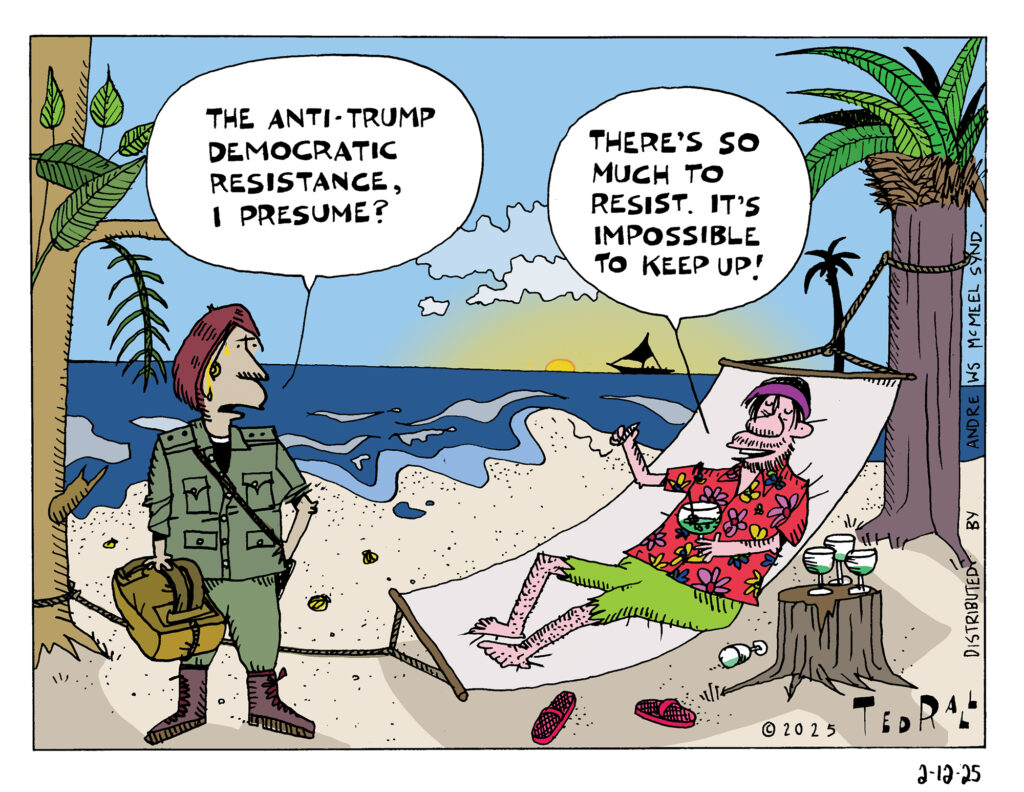
It’s Trump’s second week as president and he’s a busy boy. He’s expanding Guantánamo Concentration Camp to accommodate as many as 36,000 migrants in perpetuity, working on ways to get a third term, firing the inspectors general and running roughshod over the hapless Democrats who still seem to think they shouldn’t change a thing.

Editorial cartoonists Ted Rall (on the Left) and Scott Stantis (on the Right) could talk about all that and more. And maybe they will. But this is a Political Potpourri episode in which they’re going to roll open mic style: whatever comes to mind is what will come up.


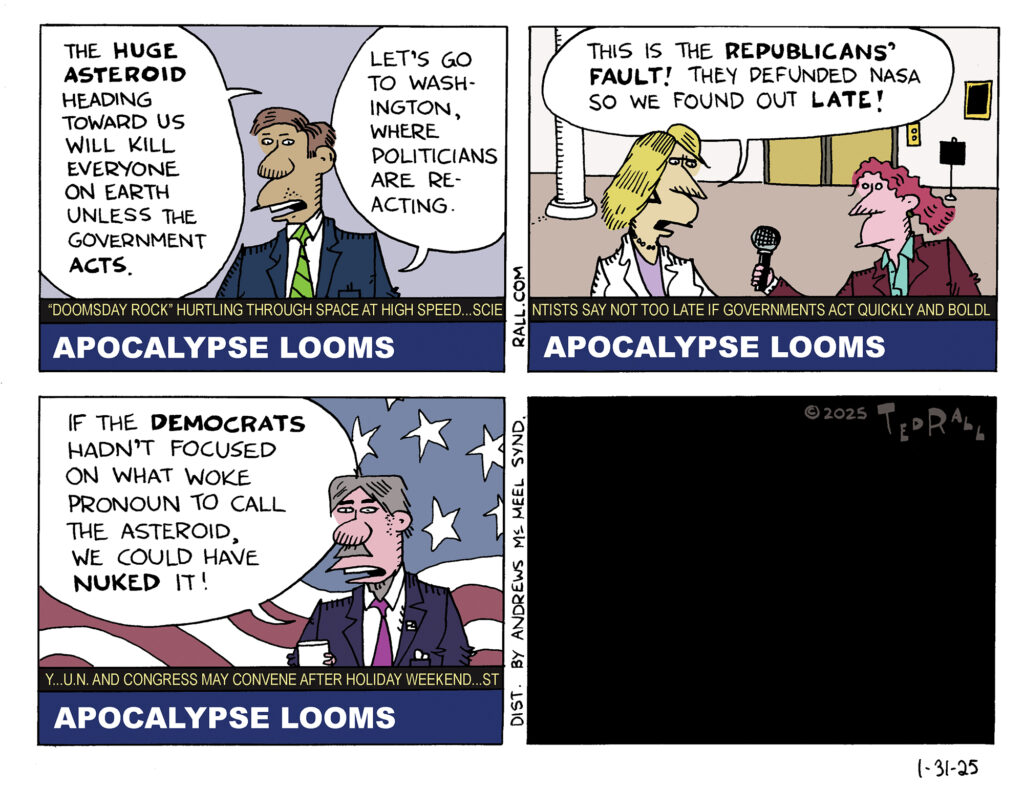
Apocalypse Looms. Who’s To Blame?

Perhaps, some day, politicians won’t waste the time they ought to be spending working to fix a problem on blaming one another for who was responsible. But that day is not today.

Democrats Want a Divorce

          When a marriage is in crisis, a point often occurs when constant bickering, arguing and fighting yields to detachment and hopelessness. The yelling stops. It’s quiet.

But it’s not peace. Exhausted, dispirited and contemptuous, one or both partners give up trying to convince the other that they’re wrong or ought to change. They accept that improvement is highly unlikely and check out emotionally.

Some psychologists call this uneasy calm a “silent divorce.” Dr. Ridha Rouabhia describes a silent divorce as “a state of being legally married but emotionally disconnected from one another, thus carrying within it a relational breakdown that is very often imperceptible but deeply damaging.” By the time you and your spouse are fighting your own personal cold war, odds of divorce are high.

Couples who fall in love and dedicate themselves to long-term committed relationships tend to fit into one of two categories. There are the soulmates who share important values and personality traits. Then there are the complementary types, a.k.a. “opposites attract,” where—hopefully—one partner’s strengths make up for the other’s weaknesses and vice versa.

Complementary couples can have successful marriages. But these relationships work only if each partner appreciates their partner’s contributions and is cognizant as well as grateful that their own failings are generously overlooked. As time builds familiarity and familiarity breeds contempt over the course of a lifetime, that can be challenging.

Years ago, I was close to a classic complementary couple. The wife, whom I met in college, was married to a man ten years older than her. A tight-cropped salt-and-brunet WASP from the Midwest, he was politically and temperamentally conservative, preppy and stuffy. A fluffy-blonde Buddhist-come-lately from the West Coast, she leaned left and was loud, bubbly and unfiltered. Everyone who met them instantly understood their mutual attraction. Wild, sexual and adventurous, my friend dragged her uptight husband out of his shell. She made his life fun and interesting. Organized and always planning for contingencies, he bailed her out and cleaned up her frequent messes. He made her feel safe. They were a cute couple.

Over the years, the mutual gratitude that drove my friends’ Lucy-and-Ricardo marriage ceded territory to sneering contempt. She got tired, and then angry, at always having to initiate sex. He grew weary of the drama from her never-ending series of crises. They fought. Then, they didn’t. They had fought to a stalemate.

Their “silent divorce” lasted a few years before giving way to the real thing.

Everyone thought it was a shame.

They needed one another.

The American political union between partisans of the two major parties is a complementary marriage. Though frequently fractious, for much of the 20th century there was a tacit understanding between Democrats and Republicans that each brought something to the union, to the country, that the other needed even if they weren’t good at verbalizing their appreciation.

Like my friend’s husband, Republicans were America’s stolid, responsible, national caretakers. Based in the countryside (and until recently in the boardroom), they were boring and hated the hippies and their rock ’n’ roll and never would have supported civil rights and other liberation movements had they not been forced upon them. But conservatives also provided and protected virtues like military strength, national pride and deficit hawkishness that, deep in their pot- and LSD-infused souls, many liberals knew were essential to the republic.

And my friend’s wild-and-loopy wife, Democrats were reckless tax-and-spenders who hung out on the coasts and in big cities and tried and failed at social engineering schemes like welfare and affirmative action. But some of those schemes, like Social Security and Medicaid, saved the country, and drove almost all the progress that improved people’s lives and thus staved off revolution. Though they didn’t like to admit it, Republicans knew in their stock-portfolios-for-hearts that liberalism saved them from their rapacious selves and forced them to admit when their wars didn’t work out.

The national marriage started to unravel under Reagan, enjoyed a rapprochement under Clinton and turned ugly under Obama. As with any failed romance, it’s hard to pinpoint a specific moment that marked the beginning of the end. I’d pick 2010, when Senate Minority Leader Mitch McConnell said that “The single most important thing we want to achieve is for President Obama to be a one-term president.” McConnell’s idea of trying to win back the White House wasn’t wild. His formulation, emboldened by the rise of the proto-MAGA Tea Party, was remarkably contemptuous of Democrats. As an opposition party, the GOP was expected to articulate its own set of policies while paying lip service to its willingness to work with the president on issues where the two parties had common ground, rather than center its messaging around pigheaded obstructionism.

            Republicans, having failed to prevent Obama’s reelection in 2012, doubled down in 2014 when McConnell pledged not only to block Democratic initiatives just because, but to threaten to shut down the federal government every time the other party tried to push through a bill.

            Now everything is going their way. White House, Congress, Supreme Court, big tech and a compliant news media—Trump and the Republicans control it all. There was scarcely an echo of the riotous protests in response to Trump’s first inaugural in 2017 in the streets of Washington for the second one last week. Democratic leaders and their allies are despondent, disorganized and silent. “Far from rising up in outrage, the opposition party’s lawmakers have taken a muted wait-and-see approach,” reports The New York Times. Liberals are actively tuning out of politics, canceling their subscriptions and turning off MSNBC, televised organ of the DNC.

            After sounding Defcon-4 at volume 11 every time Trump issued an obnoxious tweet during his first term, incessantly shrieking about the January 6th Capitol riot, unleashing ferocious partisan legal warfare against him and hysterically characterizing a Trumpian restoration as an existential threat to democracy that would bring about real and actual fascism, the post-electoral silence of the liberal lambs is deafening.

            You may feel good about all this, if you’re a Republican.

            Don’t. As the Tacitus quote currently circulating in response to Israel’s flattening of Gaza goes: “They make a desert and call it peace.” The sounds you’re not hearing—leftists marching and chanting down the block, liberals bleating in the comments section, Democratic politicians hollering about Trump’s unprecedented awfulness—are not acquiescence, much less acceptance. They are the disgust of silent divorce.

            Democratic voters (of whom I am not one, I am to their Left) have given up on the Republicans with whom they share a country. Democrats still live under the same roof as their Republican spouses—for the time being, there’s no way for them to move out—but their anger has devolved into a cold contempt from which there is rarely any way back. Those people—Republicans—can stay in their Electoral College-inflated flyover states and watch Fox and NASCAR and vote however they want, including against abortion, and we (the smart people) will keep to ourselves in our urban enclaves. They’re not worth yelling at.

            They’re not even worth talking to.

            This marriage is in trouble.

(Ted Rall (Twitter: @tedrall), the political cartoonist, columnist and graphic novelist, co-hosts the left-vs-right DMZ America podcast with fellow cartoonist Scott Stantis and The TMI Show with political analyst Manila Chan. His latest book, brand-new right now, is the graphic novel 2024: Revisited.)

DMZ America Podcast Ep 187: Interview with Cartoonist David Fitzsimmons

The DMZ America Podcast’s Ted Rall (on the Left) and Scott Stantis (on the Right) are joined by David Fitzsimmons, Cartoonist and Columnist for the Arizona Daily Star, to discuss David’s role as a Democratic activist and the future of the Democratic Party following Biden’s dropping out of the race and the defeat of Kamala Harris.


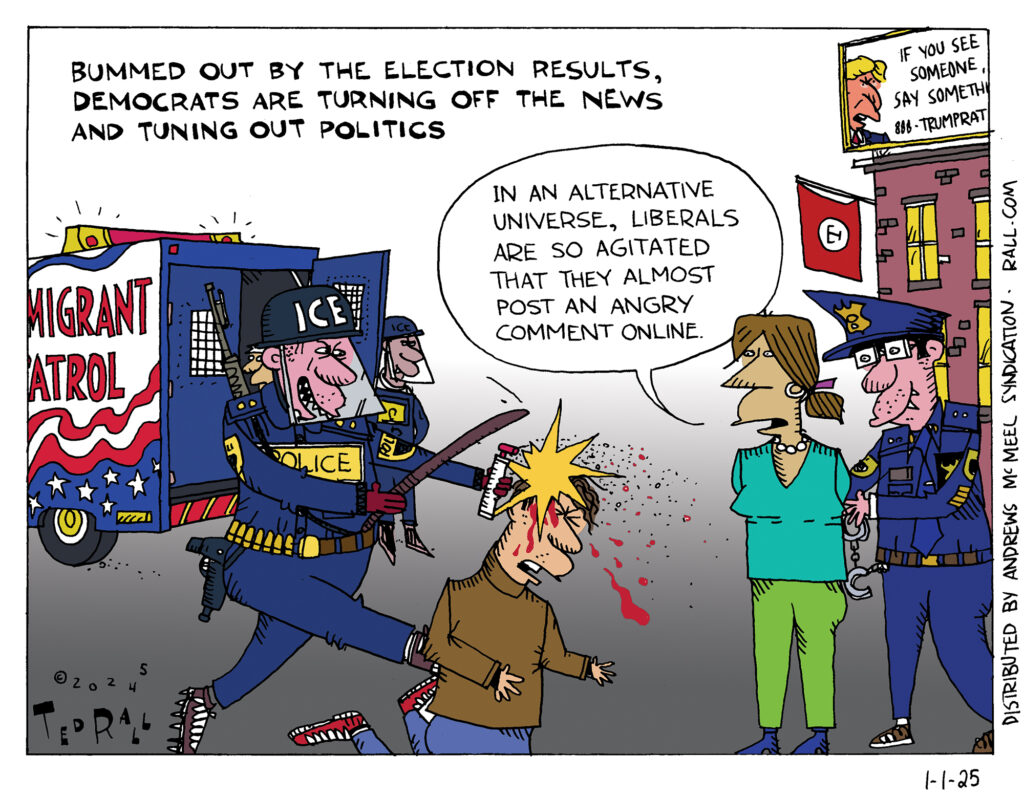
Democrats Tuning Out

Bummed out by the election results, liberals are turning off the news and tuning out politics. This will only help Trump in his mass deportations and other actions liberals claim to deplore.

Theory of the Non-Voter

           Non-voters are the biggest (potential) voting bloc in American politics. In midterm, state and local elections, more eligible voters choose not to exercise their franchise than to do so.
            Pundits and political sociologists ignore non-voters. Nobody polls them. Nobody asks them why they don’t vote. Nobody asks them what issues they care about. Nobody asks them what it would take to get them to vote, or who they would vote for if they did. Whether this lack of interest in non-voters is due to a lack of imagination or contempt based on the belief that they are lazy and apathetic, the result is that we don’t know much about the political leanings and motivations (or lack thereof) of the majority of our fellow citizens. There are tens of millions of them. They are an untapped resource and, until recently, there has been little attempt to reach out to them.

            Democratic Party strategists largely assume that there is little point dedicating precious campaign resources to an attempt to lure non-voters to the polls. From Bill Clinton in 1992 to Kamala Harris in 2024, the party has been primarily focused on trying to appeal to swing voters and moderate Republicans, even though there don’t seem to be very many of them.

            Donald Trump’s first win disproved the hypothesis that you can’t get the third or more of eligible citizens who normally sit out presidential elections to come to the polls. 15% of the people who cast a ballot in November 2016 were first-time voters, up from 9% in 2012. True, Donald Trump’s coalition included people who vote Republican no matter what as well as traditional conservatives. But the key to his takeover of the GOP was his ability to motivate people who previously weren’t even registered to vote.

            The 2016 election also highlighted the political impact of non-voting. Non-voters skewed Democratic, accounting for 55% as opposed to 41% for Republicans. Hillary Clinton lost because she wasn’t able to motivate enough of her own party’s supporters.

            The cliché of the non-voter is that they are politically disengaged. If that is true, it falls short of painting the full picture. 3.5% of those who voted for Bernie Sanders in the 2016 primaries sat out the general election; they were more than enough to cost Clinton the race. But primary voters are far more engaged than general election voters. They didn’t forget to vote for Hillary. They made an active choice to be passive because they disliked both major-party candidates.

            Non-voters were even more powerful this year. An astonishing 19 million Americans who voted for Joe Biden in 2020 considered the choice between Kamala Harris and Donald Trump and picked the couch.

She lost by 2.3 million votes.

            These 19 million people were registered to vote. We know that they know how to vote; they did it four years ago in the middle of a pandemic. And we know that they voted Democratic! More states have early voting and mail-in ballots, so it was easier to vote in 2024. Logically, a more appealing Democrat than Kamala Harris might have received their support.

            A full picture of American public opinion would include numerous thorough studies and surveys of people who sometimes vote and sit out elections at other times (this year’s Trump campaign reached out to these “irregular” and “low propensity” voters), those who never vote but are registered to vote, and those who are not registered. But the biggest factor here is obviously the defining characteristic of U.S. electoral politics: the two-party system. Democracies with two-party systems tend to have lower voter turnout than parliamentary democracies where multiple parties representing a wide range of ideological orientations are viable and active participants. The increasing percentage of Americans who self-identify as “independent” means that it is constantly less likely that a voter will agree with one of the two candidates of two polarized parties.

            In a two-party system like ours, a voter who doesn’t much care for either candidate has three choices. They can suck it up and choose “the lesser evil,” vote for a third-party candidate who almost certainly doesn’t stand a chance, or sit out the election.

A significant subset of the first category is the negative message voter, who casts a ballot for the challenger in order to indicate their displeasure with the incumbent. With only two parties to choose from, these voters flail back-and-forth. Since a vote is a vote and doesn’t come with a footnote attached to it, neither the parties nor the news media ever receives the message. As more voters realize the futility of rage and spite voting, there is a general trend toward not voting at all.

            Because they are oblivious to the left-leaning voters they are failing to motivate, Democrats have more to worry about in the short term. In the long run, however, the realization that non-voters are making an active choice not to bother with the political system is a major warning that the whole system may not be viable for much longer.

(Ted Rall (Twitter: @tedrall), the political cartoonist, columnist and graphic novelist, co-hosts the left-vs-right DMZ America podcast with fellow cartoonist Scott Stantis and The TMI Show with political analyst Manila Chan. His latest book, brand-new right now, is the graphic novel 2024: Revisited.)

Final Attraction

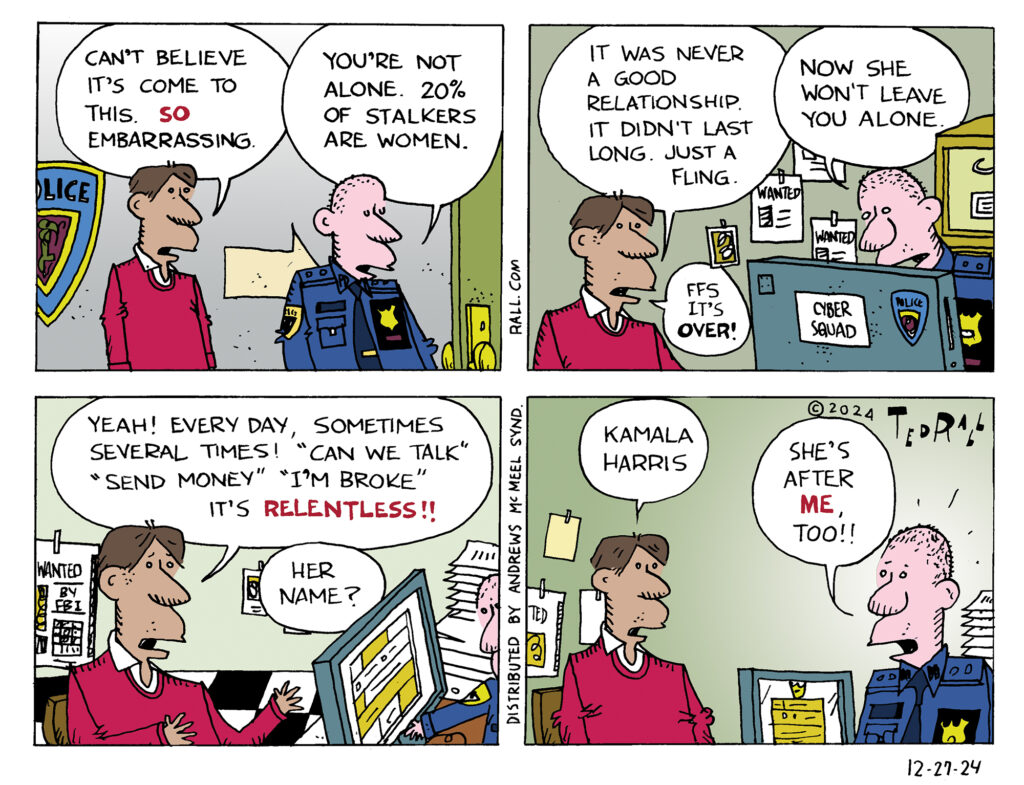
Weeks and months after she lost her presidential campaign, which ended with her millions of dollars in debt despite raising billions of dollars, vice president Kamala Harris continues to shake down Democrats for donations.

Democrats Haven’t Really Won a Presidential Campaign Since 2012

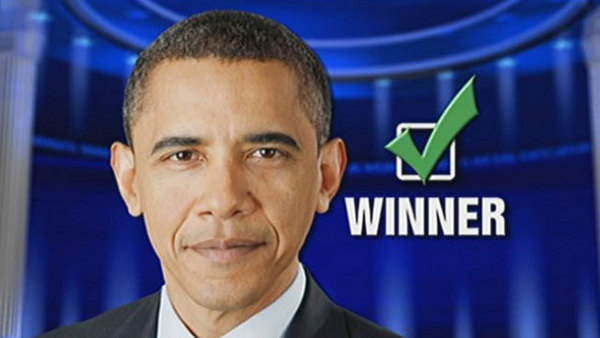
Obama Wins | UCLA Bunche Center            As Democrats survey their recent losses in the election, they should avoid drawing conclusions or floating prescriptions for fixing their party’s problems. First, they should absorb the biggest data point that is currently being ignored by both the progressive and the corporatist wings of the party: they haven’t really won a presidential election since 2012. No, 2020 doesn’t count. Not really. Read on.

Democrats don’t yet recognize it, but they have effectively messed up three consecutive elections against Donald Trump. This points less to a divided country wobbling back-and-forth between two parties than to a systemic realignment in favor of the Republicans. For Democrats, this suggests a serious set of systemic problems unlikely to be fixable by nipping and tucking messaging and candidate presentation.

            I am not an election denialist. Trump officially lost in 2020. But Biden, doddering even at the time as he campaigned from his basement, didn’t really win.

            Covid shaped that race in two significant ways. Donald Trump committed political suicide in both. Trump’s unforced errors in 2020 were so easily foreseen and so bizarre that it’s hard to imagine another candidate ever committing political malpractice to such an extreme.  Of course Democrats were able to beat him then.

            It was a weird election.

            First Trump shot himself in both feet with Operation Warp Speed, the public-private partnership launched between March and May 2020, at the start of the lockdown. Epidemiologists and ordinary citizens alike fantasized about developing a vaccine, but experts cautioned that it would take ages. “Officials like Dr. Anthony S. Fauci, the top infectious disease expert on the Trump Administration’s coronavirus task force, estimate a vaccine could arrive in at least 12 to 18 months,” the New York Times reported on April 30, 2020. “The grim truth behind this rosy forecast is that a vaccine probably won’t arrive any time soon. Clinical trials almost never succeed. We’ve never released a coronavirus vaccine for humans before. Our record for developing an entirely new vaccine is at least four years—more time than the public or the economy can tolerate social-distancing orders.”

            “Never succeed” succeeded. Relying on emergency use authorizations and conditional approvals, the first vaccines became available to the public starting December 11, 2020. By April, anyone who wanted one could get one—a mere year after Warp Speed began.

            This was a miracle. A study by the Commonwealth Fund estimated that the vaccines prevented more than 18 million hospitalizations and saved the lives of 3.2 million Americans. They saved the budget $1.15 trillion through November 2022.

            Fast action to develop vaccines, something a more conventional politician like his 2016 Democratic rival Hillary Clinton might have been hesitant to approve without additional testing prior to approval, was Trump’s greatest accomplishment during his first term. Best of all from a political standpoint, timing made it the mother of all October surprises—had Trump chosen to run with it. The president could have informed a traumatized electorate a few weeks before election day that they would be inoculated against the deadly coronavirus, not four or more years in the future, but mere weeks or months away.

            Insanely, Trump ran away from his big win. To be sure, Trump did announce that vaccines were on the way. But he did so in an uncharacteristically muted manner. His highest-profile and highest-volume pandemic messaging, influenced by his wacky supporters and political allies, many of whom subscribed to unorthodox medical views including anti-vaxxers and those who thought Covid was a hoax, deteriorated into an incoherent morass that understated the impact, including the number of deaths. “That’s all I hear about now. That’s all I hear. Turn on television—’Covid, Covid, Covid, Covid, Covid, Covid.’ A plane goes down. 500 people dead, they don’t talk about it,” Trump said at a campaign rally in North Carolina on October 24, 2020. “Covid, Covid, Covid, Covid.’ By the way, on November 4, you won’t hear about it anymore.” On October 26, he continued to downplay the scale of the pandemic as a “Fake News Media Conspiracy,” saying the U.S. had the most cases on earth only because “we TEST, TEST, TEST.”

            Thanks in large part to Trump, however, Covid vaccines were the fastest ever created. Due to internal GOP politics, however, Trump felt compelled to run away from Operation War Speed and, in doing so, threw away his best issue. An October 2020 Reuters-Ipsos poll found Trump underwater on his handling of the coronavirus crisis, with 37% approving and 59% disapproving. It was though FDR had denied having anything to do with the New Deal when he ran for reelection in 1936 and gotten dinged for making the Depression worse.

            Similarly inexplicable and tied to the vagaries of paranoid right-of-center internecine discussions, Trump repeatedly advised his supporters not to cast an early vote before election day or vote by mail, alternatives that exploded in popularity due to the pandemic lockdown, on the ground that they were rife with fraud. “MILLIONS OF MAIL-IN BALLOTS WILL BE PRINTED BY FOREIGN COUNTRIES,” Trump tweeted in June 2020. “And, you know, when they talk about Russia, China, and all these others, they will be able to do something here because paper ballots are very simple—whether they counterfeit them, forge them, do whatever you want. It’s a very serious problem,” he said in September 2020.      

            46% of ballots were cast via early or mail-in voting in 2020, double the result for four years earlier. But only 62% of Trump voters voted early or by mail, compared to 82% for Biden.

            It was an incredibly stupid mistake. It wasn’t one that the Trump campaign repeated this year.  

            Democrats convinced themselves that their 2016 loss was a fluke attributable to sexism, Russian interference and the novelty of Donald Trump, celebrity and TV star, as their opponent. They took comfort in the fact that Trump had been defeated in 2020 and therefore possibly would be again.

What they failed to grasp what is that the real anomaly here was 2020. Had Trump exploited the triumph of Operation Warp Speed and encouraged his supporters to cast early and mail-in ballots—any vote, any time, is a good vote—he would almost certainly have beat Biden. They foolishly assumed that Trump learned nothing from his previous campaign, that he would not correct his mistakes.

            For the first time since 1892, we now have a presidential candidate who ran in three consecutive elections, largely on the same issues, the border and the economy. Trump won twice and lost once, but that once was due to his suicidal moves. Whatever Democrats decide to do to try to become stronger and more viable going forward, they need to understand that they haven’t had a strong enough candidate to beat a real Republican running a normal campaign in a conventional presidential campaign since Barack Obama defeated Mitt Romney.

(Ted Rall (Twitter: @tedrall), the political cartoonist, columnist and graphic novelist, co-hosts the left-vs-right DMZ America podcast with fellow cartoonist Scott Stantis and The TMI Show with political analyst Manila Chan. His latest book, brand-new right now, is the graphic novel 2024: Revisited.)


keyboard_arrow_up
css.php