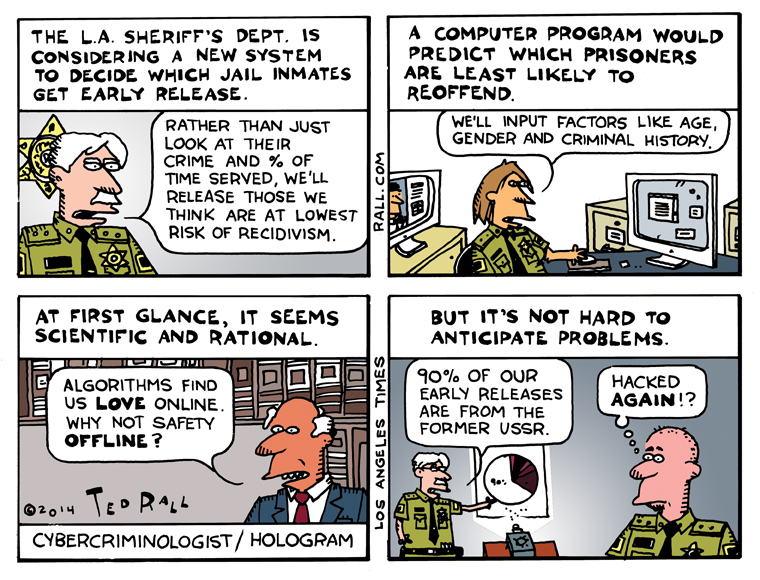
LOS ANGELES TIMES CARTOON: RoboSheriff

Minority Report


Computer algorithms drive online dating sites that promise to hook you up with a compatible mate. They help retailers suggest that, because you liked this book or that movie, you’ll probably be into this music. So it was probably inevitable that programs based on predictive algorithms would be sold to law enforcement agencies on the pitch that they’ll make society safe.

The LAPD feeds crime data into PredPol, which then spits out a report predicting — reportedly with impressive accuracy — where “property crimes specifically, burglaries and car break-ins and thefts are statistically more likely to happen.” The idea is, if cops spend more time in these high-crime spots, they can stop crime before it happens.

Chicago police used predictive algorithms designed by an Illinois Institute of Technology engineer to create a 400-suspect “heat list” of “people in the city of Chicago supposedly most likely to be involved in violent crime.” Surprisingly, of these Chicagoans — who receive personal visits from high-ranking cops telling them that they’re being watched — have never committed a violent crime themselves. But their friends have, and that can be enough.

In other words, today’s not-so-bad guys may be tomorrow’s worst guys ever.

But math can also be used to guess which among yesterday’s bad guys are least likely to reoffend. Never mind what they did in the past. What will they do from now on? California prison officials, under constant pressure to reduce overcrowding, want to limit early releases to the inmates most likely to walk the straight and narrow.

Toward that end, Times’ Abby Sewell and Jack Leonard report that the L.A. Sheriff’s Department is considering changing its current evaluation system for early releases of inmates to one based on algorithms:

Supporters argue the change would help select inmates for early release who are less likely to commit new crimes. But it might also raise some eyebrows. An older offender convicted of a single serious crime, such as child molestation, might be labeled lower-risk than a younger inmate with numerous property and drug convictions.

The Sheriff’s Department is planning to present a proposal for a “risk-based” release system to the Board of Supervisors.

“That’s the smart way to do it,” interim Sheriff John L. Scott said. “I think the percentage [system, which currently determines when inmates get released by looking at the seriousness of their most recent offense and the percentage of their sentence they have already served] leaves a lot to be desired.”

Washington state uses a similar system, which has a 70% accuracy rate. “A follow-up study…found that about 47% of inmates in the highest-risk group returned to prison within three years, while 10% of those labeled low-risk did.”
No one knows which ex-cons will reoffend — sometimes not even the recidivist himself or herself. No matter how we decide which prisoners walk free before their end of their sentences, whether it’s a judgment call rendered by corrections officials generated by algorithms, it comes down to human beings guessing what other human beings do. Behind every high-tech solution, after all, are programmers and analysts who are all too human. Even if that 70% accuracy rate improves, some prisoners who have been rehabilitated and ought to have been released will languish behind bars while others, dangerous despite best guesses, will go out to kill, maim and rob.

If the Sheriff’s Department moves forward with predictive algorithmic analysis, they’ll be exchanging one set of problems for another.

Technology is morally neutral. It’s what we do with it that makes a difference.

That, and how many Russian hackers manage to game the system.

(Ted Rall, cartoonist for The Times, is also a nationally syndicated opinion columnist and author. His new book is Silk Road to Ruin: Why Central Asia is the New Middle East.)
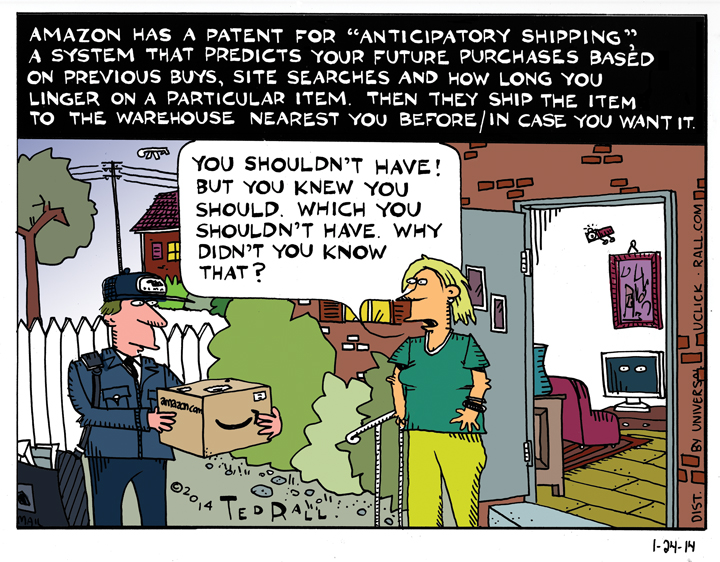
You Shouldn’t Have

Amazon has acquired a patent for “anticipatory shipping,” a system that predicts your future purchases based on previous buys, site searches, and how long you linger on a particular item. Then they ship the item to a warehouse nearest you before/in case you order it. In the future, they may even load it on a truck before you click “buy.”

SYNDICATED COLUMN: Why Don’t Kids Want to Study Engineering? Because Engineering Friggin’ Sucks.

http://mcstemcareers.pbworks.com/f/1300060168/STEM%20Logo.png

Sexing Up Science Won’t Solve a Dearth of STEM Majors

According to a survey, nearly 90% of 16- and 17-year-olds have no interest in a STEM (science/technology/engineering/math) career.

The climate is crashing, the NSA is tracking our porn, and the 99% haven’t gotten a raise in decades, but the party organ of America’s ruling class is truly, awfully worried about our imminent STEMlessness. A lot.

“The number of students who want to pursue engineering or computer science jobs is actually falling, precipitously, at just the moment when the need for those workers is soaring,” writes The Editorial Board of The New York Times, which is composed of editors no one has heard of, yet whose opinions we are all supposed to care about. “Within five years, there will be 2.4 million STEM job openings,” write The Editors.

Who, in the future, will program the great fleets of killer drones? Who will pilot them? It would suck to lose that business to the Chinese.

Whenever the question of Why No One Wants to Study Engineering comes up, the media always comes back with the same answer: conning convincing kids that STEM stuff isn’t boring.

“Most schools continue to teach math and science in an off-putting way that appeals only to the most fervent students,” the Times editors complain. Sex up the sciences — that’s the ticket!

Texas Instruments (they’re still around?) has hired neuroscientist/”Big Bang Theory” actress Mayim Bialik as a “STEM education brand ambassador” to sing the praises of partial differential equations using framing that the Kids of Today/Worker Bees of Tomorrow can relate to. “Who doesn’t know something about zombies or superheroes?” asks Bialik. “These cultural archetypes can do more than just entertain. Zombies, it turns out, can teach real science and mathematical concepts like exponential growth curves and the intricacies of human anatomy and anatomical degradation. Superheroes can prompt a variety of questions that draw on physics, such as: How does one actually travel faster than the speed of light?”

Is it me, or does this seem a little…forced?

Hey, I’m as geeky as they come. When an engineer who designed famous roller coasters gave a talk at my Ohio high school, I was enthralled. (My classmates, not so much.) But I still didn’t want to study engineering — and it wasn’t because science is boring.

I loved math, chemistry and physics in high school. I studied years ahead. I got perfect grades and tested so well that Columbia’s School of Engineering offered me a full scholarship and a well-paid teachers assistant job.

Still, I didn’t want to go. Not because math and science bored me — to the contrary. I dreaded it because I knew engineering school would probably be a sucky experience and that a career in the sciences would be depressing.

Not that my parents cared what I wanted. They bullied me into going anyway because (a) Columbia gave me the most financial aid of the schools I applied to, and (b) something “practical” like engineering guarantees a steady well-paid job after graduation. (Ha.) So off I went.

Guess what? Engineering school was a sucky experience.

My experience at Columbia highlights reasons — aside from the alleged tedium of math and science — that most young people aren’t interested in the STEM professions:

  • When you study math and science, your classmates are boring. At Columbia the engineering majors were politically disengaged, careerist, nose-to-the-grindstone types you’d never find working over the world’s problems at an overnight BS session — much less checking out a punk concert. They were academically smart and deadly dull. After graduation, people similar in personality to your fellow students become your colleagues. Engineering isn’t boring. Engineers are. Working with boring engineers is a bummer.
  • STEM majors get much lower grades than liberal arts majors. Tougher grading causes lower GPAs, so dropout and expulsion rates are also much higher: three out of four liberal art majors get a degree, only one out of four STEM majors. During freshman orientation, Columbia’s dean of students told us that 75% of us would drop out or get expelled. I wondered why I was there. (After three years, I was expelled with a 2.4 GPA. Which I worked hard for.) Why take out massive student loans for a one-in-four chance at a degree? Though some studies deny the difference, 60% of freshman engineering students are gone, dropped out or transferred to the liberal arts, by the end of their freshman year. These kids aren’t stupid or lazy — they were smart and studious enough to get admitted in the first place.
  • Low social status. Guys don’t make passes at girls who wear safety glasses; girls suddenly remember something they forgot in the ladies room when you tell them you’re an electrical engineer. Because (see above) engineers are boring. Also: in America’s anti-intellectual culture, it’s not cool or hip or prestigious to be a scientist.
  • STEM employment is sporadic (they say “cyclical”). What’s the point of playing it safe when it’s not, well, safe? The STEM major you pick as a freshman may easily be obsolete by the time you hit the senior year job fair. Even if not, it’s extremely unlikely your chosen scientific field will provide steady employment for years to come. Currently, as the Powers That Be say they need STEMmers, unemployment is sky high among STEM professionals. As of 2009, nearly 9% of electrical engineers were jobless. Oh, and it turns out that STEM majors actually don’t earn more than their liberal arts counterparts.

“Indeed, science and engineering careers in the U.S. appear to be relatively unattractive” compared with other career paths, Michael Teitelbaum of the Alfred P. Sloan Foundation in New York, which funds basic scientific, economic and civic research, testified to Congress in 2007.

High-school students know what’s up. They hear from older siblings how hard it is to graduate from engineering school. They watch their friends’ parents lose their jobs from supposedly “safe” STEM outfits. They’re not going to change their minds until reality improves.

Some fixes:

  • De-ghettoize STEM majors within colleges and universities. Require STEM majors to take lots of liberal arts classes — it’s not like a math major shouldn’t study Spanish literature — and require liberal arts majors to take more math and science. Mix up the student bodies. Think about someone like Steve Jobs, whose design sense came from his love of art and calligraphy. The divide between English and physics majors is artificial and outdated. Crosspollinate.
  • Put an end to the grading disparity between STEM majors and liberal arts. It’s unfair and it’s stupid. At Harvard, the average grade is an “A-“, and why not? The average Harvard student is intelligent and hardworking — and so is the average Columbia engineering student. Harvard’s softer grading regime hasn’t cost the school any reputation points.
  • If America wants STEM majors from America, it ought to stop importing them from overseas. “When the companies say they can’t hire anyone [for STEM jobs], they mean that they can’t hire anyone at the wage they want to pay,” Jennifer Hunt, a Rutgers University labor economist, said in 2012. So they outsource STEM jobs overseas and game the work visa program to import cheaper foreign scientists. “Tech companies that import temporary workers, mainly recent graduates from India, commonly discard more expensive, experienced employees in their late 30s or early 40s, often forcing them, as Ron Hira and other labor-force researchers note, to train their replacements as they exit,” reports the Columbia Journalism Review. Until STEM unemployment among Americans is 0%, Congress ought to get rid of the visa program.
  • Even cultural perceptions can be changed. If President Obama and other members of the political class are serious about promoting STEM careers, they could start featuring our best mathematicians and chemists at events like the State of the Union Address rather than the usual parade of military veterans. The Soviet Union pimped its scientific minds big time; kids who admired these intellectual heroes followed in their footsteps.

Math and science aren’t boring. But asking people to dedicate their lives to careers that won’t pay off is dumb.

(Support independent journalism and political commentary. Subscribe to Ted Rall at Beacon.)

COPYRIGHT 2013 TED RALL

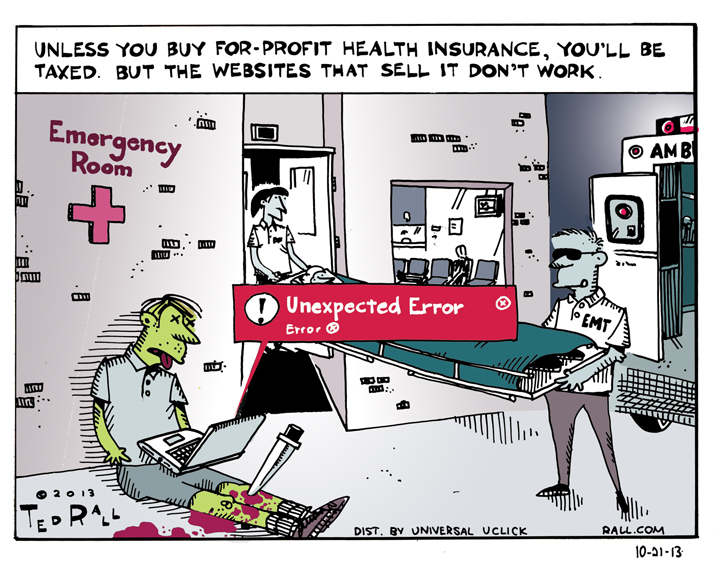
Unexpected Error

You’ll be taxed unless you buy for-profit insurance under Obamacare. But the websites you’re supposed to use to sign up don’t work. They crash. You can’t check if your local hospital or doctor participates in a given plan. You can’t find out if you’ll get a subsidy.

Get Ready for ObamaCare!

On October 1, 2013, Americans are supposed to start shopping for insurance under new Healthcare Insurance Marketplaces established under the Affordable Care Act. But there has been no attempt by the government to explain what people should do. And the system is buggy and complicated. Here’s an “easy” guide to make it simple for you.

Of course, in case it isn’t obvious, the crappy graphics and excessive gradients and tiny fonts are intentional and an attempt to satirize the complexity and the inability of the government to make things simple and understandable.

Believe it or not, one entire paragraph is word for word taken from an official government press release about this. See if you can guess which one it is.

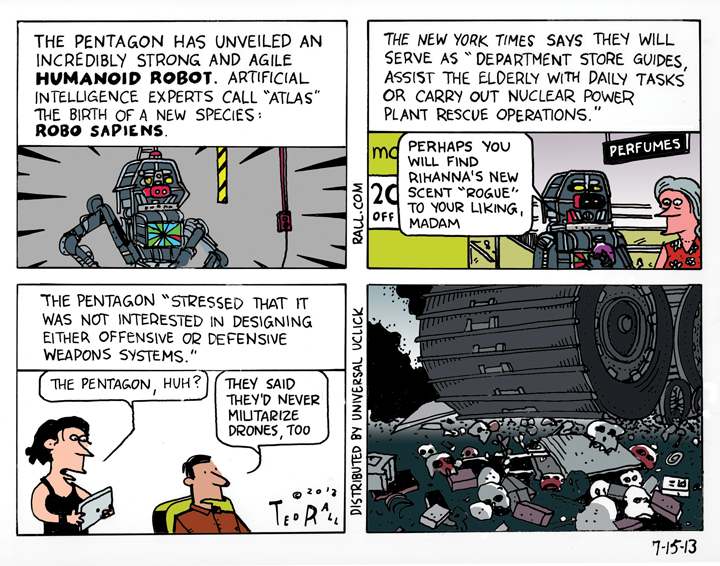
Robo Sapiens

The Pentagon has unveiled an incredibly strong and agile humanoid robot. But don’t worry, it claims that this new “robo sapiens” is purely to help old ladies find their way through Nordstrom.

The War on TVism

The number of Americans who die in terrorist attacks is comparable to the number crushed to death by their televisions. So why are we building a vast surveillance state and conducting a violent drone war to prevent such a trivial threat?

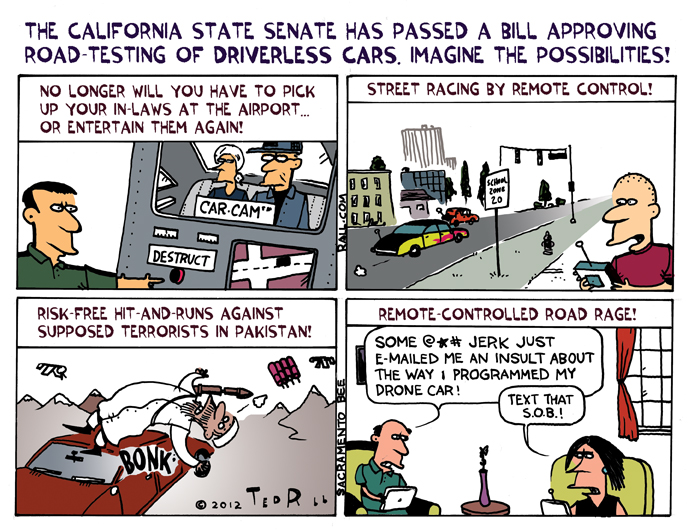
Drone Spam

U.S. researchers took up the Department of Homeland Security on its $1000 dare to try to hack into a military drone plane–€”and succeeded. What happens if Russian hackers get into one?

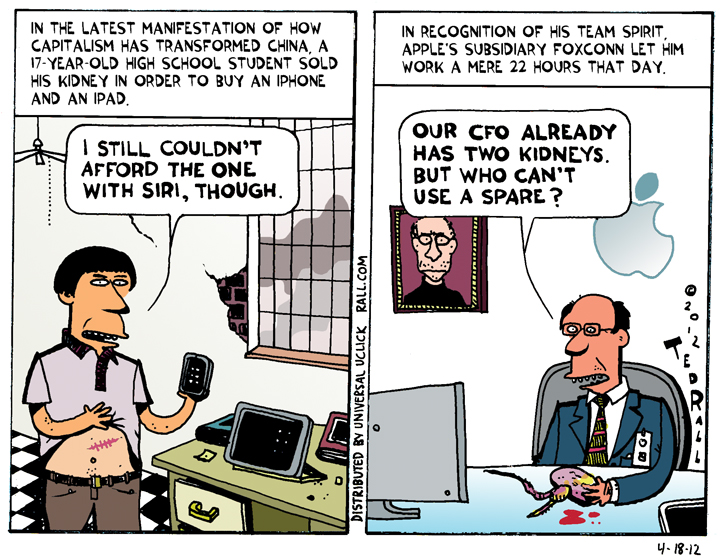
Capitalism Comes to China

In the latest manifestation of how consumer capitalism has transformed former Communist China, a 17-year-old high school student recently sold his kidney in order to buy an iPhone and an iPad.

keyboard_arrow_up
css.php