
I think this lady deserves a hearing here at the Rallblog. Because it’s where we’re at right now. She’s reacting to Obama’s “Syria” speech.
Susan
http://www.youtube.com/watch?v=XunOXRiOv0E
I think this lady deserves a hearing here at the Rallblog. Because it’s where we’re at right now. She’s reacting to Obama’s “Syria” speech.
Susan
http://www.youtube.com/watch?v=XunOXRiOv0E
Susan here. Rush Limbaugh has recently come out as against war on Syria, stating that the “damning” chemical weapons incident was staged by the so-called “rebels”. This is true, and I hope radical truth-telling on Rush’s part becomes a pattern in the future.
I’m not holding my breath, though.
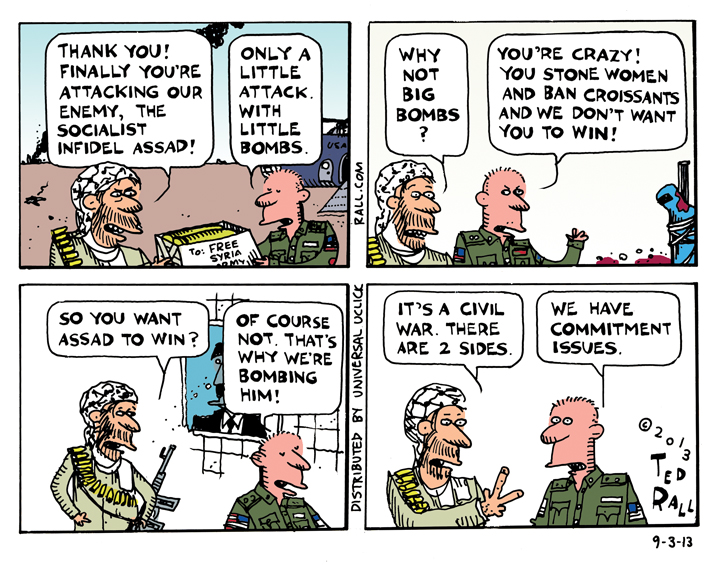
The Obama Administration prepares to launch a military strike against the government of Syrian President Assad, but openly says it does not want the rebels in the civil war there to defeat him.
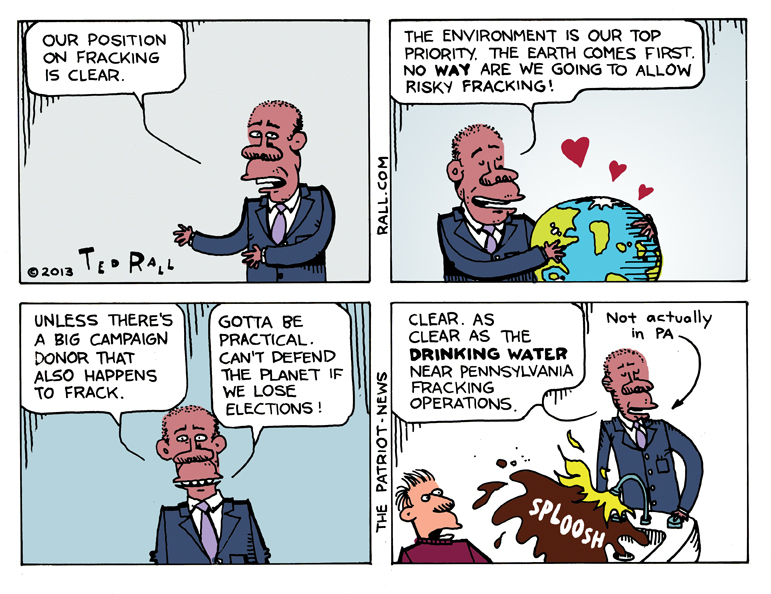
This cartoon is for The Patriot-News in Harrisburg, Pennsylvania.
The Democratic Party can’t decide what it cares about most: its liberal base, which cares about the environment, or its campaign coffers, which receive major donations by energy companies.
Lightening-Quick Obama Makes Bush’s “Rush to War” Look Slow and Methodical
Ten years ago, George W. Bush and his henchmen were beginning their war against Iraq. They wanted to invade hours after 9/11. But conning Congress and the public into invading a country that posed no threat to us delayed the invasion until March 2003. This week, as the media celebrates the 50th anniversary of the March on Washington and Martin Luther King’s iconic speech, it is shock- and awe-inspiring to see how far America has come. Where it took a white president a year and a half to pour on enough lies of omission, contextual lapses and leaps of logic to gin up a stupid, illegal war in the Middle East, our black president did it in a week.
Here we go again. A Baathist autocrat is in American crosshairs. The justification: WMDs. Also, he “kills his own people.” Which we haven’t cared about before. But: WMDs.
Ten years ago, the Baathist tyrant of Iraq denied the WMD accusations and invited UN weapons inspectors to verify his claim. Which they did. Because he was telling the truth. But the Bushies didn’t want to wait. No time! Had to invade right away!
And: again. “At this juncture, the belated decision by the regime to grant access to the UN team is too late to be credible,” an Obama official said five days after Syrian troops allegedly fired poison gas into a neighborhood on the outskirts of Damascus, killing over 1000 people.
“Too late”? Really? Assad’s government OKed the inspection less than 48 hours after the UN asked. On a weekend. I have editors who don’t get back to me that quickly. Doesn’t seem like a slow response from a government that doesn’t have diplomatic relations with the U.S. Also, they’re kinda busy fighting a civil war.
Now is a good time to think about some things the American mainstream media is omitting from their coverage — concerns strikingly similar to issues that never got discussed back in 2002 and 2003.
1. “Chemical weapons were used in Syria,” Secretary of State John Kerry says. Probably. But by whom? Maybe the Syrian army, maybe the rebels. Experts tell NPR: “The Free Syrian Army has the experience and perhaps even the launching systems to perpetrate such an attack.” Maybe we should ease off on the cruise missiles before we know which side is guilty.
2. Assuming the attack was launched by the Syrian army, who gave the order to fire? Maybe it’s Assad or his top generals. Assad denies this, calling the West’s accusations “nonsense” and “an insult to common sense.” Which, when you think about it, is true. As Barbara Walters and others who have met the Syrian dictator have found, Assad is not an idiot or a madman. He is a well-educated, intelligent man Why would he brush off Obama’s “red line” about the use of chemical weapons last year? His nation borders Iraq, so it’s not like he needs reminders of what happens when you attract unwanted attention from the U.S. Why would Assad take that chance? His forces are doing well. If the attack came from Assad’s forces, maybe it originated on the initiative of a lower-level officer. Should the U.S. go to war over the possible actions of a mid-ranked army officer who went rogue?
3. “The options that we are considering are not about regime change,” says the White House PR flack. So why is Obama “days away” from a military strike? To “send a message,” in Beltway parlance. But the air war that the attack on Syria is reportedly being modeled after, Clinton’s campaign against Serbia during the 1990s, caused the collapse of the Serbian government. Regional players think, and some hope, that degrading Assad’s military infrastructure could turn the war in favor of the Syrian rebels. If toppling Assad isn’t Obama’s goal, why chance it?
4. When you bomb one side in a civil war — a side that, by the way, might be innocent of the chemical attack — you help their enemies. Assad is bad, but as we saw in post-Saddam Iraq, what follows a dictator can be worse. Syria’s rebel forces include radical Islamists who aren’t very nice guys. They’ve installed Taliban-style Sharia law in the areas they control, issuing bizarre edicts (they’ve outlawed croissants) and carrying out floggings and executions, including the recent whipping and fatal shooting of a 14-year-old boy for making an offhand remark about Mohammed. Obama is already sending them arms and cash. Should we fight their war for them too?
5. Why are chemical weapons considered especially bad? Because the U.S. has moved on to other, more advanced ways to kill people. And because we claim to be exceptional. Paul Waldman of The American Prospect notes: “We want to define our means of warfare as ordinary and any other means as outside the bounds of humane behavior, less for practical advantage than to convince ourselves that our actions are moral and justified.” And, as Dominic Tierney argued in The Atlantic, “Powerful countries like the United States cultivate a taboo against using WMD partly because they have a vast advantage in conventional arms.” If 100,000 people have died in Syria during the last two years, why are these 1000 deaths different?
6. White phosphorus is a chemical weapon that kills people with slow, agonizing efficiency, melting their bodies down to their bones. The U.S. dropped white phosphorus in Iraq, notably in the battle of Fallujah. The U.S. uses depleted uranium bombs in Afghanistan. Those are basically chemical weapons. The U.S. uses non-chemical weapons that shock the world’s conscience, such as cluster bombs that leave brightly colored canisters designed to attract playful children. Assuming the Assad regime is guilty as charged of the horrors in Damascus, why does the U.S. have the moral standing to act as jury and executioner?
7. Why us? Assuming that military action is appropriate in Syria, why is the United States constantly arguing that we should carry it out? Why not France, which has a colonial history there? Or Turkey, which is right next door? Or, for that matter, Papua New Guinea? Why is it always us?
Because our political culture has succumbed to militarism. Which has made us so nuts that we’ve gone from zero to war in a week. Which brings up a quote from the “forgotten MLK,” from 1967: “I knew that I could never again raise my voice against the violence of the oppressed in the ghettos without having first spoken clearly to the greatest purveyor of violence in the world today — my own government.”
Some things never change.
(Ted Rall’s website is tedrall.com. Go there to join the Ted Rall Subscription Service and receive all of Ted’s cartoons and columns by email.)
COPYRIGHT 2013 TED RALL
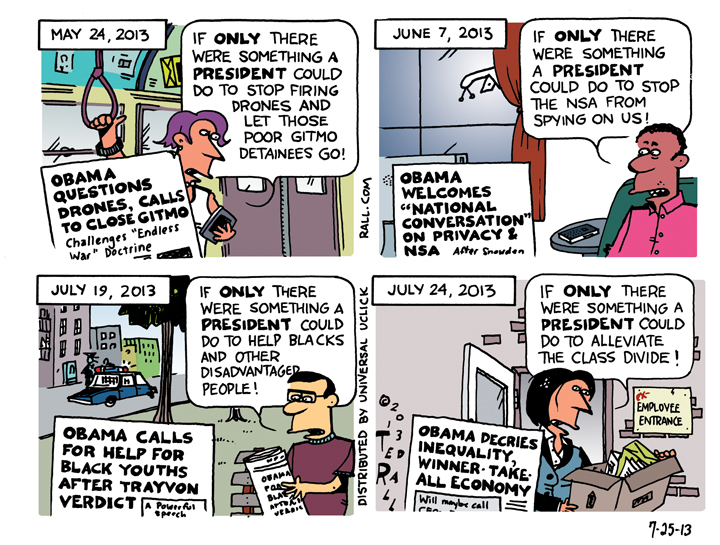
Why does Obama make speech after speech calling for change but not proposing any policy changes? Because there’s nothing the President of the United States can do to change anything.
Egypt Offers Lessons for America’s Left and Right
The U.S.-backed military coup that ousted Egyptian president Mohamed Morsi reconfirms two historical lessons that Americans repeatedly refuse to accept.
The first is for American activists, the idealistic progressives working to make the world a fairer and more decent place. Once again in Egypt, we are seeing how you can’t make a revolution without revolutionizing society – which requires the complete, violent overthrow of the ruling class. The second lesson is for elite policymakers in Washington and other Western capitals, but they won’t learn it until the inevitable blowback from their incessant manipulation and backroom schemes prompts another September 11 — or worse.
First, the takeaway for leftists.
Western critics, most of them unabashedly pro-coup, blame the Muslim Brotherhood for its own overthrow. They weren’t inclusive enough, they presided over a lousy economy, after decades of exile they just weren’t ready to govern. For the sake of argument, let’s concede all that.
No matter where you stand on Morsi, it is undeniable that his nascent presidency never stood a chance. The 2011 “revolution” that began and ended in Tahrir Square, which defined the Arab Spring and inspired the Occupy Wall Street movement, toppled an aging U.S.-backed dictator, Hosni Mubarak. But Mubarak’s regime mostly remained in place. Mubarak’s old judiciary blocked Morsi and his party, a political wing of the Muslim Brotherhood, at every turn. The other major holdover, the military and security forces, orchestrated his political demise, culminating in last week’s coup. Now there is a strong chance that Egypt is about to disintegrate into a civil conflict whose scale of violence might eclipse the mayhem in Syria.
Western analysts, liberals and even leftists who ought to know better have so cheapened the word “revolution,” attaching it to developments that, though notable, are nothing of the kind: independence struggles, civil rights movements, and most recently events like the Arab Spring, which enjoyed support by Western media and governments precisely because they were not violent, or at least not very violent, and thus not revolutionary — and therefore not a threat to the power of elites in charge of the current system. Although there may be strains of continuity in government and culture before and after a true revolution, such as the maintenance of some ministries and place names and so on, real revolution is characterized first and foremost by the replacement of one set of ruling elites — economic, cultural and political — over another. Revolution is also indicated by a vast set of radical transformations in the way that ordinary people live, such as the legalization of divorce, the abolition of the Catholic Church, and the establishment of the metric system after the French Revolution.
Though important and meaningful, what happened at Tahrir Square in 2011 didn’t come close to qualifying as a bona fide revolution. The rich remained rich, the poor remained poor, and though a few officials here and there lost their jobs, the ruling class as a whole retained their prerogatives. Meanwhile, life on the street remained miserable — and in exactly the same way as before.
Similarly, the 2013 coup d’état — weasel words to the contrary, if language has any meaning whatsoever, it is always a military coup when the military deposes a democratically elected ruler — isn’t a revolution either. Even if it was demonstrably true that, as General Abdel Fattah al-Sisi claimed and many protesters agree, that “it is not the army who took over, it is the army who acted on behalf of the people,” what we have here is nothing more than a personnel change. The system remains intact.
At the height of the Occupy movement during the fall of 2011, many knee-jerk pacifists, besotted with the post-1960s religion of militant nonviolence (in spite of its repeatedly proven ineffectiveness), agreed that radical transformation — revolution — was necessary in the United States. Yet these liberals also argued that (even though there was no historical precedent) the triumph of the mass of ordinary American workers over the corrupt bankers and their pet politicians could result from purely nonviolent protest.
They have only to look at Egypt to see why they are wrong. The Arab Spring was a huge experiment in the efficacy of nonviolence to affect political change. No country has seen a true revolution since the events of 2011. There were, however, changes — and these were most dramatic in the nations that saw the most violence, such as Libya.
Unless you dislodge the ruling elites, who have everything to gain from continuity and everything to lose from reform, your wannabe revolution doesn’t stand a chance of getting off the ground. The privileged classes won’t relinquish their privileges, power or wealth voluntarily. They will use their control over the police and the military (and, as we have recently learned, their access to the intimate details of our daily lives) in order to crush any meaningful opposition. They are violent. Their system is violence. Defeating them requires greater violence. Nothing less results in revolution.
Egypt is about to teach America’s political class yet another lesson about blowback, the tendency of meddling in the internal politics of foreign countries to result in anti-Americanism, which manifests itself in the form of terrorism.
After 9/11 you’d think that the U.S. would tread lightly in the Muslim world. This would go double in Egypt, where America’s pet dictator Hosni Mubarak ruled for 29 years, only to go down in flames despite being propped up by billions of dollars in U.S. foreign aid. In the end, like a bored and easily distracted infant, the State Department green-lit Mubarak’s removal. Now, two years later, they’re at it again, brazenly orchestrating and signing off on an old-fashioned military coup to remove the first democratically elected leader of the spiritual center of the Arab world — who just happens to be an Islamist.
The behind-the-scenes machinations of the White House are sordidly reminiscent of CIA-backed coups in Latin America in the 1960s.
“As President Mohamed Morsi huddled in his guard’s quarters during his last hours as Egypt’s first elected leader, he received a call from an Arab foreign minister with a final offer to end a standoff with the country’s top generals, senior advisers with the president said,” reported The New York Times over the weekend. “The foreign minister said he was acting as an emissary of Washington, the advisers said, and he asked if Mr. Morsi would accept the appointment of a new prime minister and cabinet, one that would take over all legislative powers and replace his chosen provincial governors.”
Over my dead body, Morsi replied.
This was conveyed to Anne Patterson, Obama’s ambassador to Egypt, and Susan Rice, his national security advisor. Rice told Morsi’s advisor she had green-lit a coup. “‘Mother just told us that we will stop playing in one hour,’ an aide texted an associate, playing on a sarcastic Egyptian expression for the country’s Western patron, ‘Mother America,'” the Times reported.
What could go wrong?
(Ted Rall’s website is tedrall.com. His book “After We Kill You, We Will Welcome You Back As Honored Guests: Unembedded in Afghanistan” will be released in 2014 by Farrar, Straus & Giroux.)
COPYRIGHT 2013 TED RALL
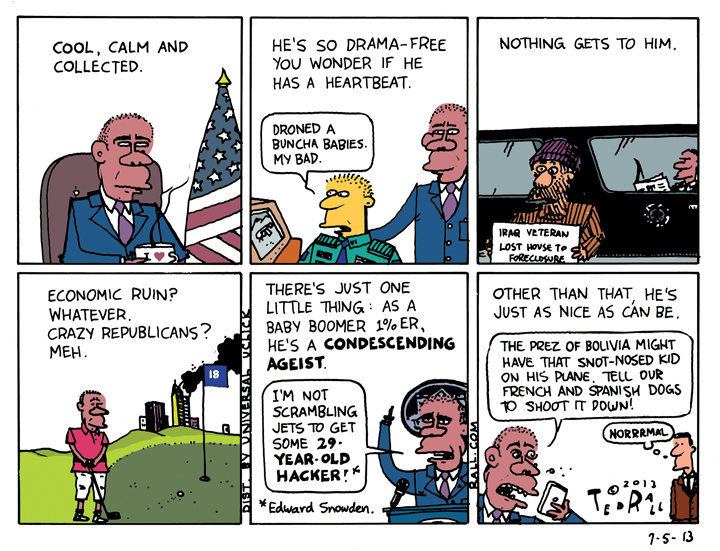
Obama is cool, calm and collected – but he has an Achilles’ Heel: contempt for young people, as demonstrated by his condescending comment describing NSA leaker Edward Snowden as “a 29-year-old hacker.”
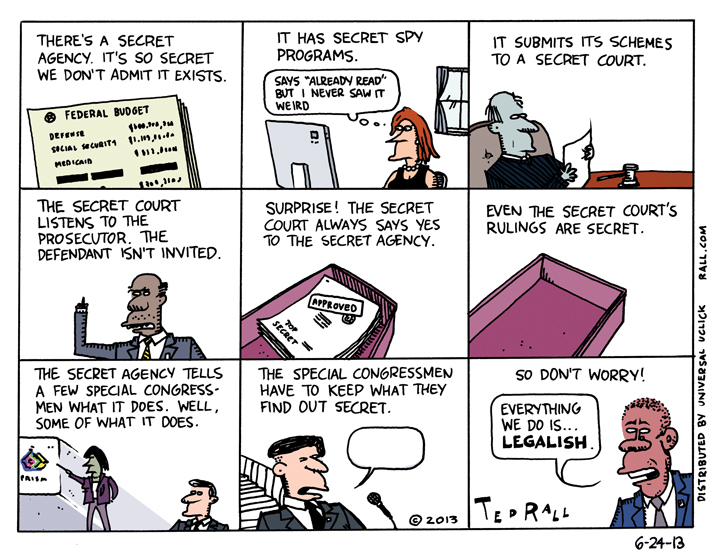
President Obama says the NSA’s surveillance programs against American citizens are “transparent.” Indeed, there is a legal veneer â memos that validate them, secret courts that supervise them, a few Congressmen who are briefed â but true legality cannot be the result of secrecy. Welcome to the Age of Legalish.
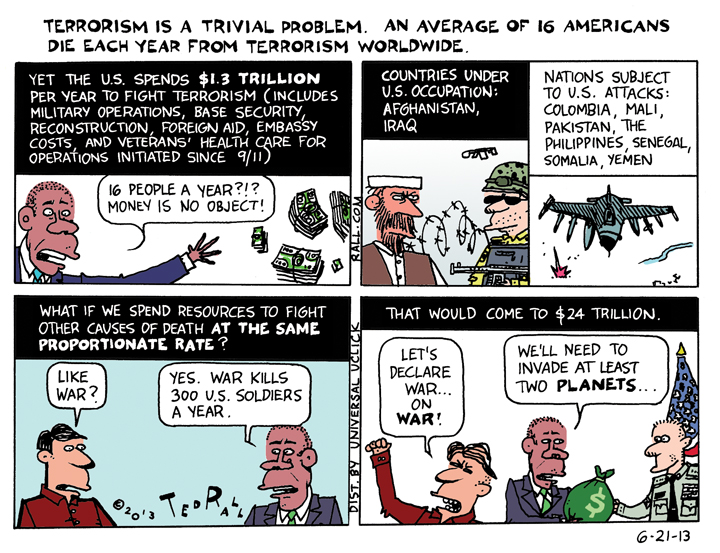
What if we devoted a proportional number of financial and other resources to threats other than terrorism?
NOTE: My apologies to people who commented on this cartoon post. Due to a glitch in WordPress, I was forced to delete this post and put it back up. Regrettably, in the process, your comments were lost. I always make every effort to avoid this sort of thing, and I am sorry.
