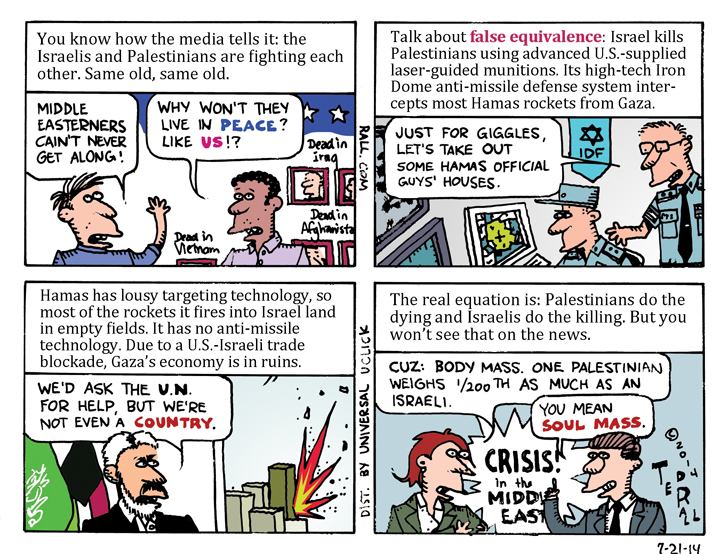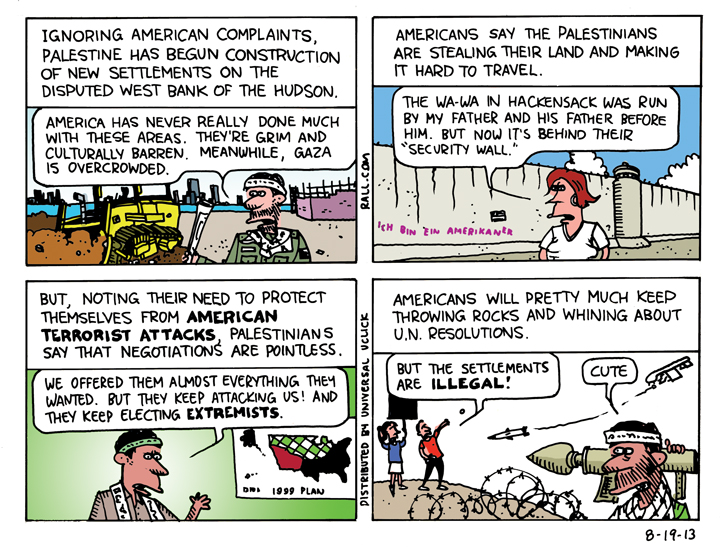
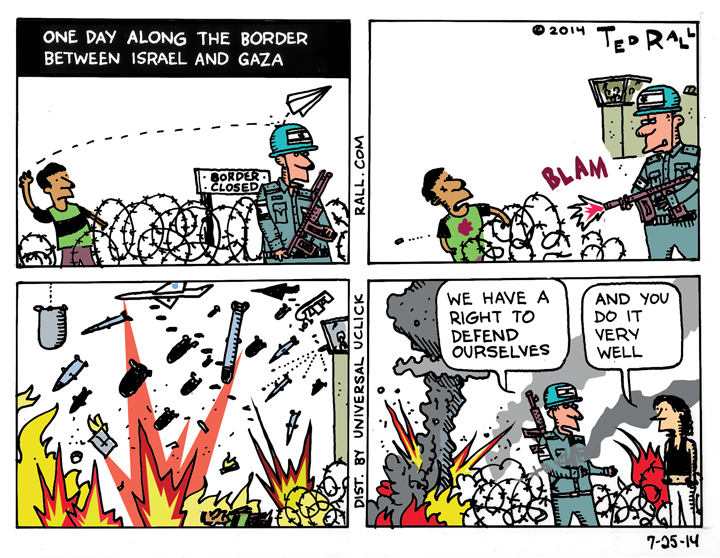
As in previous conflicts, Israel claims its right to defend itself in its current conflict with Hamas in the Gaza Strip. But its response, killing hundreds of civilians in response to the deaths of a few Israelis, is wildly disproportional and thus a violation of international law.
SYNDICATED COLUMN: Clueless in Gaza – We Americans Support Democracy, But Only When the Elections Go Our Way

“Rarely has a president been confronted with so many seemingly disparate foreign policy crises all at once,” The New York Times noted about Obama on July 23rd. What the paper didn’t/won’t/can’t say is: Rarely has a president caused so many of his own crises.
This summer, most of Obama’s problems follow from his unwillingness to respect democracy overseas.
The U.S. government supports democracy in other countries — but only if the elections go its way. If not, anything goes to obtain a favorable outcome: economic sabotage, backing violent coups d’état, installing dictators to replace democratically-elected leaders, even ginning up all-out war.
Three recent examples showcasing U.S. contempt for electoral democracy include Egypt, and two places making news this week, Palestine and Ukraine.
Egypt’s 2012 election, the first after the overthrow of U.S.-backed autocrat Hosni Mubarak, is a recent case of American perfidy that’s embarrassing going on tacky. Mohamed Morsi of the long-banned Muslim Brotherhood, an Islamist party, won the presidency in elections international observers called as fair and transparent as could be expected in a nascent democracy.
The thing to do, of course would have been to congratulate Morsi, the Brotherhood and the Egyptian people, and offer assistance upon request.
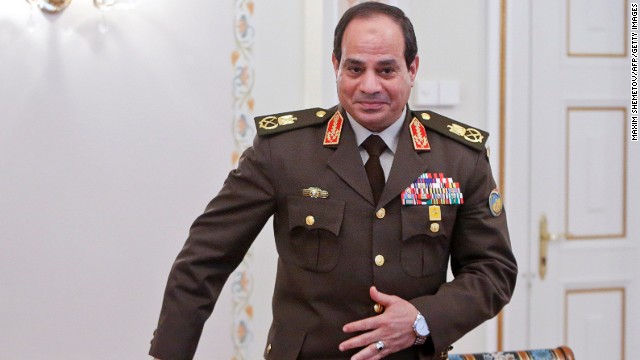
Rather than accept the results, however, the Obama Administration “channeled funding … [that] … vigorously supported activists and politicians who have fomented unrest in Egypt.” A year later, Morsi was overthrown by a coup that restored Mubarak’s military junta minus the ailing former tyrant. Ignoring American law, Obama continues to finance General Abdel Fata al-Sisi’s violent, oppressive regime, which many human rights groups describe as even more brutal than Mubarak’s. Morsi, a democratically-elected leader whom a principled American president should demand to be restored to power, rots in a prison whose jailers are paid by American taxpayers.
To add Orwellian insult to neocolonialist injury, Secretary of State John Kerry is still saying that Egypt’s post-Morsi junta is “transitioning to a democracy.” Kerry’s mouthfart came a day after al-Sisi sent three foreign journalists away for long prison terms.
Overshadowed by Israel’s latest brutal swat-a-fly-with-laser-guided-missiles invasion and bombing campaign against the Gaza Strip is the fact that, as in Egypt, the United States got the elections it demanded in Palestine, only to succumb to buyer’s remorse after the ballots were counted.
The Palestinian elections of 2006 are hardly the most thrilling story ever told, so I won’t be surprised if you decide to look at this story about the guy who sent his wife a spreadsheet detailing all the excuses she gave him for not having sex and never look back.
Still here? Here’s an abridged recounting of an episode that not only sheds some light on the current conflagration between Israel and Palestine, but reveals the methods used by Israel and its allies to undermine Palestinian self-governance — and belies America’s loudly proclaimed commitment to democracy to boot.
Israeli leaders like to complain that the Palestinian side doesn’t offer them a viable partner with whom to negotiate peace. Read the following, however, and Israel’s right-wing government’s real agenda becomes clear: to demoralize and divide the Palestinian people in order to sap their resistance to economic and military oppression.
In the Palestinian legislative elections of 2006, held both in the West Bank and Gaza in response to pressure from the United States, Hamas beat Fatah (Yasir Arafat’s more moderate party), 44.45% to 41.43%, entitling it to 74 seats in parliament over Fatah’s 45. (The current split, in which Hamas rules Gaza and Fatah has the West Bank, followed a later internal military clash.)
Israel’s interference with the 2006 elections began during campaign season, when it preemptively arrested and jailed 450 members of Hamas because they were involved in the elections as candidates or campaign workers. Despite this and other acts of sabotage, including trying to ban residents of East Jerusalem from voting, the elections went off well. The European Parliament’s spokesperson called the vote “extremely professional, in line with international standards, free, transparent and without violence.”
The thing to do would have been to congratulate Hamas and the Palestinians, and offer assistance upon request.
Instead, the Bush Administration and its allies cut off aid to the Palestinian Authority, ended diplomatic relations and imposed trade and other economic sanctions. Three months after Hamas formed its first government, in June 2006, Israel invaded Gaza and the West Bank, demolished and bombed civilian and government infrastructure, and arrested 25% of the members of parliament “because technically they were members of a terrorist organization although they may not be involved in terrorist acts themselves.” The U.S., which supplied the weapons used in the attacks, cited Israel’s “right to defend itself.”
Hamas, U.S. government-controlled media frequently reminds readers and viewers, is a U.S.-designated terrorist organization. So to people who don’t hold tickets to the Way Back A Decade Ago Machine, the actions of America, Israel and their allies vis-à-vis Hamas, which rules Gaza, seem reasonable. They’re terrorists! They shoot rockets at Israel! (Really lame rockets, but still.)
Hamas remains boxed in and desperate under Obama. Israel and Egypt’s al-Sisi regime, the two largest recipients of U.S. foreign aid military hardware, have shut the territory’s land crossings to Israel and Egypt and imposed a naval blockade on the Mediterranean coastline. Despite dozens of tunnels built to smuggle in goods, the West’s sanctions regime has been successful; Gaza’s economy has tanked, and unemployment among its 1.8 million people has risen to 38.5%. (The highest rate in the U.S. during the Great Depression of the 1930s was 25%.) Shooting rockets at civilians isn’t a great way to make friends — but desperation makes people do stupid things.
What the U.S. media doesn’t want you to know is: Hamas is popular. They won the last election, and they’d probably win again if one were held now. By pushing regime change in Gaza, therefore, the U.S. wants to replace a popular government with an unpopular one…in other words, subverting democracy.
Ukraine is yet another case of a democratically-elected ruler overthrown by a U.S.-backed coup.
Viktor Yanukovych won the Ukrainian presidency in 2010 elections that were widely believed to have conformed to international standards according to foreign observers. The thing to do would have been to congratulate him and the Ukrainian people on a fair election, and offer assistance upon request. But the U.S. was wary of Yanukovych, worried he might not easily be tamed. (Sample American punditry at the time: “The Ukrainians need to expand their relationship with the International Monetary Fund.”)
He didn’t. Finally, in November 2013, Yanukovych sealed his fate by siding with neighboring Russia over a pending EU association agreement — thus rejecting closer ties to the West and the United States. Street protests that led to Yanukovych’s ouster in February 2014 were likely indigenous, but would almost certainly not have succeeded in driving the president into exile without the flow of hundreds of millions of dollars in covert U.S. funding to the Maidan organizers.
Though more of a money-motivated oligarch than a creature of the far right, current Ukrainian president Petro Poroshenko has repeatedly demonstrated his willingness to accommodate right-wing factions, including neo-fascists, in Ukraine. Moreover, whatever you think of Poroshenko, he is not the legitimate ruler of the country. Nevertheless, President Obama has recognized him as such and offered economic and military hardware in his civil war against Russian-speaking separatists in the eastern part of the country.
I’ll close with a quote from Noam Chomsky: “For Washington, a consistent element is that democracy and the rule of law are acceptable if and only if they serve official strategic and economic objectives. But American public attitudes on Iraq and Israel/Palestine run counter to government policy, according to polls. Therefore the question presents itself whether a genuine democracy promotion might best begin within the United States.”
(Ted Rall, syndicated writer and cartoonist, is the author of “After We Kill You, We Will Welcome You Back As Honored Guests: Unembedded in Afghanistan,” out Sept. 2. Subscribe to Ted Rall at Beacon.)
COPYRIGHT 2014 TED RALL, DISTRIBUTED BY CREATORS.COM
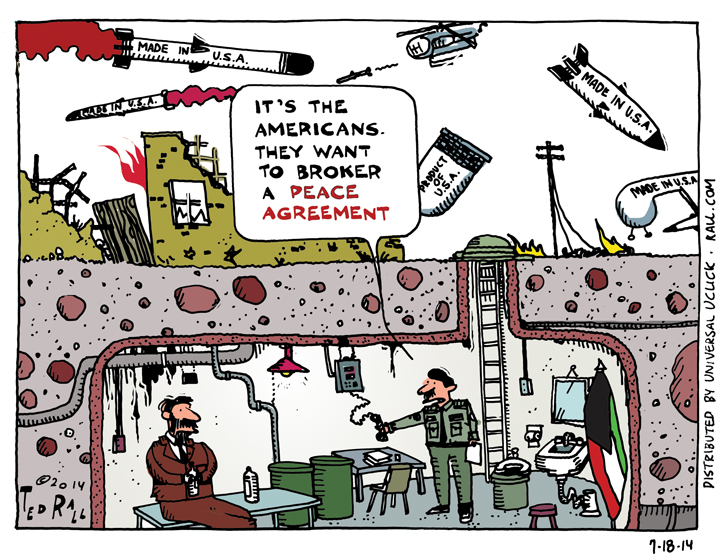
War and Peace, Made in USA
As the largest, most expansionary military empire in history and the world’s number one arms supplier, often to both sides in conflicts, the United States is once again offering, hilariously, to broker a peace agreement, this time between Hamas in Gaza, and Israel. First you start the war, or at least expand it, then you get credit for making peace!
SYNDICATED COLUMN: We Are All Soviets Now
Not-So-Secret “Secret Bombings” Have Big Implications
Did Israel bomb Damascus yesterday? Of course it did. According to Syrian rebel sources, 42 Syrian army soldiers were killed. But Israel – following its customary policy – won’t admit it. This has happened before. Usually, Syria doesn’t say anything about Israeli airstrikes. (The Syrian government’s complaint about Sunday’s airstrike is unusual, and thus cause for concern that the civil war might escalate into a regional conflict.)
According to experts, the official silence following not-so-secret secret bombings reflect the fact that even enemies have to cooperate sometimes. If Syria acknowledges that it has been the victim of what international law and anyone with a dictionary defines as an act of war, Syrian citizens and non-Syrians throughout the Muslim world would pressure the government of President Bashar al-Assad into a war it can’t win. Knowing this, the Israelis – who don’t want a war that could unite the fractious Arabs against them and set the Middle East ablaze – let Assad save face. By refusing to confirm or to deny, they quietly gloat over what everyone knows, that they can come and go as they please over Syrian airspace (or fire long-range missiles from Israeli territory, since even the Syrians don’t seem sure what hit them yesterday).
We live in a time that bears out the most dystopian of George Orwell’s predictions, yet even in a world of bluster and BS few news events are as surreal and mind-blowing as a so-called secret bombing. There is, after all, nothing secret about bombs. Especially when they fall into a densely populated metropolis. Certainly the families of those 42 dead soldiers are in the loop.
“Imagine an airstrike on a US weapons depot and no one claims responsibility,” the political cartoonist Kevin Moore tweet-asked. “Would we be so blasé about it?” We would be if we were a weak nation and the attacker was a strong one.
Not that this is a first-time occurrence.
Older readers remember the so-called secret bombing of Cambodia in 1969 and 1970, when President Richard Nixon ordered the carpet bombing of North Vietnamese supply bases in eastern Cambodia and Laos, a violation of international law. It was a sensational scoop for to readers of the New York Times and members of Congress (who hadn’t been informed), but if you were there, there was nothing secretive about the 100,000-plus tons of ordnance dropped in 3800-plus sorties by American B-52s.
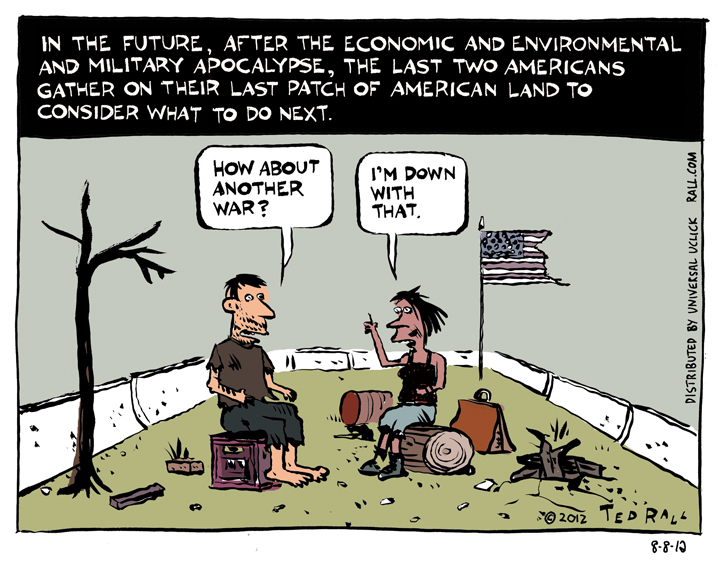
Tens of thousands of Cambodians, including many civilians, were killed.
As far as the rest of the world was concerned, however, the bombings were cloaked by a conspiracy of silence. The international media found out about it right away but coverage was scant and tentative. Cambodia’s leader, Prince Norodom Sihanouk, supposedly sent his tacit approval through back channels; for its part, North Vietnam couldn’t say boo because they weren’t supposed to be in Cambodia either.
The US drone war in Pakistan bears similarities to Cambodia, though it features a delicious extra dollop of deception.
As I reported in 2010, the United States isn’t so much occupying Afghanistan as it is using eastern Afghanistan as a staging area to launch drone strikes against tribal areas in western Pakistan. Again we have the ridiculous spectacle of something that couldn’t possibly be less secret – Hellfire missiles streaming out of the sky from buzzing drones circling Pakistani cities in broad daylight and blasting homes and cars – while both the Americans firing the weapons and the Pakistani government whose territory they are landing on officially deny knowing anything about them. Although Pakistani officials either claim helplessness in the face of American military might or condemn the drone strikes outright, thousands of people have died in hundreds of attacks under the Bush and Obama administrations as the result of a brutal quid pro quo: the CIA kills political dissidents and other “enemies of the state” on the Pakistani regime’s hit list in exchange for the privilege of killing “terrorists” it deems a threat. (It recently came out that CIA drone operators fire blindly, without knowing who they’re killing.)
The United States has similar arrangements with Yemen and Somalia.
Oh, and the U.S. doesn’t even officially acknowledge that it has a drone program. It’s classified. If it exists. Even though Obama jokes about it.
I wonder whether the lawyered-up officials who gin up these pssst arrangements worry about the geopolitical implications. For at least 200 years – arguably since the Peace of Westphalia in 1648 – the Western world has been governed on the basis of strictly defined borders. In the postwar era the United Nations has served primarily as an attempt to enshrine the sovereignty of nation-states. At the core of contemporary international law is the doctrine that invading the territory or airspace is an act of war, particularly when the victim is internationally recognized as sovereign. So how does that square with secret bombings?
If Israel can carry out acts of war against Syria with impunity, without suffering any sanction, and if United States can do the same in Pakistan, who is to say which cross-border incursions of the future are acceptable and which are not? If Syria and Pakistan tacitly consent to their territory being bombed, but don’t sign formal agreements to allow it, can they legitimately claim to be sovereign independent states? It seems to me that both the bombers and the victim countries are messing around with issues with huge potential ramifications without thinking them through.
When political leaders wallow in “who are you going to believe, me or your lying eyes” absurdism, citizens roll their eyes and learn to reflexively distrust everything they see and hear from officials and in mainstream media. How, for example, can you take an Israeli government seriously that has had nuclear weapons since the 1970s but refuses to admit it (and sabre-rattles with Iran over its nuclear weapons program, which probably doesn’t exist)? Or a United Nations that refuses to call them to account under nuclear nonproliferation treaties?
The greatest enemy of political stability is alienation. Citizens don’t have to like their leaders to hand them the tacit consent of the governed. But if a regime wants to stay in power, the people have to believe their government more often than not. It can’t be perceived as totally full of crap.
Just ask Mikhail Gorbachev.
Sure, all rules are arbitrary. But once you start breaking your own rules, you undermine the basis of legitimacy for the system you’ve created and hope to perpetuate. If we go back to the basis of nationhood – you have a right to exist if you can carve out borders, defend them, and repel invaders – we unwind the world order that has been in place for nearly half a millennium. Which may be for the better. But it’s probably something that we should all discuss.
In the open.
(Ted Rall’s website is tedrall.com. His book “After We Kill You, We Will Welcome You Back As Honored Guests: Unembedded in Afghanistan” will be released in November by Farrar, Straus & Giroux.)
COPYRIGHT 2013 TED RALL
SYNDICATED COLUMN: Will the Next 9/11 Arrive via Drone?
Aggressive Drone Wars Set a Dangerous Precedent
There’s no denying it: we Americans, we have a lot of nerve.
We love to pick fights, but when someone punches back, man, the whining never stops. And boy, do we love to escalate. Nuclear weapons? We invented the suckers, used them not once but twice – the only country that ever has – the only anybody who ever has – yet we have the balls to slap economic sabotage on the Iranians and North Koreans and smear them as “rogue states” for even thinking about trying to get their own. Which these nations only want – irony alert – because they’re afraid of us.
You know the pattern. We escalate the arms race with some nifty new gadget devilishly designed to kill and maim more efficiently and effectively, then we deploy brute economic and military force (along with wildly hypocritical propaganda about how we’re nice and peaceful and the most trustworthy bunch around) to keep those fancy new weapons all to ourselves for as long as possible. Like cyber warfare. We started it.
The first major state-against-state – completely unprovoked – first strike in cyberspace was the Stuxnet virus unleashed against Iranian nuclear power facilities. A joint American-Israeli effort, it wasn’t enough for us to mess with the Iranians. We had to gloat.
Now it’s drones. Beginning in 2004 with George W. Bush, the drone warfare program against the peoples of Afghanistan, Pakistan, Yemen, Somalia, Ethiopia and God knows where else was greatly escalated by an Obama administration marketing itself as a regime ending two wars in public (though not really) while it secretly expands America’s military footprint.
And jokes about it.
Operating as usual in full-on bully mode, the U.S. blithely acts as though it’s entitled to the perpetual exclusive right to invade other nation’s sovereign airspace at will. Rather than assume the dignified posture of silence or the embarrassed sheep business of a kid who got caught in the cookie jar, Obama officials even had the gall to get all sassy and file a formal diplomatic protest after the Iranians shot at one of their spy Predators in November. In a different world, one where Iran had the world’s largest military and was the world’s undisputed number-one arms dealer, the Islamic Republic could have made a credible case under international law for war against the U.S.
In an ideal world – i.e., the kind of society people of goodwill work to create – these devices would be illegal under international law. Like landmines, drones do a lot more harm than good. You’d might as well declare the First Amendment dead and gone now that private corporations, the FBI, CIA, local police and just about anyone else can scan the crowds at antigovernment protests and identify demonstrators with facial recognition software. Who is going to dare to make a radical statement now? As it is, you can’t count on cops not to shoot unarmed African-American men. How many more innocent civilians are going to die due to the faulty judgment of a drone pilot miles away? As the first country to develop drone technology, the U.S. had the chance to keep this genie stuffed inside its bottle; instead, we let the monster loose and told it to run wild.
It doesn’t take a genius military strategist to worry about drone weapons proliferation. The technology is relatively simple and cheap, so cheap that soldiers occupying Afghanistan use throwaway six-pound mini-drones slightly larger than paper airplanes to see what’s around the next mountain.
The FAA is rushing to approve licenses to “tens of thousands of police, fire and other government agencies able to afford drones lighter than traditional aircraft and costing as little as $300,” reports The New York Times, including everything from “remote-controlled planes as big as jetliners to camera-toting hoverers called Nano Hummingbirds that weigh 19 grams.” Police departments from Seattle to Gadsden, Alabama have already bought these creepy devices. And it’s now possible for a private citizen to buy his own drone for $300. A peeping Tom’s dream!
It was only a matter of time – not much time – before other countries followed suit. Which prompts two questions.
What’s to stop a hostile nation-state from attacking the United States with drones?
What if terrorists get drones?
Answer to the first question first: Nothing can stop a nation from Hellfiring us. While there are practical and economic barriers to entry that reduce nuclear proliferation, even the poorest nations can develop a scary drone program. Israel and its American ally claim to be terrified of the prospect of an Iranian nuclear attack against Tel Aviv, but the threat of a conventional weapons attack via drone is really what should be keeping policymakers up at night. Iran unveiled its Shahed 129 drone plane, a device that can fly 24 hours in a row, in September. That’s the one they plan to export. In September an Iranian drone launched from Lebanon successfully took pictures of Israeli military facilities.
The trouble isn’t just the drones themselves. It’s how the United States uses them: aggressively, prolifically, violently and with little concern for legal or diplomatic niceties. “Skip the drone debate, just kill the terrorists before they kill us,” reads the headline of a FoxNews piece by Erick Erickson, one of the Right’s most reliable cretins. But it’s not that simple. When the United States, the first nation to develop and deploy drones for surveillance and military attack purposes, asserts the right to “defend” itself by looking anywhere it wants and blowing up anyone it feels like, including its own citizens and people who have never expressed the slightest desire to attack the United States, it sets a precedent.
“More than 50 nations have or are trying to get [drone] technology,” notes The Times. “The United States will set the standard for them all.” Osama bin Laden said he wouldn’t have hesitated to use a nuke against the U.S. because Hiroshima and Nagasaki were civilian targets. Using the same reasoning as the Obama administration, why wouldn’t the government of Yemen be legally justified to deploy Yemeni drones over American airspace and use them to blow up any Americans or anyone else they felt like?
We don’t hold back. Why should anybody else?
While a nation-state might feel constrained by the international community, its allies or domestic public opinion from attacking civilian targets in the United States, an underground resistance organization would be far less likely to refrain from using drones to make a political statement and/or wage remote-control guerrilla warfare. Even terrorist groups care about PR – but, like bin Laden, they could easily make the case that we have it coming.
Though some commentators – mainly and interestingly, liberals aligned with the Obama administration, which makes one wonder if they’d change sides after a GOP electoral sweep – pooh-pooh the terrorist drone threat, this is one time when the smoke rising from the ashes of buildings in an American city isn’t a remote (no pun intended) possibility created by a fevered theorist but rather an absolute certainty. It isn’t a matter of if we’ll get hit by drones. It’s a matter of when.
(Ted Rall’s website is tedrall.com. His book “After We Kill You, We Will Welcome You Back As Honored Guests: Unembedded in Afghanistan” will be released in November by Farrar, Straus & Giroux.)
COPYRIGHT 2013 TED RALL
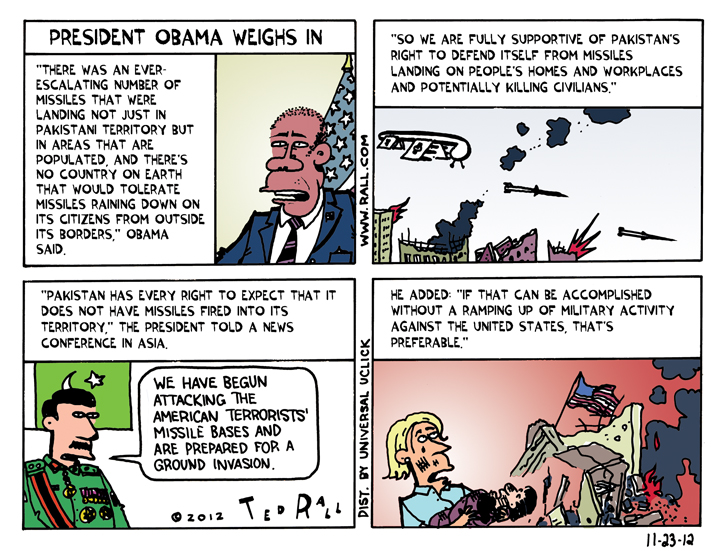
President Obama Weighs In
President Obama expresses his support for Israel’s right to defend itself from Hamas missiles originating in Gaza. He even says it would be OK for Israel to invade. Does the same rule apply to Pakistan, currently under fire by American missiles? Is it OK for Pakistan to invade the United States in order to defend itself?
SYNDICATED COLUMN: Factchecking the Factcheckers
In a Media Without Real Journalists, Lies Become True
When fact-checking organizations like Politifact and Factcheck.org appeared a few years ago, they seemed like perfect antidotes to a lazy, corrupt and broke corporate media unable and/or unwilling to hold politicians to account for their lies. Cue Murphy’s Law: Rather than set a higher standard, independent fact-checkers gave mainstream journalists more excuses not to work.
“Perhaps the most jarring aspect of media factchecking is that many reporters see it as someone else’s job,” Peter Hart and Julie Hollar wrote in FAIR’s Extra! magazine.
This year’s presidential debates have been showcases of absentee journalism. With the exception of a single interjection by Candy Crowley (on a trivial point), all three moderators sat silently and passively as Barack Obama and Mitt Romney told one lie after another to an audience mostly composed of citizens who were paying attention to the campaign for the first time.
“My moderator mission was to stay out of the way of the flow,” said Jim Lehrer, moderator of debate number one.
Lame mission accomplished.
To make things worse, the pundits and journalists voters count upon to set things straight let the biggest lies and gaffes stand uncorrected. Even partisan screamers let us down: Fox News failed to call out Obama’s biggest fibs while MSNBC dropped the ball on Romney’s.
And the fact-checking commentariat let the ugliest and meanest sleeping dogs lie.
Last night’s third and final presidential debate included a few gaffes—my favorite was the geographically challenged Romney’s repeated statement that “Syria is Iran’s route to the sea“—Iran doesn’t have a border with Syria, nor is it landlocked—and the usual share of whoppers, most of which have gone unchallenged so long that people consider them facts.
Do politicians’ lies matter? You bet.
Whether people are deciding which of the two corporate major-party candidates to vote for, or they’re looking outside the system to a third party, voter boycott or revolution to overthrow the entire system, they can’t make an intelligent decision without knowing the pertinent facts. The myth of U.S. exceptionalism, for example, mistakenly teaches Americans that their country is #1; if they knew the truth, that the U.S. is behind much of the industrialized world by such measures as child poverty (we’re #34 out of the 35 industrialized nations, just ahead of Romania), they might decide to stop tolerating U.S.-style corporate capitalism.
Lies are the glue that hold a sick and sickening system together.
As far as I can tell, neither cable news networks, nor news websites, nor newspapers have questioned somewhere the following bipartisan lies, which all reared their heads at the third debate:
Obama said: “We ended the war in Iraq, refocused our attention on those who actually killed us on 9/11.”
Actually, 16,000 U.S. troops will remain after the “pullout.” Hilariously reclassified as “staff” of the U.S. embassy in Baghdad—world’s biggest force of security guards—American soldiers will be fighting alongside 3,500 to 5,000 private U.S.-paid mercenaries.
9/11 was not carried out, or planned, by citizens of Iraq or Afghanistan.
What if they gave a war, and people came, but nobody knew? Some antiwar voters will vote for Obama for ending a war he is actually continuing.
Obama said: “We killed bin Laden…when we bring those who have harmed us to justice, that sends a message…”
The president could have argued that bin Laden got what he deserved. Bringing someone to justice means placing them under arrest so their fate can be determined by a judge and jury in a court of law. If the president can get away with saying—and the media doesn’t question it—that an assassination is justice, then law and order no longer have any meaning.
We live in an authoritarian police state.
A police state full of lazy reporters.
Obama said: “Moammar Gadhafi had more American blood on his hands than any individual other than Osama bin Laden.”
Everyone “knows” bin Laden was behind 9/11. That he admitted it in a video. But though bin Laden never shied away from his involvement in terrorism—he admitted ordering the 1998 East Africa embassy bombings—he denied ordering 9/11. The translated “confession” was shown to have been faked by the CIA.
Obama said: “Iran is a threat to our national security and it’s a threat to Israel’s national security…And they have said that they want to see Israel wiped off the map.”
Though debunked, the oft-repeated canard that Iranian president Mahmoud Ahmadinejad wants to “wipe Israel off the map” is part of Democratic and Republican propaganda alike.
Jonathan Steele of the UK Guardian provides the best available translation of what Ahmadinejad really did say: “The Iranian president was quoting an ancient statement by Iran’s first Islamist leader, the late Ayatollah Khomeini, that ‘this regime occupying Jerusalem must vanish from the page of time,’ just as the Shah’s regime in Iran had vanished. He was not making a military threat. He was calling for an end to the occupation of Jerusalem at some point in the future. The ‘page of time’ phrase suggests he did not expect it to happen soon.”
A top Israeli official, intelligence and atomic energy minister Dan Meridor, agreed recently that Ahmadinejad never used that “wipe off the map” phrase, which doesn’t exist in Farci. Meridor says that Ahmadinejad and Ayatollah Ali Khamenei said “that Israel is an unnatural creature, it will not survive. They didn’t say, ‘We’ll wipe it out.'”
Romney again repeated his meaningless line that Iran is “four years closer to a nuclear weapon.” By the same logic, Iran was eight years loser to a nuclear weapon during Ronald Reagan’s two terms as president.
Bob Schieffer asked Romney: “What if the prime minister of Israel called you on the phone and said: Our bombers are on the way. We’re going to bomb Iran. What do you say?” Romney replied: “Our relationship with Israel, my relationship with the prime minister of Israel is such that we would not get a call saying our bombers are on the way or their fighters are on the way. This is the kind of thing that would have been discussed and thoroughly evaluated well before that kind of action.”
Romney can’t be that sure. Israeli officials have told their U.S. counterparts that they won’t ask permission before attacking Iran—and will give us no more than 12 hours advance notice.
Romney lied less but his biggest lie was the biggest.
“America’s going to…continue to promote principles of peace,” he said in his closing statement.
It must have been difficult for the audience, who’d promised to keep quiet, not to laugh out loud. America? Peaceful?
Unless they believe that stuff about Obama ending the war in Iraq.
(Ted Rall‘s latest book is “The Book of Obama: How We Went From Hope and Change to the Age of Revolt.” His website is tedrall.com.)
COPYRIGHT 2012 TED RALL
DISTRIBUTED BY Universal Uclick/TED RALL
4520 Main St., Kansas City, Mo. 64111; (877) 682-5425 / TED RALL ONLINE: rall.com
RALL 10/23/12