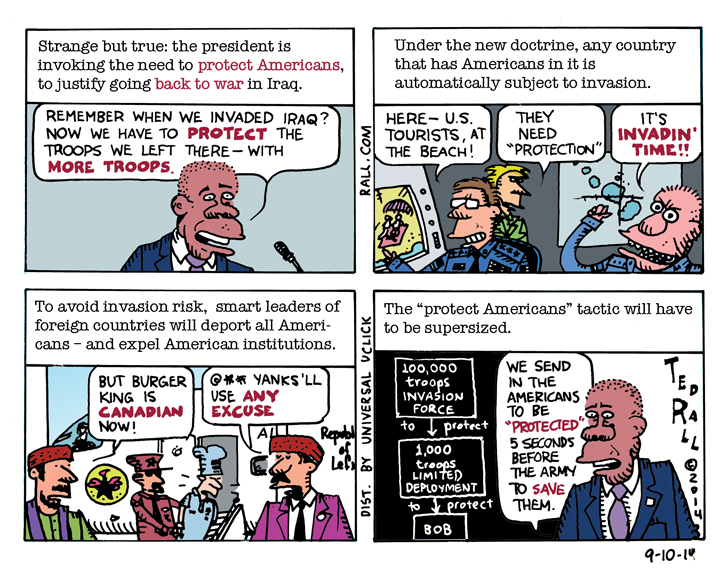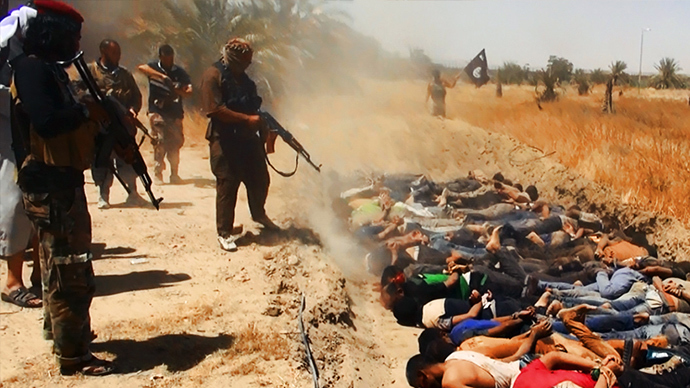
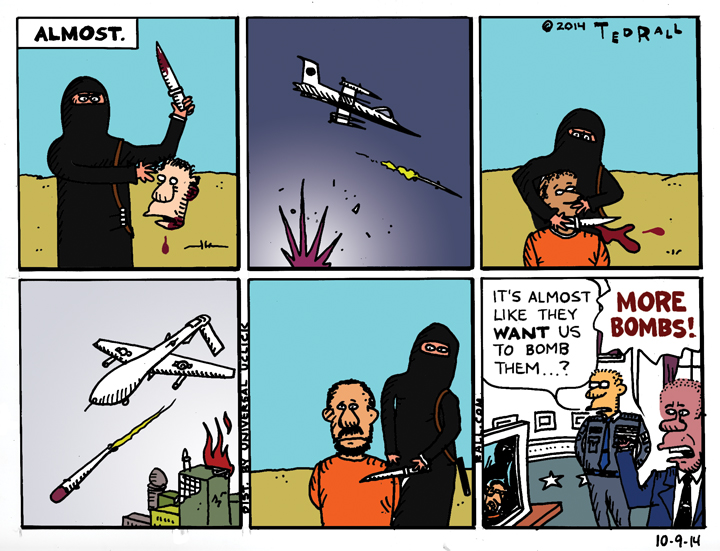
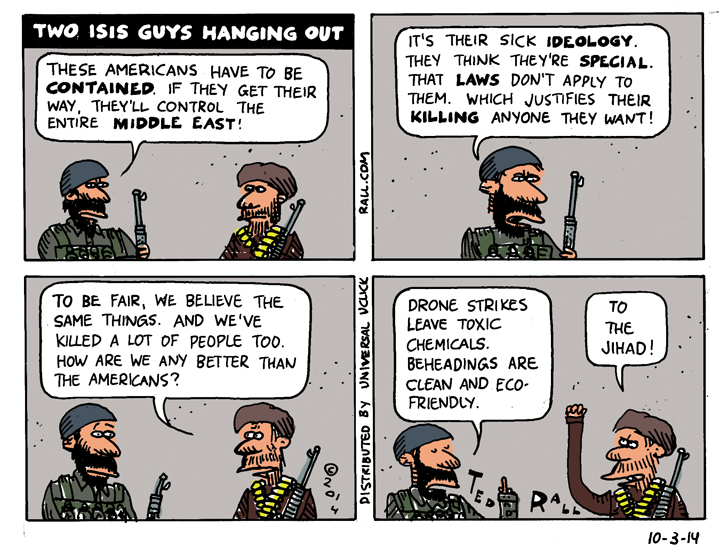
ISIS beheads a journalist. The US bombed them. They behead another one. The US bombs more. So it goes and goes, yet no one asks: why is ISIS still cutting off its hostages’ heads? Could it be that we’re playing into their blood-soaked hands by provoking contempt for the US among bombing victims?
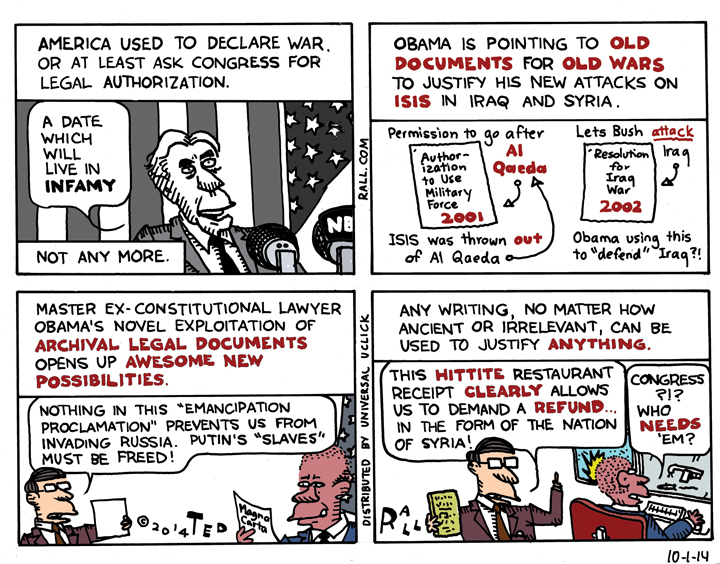
Archival War
FDR asked Congress for a formal Declaration of War against Germany and Japan. Subsequent presidents asked Congress for various forms of legal justifications to attack other nation-states. Now Obama is further eroding Congress’ right to declare war by relying on obselete and irrelevant authorizations for old conflicts.
SYNDICATED COLUMN: Obama a “Reluctant Warrior,” My Ass

David Ignatius is to The Washington Post what Thomas Friedman is to The New York Times, the 50-yard line of the world as seen by political elites. Like Friedman (but minus the Mustachioed One’s tortured syntax and penchant for airport-to-Four-Seasons taxicab policy briefings), Ignatius mirrors the views of our wealthy, powerful and oblivious leaders at any given hour of the day.
Like the president and his advisors and Congress and the Pentagon brass, he never spies a crisis abroad that couldn’t be improved by firing explosives at it. Long after everyone, including even the media, tires of the carnage (in Iraq, in Afghanistan, etc.), he continues to defend it until the war’s approval ratings dip into fractions of a percentage point, at which point he pivots, bravely arguing that intervention is a mistake.
At this writing, we are at the start of America’s war cycle: (post-beheading video) anger, bombing, more bombing, withdrawal.
Obama’s bombing campaign against ISIS (the Islamic State of Iraq and Syria) in Syria is in its larval form. Which means Ignatius is cheerleading what the U.S. does best: turning living human beings into corpses.
Ignatius, a right-winger, is more pro-war than pro-Republican. Which earns the president official Ignatian praise as — no, really! — a “reluctant warrior.”
Obama, writes Ignatius, “certainly didn’t go looking for another war in the Middle East.” He “contorted himself almost to the breaking point to avoid one.” He “had no choice.”
Ignatius approvingly cites fellow Iraq War neo-con Stephen Hadley (last seen in the desert searching for Saddam’s WMDs, rather than in prison where he belongs): “Hadley noted that Obama’s stance as a reluctant warrior will help him reassure foreigners and Americans alike that this isn’t a reckless, unilatateral U.S. crusade,” Ignatius writes.
Beware of warmongers bearing the “no choice” argument. In matters of war, especially against a foe like ISIS deemed by U.S. government’s own professional intelligence analysts to pose no imminent threat to the U.S., there is always a choice.
To war or not to war?
You might also want to be wary of warmongers whose last war, and the one before, and the one before that, didn’t work out well — guys who are always, reliably wrong. Though, to be fair to Iggy, that’s also true about most of his colleagues.
More galling than Ignatius’ Lucy-and-the-football “no, really, this time really will be awesome” here-we-go-again shtick is this “mainstream” columnist’s belief that Americans can’t remember the last five years of U.S. history.
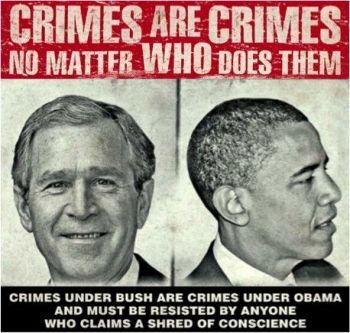
When it comes to killing, Obama is anything but reluctant. To the contrary — he makes George W. Bush look like a dirty peace hippie.
Barack Obama won the presidency in 2008 by running against the “stupid war” against Iraq. Once in office, however, he issued order after order extending said stupid war with tens of thousands of soldiers and U.S. private “contractors” (corporate mercenaries).
Obama doubled down in Afghanistan with the failed “surge” of additional troops.
It’s pretty much forgotten now, but in 2011 Obama went in deep against Libya, assassinating dictator Col. Moammar Gaddaffi with a drone. The collapse of Gaddaffi’s government opened a vacuum instantly filled by Benghazi-based radical Islamist militias and sparked a civil war that has reduced a formerly viable nation to a failed state.
Speaking of drones…
Does anyone need reminding that Obama aggressively expanded Bush’s illegal program of drone assassinations in Yemen, east Africa and Pakistan, killing thousands of people, 98% or so of whom have been innocent civilians? Or that, rather than grant the victims of the 9/11 attacks justice in the form of a trial, he ordered the assassination and midnight body dump of Osama bin Laden?
From Iraq to Afghanistan to Libya to now Iraq all over again, Barack Obama is as much of a “reluctant warrior” as Genghis Khan.
(Ted Rall, syndicated writer and cartoonist, is the author of the new critically-acclaimed book “After We Kill You, We Will Welcome You Back As Honored Guests: Unembedded in Afghanistan.” Subscribe to Ted Rall at Beacon.)
COPYRIGHT 2014 TED RALL, DISTRIBUTED BY CREATORS.COM
SYNDICATED COLUMN: Obama Trolled by ISIS
President Obama’s reaction to the videos of two American freelance journalists getting beheaded by Islamist militants gives me the uncomfortable feeling that the American people are getting punk’d — again.
The same thing happened 13 years ago this week, when a dozen and a half Muslim fundamentalists attacked our financial and political capitals using our own planes. The hijackers got exactly the reaction that they wanted: overreaction.You should never underestimate an adversary, least of all when their remarkable success against difficult odds have demonstrated the wisdom of their tactics. The Islamic State of Iraq and Syria, like the 9/11-era Al Qaeda from which it split, is not run by stupid people. Stupid people don’t take half of Syria away from its longtime authoritarian dictator – whose armed forces happen to be better equipped and trained – and half of Iraq away from a puppet regime backed by the world’s most ferocious superpower – in two years.
Considering ISIS through the lens of proper respect for their leaders’ intelligence, what were they thinking when they posted those two gruesome videos? Abu Bakr al-Baghdadi, Abu Suleiman al-Naser and other top officials of the Islamic State had to know they would provoke a political reaction. It has: More Americans (94%) are aware of the ISIS execution videos than any other news event in the last five years.
ISIS’ leaders also must have anticipated a military reaction. After the videos, a war-weary American public’s apathetic stance toward the civil war in Syria flipped toward strong support in favor of the bombing campaign announced by Obama (who paradoxically continues to poll poorly on foreign policy).
Clearly ISIS’ top brass believe they stand more to gain than to lose from the coming onslaught by U.S. drones and fighter jets. This should frighten us.
Put yourself into the mindset of the insurgents. Their enemies are the existing governments of the countries they seek to occupy: Syria, Iraq, possibly Jordan, certainly Saudi Arabia and the Gulf states. But – again, like Al Qaeda in the early 2000s – they have a more formidable adversary: moderation.
To survive and expand, radical jihadists don’t need all, or even most, Muslims to join the fight. But they do require the tacit consent of the governed in the areas they control, and the political sympathy that prompts donors to send them the financial contributions that allow them to arm new recruits and hold their territory — factors that fuel legitimacy.
As radicals and fundamentalists, ISIS’ Manichean worldview portrays the West, and especially the United States and Great Britain, and their Middle Eastern client states – obviously Israel most of all – as monsters hell-bent on the oppression of Muslims, the exploitation and appropriation of Muslim lands, using moral corruption and godless capitalism as means toward global domination at their expense.
Until recently, most Muslims – including most Sunnis – didn’t buy it. Hundreds of millions of them drank, smoked, failed to pray regularly, and envied the liberalism and economic power of the West.
The genius of 9/11 was to provoke the United States and its allies into behaving exactly like the monsters Al Qaeda and other jihadist groups had long argued they were. The invasions of Afghanistan and Iraq, brazenly embracing torture and mass kidnappings and opening a gulag archipelago of secret prisons everywhere from Eastern Europe to Guantánamo to jail ships floating in the Indian Ocean, as well as the brazen disregard for innocent civilians demonstrated by Bush and Obama’s willy-nilly drone program, convinced countless fence sitters and former moderates to join the militants, cut them a check, or at least look the other way. By the end of the Bush years, the United States was wildly unpopular, viewed as “violent” and “selfish” throughout the Muslim world.
We got trolled.
The tactics Obama plans to use against ISIS are more of the same. Once again, U.S. warplanes and remote-controlled killer air robots will rain death upon people, the vast majority of whom were innocent and had nothing to do with the group responsible for beheading those poor journalists. Once again, although we will on occasion succeed in killing some #1 or #2 “top terrorist,” we will lose this battle for hearts and minds because (a) the nature of guerrilla warfare is that no leader is indispensable and anyone can and will be replaced, and (b) each civilian death will generate thousands of fierce lifelong enemies – yes, some family members and many friends, but most of all the one group of people American pundits and journalists rarely reference when discussing “collateral damage” – ordinary people, there and in the region and around the world, who react with disgust and rage at our cruelty.
Ironically, disgust and rage are the very same emotions that triggered America’s latest tumble into the Islamist trap.
(Ted Rall, syndicated writer and cartoonist, is the author of “After We Kill You, We Will Welcome You Back As Honored Guests: Unembedded in Afghanistan,” out this week. Subscribe to Ted Rall at Beacon.)
COPYRIGHT 2014 TED RALL, DISTRIBUTED BY CREATORS.COM
SYNDICATED COLUMN: “Ask the Pundit”: What Should the U.S. Do About ISIS?

Reader Brian McManus asks:
“Just wondering if you can find time to post a piece on what the U.S. should do (or not do) regarding the current situation with ISIS in Iraq. Not so much on how the situation got to be where it is, but what the U.S. and/or other nations should do in situations like this. Would appreciate your thoughts on the issue.”
Thanks for writing, Brian.
Americans are “can do” people. Optimism is an appealing national personality trait but it comes with the unfortunate tendency to overestimate what can be done and its more dangerous corollary, the will to act when doing nothing would be preferable.
We saw the pitfalls of can-do following 9/11. Initial reactions to the attacks were shock and confusion. Traditional ideological divides were blurred, but in those early days one could still discern the pre-GWOT liberal tendency toward treating terrorism as a law enforcement issue, versus the old hawkish rightist desire to lash out militarily. Then the Right trotted out a line that resonated across the spectrum and caused the antiwar left to dissolve as into mist:
We have to do something.
In the United States, “something” means military action.
The thing we “have” to do “something” about always refers to foreign policy.
Americans don’t feel that “have to do something” about domestic problems. Poverty? No need to act. Corrupt bankers? Inaction is fine. But if a crisis flares up overseas (a civil war as in Syria or Libya, a siege of civilians as in Sarajevo or Iraqi Kurdistan, cross-border encroachment as in ex-Soviet Georgia or Crimea), and especially if it involves opponents the media categorizes as “bad guys” (regional economic rivals such as Iran, China or Russia, radical Islamists who may or may not have gotten their guns from us), “we” “have” “to” “do” “something” (military action).
This is not true.
There are always alternatives to military action. The success of the formerly Al Qaeda-affiliated Islamic State of Iraq and Syria insurgency, which controls half of both countries, is no exception. Half-measures come in both military (money and weapons) and non-military (political advisors) forms.
We can do nothing.
Albania is doing nothing in Iraq. Cuba is doing nothing in Iraq. Vietnam is doing nothing in Iraq. These countries have not been harmed by their refusal to intervene militarily in Iraq.
As I see it, Brian, whatever appetite ordinary Americans have for Obama’s airstrikes against ISIS and other attempts to prop up the current regime in Baghdad stems from the investment of lives and treasure the U.S. has made since the 2003 invasion.
“To be sure, the cost was high,” then-Secretary of State Leon Panetta said when Obama ordered the main troop withdrawal from Iraq. “But those lives were not lost in vain. They gave birth to an independent, free, and sovereign Iraq.”
If ISIS captures Baghdad and establishes Taliban-style Sharia law throughout Iraq, complete with amputations of accused thieves and stonings of wayward women — leaving Iraq, already in worse shape than it was under Saddam, an unequivocal nightmare for its people and a base for radical jihadis out to overthrow U.S. allies like Saudi Arabia — Panetta’s statement will have been belied.
The war will have been exposed as a total waste.
Which it was. Every American who lost a life or a limb in Iraq was sacrificed stupidly, predictably, in a war that never could have been won even had the generals and politicians in charge of it weren’t idiots.
The attempt to salvage Iraq by saving the rump Iraqi state inside the Green Zone is a refusal to accept defeat. But that doesn’t change reality.
We lost the Iraq War years ago. The sooner we accept that there is nothing to be saved there and move on, the better off we’ll be.
Undeniably and regrettably, washing our hands of Iraq — aside from leaving ISIS alone, we ought to evacuate the embassy and other government personnel Obama says we need to “protect” — will result in awful consequences. Whether or not ISIS can close the deal by capturing Baghdad, the sectarian conflict will escalate. Areas within ISIS control will be lost for the foreseeable future. More civilians will die, many as the result of “ethnic cleansing.”
We know these things will happen because we’ve lost wars before. The U.S. withdrawal from Vietnam created the “boat people” crisis, opened space for wars between Vietnam and its neighbors China and Cambodia, and permitted a communist regime hostile to U.S. interests to consolidate power, and exclude American business for decades.
But consider the alternative.
Remaining in Vietnam would have required pouring more money and more soldiers down a hole, and slaughtering countless more Vietnamese. We still would have lost. All that post-withdrawal stuff — the civil conflicts, reprisals against our former local collaborators — would still have happened. It just would have happened later.
After we accepted defeat and walked away from Vietnam, on the other hand, things eventually worked out. Vietnam is now a major U.S. trading partner; nearly half a million American tourists visit Vietnam each year.
A guy named Barack Obama once summarized his foreign policy as “Don’t do stupid stuff” like invading Iraq in the first place. Hillary’s jibes and Obama’s actions aside, it’s good advice. To which I’ll add Ho Chi Minh’s legendary order to his general Vo Nguyen Giap, who was planning the decisive 1954 battle that would expel France from Indochina: “If victory is certain, then you are to attack. If victory is not certain, then you must resolutely refrain from attacking.”
Victory against ISIS is anything but certain. Therefore, in this and similar situations, I would refrain from attacking.
(Ted Rall, syndicated writer and cartoonist, is the author of “After We Kill You, We Will Welcome You Back As Honored Guests: Unembedded in Afghanistan,” out Sept. 2. Subscribe to Ted Rall at Beacon.)
COPYRIGHT 2014 TED RALL, DISTRIBUTED BY CREATORS.COM
SYNDICATED COLUMN: Clueless in Gaza – We Americans Support Democracy, But Only When the Elections Go Our Way

“Rarely has a president been confronted with so many seemingly disparate foreign policy crises all at once,” The New York Times noted about Obama on July 23rd. What the paper didn’t/won’t/can’t say is: Rarely has a president caused so many of his own crises.
This summer, most of Obama’s problems follow from his unwillingness to respect democracy overseas.
The U.S. government supports democracy in other countries — but only if the elections go its way. If not, anything goes to obtain a favorable outcome: economic sabotage, backing violent coups d’état, installing dictators to replace democratically-elected leaders, even ginning up all-out war.
Three recent examples showcasing U.S. contempt for electoral democracy include Egypt, and two places making news this week, Palestine and Ukraine.
Egypt’s 2012 election, the first after the overthrow of U.S.-backed autocrat Hosni Mubarak, is a recent case of American perfidy that’s embarrassing going on tacky. Mohamed Morsi of the long-banned Muslim Brotherhood, an Islamist party, won the presidency in elections international observers called as fair and transparent as could be expected in a nascent democracy.
The thing to do, of course would have been to congratulate Morsi, the Brotherhood and the Egyptian people, and offer assistance upon request.
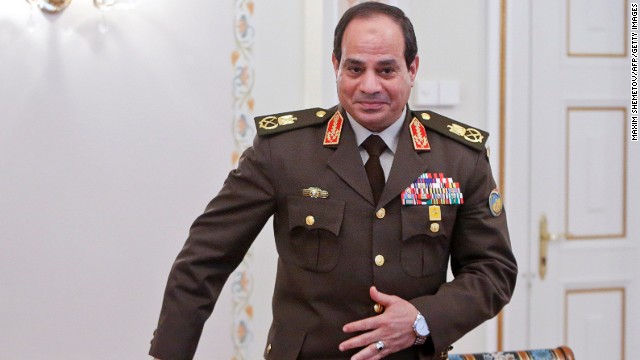
Rather than accept the results, however, the Obama Administration “channeled funding … [that] … vigorously supported activists and politicians who have fomented unrest in Egypt.” A year later, Morsi was overthrown by a coup that restored Mubarak’s military junta minus the ailing former tyrant. Ignoring American law, Obama continues to finance General Abdel Fata al-Sisi’s violent, oppressive regime, which many human rights groups describe as even more brutal than Mubarak’s. Morsi, a democratically-elected leader whom a principled American president should demand to be restored to power, rots in a prison whose jailers are paid by American taxpayers.
To add Orwellian insult to neocolonialist injury, Secretary of State John Kerry is still saying that Egypt’s post-Morsi junta is “transitioning to a democracy.” Kerry’s mouthfart came a day after al-Sisi sent three foreign journalists away for long prison terms.
Overshadowed by Israel’s latest brutal swat-a-fly-with-laser-guided-missiles invasion and bombing campaign against the Gaza Strip is the fact that, as in Egypt, the United States got the elections it demanded in Palestine, only to succumb to buyer’s remorse after the ballots were counted.
The Palestinian elections of 2006 are hardly the most thrilling story ever told, so I won’t be surprised if you decide to look at this story about the guy who sent his wife a spreadsheet detailing all the excuses she gave him for not having sex and never look back.
Still here? Here’s an abridged recounting of an episode that not only sheds some light on the current conflagration between Israel and Palestine, but reveals the methods used by Israel and its allies to undermine Palestinian self-governance — and belies America’s loudly proclaimed commitment to democracy to boot.
Israeli leaders like to complain that the Palestinian side doesn’t offer them a viable partner with whom to negotiate peace. Read the following, however, and Israel’s right-wing government’s real agenda becomes clear: to demoralize and divide the Palestinian people in order to sap their resistance to economic and military oppression.
In the Palestinian legislative elections of 2006, held both in the West Bank and Gaza in response to pressure from the United States, Hamas beat Fatah (Yasir Arafat’s more moderate party), 44.45% to 41.43%, entitling it to 74 seats in parliament over Fatah’s 45. (The current split, in which Hamas rules Gaza and Fatah has the West Bank, followed a later internal military clash.)
Israel’s interference with the 2006 elections began during campaign season, when it preemptively arrested and jailed 450 members of Hamas because they were involved in the elections as candidates or campaign workers. Despite this and other acts of sabotage, including trying to ban residents of East Jerusalem from voting, the elections went off well. The European Parliament’s spokesperson called the vote “extremely professional, in line with international standards, free, transparent and without violence.”
The thing to do would have been to congratulate Hamas and the Palestinians, and offer assistance upon request.
Instead, the Bush Administration and its allies cut off aid to the Palestinian Authority, ended diplomatic relations and imposed trade and other economic sanctions. Three months after Hamas formed its first government, in June 2006, Israel invaded Gaza and the West Bank, demolished and bombed civilian and government infrastructure, and arrested 25% of the members of parliament “because technically they were members of a terrorist organization although they may not be involved in terrorist acts themselves.” The U.S., which supplied the weapons used in the attacks, cited Israel’s “right to defend itself.”
Hamas, U.S. government-controlled media frequently reminds readers and viewers, is a U.S.-designated terrorist organization. So to people who don’t hold tickets to the Way Back A Decade Ago Machine, the actions of America, Israel and their allies vis-à-vis Hamas, which rules Gaza, seem reasonable. They’re terrorists! They shoot rockets at Israel! (Really lame rockets, but still.)
Hamas remains boxed in and desperate under Obama. Israel and Egypt’s al-Sisi regime, the two largest recipients of U.S. foreign aid military hardware, have shut the territory’s land crossings to Israel and Egypt and imposed a naval blockade on the Mediterranean coastline. Despite dozens of tunnels built to smuggle in goods, the West’s sanctions regime has been successful; Gaza’s economy has tanked, and unemployment among its 1.8 million people has risen to 38.5%. (The highest rate in the U.S. during the Great Depression of the 1930s was 25%.) Shooting rockets at civilians isn’t a great way to make friends — but desperation makes people do stupid things.
What the U.S. media doesn’t want you to know is: Hamas is popular. They won the last election, and they’d probably win again if one were held now. By pushing regime change in Gaza, therefore, the U.S. wants to replace a popular government with an unpopular one…in other words, subverting democracy.
Ukraine is yet another case of a democratically-elected ruler overthrown by a U.S.-backed coup.
Viktor Yanukovych won the Ukrainian presidency in 2010 elections that were widely believed to have conformed to international standards according to foreign observers. The thing to do would have been to congratulate him and the Ukrainian people on a fair election, and offer assistance upon request. But the U.S. was wary of Yanukovych, worried he might not easily be tamed. (Sample American punditry at the time: “The Ukrainians need to expand their relationship with the International Monetary Fund.”)
He didn’t. Finally, in November 2013, Yanukovych sealed his fate by siding with neighboring Russia over a pending EU association agreement — thus rejecting closer ties to the West and the United States. Street protests that led to Yanukovych’s ouster in February 2014 were likely indigenous, but would almost certainly not have succeeded in driving the president into exile without the flow of hundreds of millions of dollars in covert U.S. funding to the Maidan organizers.
Though more of a money-motivated oligarch than a creature of the far right, current Ukrainian president Petro Poroshenko has repeatedly demonstrated his willingness to accommodate right-wing factions, including neo-fascists, in Ukraine. Moreover, whatever you think of Poroshenko, he is not the legitimate ruler of the country. Nevertheless, President Obama has recognized him as such and offered economic and military hardware in his civil war against Russian-speaking separatists in the eastern part of the country.
I’ll close with a quote from Noam Chomsky: “For Washington, a consistent element is that democracy and the rule of law are acceptable if and only if they serve official strategic and economic objectives. But American public attitudes on Iraq and Israel/Palestine run counter to government policy, according to polls. Therefore the question presents itself whether a genuine democracy promotion might best begin within the United States.”
(Ted Rall, syndicated writer and cartoonist, is the author of “After We Kill You, We Will Welcome You Back As Honored Guests: Unembedded in Afghanistan,” out Sept. 2. Subscribe to Ted Rall at Beacon.)
COPYRIGHT 2014 TED RALL, DISTRIBUTED BY CREATORS.COM
The High Price of Abortion Rights
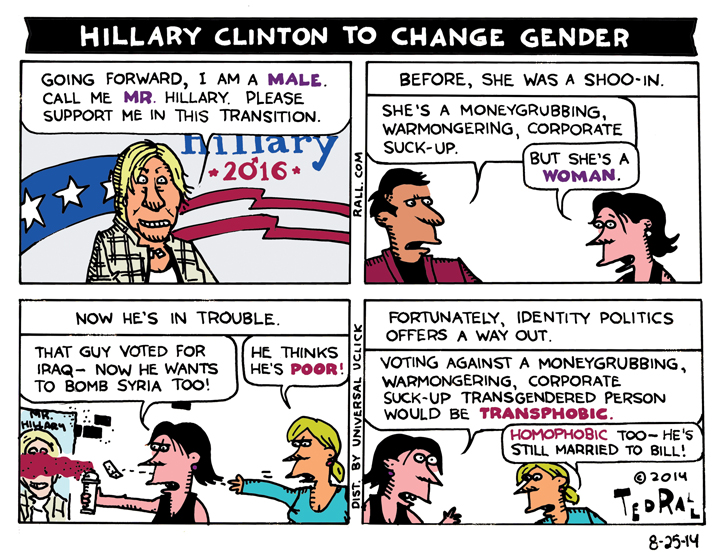
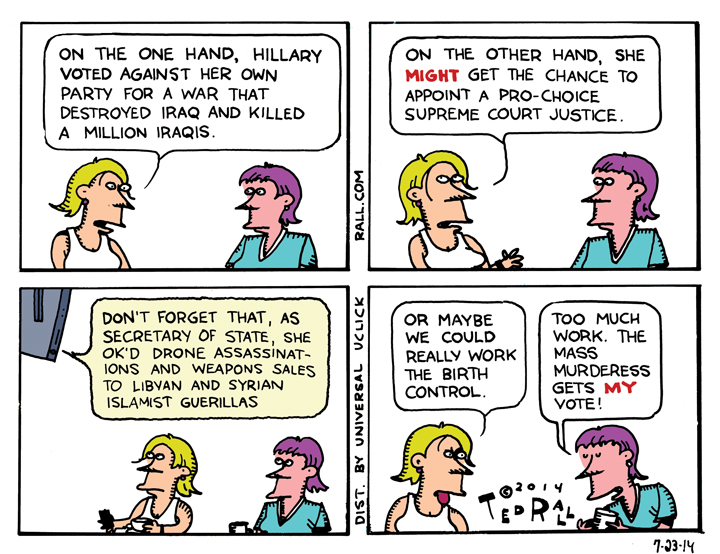
Hillary Clinton supporters are resurrecting an argument made by Obamabots to progressives: Despite her support for right-wing policies like NAFTA and voting for war against Iraq, liberals should vote for her because she might get to fill a vacancy on the Supreme Court that might determine whether abortion remains legal. I’m pro-choice, but I’m nauseated by the thought that the right to an abortion necessitates voting for someone like Hillary Clinton, who has the blood of millions of innocent people on her hands.