SYNDICATED COLUMN: Republican Socialists, Democratic Capitalists

GOP Pols Exploit Anti-Wall Street Rage

Newt Gingrich made a name for himself as the right-wing ideologue who led the 1994 “Republican Revolution.”

What a difference the wholesale collapse of international capitalism makes.

Forget 9/11—everything changed on 9/14/08, when Lehman Brothers hit the skids. Millions lost their jobs. Millions more lost their jobs. And the government refused to help them.

The government’s masters, the bankers, wouldn’t let them. They wanted all that taxpayer money for themselves.

The system was finally exposed as the corrupt, inefficient, cruel pseudodemocracy that we on the Left had always known it was. More than three years have passed yet neither the political class nor its corporate bosses have found the wherewithal to sate the anger of America’s roiling masses with the traditional bundle of social programs. To the contrary, the powers that be are calling for austerity, for gutting what’s left of the safety net.

They’re stealing the rope with which we will hang them.

Political disintegration is disruptive and painful. But it sure is entertaining.

The rise of the Republican primary season’s Anti-Capitalist Brigades is the center ring of this circus of death. At the head of the anti-Romney cadres is one of Newt’s well-heeled supporters, who is dropping a cool $3 million on an ad blitz that denounces Mitt Romney for engaging in slash-and-burn capitalism. (Is there another kind?)

“There’s a company in The Wall Street Journal today that Bain [Capital, Romney’s company] put $30 million into, took $180 million out of and the company went bankrupt,” Newt Gingrich said on January 10th. “And you have to ask yourself: Was a six-to-one return really necessary? What if they only take $120 million out? Will the company still be there? Will 1,700 families still have a job?”

Good questions all. But the heartless beasts who populate Wall Street venture capital firms don’t worry about the blood and tears they leave in their wake. Like all vampires they feast and flee. Their pet Republicans don’t care either. Not usually.

“I think there’s a real difference between people who believe in the free market and people who go around, take financial advantage, loot companies, leave behind broken families, broken towns, people on unemployment,” the former speaker continued.

Not much difference. Not when you think about it. Still, this is a serious slap-the-forehead moment.

Bear in mind, Gingrich is still a man of the Right. A few weeks ago his proposal for forced child labor of impoverished waifs marked the Dickensianest moment of the 2011 Christmas shopping season.

Newt isn’t the only Republican presidential candidate attacking capitalism’s sacred right to loot and pillage. Texas governor Rick Perry, whose brain freezes and loutish yucks over his role as the nation’s top executioner of lower-class misérables (and at least one innocent man) make his predecessor George W. Bush look like Adlai Stevenson, calls buyout specialists like Romney “vultures” who “swoop in…eat the carcass, and…leave the skeleton” of companies they target. Romney, he said, is a “buyout tycoon who executed takeovers, bankrupted businesses, and sent jobs overseas while killing American jobs.”

“Governor Romney enjoys firing people—I enjoy creating jobs,” added Jon Huntsman.

These are Republicans?

What’s up?

“For all the talk about this being a center-right nation, there’s a realization that Americans are uncomfortable with excessive greed and the kind of ruthless, screw-the-workers style of capitalism Romney used to get rich,” Steve Benen writes in Washington Monthly.

Greg Sargent of The Washington Post chimes in: “The leading GOP candidates are on record arguing that Romney’s practice of [capitalism]—which he regularly cites as proof of his ability to create jobs, as a generally constructive force and even as synonymous with the American way—is not really capitalism at all, but a destructive, profit-driven perversion of it. Thanks to them, this is no longer a left-wing argument.”

(Actually, destruction and profit-taking are the essential cores of capitalism. But why quibble? Everyone agrees that capitalism sucks. Yay!)

Times are changin’. According to polls, communism is more popular than Congress. So why isn’t the party of the left jumping on the Wall Street-bashing bandwagon?

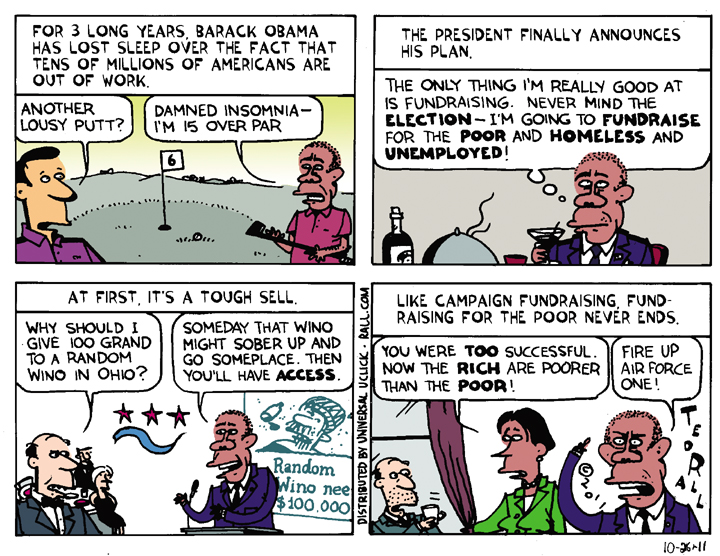
Throughout the 2008 campaign and his presidency Barack Obama has taken pains to reassure the 1 percent that if he’s not exactly one of them he’ll look out for their bank accounts. Certainly he has enacted policies that have increased the gap between rich and poor while sucking the life out of the dry husk of the middle class.

Meanwhile, revolution looms.

Why don’t the Democrats see it? Don’t they understand that capitalism is discredited? Newt Gingrich does. So do most Republicans.

It comes down to a simple explanation: Everything has changed, but not the Democrats. They’ve always been slower than the GOP to recognize the shifting winds of American politics, slower to respond, inept when they try.

We used to be a center-right country. Now we’re left-right. Soon we’ll be left-left. Both the Dems and the Reps will be left behind. In the meantime, watch the dying Republicans make the most of an agenda that ought to belong to the dying Democrats: bashing the rich and greedy.

If nothing else, it’ll be entertaining.

(Ted Rall is the author of “The Anti-American Manifesto.” His website is tedrall.com.)

COPYRIGHT 2012 TED RALL
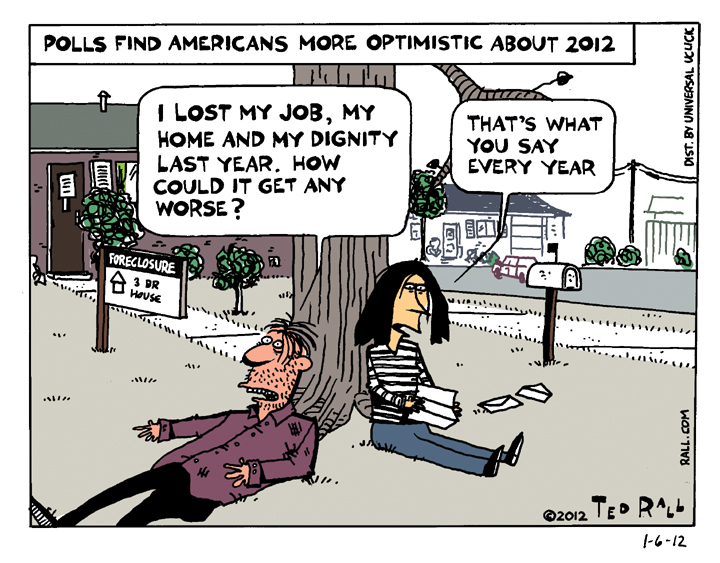
Boundless Optimism

Year after year, things get worse. Year after year, Americans are optimistic about the future.

Sorry

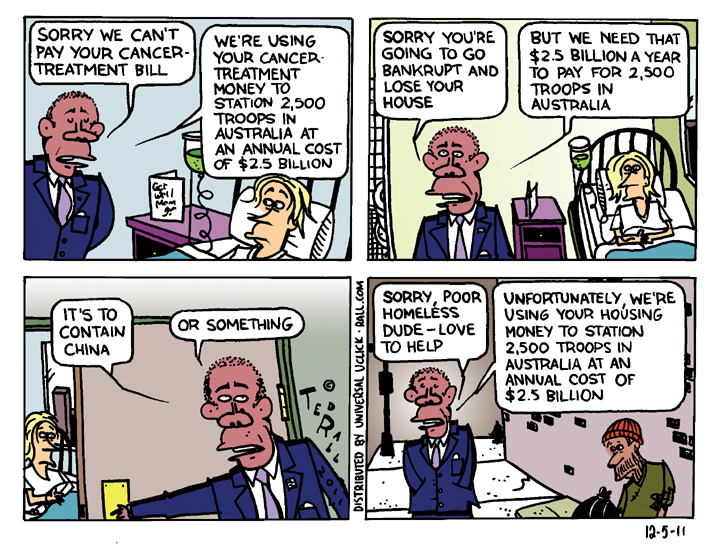
Obama announced that the U.S. will station 2,500 U.S. troops in northern Australia.

Back to Normal

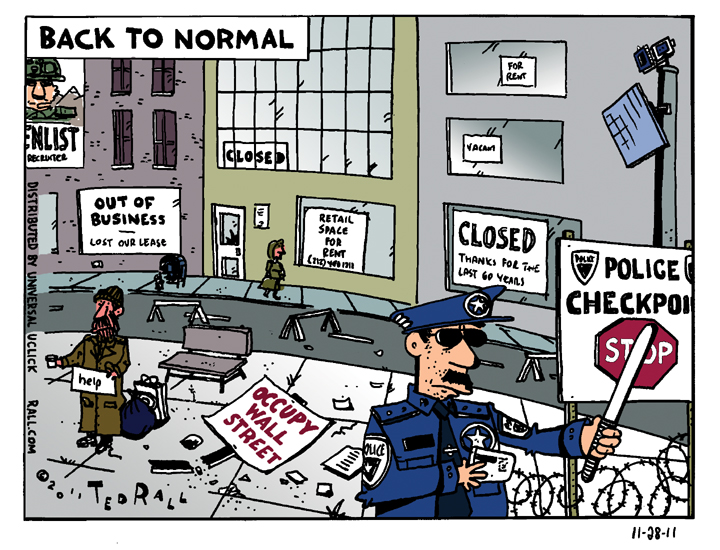
Some people celebrate as Occupy Wall Street is evicted from Zuccotti Park.

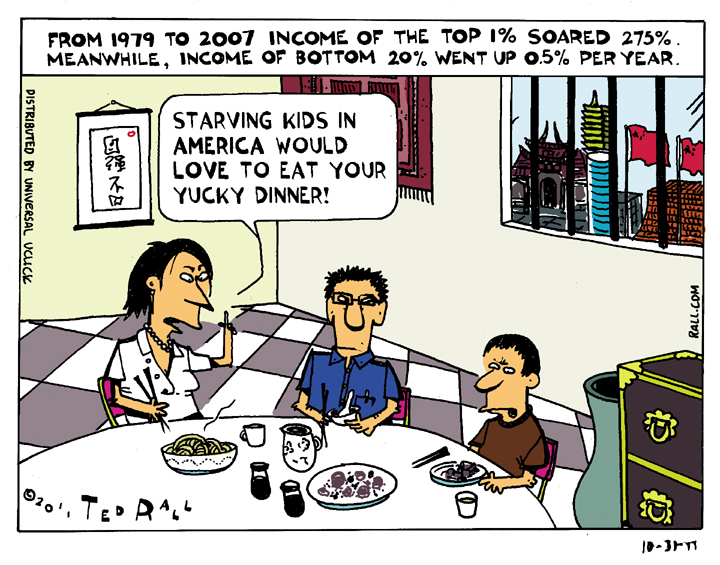
Starving Kids in America

From 1979 to 2007 the income of the top 1% soared 275%. Meanwhile, income of the bottom 20% went up 0.5% per year.

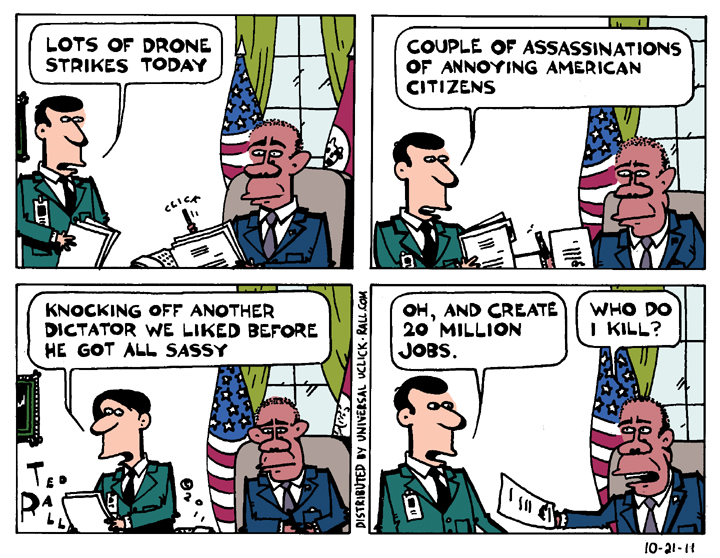
Born to Kill

Barack Obama is running Murder, Inc. No wonder he’s too distracted to run the country.

SYNDICATED COLUMN: Quit Whining About Student Loans

Time for #OWS to Broaden Its Appeal

It has been 30 days since Occupy Wall Street began. The movement hasn’t shaken the world à la John Reed—not yet—but at one thousand occupations and counting, it can’t be ignored.

OWS has become so impressive, so fast, that it’s easy to forget its half-assed origin. No matter. The fact that the French Revolution was partly set off by the drunken ravings of the Marquis de Sade hardly reduces its importance.

Soon the Occupiers will have to face down a number of practical challenges. Like weather. Winter is coming. Unless they move indoors, campers at Occupy Minneapolis and Occupy Chicago will suffer attrition. But indoor space is private property. So confrontation with the police seems inevitable.

As I saw at STM/Occupy DC, there is an ideological split between revolutionaries and reformists. Typical of the reformists: This week OWSers urged sympathizers to close their accounts with big banks like Citibank and Bank of America and move their savings to credit unions and local savings and loans. If revolutionaries get their way, there will be no banks. Or one, owned by the people.

There is no immediate rush, nor should there be, to issue demands. The horizontal democracy format of the Occupy movement’s General Assemblies is less about getting things done than giving voices to the voiceless. For most citizens, who have been shut out of politics by the fake two-party democracy and the corporate media, simply talking and being heard is an act of liberation. At some point down the road, however, the movement will come to a big ideological fork: do they try to fix the system? Or tear it down?

The Occupiers don’t have to choose between reformism and revolution right away—but they can’t wait too long. You can’t make coherent demands until you can frame them into a consistent narrative. What you ultimately want determines what you ask for in the time being—and how you ask for it.

Trotsky argued for the issuance of “transitional demands” in order to expose the uncompromising, unjust and oppressive nature of the regime. Once again, an “epoch of progressive capitalism” (reformism, the New Deal, Great Society, etc.) has ended in the United States and the West. Thus “every serious demand of the proletariat” de facto goes further than what the capitalist class and its bourgeois state can concede. Transitional demands would be a logical starting point for an Occupy movement with a long-term revolutionary strategy.

Both routes entail risk. If the Occupiers choose the bold path of revolution, they will alienate moderates and liberals. The state will become more repressive.

On the other hand, reformism is naïve. The system is plainly broken beyond repair. Trying to push for legislation and working with establishment progressives will inevitably lead to cooption, absorption by big-money Democrats and their liberal allies, and irrelevance. (Just like what happened to the Tea Party, a populist movement subsumed into the GOP.)

Revolution means violence in the streets. Reform means failure, and the continued, slow-grinding violence by the corporate state: poverty, repression, injustice.

At this point, job one for the movement is to grow.

I don’t mean more Facebook pages or adding more cities. The day-to-day occupations on the ground need to get bigger, fast. The bigger the occupations, the harder they will be for the police to dislodge with violent tactics.

More than 42 percent of Americans do not work. Not even part-time. Tens of millions of people, with free time and nothing better to do, are watching the news about the Occupy movement. They aren’t yet participating. The Occupiers must convince many of these non-participants to join them.

Why aren’t more unemployed, underemployed, uninsured and generally screwed-over Americans joining the Occupy movement? The Los Angeles Times quoted Jeff Yeargain, who watched “with apparent contempt” 500 members of Occupy Orange County marching in Irvine. “They just want something for nothing,” Yeargain said.

I’m not surprised some people feel that way. Americans have a strong independent streak. We value self-reliance.

Still, there is something the protesters can and must do. They should make it clear that they aren’t just fighting for themselves. That they are fighting for EVERYONE in “the 99 percent” who aren’t represented by the two major parties and their compliant media.

OWSers must broaden their appeal.

Many of the Occupiers are in their 20s. The media often quotes them complaining about their student loans. They’re right to be angry. Young people were told they couldn’t get a job without a college degree; they were told they couldn’t get a degree without going into debt. Now there are no jobs, yet they still have to pay. They can’t even get out of them by declaring bankruptcy. They were lied to.

But it’s not about them. It’s about us.

The big point is: Education is a basic right.

Here is an example of how OWSers could broaden their appeal on one issue. Rather than complain about their own student loans, they ought to demand that everyone who ever took out and repaid a student loan get a rebate. Because it’s not just Gen Y who got hosed by America’s for-profit system of higher education. So did Gen X and the Boomers.

No one will support a movement of the selfish and self-interested.

The Freedom Riders won nobility points because they were white people willing to risk murder to fight for black people. Occupiers: stop whining about the fact that you can’t find a job. Fight for everyone’s right to earn a living.

The Occupy movement will expand when it appeals to tens of millions of ordinary people sitting in homes for which they can’t pay the rent or the mortgage. People with no jobs. Occupy needs those men and women to look at the Occupiers on TV and think to themselves: “They’re fighting for ME. Unless I join them, they might fail.”

The most pressing issues for most Americans are (the lack of) jobs, the (crappy) economy and growing income inequality. The foreclosure and eviction crisis is also huge. OWS has addressed these issues. But OWS has not yet made the case to the folks watching on TV that they’re focused like a laser.

It takes time to create jobs. But the jobless need help now. The Occupy movement should demand immediate government payments to the un- and underemployed. All foreclosures are immoral; all of them ruin neighborhoods. The Occupy movement should demand that everyone—not just victims of illegal foreclosures—be allowed back into their former homes, or given new ones.

For the first time in 40 years, we have the chance to change everything. To end gangster capitalism. To jail the corporate and political criminals who have ruined our lives. To save what’s left of our planet.

The movement must grow.

Nothing matters more.

(Ted Rall is the author of “The Anti-American Manifesto.” His website is tedrall.com.)

COPYRIGHT 2011 TED RALL

keyboard_arrow_up
css.php