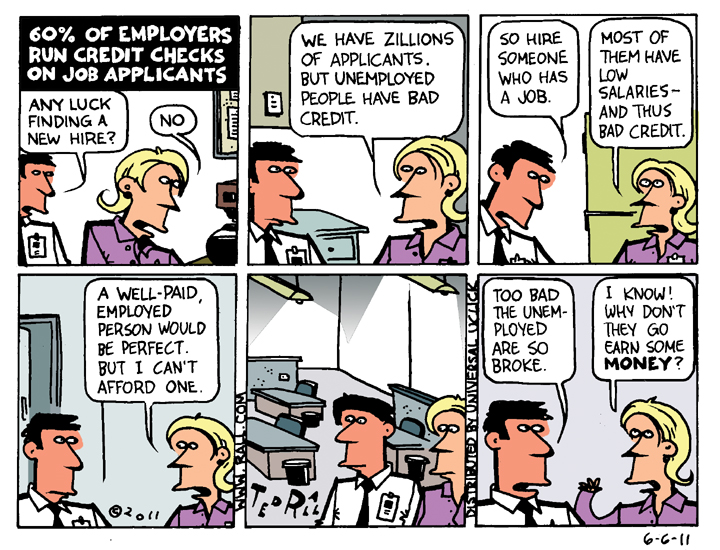
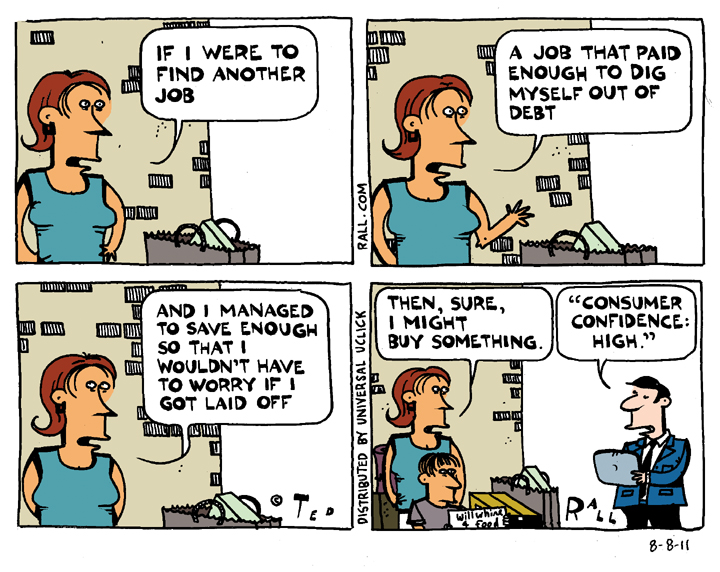
Consumer confidence hits new lows. Gee, what a surprise–no one has any money, nor any prospect of earning any.
Consumer confidence hits new lows. Gee, what a surprise–no one has any money, nor any prospect of earning any.
Voters Focus on Spending at Just the Wrong Time
Ross Douthat, the conservative columnist who elevates bland to middle-brow art for The New York Times, thinks Republicans have overreached in their showdown with Obama over the debt ceiling. “[The Republicans’] inability to make even symbolic concessions has turned a winning hand into losing one,” he says.
Advantage, according to Douthat, representing the mainstream media: Obama.
Of course, Obama had already agreed to begin dismantling Social Security and Medicare, surrenders Republicans have craved for decades. If he pulls off this “victory” Obama will have done more damage to the Democratic Party and its core values than any president in our lifetimes. How will he promote what Douthat fears will be a “victory”? I wonder.
Or, to lift a line from “Double Indemnity”: I wonder if I wonder.
Back a few pages, Times reporter Jesse MacKinley finds himself in the curious position of writing that no one really cares about a story that has dominated the headlines for weeks.
“Indeed, the drama of whether the government will raise the debt ceiling (to the chagrin of some conservatives demanding tighter financial belts) or allow it to remain as is (to the horror of the administration and economists who predict financial ruin) seemed largely lost on a populace involved in more pressing—and more pleasant—summer distractions,” asserts MacKinley.
To summarize:
No one cares about the debt ceiling.
And:
Among the few political geeks who understand what’s going on, much less have an opinion, the tide is allegedly turning in favor of Obama because he’s willing to compromise and the Tea Party-led GOP isn’t.
Conventional wisdom floggers like Douthat say that if Congress can’t strike a deal and economic consequences follow—a reduction in the ratings of U.S. government-issued securities and a panic in the securities market—voters will hold Republicans accountable in 2012. Even if things don’t turn that far south, the GOP will pay for their intransigence. Obama wins in a cakewalk.
I’m not so sure.
In the same way that generals usually refight the last war, mainstream political pundits often apply old scenarios to new situations. This is not 1995, when then-House Speaker Newt Gingrich orchestrated a shutdown of the federal government that set the stage for Bill Clinton’s reelection the following year.
Without a doubt, the Republicans’ willingness to imperil the pure platinum credit of Treasury notes and bonds is reckless and irresponsible. There is also no denying their naked hypocrisy and intellectual dishonesty. These so-called “deficit hawks” voted 19 times to raise the debt ceiling by $4 trillion.
If Republicans were serious about balancing the federal budget they’d start by slashing the military, which accounts for 54 percent of discretionary spending—and which hasn’t done anything to defend the U.S. from a real enemy since 1945. The Department of Homeland Security, a vast new bureaucracy created by Bush after 9/11 in order to make us take off our shoes, should be eliminated.
Moreover, the middle of the biggest economic meltdown since the industrial revolution is no time to be cutting debt. Read your Keynes: governments are supposed to spend their way out of downturns, and pay down debt during upswings.
Republicans, it seems, are trying to finish off an economy that is already gravely wounded.
Politically, however, I think they’re onto something. Year after year of warnings about the expanding national debt—remember Ross Perot’s charts?—the American people are finally, genuinely alarmed about the pace and scale of government spending. The current national debt of $14 trillion isn’t the magic number that flips some sort of switch in the public.
It’s simply that, at certain times, public opinion on an issue that has been around for years, divisive and apparently intractable, suddenly coalesces into widespread consensus. Climate change. Gay marriage. The war in Afghanistan, which was so popular in 2008 that Obama won by promising to expand it, but is now seen as stale and unwinnable.
Win or lose on the debt ceiling showdown, GOP strategists are betting than voters will reward them for taking an uncompromising stand on spending against a president who has increased the national debt faster than any of his predecessors. It’s not 100 percent—but I’d say it’s a pretty safe bet.
This is the worst possible time for the American people to start worrying about out-of-control federal spending. But it’s good for the GOP.
(Ted Rall is the author of “The Anti-American Manifesto.” His website is tedrall.com.)
COPYRIGHT 2011 TED RALL
Many Foreclosed Houses Are Infested by Mold
The next time someone tells you that capitalism is efficient, remember the mold houses.
I used to be a banker. Some of my customers had trouble making their loan payments. We usually had recourse to some sort of collateral—often real estate. But my bank really didn’t want to foreclose.
“We’re bankers,” my boss told me the first time this issue came up. “Not landlords.”
Back in the 1980s most banks held this view. Bankers sat on their butts in air-conditioned offices. They didn’t want to manage vacated properties, much less try to sell them. They understood banking. Banking was a straightforward business: take deposits, issue loans, collect the difference in interest as profit.
It was boring. Just the way they liked it.
My bank did a lot to avoid declaring a default. We lowered interest rates. We allowed skipped payments. Sometimes we even reduced principal.
Banking became exciting during the 1990s. Glass-Steagall got repealed, allowing formerly staid bankers to compete with high-flying Wall Street financiers in the securities business. Bank consulting firms invented big new fees for services that used to be free, like using an ATM.
Banks issued millions of home loans to borrowers whom they knew couldn’t afford to pay them back. Crédit Suisse estimates that such “liars’ loans” accounted for 49 percent of originations by 2006. Why they’d do it? Like mobsters, bank executives were “busting out” their companies—generating false short-term profits in order to collect annual performance bonuses. By the time the toxic chickens came home to roost, as they did in the form of the September 2008 financial crisis, they and their paychecks had moved on.
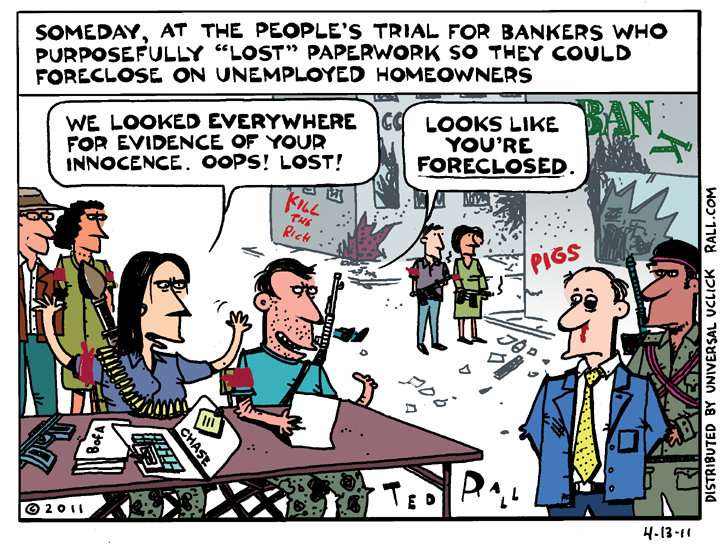
As the global financial system was in the midst of total collapse, greedy bankers conjured up a way to profit from the very misery they had caused. Rather than work with distressed homeowners who faced foreclosure (for example, refinancing subprime and adjustable rate mortgages into old-fashioned 30-year fixed mortgages) they dragged out the process in order to collect more late fees.
Banks were eager to foreclose. They were merciless. They evicted homeowners while they were on active-duty serving in Iraq and Afghanistan, a violation of federal law. They even evicted people who didn’t owe them a cent.
Now banks are sitting on top of nearly a million homes. “All told, [banks] own more than 872,000 homes as a result of the groundswell in foreclosures, almost twice as many as when the financial crisis began in 2007, according to RealtyTrac, a real estate data provider,” reports The New York Times. “In addition, they are in the process of foreclosing on an additional one million homes and are poised to take possession of several million more in the years ahead.”
Which is where the wonderful tragic tale of the mold houses comes in.
“In most homes,” reported NPR recently, “as residents go in and out and the seasons change, natural ventilation sucks moisture up to the attic and out through the roof. It’s called the ‘stack effect.’ And in many parts of the country, it’s driven by air conditioning in the summer and heat in the winter. But no one is going in or out of most foreclosed homes—regardless of climate—and the effects can be devastating.”
Far from the profit center imagined by freshly-minted analysts with MBAs, empty houses depreciate faster than a new car driving off the lot. They fall apart quickly. Mildew and mold sets in, some of it toxic.
“In some states, it’s estimated that more than half of foreclosed homes have mold and mildew issues,” reported NPR. “Realtors across the country say they’re seeing the problem in everything from bungalows to mansions.”
Turns out those old-fashioned bankers were on to something. Bankers shouldn’t become landlords.
A minor mold problem starts at $5,000 and can easily run $20,000 or more. Considering that the average house in the Midwest is valued at $136,000, that’s not insignificant. Many houses with toxic mold have to be demolished.
Greed may be good. But it doesn’t always pay.
(Ted Rall is the author of “The Anti-American Manifesto.” His website is tedrall.com.)
COPYRIGHT 2011 TED RALL
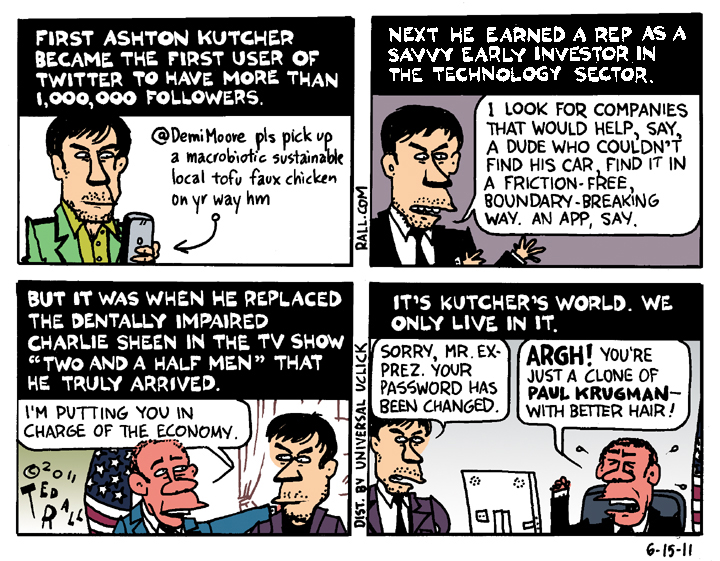
Charlie Sheen flopsÑand Ashton Kutcher steps in…just about everywhere.

If The Kiss famously caught by a photographer on V-J Day in Times Square happened today, it might look and feel different. The death of Osama bin Laden does nothing to ease the economic pain of depression and collapse.
Why Not Link Pols’ Pay Level to Ours?
Most Americans don’t like Moammar Kadafi or Mahmoud Ahmedinejad. But that might change if they knew their paychecks. The leaders of Libya and Iran get $9,516 and $3,000 a year annually, respectively.
Obama collects $5,505,509—a whopping $22,022 per day.
Who’s the real out-of-touch dictator?
As the U.S. enters its third year of economic collapse, real unemployment has surged past levels that triggered revolts in Tunisia and Egypt. Yet neither the President nor members of Congress seem worried. They’re not even discussing the possibility of a bailout for the one-third of the workforce that is in effect structurally unemployed. Do you wonder why?
Maybe they don’t know what’s going on. As the saying goes, it’s a recession when you’ve gotten laid off. For members of Congress, who are raking it in, these are boom times.
Congressmen and Senators are insulated by huge salaries—$174,000 and up—that put them out of touch with and unaware of the problems of the 97 percent of Americans who earn less. Out of 535 members of Congress, 261 are millionaires.
It can’t be easy for Senator Dianne Feinstein, Democrat of California, to feel our pain. According to campaign disclosure documents filed in 2010, her net worth is somewhere between $46 million and $108.1 million—and she’s only the 10th richest member of Congress. The top honor goes to Representative Darrell Issa, also from the Golden State but a Republican. Estimates of Issa’s net worth range between $156.1 million and $451.1 million.
Years ago the SEC floated the idea of a maximum wage for the CEOs of publicly traded corporations. If their pay was capped at, say, 20 times that of the lowest-paid employee, it wouldn’t be long before the whole pay scale went up.
The SEC pay cap didn’t go anywhere. But there’s the germ of a smart—and fair—idea there, one that could help Congressmen feel what it’s like to be an ordinary American during a time of poverty and mass layoffs.
Our elected representatives set the minimum wage, work standards, healthcare benefits, union organizing rules and thousands of regulations that determine the salaries and working conditions for tens of millions of American workers. As things stand now, the president and members of Congress have no personal incentive to improve those things for us. After all, they’re all set. They’re rich.
Paul Abrams writes: “Many Republicans ran for office declaring they would run the government ‘like a business’…
If they are serious, however, there is one way [Congress] can operate like a business. Cut their base pay and provide large incentive bonuses should the economy hit certain goals.” A nice thought, but why not follow this line of thinking to its logical conclusion?
It is high time to set a Maximum Wage for Congress, the president and other high-ranking elected representatives. The Maximum Wage for Congress should be set at the lowest pay received by an American citizen.
As long as one American citizen is homeless and unemployed, the Maximum Wage would be zero.
Similarly public officials ought to receive a Maximum Benefit set at the lowest/worst level received by an American citizen. If one U.S. citizen receives no healthcare benefits, so it would go for members of Congress. If one U.S. citizen does not have free access to a gym, members of Congress would lose theirs.
I have a hunch that our lives would get better in the blink of an eye.
Of course I could be wrong. Perhaps it’s really true that America somehow can’t afford socialized healthcare (even though there’s always plenty of cash for wars). If that’s the case, personal incentives won’t convince Congress.
Still, that’s OK. It’s only fair that our leaders be forced to tough it out as much as we do.
We’re all familiar with the arguments for paying six-figure salaries to politicians:
They have to maintain two homes, one in D.C. and one in their home district. It reduces the temptations of corruption. They should focus on their jobs, not how to pay their kids’ college tuition. People who are not wealthy ought to be able to afford to serve. The best and brightest won’t want the job if the pay is terrible.
To which I say:
Live modestly. Couchsurf. If you take a bribe, you’ll be jailed—so don’t. Everyone worries about bills; shouldn’t Congressmen? The current salary structure has resulted in a Congress full of millionaires. As for attracting the best and brightest—look at the fools we’ve got now.
Besides, there is no reason why the president and his congressional cronies shouldn’t be able to keep their current wonderful salaries and perks under a Maximum Wage. All they’d have to do is create an economy that shared those bounteous treats with everyone else.
(Ted Rall is the author of “The Anti-American Manifesto.” His website is tedrall.com.)
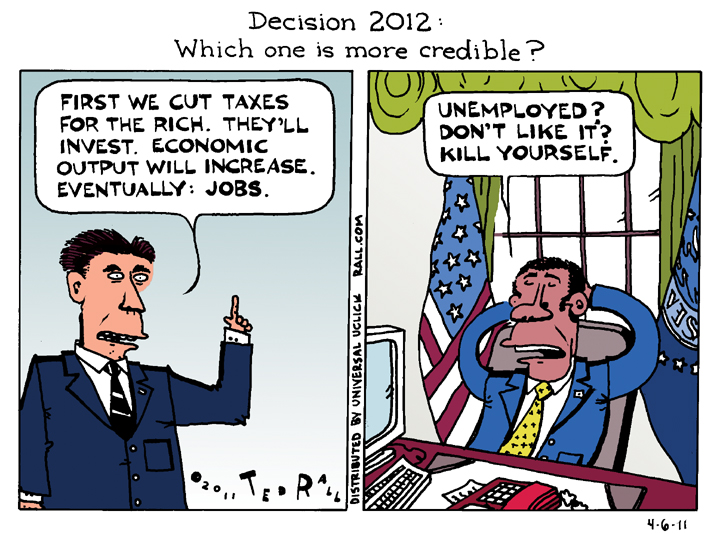
Jobs are the big issue in the next election. Which party has the more the credible plan? The GOP, with tax cuts for the rich? Or the Democrats, with nothing whatsoever?
Can Obama Get Reelected?
Usually I don’t care about political horseraces. Yet I am fascinated by Obama’s reelection bid. Never mind what’s good for the country. I’m dying to hear him make his case for another four years.
I don’t pretend to be able to predict the future. But I have a rich imagination—and I still can’t begin to guess how the president can convince a majority of voters to choose him over the Republican nominee whether he be Mitt Romney or she be Michele Bachmann.
Obama is good with words. But what can he possibly say for himself after this first fiddling-while-Rome-burns term?
The president only has one major accomplishment to his credit: healthcare reform. However—assuming Republicans don’t repeal it—it doesn’t go into effect until 2014. Which, from Obama’s standpoint, actually helps him. After people find out how it transforms the First World’s worst healthcare system into something even crappier and more expensive, they’ll be burning him in effigy.
“Socialized” (if only!) healthcare has driven away the Reagan Democrat swing voters who formed half of Obama’s margin of victory in 2008. Unless the GOP nominates some total loon (hi Michele) or past-due retread (what up Newt) these ideological reeds in the wind will blow Republican.
The other major component of the Obama coalition, young and reenergized older liberals, see ObamaCare as a right-wing sellout to corporations. Nothing less than single-payer would have satisfied them. On other issues it seems that Obama has missed few opportunities to alienate the Democrats’ liberal base.
“The combination of Afghanistan and Libya could bring a bitter end to the romance between Democratic liberals and Obama,” Steve Chapman writes in Reason magazine. “Many of them were already disappointed with him for extending the Bush tax cuts, bailing out Wall Street, omitting a public option from the healthcare overhaul, offering to freeze domestic discretionary spending, and generally declining to go after Republicans hammer and tong.”
Chapman predicts a strong primary challenge to Obama’s left flank—someone like Russ Feingold.
Lefties are also angry about Obama’s other lies and betrayals: keeping Gitmo open, signing off on assassinations and even the torture of U.S. soldiers (PFC Bradley Manning), redefining U.S. troops in Iraq as “support personnel.” Just this week he reneged on his promise to get rid of Bush’s kangaroo courts and put 9/11 suspects on trial.
Everyone—left, middle and right—is furious about his Herbert Hoover-like lack of concern over the economy. While the multimillionaire president blithely talks about a recovery as he heads off to golf with his wealthy friends, unemployment is rising and becoming structural. Obama will surely pay for the disconnect between reality (no jobs, shrinking paychecks, hidden inflation) and the rosy rhetoric coming out of the White House and U.S. state media.
What, exactly, will be Obama’s 2012 sales pitch? I seriously want to know. Think about it: how many other presidents have been so disappointing that they had to distribute lists of their accomplishments so their supporters would have talking points?
Among the highlights of one of these enumerations going around the Internet are:
“1. Ordered all federal agencies to undertake a study and make recommendations for ways to cut spending.
“5. Families of fallen soldiers have expenses covered to be on hand when the body arrives at Dover AFB.
“14. Removed restrictions on embryonic stem-cell research.”
I’m in favor of these things. (Although I’m not sure why, with real unemployment over 20 percent and the NSA rifling through my email, I should care about numbers 76—”appointment of first Latina to the Supreme Court”—or 86—”held first Seder in the White House.” Really?)
Will micro-mini-accomplishment lites be enough to pry liberal asses off the sofa on Election Day? I think not. On the Big Issues That Really Matter—war, the economy, civil liberties—Obama is a right-wing Republican. He’s only a Democrat on the little stuff. Liberals won’t turn out big for Obama in 2012.
That goes double for the youth vote, a big bloc for O in 2008. From student loan debt to unemployment (which hits Americans under 30 even harder than other age groups), Obama hasn’t delivered. They’ll sit on their hands.
“We’ve always known that lasting change wouldn’t come quickly or easily,” began Obama’s official campaign announcement.
“Always known”?
Remember those Soviet-style “Hope” and “Change” posters from ’08, presenting the skinny Columbia grad as a postmodern Messiah for a nation ravaged by eight years of Bush? Just guessing, but somehow I doubt Obama’s propaganda would have gone over as easily with the caption “Change That Won’t Come Quickly or Easily.”
“It begins with us,” will apparently be one of the slogans for Obama-Biden 2012.
That’s the problem Obama faces next year. In 2008 he told us it was going to begin with him.
(Ted Rall is the author of “The Anti-American Manifesto.” His website is tedrall.com.)
COPYRIGHT 2011 TED RALL