
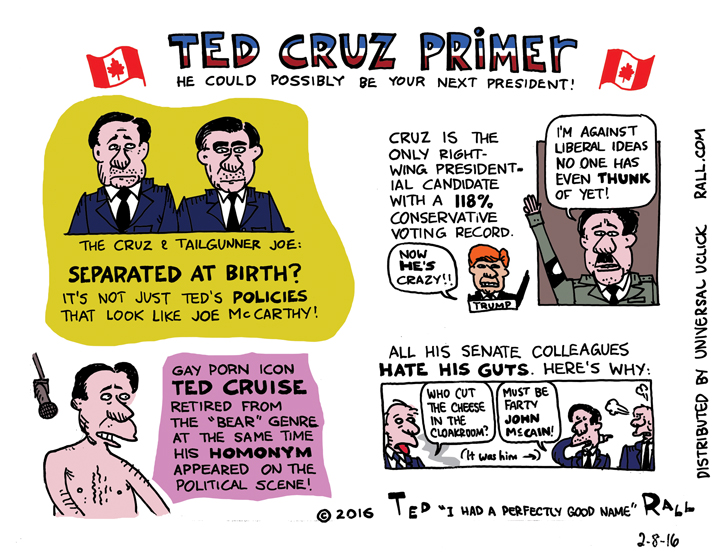
Ted Cruz upset Donald Trump in the Iowa Caucus. Who is he? What do you need to know about our possible next president?
Ted Cruz upset Donald Trump in the Iowa Caucus. Who is he? What do you need to know about our possible next president?

In an aggressive move that recalled the Bush campaign in its Florida 2000 judicial coup d’etat, Hillary Clinton declared victory in the incredibly tight Iowa Caucus a full day before the state officially announced the results and before any TV network issued a projection.

The independent senator from Vermont says the economic system is rigged against working-class Americans. He’s right.
The electoral political system is a subsidiary of those who rule the economy. Which is why Bernie Sanders never stood a chance. The political system was rigged against him.
And yet, despite the formidable institutional obstacles stacked against him, Sanders is doing great: largely considered a shoo-in to win New Hampshire, leading in Iowa, closing the gap nationally. Surprised pundits are marveling at his popular momentum, ground organization and fundraising prowess. There is now a credible path to the Democratic nomination and, if he runs against GOP frontrunner Donald Trump, to the White House.
Center-right Hillaryworld wants to know: how did this happen?
Leftists wonder: is this cause for hope?
It is an amazing story. Everyone in a position to block Sanders’ campaign did everything they could to sabotage him.
Knowing that coverage is the essential oxygen of politics, the media mostly ignored him. By one measure, corporate media gave Trump 23 times more coverage than Sanders! On the few occasions when they spilled a little ink on Bernie, it was to insult him and his socialist politics. (My personal Exhibit A was a New York Times piece that carried a photo that emphasized his bald spot.)
Marginalization always used to work. Remember John Edwards? His 2008 primary campaign was doomed because TV networks refused to cover him. But the media’s cold shoulder isn’t hurting Bernie.
In the bag for Hillary Clinton and remembering the lesson of 2008 — the more voters hear from her the less they like her — the Democratic National Committee fed her aura of inevitability by refusing to give Bernie the exposure and legitimacy offered by a robust round of debates. Debates, the few of them the manipulative DNC chair and Hillary toady Debbie Wasserman Schultz allowed to take place, were scheduled for the nights known for low television viewership.
That tactic backfired. Hillary did better than Bernie in the first three debates. But no one saw her flex her foreign-affairs muscles.
Bernie got nothing but chicanery from the DNC, to the point that the Sanders camp had to sue to access its own voter data. Which only reinforced his image as a rebel — not easy for a U.S. senator — and further endeared him to his supporters.
Despite everything, Sanders could win.
Moreover, it’s not just Sanders the candidate who is doing well. His “unusual” politics are becoming usual.
Sanders’ self-labeling as a democratic socialist — universally considered political suicide in the United States — is catching on. In one of the most surprising poll results of the 2016 race, a recent survey of likely Iowa caucus-goers finds that more of them call themselves socialist (43%) than capitalist (38%).
Where did Iowa’s socialists come from? They certainly weren’t indoctrinated by the mainstream system. No ideology, not even radical Islam, has come under heavier systemic assault than socialism. From the Palmer Raids of a century ago to McCarthyism to the Tea Party’s (sadly mistaken) insinuations that President Obama is a secret red, socialism has been the bête rouge of mainstream American politics: reviled in ridiculous movies, misrepresented and excluded from acceptable public debate, even on the watered-down liberalism that passes for a “left.” Even in schools, socialism and communism are lied about — if they’re mentioned at all.
My friend the film critic Cole Smithey calls what we’re seeing “the failure of propaganda.”
It’s certainly a notable moment. The ruling elite’s old tricks are indeed failing them. But it’s too early to declare propaganda dead and gone. Propaganda works. That’s why those in power keep using it.
Here’s what I think is really going on: old institutions have been discredited. Sanders’ growing support and Iowa’s surprisingly socialist hordes reflect public contempt for everyone in charge.
Pundits have mostly focused on populist anger on the right, embodied by the wild neofascist-lite pronouncements of Donald Trump. But there is just as much rage on the left excluded from the Democratic Party since George McGovern’s 1972 defeat to Richard Nixon. Divided or not, one thing Americans can agree upon is that they don’t trust government — on the right to leave them alone, and on the left to help them out.
Propaganda is still effective. But when it’s broadcast by elites who are widely despised, its effect is opposite of what’s intended.
Hillary Clinton racks up endorsements from unions and left-leaning organizations like Planned Parenthood. In the past, these would have given her a boost. This year, it reinforces a negative framing of her as bought and paid for by special interests.
In days of yore the endorsement of a young actress starring in a hip TV show would have been a feather in Hillary’s cap. In 2016, it’s hard to imagine how poor Lena Dunham will wash away the stink of Hillary’s hard-edged corporatism.
Hillary has an incredible resume: first lady, senator, secretary of state. This year, she’d be better off as an outsider. Credentials subtract from her credibility. What’s wrong now, voters feel, is partly her fault.
Bernie Sanders’ campaign gets accused of improperly accessing Hillary’s data on DNC servers. In the old days, the smell of an ethical breach might have doomed his candidacy. Now, because Democratic voters are disgusted by the DNC’s brazen attempt to fix the primaries for Hillary, the controversy looks like another sleazy attack on Bernie the outsider.
Because the public distrusts journalists, the media blackout works in Bernie’s favor. Through the lens of this new politics of contempt, if the powers that be want to censor the “wild and crazy” socialist senator, he musn’t be that bad after all.
What Bernie really needs is for Hillary to receive Obama’s endorsement (which she obviously, foolishly, wants.) That would be the end of her.
The same reverse-propaganda paradigm holds true for socialism. As America’s continuously lauded state religion, capitalism takes the blame for all its associated evils: layoffs, stagnant wages, home foreclosures, health insurance companies that don’t pay claims. If socialism is anti-capitalism, an alienated populace has evidently concluded, it doesn’t matter that they don’t know very much about it. Socialism can’t be that bad.
If elected, President Sanders will be ineffective. Either that, or he’ll sell us out. Such is the nature of this system: it chews up and spits out those who don’t go along to get along.
A Sanders victory would nonetheless mark an important prerevolutionary moment. As Ché Guevara observed, people will not resort to armed struggle before they exhaust every last opportunity to nonviolently reform the existing system by casting their votes in elections.
A Sanders Administration would be our best, last, 100% doomed shot at fixing a rigged regime.
(Ted Rall is the author of “Bernie,” a biography written with the cooperation of Democratic presidential candidate Bernie Sanders. “Bernie” is being released today.)
Originally published by SkewedNews.net:
 Donald Trump has surged to the top of the Republican heap by saying outrageous things, issuing over-the-top insults, and making ridiculous proposals. Some of his utterances, like his sexist remarks about Carly Fiorina’s looks, are offensive. His nativist demagoguery, calling for mass arrests and deportations of Latinos and a visa ban to Muslim visitors, are outright fascist.
Trump also says stuff that other politicians, and the media are afraid to say and need to be said. Here is a sample of the top six.
For Skewed News, I’m Ted Rall.
 Donald Trump likes to call people “stupid.” And/or “loser.”
Obviously, it’s juvenile.
Also obviously, Republican primary voters are into it. They like Trump’s short declarative sentences — the secret sauce of which is namecalling.
Trump’s namecalling, so loud and so short on specifics, drives the establishment political writers who dominate corporate media crazy. I suspect this is because it doesn’t give them much to do: no 12-point plans to debunk, no statistics to factcheck, no rhetorical rabbit holes in which to run around in circles at 50 cents a word.
I think it’s fabulous.
Not his politics. Those are reprehensible. For the purpose of this week’s column, however, let’s focus on The Donald’s namecalling.
First, though, I’m not at all into the “loser” thing.
Consider the source: it’s hard not to win when you inherit a fortune from your dad. Trump started the marathon of life at mile 25-1/2.
Competition does more harm than good, especially the way we do it here in America. Consider athletics: everyone who doesn’t win a gold medal or get ranked first in his or her sport is technically a loser. But those “losers” include a lot of superb athletes, many of whom are separated from the gold by random hundredths of a second in some race that easily could have gone another way. Not to mention, competition is subject to the corruption, nepotism and bad taste that determines that neither Patti Smith nor Public Enemy deserve a Grammy while Toto and Milli Vanilli do. If Patti Smith is a “loser,” there’s something wrong with the dictionary.
There is, on the other hand, something wonderfully refreshing about Donald Trump’s gleeful deployment of the S-word.
“She is the one that caused all this problem with her stupid policies,” Trump said, referring to Hillary Clinton. “You look at what she did with Libya, what she did with Syria. Look at Egypt, what happened with Egypt, a total mess. She was truly — if not the — one of the worst secretaries of state in the history of the country. She talks about me being dangerous. She’s killed hundreds of thousands of people with her stupidity.”
Trump is absolutely right. Hillary voted for the invasion of Iraq, which killed a million people. As I’ve pointed out, it wasn’t just an immoral decision — it was a stupid one, since anyone with a half a brain could see at the time that Saddam probably didn’t have WMDs, and that Bush’s war would be a disaster.
As secretary of state, Clinton never met a war she didn’t love. Under her watch and following her counsel, the United States armed radical jihadis who are now terrorists, helped topple Moammar Gaddafi, expanded a civil war that has killed hundreds of thousands of Libyans and reduced one of the most advanced nations in Africa into a failed state. Then she turned around and did the same exact thing to Syria.
Stupid.
Let Hillary’s supporters take offense. How is it unfair, wrong or intemperate to call out a foreign policy record that fits the dictionary definition of “stupid” — doing the same thing over and over, even though it never works? Stupid is as stupid does. Hillary is stupid, especially on foreign policy, and Trump is right to say so.
Winner or loser, Trump has done political debate in America a huge favor by freeing “stupid” from the rhetorical prison of words and phrases polite people aren’t allowed to use.
Interestingly, stupid people aren’t all losers and losers aren’t always stupid in Trumpworld. Hillary Clinton has one hell of a resume, which she has parlayed into a big pile of cash. She is, by Trump standards, a winner (albeit a stupid one). If I met Trump, I’d ask him if a smart person can be a loser (possible example: he called the obviously smart Russell Brand a loser, but also a “dummy”).
Pre-Trump, American politics and culture suffered from a lack of stupid-calling. I am serious.
“There has been a long tradition of anti-intellectualism in America, unlike most other Western countries,” Ray Williams wrote last year in Psychology Today. Insults reflect a society’s values. Americans value macho masculinity, good looks and youth, so our top slurs accuse their victims of being effeminate, weak, ugly, fat, old and outdated. In France, where the life of the mind is prized so much that one of the nation’s top-rated TV shows featured philosophers and auteurs discussing politics and culture over cigarettes, there are few things worse than being called stupid and having it stick. A society that ranks “stupid” as one of its worst insults lets it be known that being smart is at least as important as being tough or hot or buff.
So, Donald Trump, thanks for dropping those S-bombs.
But I’m not voting for you.
(Ted Rall, syndicated writer and the cartoonist for ANewDomain.net and SkewedNews.net, is the author of “Snowden,” about the NSA whistleblower. His new book “Bernie” about Democratic presidential candidate Bernie Sanders, is now available for pre-order. Want to support independent journalism? You can subscribe to Ted Rall at Beacon.)
COPYRIGHT 2015 TED RALL, DISTRIBUTED BY CREATORS.COM
Originally published at Skewed News:
 Skewed News — Donald Trump is a nativist asshole. Why is he leading in the polls, and what does this say about Americans and/or Republicans?
Analysts and pundits are obsessing over these questions even more now that the real estate developer billionaire candidate seemed to have jumped the political shark with his statement that he wants to ban Muslims from emigrating to or even merely visiting the United States as tourists. Some writers called that the beginning of the end, yet his poll numbers shot up as a result.
Are likely Republican primary voters a bunch of xenophobes and racists? Yes, that’s part of it. The GOP has a long, sorry history of race-baiting and bigotry. A 2012 AP poll found that 79% of Republicans are racist, compared to 32% of Democrats.
There’s nothing new about Republican racism. But Trumpism, being increasingly compared to fascism, is clearly a new phenomenon in modern American politics, which had seemed to be moving away from the charismatic populist Huey Long and Ross Perot types and increasingly toward the bland European postwar technocrat model epitomized by President Obama.
Experts are struggling to explain the effectiveness of Trump’s special sauce — militant xenophobia with a dual focus on keeping out Muslims (because some might be terrorists) and throwing out Mexicans (because some are rapists). He’s soaring, month after month, despite being untelegenic, way short on specifics, obviously ignorant, and being repeatedly caught lying.
Why is he having so much success, despite his shortcomings?
Mark Krikorian of the anti-immigration group Center for Immigration Studies comes the closest of anyone to the answer — but even he doesn’t fully get The Donald’s appeal.
“Every society needs elites, but our elites have come to reject the basic worldview of the people they purport to lead,” Krikorian writes. “We have, as the late Samuel Huntington wrote, a patriotic public and a post-American, post-national elite that is mystified, at best – and disgusted, at worst – at the public’s demand that our government put the interests of Americans first. This disconnect is why immigration policy is at the core of Trump’s success.”
Absolutely right. But then, he goes a little off the rails:
“Mass immigration is perhaps the most potent symbol of the elite’s unconcern with America’s sovereignty and the well-being of ordinary people. Many Americans – not just Republicans but also independents and some Democrats – want policies that promote America’s sovereignty and self-determination. Our elites are more out-of-step with the public on immigration than on any other issue. The Chicago Council of Foreign Affairs surveyed both the public and opinion leaders on a variety of issues broadly related to foreign policy and found the biggest gaps on immigration policy. Even questions like support for the United Nations or support for foreign aid didn’t show as big a gap as immigration. Surveys of specific constituencies found the same thing. Whether union leaders vs. union members, religious leaders vs. their members, or minority leaders vs. minority voters, the results were the same – huge gaps between the demands of ordinary people for tighter borders and commitment to American workers vs. elite preference for amnesty, loose borders and increased immigration.”
Krikorian is right: illegal immigration is a symbol, but it’s not the big problem itself.
Numerous studies have shown that illegal immigration has a neutral or even upward effect on the wages of legal citizens working in the United States. Overall, however, real wages of U.S. workers have been stagnant or declining since the 1970s, while the richest 1% and superrichest 1% of 1% have seen a massive surge in income and wealth.
Elections are mostly about pocketbook issues, and 2016 is no exception. Adding to pressure on average American workers is the fact that, since the 2008-09 financial crisis, credit has been extremely difficult to obtain. Not only are you losing ground to inflation year after year, you’ve maxed out your credit card and the banks aren’t sending you any new ones.
Worries about declining living standards are at the top of the concerns of American voters. But neither the Democratic nor Republican parties are talking, much less doing anything about, people’s fears that they and their children will keep finding it harder and harder to pay their bills.
It is true that the borders have been open for years, as Trump says. The two parties have long been perfectly fine with this. The Republicans’ business allies like the cheap labor and Democrats think second-generation Latinos are likelier to vote for them. But as I said above, open borders are only a symbol, particularly now that the U.S. economy is so bad that more Mexicans are going back home than coming here.
Both parties have also been in cahoots on free trade. From NAFTA to the TPP (Trans Pacific Partnership), the Ds and Rs in Congress have rubberstamped every proposal to liberalize trade. But these deals are terrible for American workers, not least because they outsource U.S. jobs overseas.
Trump is the first major candidate in years to oppose free trade deals, saying he would kill both NAFTA and the TPP. “I am all for free trade, but it’s got to be fair. When Ford moves their massive plants to Mexico, we get nothing. I want them to stay in Michigan,” he said. Poor and working-class voters, many of whom are backing Trump right now, have long opposed free trade agreements.
Bernie Sanders also opposes free trade. Interestingly, Sanders would beat Trump, whereas Hillary Clinton would not.
I would modify Krokorian’s thesis to say that Trumpism is the primal scream of an American public sick and tired of politicians who put don’t put the interests of American workers first.
For Skewed News, I’m Ted Rall.
George Stephanopoulos, ABC News: “You’re increasingly being compared to Hitler. Does that give you any pause at all?”
Donald Trump: “Because what I’m doing is no different than what FDR [did]. FDR’s solution for Germans, Italians, Japanese many years ago. This is a president who was highly respected by all. He did the same thing — if you look at what he was doing it was far worse.”
When it comes down to core values, you can never make an exception.
This week shows why.
After Republican presidential frontrunner Donald Trump called for a ban against Muslims to enter the United States — all Muslims, including businesspeople, college students, athletes, performers, even U.S. citizens currently living abroad — corporate media and the experts in their contact lists called the idea outlandish.
Primarily, they said it was crazy because it is unprecedented.
For example, NYU law professor Nancy Morawetz told The New York Times: “This is just so antithetical to the history of the United States. I cannot recall any historical precedent for denying immigration based on religion.”
True, there hasn’t been a religious test for admission to the U.S. But in a broader sense, Trump’s idea continues a long tradition of using immigration rules as expressions of American racism and intolerance.
There have been plenty of blanket bans motivated by bigotry. The Chinese Exclusion Act comes to mind. The Immigration Act of 1924 banned all immigration to the U.S. by Asians and Arabs. People with HIV-AIDS weren’t allowed to visit the U.S. from 1987 to 2009.
In each case, supporters of blanket exclusions argued that their extraordinary measures were “temporary” (that’s what Trump says) responses to unusual threats, such as the 19th century “yellow peril.” (Asians with “special powers,” Americans were told, were going to crush white culture.) Now we understand that the threats were trivial or nonexistent, that these responses were outlandishly reactionary. At the time, however, idiots and opportunists exploited the masses’ fear and ignorance to whip up paranoia — which set some terrible precedents we’re living with today.
Trump’s no-Muslims-need-apply plan is being criticized harshly. Rightly so, though no one asks the obvious question: If this is about border security, wouldn’t a real Islamic terrorist lie when asked about his religious affiliation, or claim to have renounced Islam, while applying for a visa? After all, some of the 9/11 hijackers were clean-shaven, drank alcohol and hung out in topless bars.
If anything, criticism of Trump has been too muted. Not one single Republican presidential candidate or major GOP official has said he or she would not support Trump should he win the Republican nomination. Believe you me, they’ll all fall in line if The Donald becomes The Man running against Hillary or Bernie.
Such weaselry is part of the way these things usually go. First there’s some sort of shock. Then a demagogue enters the scene who frames the shock as part of a crisis, followed by overreaction (we must give up some freedoms to stay safe) based on “exceptional times” because “everything has changed. Ultimately sanity returns, thanks to the passage of time, the cooling of passions and moving on to other concerns. This is a pattern we’ve seen before and we will surely see again — mainly because previous overreactions, many of them never renounced, serve as a perfect justification for new crimes against humanity.
“Look at what FDR did many years ago,” Trump said by way of justification, “and he’s one of the most respected presidents.”
So, sadly, true.
During World War II Franklin Roosevelt issued presidential proclamations that allowed officials to declare people of German, Italian and Japanese ancestry to be “enemy aliens” who could be detained without trial. Even though there is no evidence that any Japanese-American ever committed a disloyal act during the war, FDR ordered the internal deportation of tens of thousands from the Pacific Coast to concentration camps. Many lost their homes and their businesses. (Trump hasn’t decided whether he’d create Muslim concentration camps beyond the existing facilities at Guantánamo and overseas.)
There are two problems with FDR’s assault on the basic legal principle that we are innocent until proven guilty: his actions themselves, and the failure of our political and legal culture to repudiate him and what he did.
Had they been reversed and retroactively annulled, the FDR actions cited so approvingly by Trump would nevertheless stand as historical precedent. When something Really Bad happens — a sneak attack on your naval base, planes crashing into buildings, a couple going berserk and shooting up their workplace — all bets are off, including the Constitution.
But they were never annulled, much less reviled. So they also stand as legal precedent.
As Trump says, FDR is considered one of our finest presidents. The New Deal and winning World War II are what we remember. The internment camps, which affected only people with yellow skin, are a minor footnote in history classes. The message is clear: No one cares. If we thought the camps were really so wrong, Roosevelt would stand with Nixon and George W. Bush among our worst leaders, the same way Woodrow Wilson’s accomplishments in World War I and with the League of Nations are now being eclipsed by his racism.
And he should. Send just one kid to a camp, as FDR did to thousands, and yeah, that really does erase the Social Security Act.
The United States has never fully renounced those concentration camps for Japanese-Americans. Forty-three years after the end of World War II, Congress finally issued an apology but only paid token $20,000 payments to each surviving victim. (40,000 of the 120,000 prisoners had died.) No one was compensated for lost property. It’s still a fairly obscure chapter in history; I’d be surprised if 10% of Americans know it happened.
Disgustingly, the legal underpinnings of Roosevelt’s actions remain in full effect, namely the 1944 Supreme Court ruling in favor of the government in Korematsu v. United States. Fear of espionage and sabotage — though completely unsubstantiated — outweighed the right to due process of Japanese-Americans, said a 6-3 majority.
As a rule Americans prefer “to look forward as opposed to looking backwards,” as Obama said in 2009 about Bush-era torture. The trouble is, the future winds up looking a lot like the past unless that past is truly dead and buried.
Use waterboarding, as U.S. troops occupying the Philippines did with impunity against Filipino independence fighters, and it comes back after 9/11. (No Marines were ever prosecuted for using this form of torture, but the U.S. did execute Japanese soldiers who waterboarded American POWs during World War II. Since Obama refused to prosecute CIA waterboarders, we can be sure it will happen again.)
Allow the president to fight a war without a formal declaration of war, “exceptionally” violating the Constitution as Congress did in 1950 with Korea, and a future president will do the same in Vietnam. And Panama. And Iraq. And Bosnia. And Afghanistan. And Iraq again.
And now Syria.
Because America never drives a stake through the darkest heart of its history, like the Korematsu decision, “exceptions” become precedents that keep coming back.
Several of George W. Bush’s memos calling for the suspension of the ancient right of habeas corpus cited Korematsu in order to justify holding Muslim POWs without charges or access to an attorney at Gitmo. In 2004, the Bush Administration used the precedent to fight a challenge by Gitmo detainees — prisoners who have been languishing under both Bush and Obama. (The Military Commissions Act of 2006 ended habeas corpus, the 800-year-old right to a court trial, for American citizens.)
As recently as 2014, Justice Antonin Scalia said the ruling remained in effect. It was, he said, “wrong, but it could happen again in wartime.”
Or, under a President Trump, in peacetime.
Just this once.
Because this time is different.
(Ted Rall, syndicated writer and the cartoonist for ANewDomain.net and SkewedNews.net, is the author of “Snowden,” about the NSA whistleblower. His new book “Bernie” about Democratic presidential candidate Bernie Sanders, comes out January 12 and is available for pre-order. Want to support independent journalism? You can subscribe to Ted Rall at Beacon.)
COPYRIGHT 2015 TED RALL, DISTRIBUTED BY CREATORS.COM
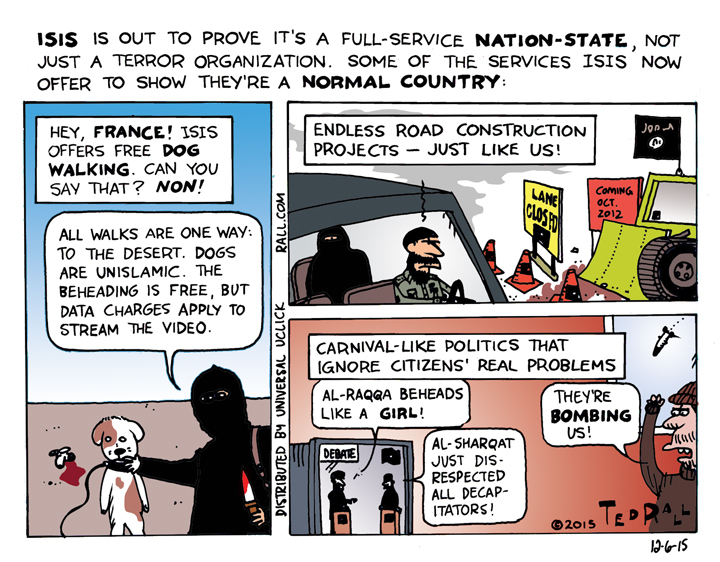
The Islamic State wants to be a full-service nation-state. What would ISIS look like if it governed like a legitimate nation-state like the United States? Let’s take a look.
Originally published at SkewedNews.net:
 Skewed News — It’s time to face the truth: Donald Trump could be our next president.
It’s also time to recognize that he is dangerous.
First, the likelihood of him being elected.
For many months the professional pundit class (the same guys who told us U.S. troops would be greeted as liberators) has assured us that the Trump surge couldn’t and wouldn’t last. That this was the silly season — remember Herman Cain? That after the kids had their fun, the adults would prevail. Jeb, anointed years ago by the Republican establishment. Perhaps Marco Rubio, to appeal to Latinos. Maybe John Kasich, the Ohio governor beloved of political reporters but sadly, not by Republican voters.
They were wrong. Aside from a short-lived challenge by Ben Carson (he turned out to be this year’s Herman Cain), now sinking and almost certainly permanently done in by his on-the-fly approach to foreign policy, The Donald has consistently been #1 in the polls since the beginning of the campaign. Yes, there are flaws in polling, especially for the Iowa caucuses. But only an idiot dismisses the political prospects of the guy who looked most likely to win all along and still does.
Republican Party leaders are finally catching on. “Irritation is giving way to panic as it becomes increasingly plausible that Mr. Trump could be the party’s standard-bearer and imperil the careers of other Republicans,” The New York Times reports. “Many leading Republican officials, strategists and donors now say they fear that Mr. Trump’s nomination would lead to an electoral wipeout, a sweeping defeat that could undo some of the gains Republicans have made in recent congressional, state and local elections.”
Maybe.
Or maybe he’ll win the White House.
The road to the nomination isn’t that hard to imagine. The latest poll has him at 27%. If Marco Rubio Ted Cruz Ben Carson were one candidate, they’d have 49% — but they aren’t, so they don’t. They’re evenly splitting the anti-Trump vote 17% to 16% to 16%. Since all three get more famous with every passing day, none has an incentive to quit. Iowa is a wild card, but Trump will probably win New Hampshire. But here’s what really matters: South Carolina. In recent races, South Carolina has been super — as in Super Tuesday — important to Republicans. Carson has faded there. Trump is favored to win South Carolina.
What about the much-vaunted Republican party leadership? Their man (Jeb!) is polling at 5% and, I expect, will be out of the race within a month or so in order to avoid further embarrassment. With no alternative, the insiders will recognize reality and rally around Trump. They have a history of resisting insurgents, like Arnold Schwarzenegger when he ran for California governor, and embracing them later.
Republican nominee Trump’s prospects depend upon which Democrat he’s facing.
If Trump faces current Democratic frontrunner Hillary Clinton, polls show that he defeats her and moves into the White House. This election cycle, voters are looking for authenticity. That isn’t Hillary. Also, a Trump vs. Clinton race leaves the liberal and progressive base of the Democratic Party without a candidate. Sure, many would punch a chad for Hillary out of fear. But many others would stay home — and that would hand it to Trump.
In the Democratic race, Hillary supporters constantly say she’s the most electable. But that’s not true if, as is becoming increasingly likely, Donald Trump is the Republican nominee.
“In a new McClatchy-Marist poll, Democratic presidential candidate Sen. Bernie Sanders (I-Vt.) leads Republican candidate Donald Trump by a landslide margin of 12 percentage points, 53 to 41. In the McClatchy poll, Sanders also leads former Florida Gov. Jeb Bush (R) by a landslide margin of 10 points, 51 to 41,” reports The Hill. “The huge Sanders advantage over Trump is not new. In the last four match-up polls between them reported by Real Clear Politics, Sanders defeated Trump by margins of 12, 9, 9 and 2 percentage points.”
Sanders beats all the top-tier GOP candidates in head-to-head matchups. “Mr. Sanders led Donald Trump 49 to 41 percent, Sen. Ted Cruz of Texas 49 to 39 percent, Dr. Ben Carson 47 to 41 percent and Sen. Marco Rubio of Florida 44 to 43 percent, according to the [latest Quinnipiac] poll.
Democrats voting based on electability should vote for Sanders.
Unless the Democratic contest shifts, however, they won’t. The same Quinnipiac poll shows Hillary strengthening and widening her lead over Sanders.
Which is how Trump wins.
Trump — who is a dangerous man.
Even Republicans like Times columnist Ross Douthat are beginning to see the light. In a column titled “Is Trump Fascist?” Douthat concludes: only a little. Trump, he writes, is “closer to the ‘proto-fascist’ zone on the political spectrum than either the average American conservative or his recent predecessors in right-wing populism.”
“Trump may indeed be a little fascistic, but that sinister resemblance is just one part of his reality-television meets WWE-heel-turn campaign style,” Douthat slightly reassures us.
I disagree.
History shows us that, more often than not, we are wise to take politicians at their word. Liberals who projected fantasies upon Bill Clinton and Barack Obama that both men were secret progressives who pretended to be corporate centrists to get elected were disappointed. Germans who thought there was no way Hitler could possibly mean that Final Solution stuff allowed it to come to pass.
We don’t have that clairvoyant character from Stephen King’s “The Dead Zone” to read Donald Trump’s mind. All we know is what he says.
What he says is terrifying.
Trump’s policies (which, truth be told, are Carsonishly invented on the fly) are frightening enough: the mass deportation of all 11 million people in the United States illegally, closing mosques, assassinating exiled NSA whistleblower Edward Snowden and forcing Muslims to register with the police — the same as the Nazis did to Jews in 1936. (To be fair, he kind of backed off from the registry. But what kind of person comes up with such an idea in the first place?)
Even more worrisome is Trump’s temperament.
Is he completely unhinged? Or merely psychologically undisciplined? Either way, voters across the political spectrum ought to ensure that someone with such outlandish ideas, expressed wildly and glibly, never become commander-in-chief of the most powerful armed forces in the world.
Just a couple days ago, for example, Trump said he wants to murder not just members of ISIS, but their families too. “When you get these terrorists, you have to take out their families,” he said on FoxNews. “They care about their lives, don’t kid yourselves. But they say they don’t care about their lives. But you have to take out their families.”
This is crazy. It’s also fascist. The Nazis murdered the families of resistance fighters. And it’s expressed with so much idiotic certainty.
If Trump gets elected, we’ll be lucky if he doesn’t start World War III his first week in office.
Yes, it could happen here.
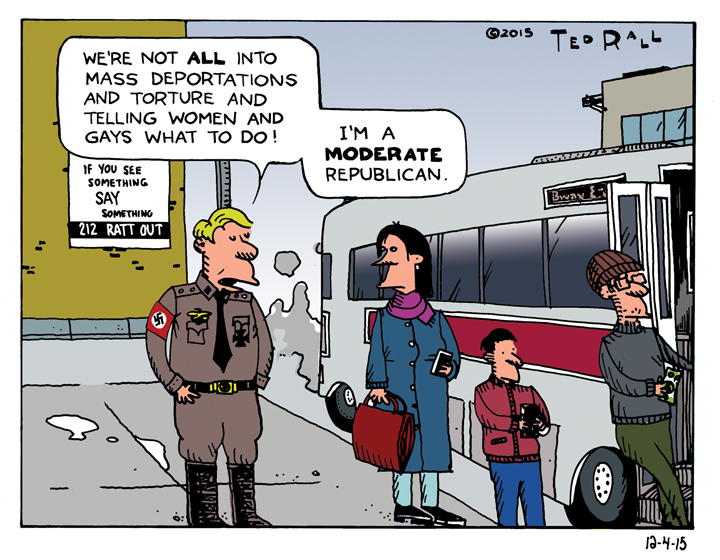
Most of the mainstream Republican Party presidential candidates advocate extreme positions on immigration, including mass deportations. They deny the reality of climate change science and evolution. They think torture is fine, oppose gay marriage, and remain silent about the murder of abortionists. Amid this shift to the right, some “moderate” Republicans say they’re still a legitimate voice within the party. But does it matter?
