SYNDICATED COLUMN: A President Who Doesn’t Even Try

Is Obama Kowtowing to the Right? Or Is He One of Them?

The President’s progressive critics blame him for continuing and expanding upon his Republican predecessor’s policies. His supporters point to the obstructionist, Republican-controlled Congress. What can Obama do? He’s being stymied at every turn.

The first problem with the it’s-the-GOP’s-fault defense is that it asks voters to suffer short-term memory loss. In 2009, you probably recall, Democrats controlled both houses of Congress. By a sizeable majority. They even had a filibuster-proof 60-seat majority in the Senate. His approval ratings were through the roof; even many Republicans who had voted against him took a liking to him. The media, in his pocket, wondered aloud whether the Republican Party could ever recover. “Rarely, if ever, has a President entered office with so much political wind at his back,” Tim Carney wrote for the Evans-Novak Political Report shortly after the inauguration.

If Obama had wanted to pursue a progressive agenda—banning foreclosures, jailing bankers, closing Guantánamo, stopping the wars, pushing for the public option he promised in his healthcare plan—he could have. He had ample political capital, yet chose not to spend it.

Now that Congress is controlled by a Republican Party in thrall to its radical-right Tea Party faction, it is indeed true that Obama can’t get routine judicial appointments approved, much less navigate the passage of legislation. Oh-so-conveniently, Obama has turned into a liberal-come-lately. Where was his proposed Buffett Rule (which would require millionaires with huge investment income to pay the same percentage rate as middle-class families) in 2009, when it might have stood a chance of passage?

Team Obama’s attempt to shore up his liberal base also falls short on the facts. Progressives were shocked by the U.S. Supreme Court’s 5-4 ruling, along party lines, that legalized strip-searches and body cavity rapes by police and private security firms who detain people suspected of any crime, even minor traffic infractions.

“What virtually none of this…commentary mentioned,” reported Glenn Greenwald in Salon, “was that that the Obama DOJ [Department of Justice] formally urged Court to reach the conclusion it reached…this is yet another case, in a long line, where the Obama administration was able to have its preferred policies judicially endorsed by getting right-wing judges to embrace them.”

No wonder Obama stayed mum.

Which brings us to the biggest, yet least discussed, flaw in the attempt to pin Obama’s inaction on the heads of Congressional Republicans: the bully pulpit.

Whether Donald Trump likes it or not, Barack Obama is still president. If he calls a press conference to call attention to an issue, odds are that reporters will show up. But he’s not walking tall or even talking big.

Responding to fall 2011 polls that indicated softening support among the younger and more liberal voters who form the Democratic base, Obama’s reelection strategists began rolling out speeches inflected with Occupy-inspired rhetoric about class warfare and trying to make sure all Americans “get a fair shot.” But that’s all it is: talk. And small talk at that.

Instead of introducing major legislation, the White House plans to spend 2012 issuing presidential orders about symbolic, minor issues.

Repeating Clinton-era triangulation and micro-mini issues doesn’t look like a smart reelection strategy. The Associated Press reported: “Obama’s election year retreat from legislative fights means this term will end without significant progress on two of his 2008 campaign promises: comprehensive immigration reform and closing the military prison for terrorist suspects at Guantánamo Bay, Cuba. Piecemeal presidential directives are unlikely to make a sizeable dent in the nation’s 8.6 percent unemployment rate or lead to significant improvements in the economy, the top concern for many voters and the issue on which Republican candidates are most likely to criticize Obama. In focusing on small-bore executive actions rather than ambitious legislation, the president risks appearing to be putting election-year strategy ahead of economic action at a time when millions of Americans are still out of work.”

Of course, Obama may prevail. Romney is an extraordinarily weak opponent.

For progressives and leftists, however, the main point is that Obama never tries to move the mainstream of ideological discourse to the left.

Obama has been mostly silent on the biggest issue of our time, income inequality and the rapid growth of the American underclass. He hasn’t said much about the environment or climate change, the most serious problem we face—and one for which the U.S. bears a disproportionate share of the blame. Even on issues where he was blocked by Congress, such as when Republicans prohibited the use of public funds to transport Gitmo detainees to the U.S. for trials, he zipped his lips.

It isn’t hard to imagine a president launching media-friendly crusades against poverty or global warming. FDR and LBJ did it, touring the country, appointing high-profile commissions and inviting prominent guests to the White House to draw attention to issues they cared about.

In 2010, Venezuelan President Hugo Chávez invited flood victims to move into his presidential palace. Seven years after Katrina, Gulf Coast residents are still waiting for help. What if Obama opened up the Lincoln Bedroom to a homeless family? The media couldn’t ignore a PR stunt like that.

Obama has mostly shunned the time-honored strategy of trapping your opposition by forcing them vote against your popular ideas. In 2009, for example, it would have been smarter politics—and better governance—to push for real socialized medicine, or at least ObamaCare with the public option he promised. He would either have wound up with a dazzling triumph, or a glorious defeat.

Liberals don’t blame Obama for not winning. They blame him for not trying. When he does crazy things like authorizing the assassinations of U.S. citizens without trial, progressives have to ask themselves: Is this guy kowtowing to the Right? Or is he one of them?

(Ted Rall’s next book is “The Book of Obama: How We Went From Hope and Change to the Age of Revolt,” out May 22. His website is tedrall.com.)
SYNDICATED COLUMN: Handicapped

Conventional Wisdom Is Wrong. It’s Romney’s To Lose.

Catching Barack Obama in a rare moment of candor, an open mic found the president confiding to his Russian counterpart that he expects to win this fall. “This is my last election,” he told Russian President Dmitry Medvedev.

Last, yes. But I wouldn’t bet on Obama winning.

The corporate pundit class has largely conceded the general election to Obama, already looking ahead to 2016. The mainstreamers have their reasons. Their analysis is based on good, solid, reasonable (inside the box) logic. All things considered, however, I would (and have) put my money on Mitt Romney this fall.

This isn’t wishful thinking. I voted for Obama last time and wanted him to succeed. He failed. His accomplishments have been few and have amounted to sellouts to the right. Even so, the prospect of watching Mitt Romney move into the White House fills me with as much joy as an appointment for a colonoscopy. And I think he’s going to win.

For me, the D vs. R horserace is a parlor game with minor ramifications for our daily lives. Whichever corporate party wins, unemployment and underemployment will continue to worsen, income disparity will widen, and most of our taxes will fund the worst approach to international affairs since a former Austrian corporal blew out his brains out in a bunker under Berlin.

Thanks to the Occupy movement, real politics is back where it belongs—in the streets. That’s what I’ll be watching and working. With a lot of luck (and even more pepper spray) this will be a year of revolution rather than more electoral devolution.

Revolution is inevitable. But we don’t know when it’s coming. So the 2012 campaign may still matter. Besides, handicapping elections is a game I enjoy and am good at. During 17 years of syndication my pick to win has only lost once (for the 2004 Democratic nomination). So, on the off chance that you’re one of those who still cares about our husk of a democracy, who hangs on every meaningless development of a political process devoid of politics—or you’re just a betting person, here’s my thinking.

Barring an assassination or a scandal, Mitt Romney will be the Republican nominee.

Obama currently leads Romney by about four to five points. But that’s not nearly enough of a lead to carry him to November. History shows that Republican nominees steadily increase in popularity throughout the summer and fall of an election year.

In April 2004, for example, John Kerry led George W. Bush by eight points. But Swift Boating erased that lead, and then some.

In order to win, a successful Democratic nominee has to begin with a big margin. That early lead must be large enough to wind up in the black, after months of being whittled away, when the votes get counted in November. I can’t see Obama pulling far enough ahead soon.

Incumbency is a huge advantage. If the election were held tomorrow, Obama would prevail. But the election is not being held tomorrow. It’s being held in November.

By the time they head to the polls this fall, voters’ brains will be drowning in months of hundreds of millions of dollars of slick, demographically targeted, pro-Romney attack ads. Republican campaigns are more effective at this sort of thing, and as Newt Gingrich and Rick Santorum can attest, Romney’s consultants pull no punches. Obama’s current lead will be a faded memory.

Every political campaign comes down to a contest of narratives. In 2008 Obama developed an effective sales pitch: Hope and Change for a nation exhausted by eight years of Bush, 9/11, war, taking off your shoes at the airport, and a full-fledged global economic crisis to boot. Obama’s advisers turned his biggest weaknesses—his inexperience, race, unusual name and foreign background—into assets. Here was a new kind of president. Just the guy to lead us out of the Bad Old Days into something better. McCain-Palin’s narrative—a cranky old ex-POW paired with a zany housewife-gone-wild—didn’t stand a chance.

This year the narratives favor Romney.

Romney is already pointing to the biggest issue on people’s minds, the economy, and claiming that his background as a turnaround artist qualifies him to fix what ails us. His prescriptions are Republican boilerplate, vague and counterproductive, but at least he’s doing something Obama hasn’t—talking a lot about creating jobs. Voters prefer useless attentiveness to calm, steady golfing (Obama’s approach). And—despite its illogic—they like the run-government-like-a-business narrative (c.f. Ross Perot, the Bushes).

Obama is boxed in by three-plus years of inaction on, well, pretty much everything. He’ll argue that he’ll be able to “finish the job” during a second term, but that’s a tough sell when you haven’t tried to start the job—in 2009, when Democrats had huge majorities in both houses of Congress. His single signature accomplishment, healthcare reform, is disliked by two-thirds of the electorate. The recent “good news” on the economy has been either insignificant (net positive job creation of 100,000 per month for two months, less than one-tenth of one percent of the 25 million jobs needed) or falsified (discouraged workers no longer counted as unemployed).

Despite what Obama tells them, Americans know things are still getting worse. Similarly, Obama’s recent, feeble, impotent rhetorical attempts to shore up his support among his Democratic Party’s disappointed liberal base will probably not generate enough enthusiasm to counter other factors that favor Romney.

You can’t vote for the first African-American president twice. Unless he picks a woman as vice president, a vote for Obama will be a vote for the same-old, same-old. The history-making thrill is gone.

At this writing the Republican Party appears to be in disarray. No doubt, Romney is emerging from the primaries battered and bruised. His awkward and demented soundbite stylings (“corporations are people,” “the trees are the right height”) will provide fodder for countless YouTube parodies. But Romney hasn’t been damaged as much as the official political class seems to think.

Republicans are a remarkably loyal bunch. United by their many hatreds (liberals, blacks, gays, poor people, Mexicans, Muslims, foreigners, etc.), they will set aside their comparatively low simmer of anti-Mormon bigotry this fall. Picking a standard-issue white Anglo Christianist thug as veep will cinch the deal.

The GOP enjoys a huge fundraising advantage, especially via the new-fangled SuperPACs. Romney has raised $74 million against $151 million for Obama, but look for that ratio to flip after he locks up the nomination. Cue those vicious, potent ads mentioned above.

About the only major factor working for Obama is the presidential debates. Romney doesn’t stand a chance against the cool, articulate Obama.

Of course, it’s a long way to November. A lot can happen. It’s very possible for Obama to win. But that’s not how it looks now.

(Ted Rall’s next book is “The Book of Obama: How We Went From Hope and Change to the Age of Revolt,” out May 22. His website is tedrall.com.)
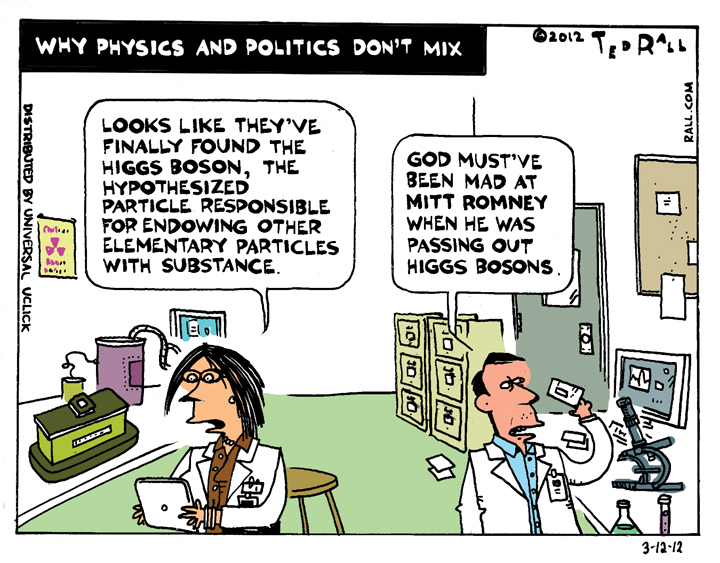
Why Physics and Politics Don’t Mix

Scientists claim to have finally isolated the long-hypothesized Higgs Boson, a particular responsible for endowing other elementary particles with mass. Which gives us an opportunity to, as many editorial cartoonists do, blend two completely unrelated news stories into an awkward cartoon about contemporary politics.

SYNDICATED COLUMN: Death and Trivia

Bankrupt and Corrupt, U.S. Can’t/Won’t Address Issues We Care About

Millions of Americans won’t vote this November. “Voter participation in the U.S. remains consistently below corresponding levels in most other western democracies,” the International Business Times reported last year. “In countries like Italy, Belgium, Austria and Australia, more than 90 percent of the voting public cast ballots at election time.”

They—the corporate politicians and their media mouthpieces—call it apathy. Obama advisor David Axelrod blamed it for the Iraq War. “There was apathy in 2000, and Al Gore lost that election to George W. Bush by 300 votes, and as a result we wound up in Iraq,” he told the Harvard Crimson. That’s crap. People don’t boycott elections because they don’t care. They are alienated.

We don’t care about two-party electoral politics because two-party electoral politics don’t care about us.

What are Americans most worried about this election season? The same thing we’ve been most worried about for years: the economy. You name the poll: local or national, liberals or conservatives doesn’t matter. Tens of millions of people are unemployed. People who still have jobs live in terror of layoffs. Real inflation is out of control but salaries are frozen or falling. (The fact that we have to specify “real” says a lot about the gap between life out here “on the ground” and over there “inside the Beltway.”)

We’re being ground down. Demoralized. Bankrupted. And they don’t care. Not only do they not care, they don’t notice.

The Fed and the White House are colluding in their quadrennial tradition of ginning up a pseudo-boomlet to support the incumbent. Thus the latest Dow bubble and phony 8.3 percent unemployment rate, which count people who have given up looking for work as “employed.”

Everyone knows the recovery is fiction. Who are you going to believe—the talking heads or your lying, overdrawn, second-mortage line of credit? According to the latest Gallup tracking poll, which actually asks actual people how they’re actually doing in the actual world, 9.1 percent of Americans are unemployed and 19.0 percent are underemployed. When 28.1 percent of Americans are broke, that affects everyone, including the richest 1% trying to sell goods and services.

People expect their “representative” democracy to represent their interests. To address their problems. And solve them.

No wonder why we’re so apathetic. Our “leaders” hardly talk about the economy.

Santorum is more worried about how easy it is to get sex than how hard it is to find work.

Romney thinks it’s 1992 and that he’s Ross Perot, the businessman who promised to run America like a corporation. As though it wasn’t already. As if that wasn’t the problem.

Obama imagines that we didn’t notice that he only started asking Congress to work on the economy after Congress fell under the control of the other party. We’re slow. We’re not deranged.

Our dying political system is unwilling and unable to address joblessness and the widening class divide because our misery isn’t an aberration. It’s an inherent manifestation of corporate capitalism. Ordinary Americans understand this. Half the citizens of this “conservative” country already prefer socialism or communism, according to a Gallup poll conducted in December—watch that go up—yet the political class dares not question the Crappy Economic System That Must Not Be Named.

Since they can’t take on the real issues the elites are reduced to the politics of distraction.

Kids and death.

Those are the D-grade “issues” the powers that be are using this week in order to avoid talking about the atrocious economy.

Federal regulators announced on February 27th that all cars manufactured after 2014 must feature rearview cameras that allow drivers to see what is behind them. The National Highway Traffic Administration says that “95 to 112 deaths and as many as 8,374 injuries could be eliminated each year by eliminating the wide blind spot behind a vehicle,” reported The New York Times. The estimated cost of the devices is $2.7 billion per year.

“In terms of absolute numbers of lives saved, it certainly isn’t the highest,” admitted Clarence Ditlow of the Center for Auto Safety. “But in terms of emotional tragedy, backover deaths are some of the worst imaginable. When you have a parent that kills a child in an accident that’s utterly avoidable, they don’t ever forget it.”

No doubt. I can imagine. By all means, put in those cameras.

But there’s something screwy about a political culture that slaps this trivial story on the front page of the biggest newspaper in the country and makes it a Congressional priority while the elephants in the room go unaddressed. Every year 17,000 Americans die in slip and fall accidents—151 times the rate from backover car accidents. Maybe we should install cameras on the backs of our heads.

Yo, moron journalists and politicos: Jobs! We care about jobs!

If you idiots must obsess over cars, why aren’t you pushing through radical improvements in fuel efficiency, like requiring that every car made after 2014 be either electric or a hybrid? Autos are a major cause of air pollution, which triggers asthma attacks, which kill at least 5000 people annually in the U.S.

It’s not just about the kiddie-poos. The establishments is still wallowing in Bush’s hoary post-9/11 death cult.

The day after its hold-the-presses car-cameras scoop the Times was back with another page-one heartstopper:

“The mortuary at Dover Air Force Base in Delaware disposed of body parts of some victims of the Sept. 11, 2001 attacks by burning them and dumping the ashes in a landfill,” began the story. The victims were killed on Flight 93, which crashed in western Pennsylvania.

Gross? No doubt. Inappropriate? Unquestionably. Important? Hell no.

The worst thing that could ever happened to the people to whom those body parts belonged occurred before. They were dead. Murdered. What went down after that was comparatively trivial.

Not to stir up the Truthers (with whom I disagree), but a more appropriate front-page story would ask: “More Than 11 Years After 9/11, Why Hasn’t There Been an Independent Investigation?”

Here’s what we’ve come to: Get killed on Flight 93 and no one bothers to find out what really happened to you. Have your remains disposed of in a culturally insensitive manner and it’s a scandal.

What if Flight 93 had landed safely? Some passengers would gotten laid off. Some would have been foreclosed upon. And the government wouldn’t have given a rat’s ass about them.

Why don’t people vote?

A better question is: Why do people vote?

(Ted Rall is the author of “The Anti-American Manifesto.” His website is tedrall.com.)

COPYRIGHT 2012 TED RALL

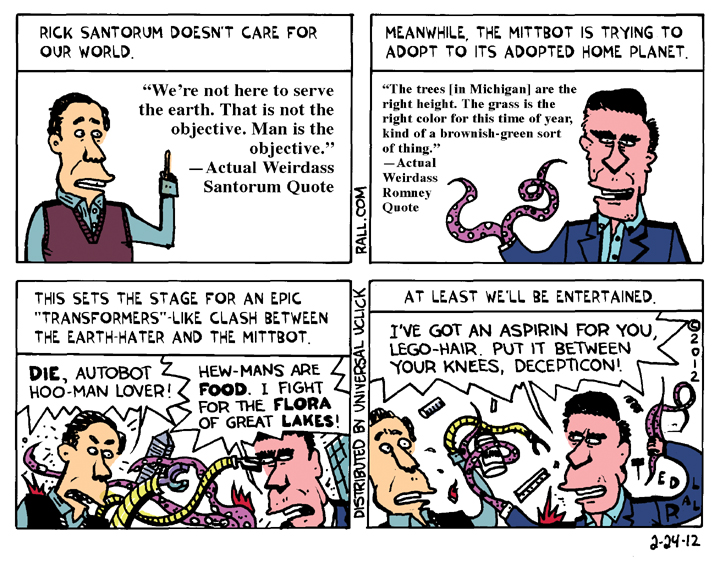
That’s Entertainment

Rick Santorum and Mitt Romney gear up for an epic clash about the fate of the planet. Also the presidency.

SYNDICATED COLUMN: Want More Wars? Raise Taxes on the Rich

Tax Fairness Won’t Reduce Inequality

Reacting to and attempting to co-opt the Occupy Wall Street movement, President Obama used his 2012 State of the Union address to discuss what he now calls “the defining issue of our time”—the growing gap between rich and poor.

“We can either settle for a country where a shrinking number of people do really well, while a growing number of Americans barely get by,” Obama said. “Or we can restore an economy where everyone gets a fair shot, everyone does their fair share, and everyone plays by the same set of rules.”

No doubt, the long-term trend toward income inequality is a major flaw of the capitalist system. From 1980 to 2005 more than 80 percent in the gain in Americans’ incomes went to the top one percent. This staggering disparity between the haves and have-nots has created a permanent underclass of underemployed, undereducated and alienated people who often turn to crime for survival and social status. Aggregation of wealth into fewer hands has shrunk the size of the U.S. market for consumer goods, prolonging and deepening the depression.

How can we make the system fairer?

Liberals are calling for a more progressive income tax: i.e., raise taxes on the rich. Obama says he’d like to slap a minimum federal income tax of 30 percent on individuals earning more than $1 million a year.

Soaking the rich would obviously be fair. GOP frontrunner/corporate layoff sleazebag Mitt Romney earned $59,500 a day in 2010—and paid half the effective tax rate (13.9 percent) of that paid by a family of four earning $59,500 a year.

Fair, sure. But would it work? Would increasing taxes on the wealthy do much to close the gap between rich and poor—to level the economic playing field?

Probably not.

From FDR through Jimmy Carter it was an article of faith among liberals that higher taxes on the rich would result in lower taxes on the poor and working class. This was because the Republican Party consistently pushed for a balanced budget. Tax income was tied to expenditures, which were more or less fixed—and thus a zero-sum game.

That period from 1933 to 1980 was also the era of the New Deal, Fair Deal and Great Society social and anti-poverty programs, such as Social Security, the G.I. Bill, college grants and welfare. These government handouts helped mitigate hard times, gave life-changing educational opportunities that allowed class mobility, closing the gap between despair and hope for tens of millions of Americans. As the list of social programs grew, so did the tax rate—mostly on the rich. The practical effect was to redistribute income from top to bottom.

Democrats think it still works that way. It doesn’t.

The political landscape has shifted dramatically under Reagan, Clinton and the two Bushes. Budget cuts slashed spending on student financial aid, food stamps, Medicaid, school lunch programs, veterans hospitals, aid to single mothers. The social safety net is shredded. Most federal tax dollars flow directly into the Pentagon and defense contractors such as Halliburton.

As the economy continues to tank, there’s only one category to cut: social programs. “Eugene Steuerle worked on tax and budget issues in the Reagan Treasury Department and is now with the Urban Institute,” NPR reported a year ago. “He says one reason no one talks about preserving the social safety net today is that lawmakers have given themselves little choice but to cut it. They’ve taken taxes and entitlements, such as Social Security and Medicare, off the budget-cutting table, so there’s not much left.”

Meanwhile, effective tax rates on the wealthy have been greatly reduced. Which isn’t fair—but not in the way you might think.

Taxes on middle-class families are at their lowest level in 50 years, according to the Center on Budget and Policy Priorities, a liberal thinktank.

What’s going on?

On the revenue side of the budget equation, the poor and middle-class have received tiny tax cuts. The rich and super rich have gotten huge tax cuts. Everyone is paying less.

On the expense side, social programs have been pretty much destroyed. If you grow up poor there’s no way to attend college without going into debt. If you lose your job you’ll get 99 weeks of tiny, taxable (thanks to Reagan) unemployment checks before burning through your savings and winding up on the street.

Military spending, on the other hand, has soared, accounting for 54 percent of federal spending.

In short, we’re running up massive deficits in order to finance wars in Afghanistan, Iraq, and so on, and so rich job-killers can pay the lowest tax rates in the developed world.

I’m all for higher taxes on the rich. I’m for abolishing the right to be wealthy.

But liberals who think progressive taxation will mitigate or reverse income inequality are trapped in the 1960s, fighting the last (budget) war in a reality that no longer exists. The U.S. government’s top priority is invading Muslim countries and bombing their citizens. Without big social programs, invading Muslim countries and bombing their citizens is exactly where every extra taxdollar collected from the likes of Mitt Romney would go.

The only way progressive taxation can address income inequality is if higher taxes on the rich are coupled with an array of new anti-poverty and other social programs designed to put money and new job skills directly into the pockets of the 99 percent of Americans who have seen no improvement in their lives since 1980.

You have to rebuild the safety net. Otherwise higher taxes will swirl down the Pentagon’s $800 toilets.

If you’re serious about inequality, income redistribution through the tax system is only a start. Whether through stronger unions or worker advocacy through federal agencies, government must require higher minimum wages. It should set a maximum wage, too. A nation that allows its richest citizen to earn ten times more than its poorest would still be horribly unfair—yet it would be a big improvement over today. Shipping jobs overseas must be banned. Most free trade agreements should be torn up. Companies must no longer be allowed to layoff employees before eliminating salaries and benefits for their top-paid managers—CEOs, etc.

And a layoff should mean just that—a layoff. First fired should be first rehired—at equal or greater pay—if and when business improves.

Once a battery of spending programs targeted to the 99 percent is in place—permanent unemployment benefits, subsidized public housing, full college grants, etc.—the tax code ought to be radically revamped. For example, nothing gives the lie to the myth of America as a land of equal opportunity than inheritance. Aristocratic societies pass wealth and status from generation to generation. In a democracy, no one has the right to be born into wealth.

Because everyone deserves an equal chance, the national inheritance tax should be 100 percent. While we’re at it, why should people who inherited wealth but have low incomes get off scot-free? Slap the bastards with a European-style tax on wealth as well as the appearance of wealth.

Now you’re probably laughing. Even Obama’s lame call for taxing the rich—so the U.S. can buy more drone planes—stands no chance of passing the Republican Congress. They’re empty words meant for election-year consumption. Taking income inequality seriously? That’s so off the table it isn’t even funny.

Which is why we shouldn’t be looking to corporate machine politicians like Obama for answers.

(Ted Rall is the author of “The Anti-American Manifesto.” His website is tedrall.com.)

COPYRIGHT 2012 TED RALL

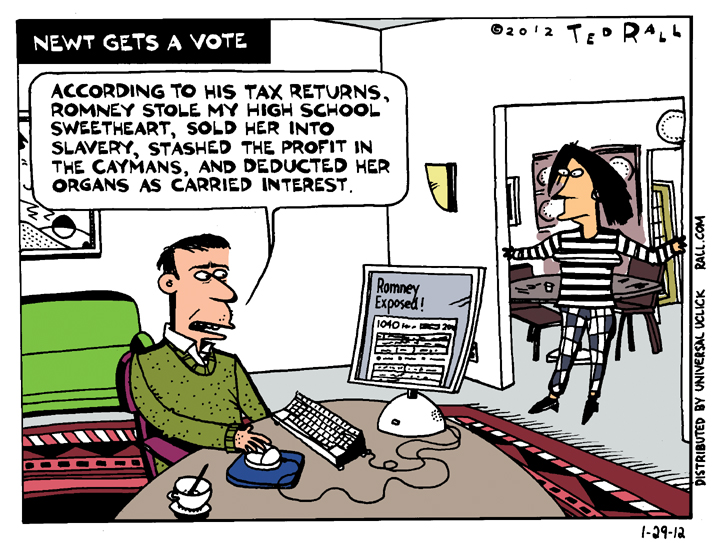
Newt Gets a Vote

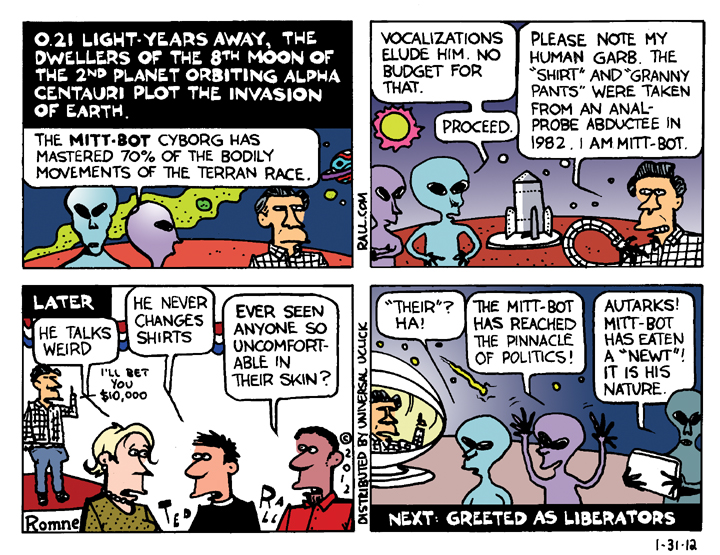
Mitt Romney’s tax returns, finally released, reveal a staggering level of wealth and attempts to evade his already low 15% effective tax rate.

SYNDICATED COLUMN: Occupy Sexual Freedom

Sympathy for Newt and Open Marriage

You know the narrative. Right-wing family-values Republican gets caught doing secular-liberal totally-not-family-values stuff, usually involving sex:

Cruising for manlove in an airport men’s room.

Knocking up the maid.

Sending dirty emails to young male pages.

Hiring male hookers and smoking meth.

Asking wife #2 for an open marriage.

This kind of thing happens all the time. And it’s always red meat for leftie media commentators.

Liberal pundits love to call fallen Republicans hypocrites. They point out that liberal politicians are often more heterosexual and monogamous than many so-called conservatives—and remain married to the same spouse for life.

Now it’s Newt Gingrich’s turn.

In her divorce filing Ms. Gingrich the Second claims that Mr. Gingrich asked her for an open marriage so he could stay with her while carrying on with Callista, who became Ms. Gingrich the Third after Ms. Gingrich the Second refused said request. (You may need to re-read the previous sentence.)

Cue the holier-than-thou liberals.

CNN reporter John King opened a presidential debate with an assault on Newt’s alleged yearning for sexual freedom. A New York Times editorial called this “a perfectly reasonable question.”

Across the vertical seam in the op-ed graveyard Gail Collins could barely contain herself. “Beyond the hypocrisy of this sort of behavior from a guy who wants to protect the sanctity of holy matrimony from gay couples, there also seems to be a streak of almost crazed self-absorption that runs through the Newt saga,” Collins gloated. “Who would ditch a spouse of 18 years in a phone call? Shortly after she was diagnosed with multiple sclerosis? And, of course, he broke up with his first wife while she was battling cancer.”

That Newt Gingrich is pompous, nasty and one of the most hideous members of that physically repugnant tribe known as politicians can be stipulated by all but those blinded by hatred of Mormons and Kenyan-born socialists. Still, I think we on the Left are missing an opportunity for a teachable moment.

Progressives are fighting for human emancipation. The right to engage in sex with any consensual adult in any form is integral to this struggle to liberate ourselves from patriarchy, sexism, racism, homophobia and capitalism. How, then, can we justify mocking anyone—even a hypocritical Christian conservative—for expressing their sexuality?

When Senator Larry Craig was arrested, essentially for the crime of being a closeted gay or bisexual male, in that Minneapolis-St. Paul airport restroom, he needed our support, not our ridicule.

Imagine if supporters of gay rights from across the spectrum had refused to get sucked into stupid D-vs-R theatrics. Remember, the cops weren’t trying to catch a right-wing gay-bashing closeted senator. Craig was ensnared by one of countless sting operations conducted by police departments across the United States designed to harass all gays and lesbians. We should oppose such tactics forcefully and consistently. Defending Craig’s right to hit on other guys would have served the cause better than scoring cheap partisan points.

As for Newt’s alleged—divorce allegations ought to be swallowed with a massive dollop of sodium chloride—request for an open marriage, well, so what if he did?

When 40 to 50 percent of marriages end in divorce it’s clear that state-enforced monogamy for life isn’t working for everyone. Researchers estimate that up to six percent of American couples are in open marriages. And there’s nothing wrong with that. It’s their decision. It’s their choice. Asked privately, most liberals would agree.

Millions of Americans prefer alternative arrangements for their sex lives—open marriages, swinging, etc. Yet they are forced to sneak around. They’re not hiding from their lovers, but from their friends and neighbors and colleagues lest they be shamed and shunned. Unlike conventionally married couples (who cheat on one another in significant numbers), people in open relationships know exactly what their partners are up to.

Moreover, there are a lot of open relationships that no one thinks about. Does anyone doubt, for example, that the Clintons had a “don’t ask don’t tell” policy that essentially amounted to a license to cheat?

You shouldn’t have to hide or lie when you’re doing nothing wrong. Yet so-called “liberals” join their rightist counterparts in snickering about Craig’s “wide stance” and Gingrich’s request for an open marriage. The effect is to denigrate gays, lesbians and other sexually marginalized and oppressed people.

Nona Willis Aronowitz calls Gingrich “the poster child for the messy, miserable life people can have if they’re stuffed into rules they weren’t built to follow. He’s the poster child for how our sexist and repressive culture can hurt relationships. Gingrich was raised in, and now advocates for, a world that sets up incredibly narrow parameters for sex and love, and shames people who don’t adhere to those standards.”

We should tell right-wingers like Newt Gingrich: you’re one of us. You always were. The fact that you can’t live by your own supposed rules proves it.

Quit living a lie, Newt. More importantly, quit asking everyone else to live the stupid lie that defines your stupid out-of-date politics.

Hey Republicans! Are you a maid-knocking-up, men’s-room-trolling, sexting, bondage-loving, gay-bi-trans-whatever?

The Right’s not that into you. Join us.

(Ted Rall is the author of “The Anti-American Manifesto.” His website is tedrall.com.)

COPYRIGHT 2012 TED RALL

keyboard_arrow_up
css.php