
DMZ America Podcast Ep 172: Interview with Cartoonist David Horsey on Campaign 2024

It may feel surreal, but tens of millions of Americans have already voted and the wild 2024 presidential campaign comes to an end in days. The DMZ America podcast, which began at the beginning of the Biden Administration, reviews how we’ve arrived at this unexpected contest between Trump and Vice President Kamala Harris. Pulitzer Prize-winning cartoonist David Horsey, formerly of the Seattle Post-Intelligencer, joins DMZ co-hosts and cartoonist pals Ted Rall (from the Left) and Scott Stantis (from the Right) to analyze the closing minutes of the race and make their predictions.

Listen to the Audio Version:

Or Watch the Video Version:


Why Can’t Kamala Talk Dude?

           One of the most persistent challenges faced by Kamala Harris’ abbreviated presidential campaign is a vexingly wide gender gap. Men just aren’t that into her.

            Democrats have deployed several approaches to convince male voters to feel the joy.

            Divide and conquer: Harris’ policies divvy up guys by race. Her “opportunity agenda for Black men” would offer special loans and internships to Black entrepreneurs (no word on whether that’s been lawyered for constitutionality), fund federal studies on sickle-cell anemia and other diseases that disproportionately affect Black men and give them priority to profit from the emerging legal marijuana business (note to Democrats: cannabis equity failed in New York). Harris’ “opportunity agenda for Latino men” (see a trend?) would offer Latino guys more small business loans. A Google search for “opportunity agenda for white men” comes up empty but hey, there are still a couple hours left in the race.

Kamala is also playing the class card. A spot for the Pittsburgh TV market features a Steelers fan and maintenance worker who calls himself a “yinzer” (Pittsburgh native). “Donald Trump does not care about the working man whatsoever,” he says. “He’s a little rich kid too; he ain’t me. Little silver spoon boy Donald Trump. How is he relatable to me whatsoever? The guy literally lives in a country club. Do I look like a country club kind of guy?” Don’t tell the yinzers that Harris, worth $8 million and a member of an exclusive country club with a $300,000 initiation fee, is more at home with the Trumps than with them.

            Humor: A Harris super PAC made news with “Man Enough,” an ad that showcases six hypermacho dudes—evoking more than a smidge of homoeroticism (“my full-throated endorsement”)—who say they’re so butch that they eat “carburetors for breakfast” and aren’t “afraid of bears,” but also like chicks and plan to vote for Harris and support abortion rights. An official Harris ad depicts a burly Black finance bro who ditches his plan to refrain from voting after confronted by a passel of disapproving ladies. Ladies are doters for early voters!

            Shame and guilt: Former president Barack Obama called out sexist men whom, he finger-wagged, “just aren’t feeling the idea of having a woman as president.” His wife Michelle helpfully reminded the XY set that “your wife and mother could be the ones at higher risk of dying from undiagnosed cervical cancer because they have no access to regular gynecological care.” As if men didn’t care about their wives, sisters, mothers and female friends.

            This is a portrait of a campaign that wants men’s votes enough to embarrass itself, but isn’t willing to do much, if anything, to earn them. Democrats suffer from a prepositional disconnect: Harris and her surrogates talk at men, not to or, better still, with them.

            If she loses to Trump, a major contributing factor will be the perception that Harris and the Democrats don’t like men.

This is puzzling. Harris knows men. She’s married to one. Most of her Senate colleges are men. Her running mate is a guy, albeit a goofy beta. Why can’t Kamala speak fluent dude?

            A more talented politician would recognize male voters—especially white male voters—less as an obstacle to fool, bully or circumnavigate than as what they realty are: virgin electoral territory.

American men are suffering from a set of very real, very serious problems with which neither political party has begun to identify, much less engage.

            One of Trump’s superpowers in 2016 was his recognition of the pain, frustration and anger of Rust Belt voters (including men) left behind by deindustrialization to wallow in poverty, addiction and dysfunction. Trump, and now his running mate J.D. Vance, described the shuttered factories and the blighted neighborhoods in places like Dayton, Ohio, where I grew up. They argued that American citizens deserved better and promised to fix it. Trump didn’t fix it as president. Maybe he couldn’t.

But he did see the people of Flyover Country. That was enough to take over the GOP, defeat Hillary Clinton and build the MAGA movement.

            Today, boys and men represent an even bigger untapped reservoir of political support for the politician and party with enough vision to recognize it. Males are in crisis. They are angry and confused.

            Men are in crisis.

They are desperate for compassion and looking for leadership.

            Males are far more likely to abuse and become addicted to illegal drugs than females. Boys drop out of high school more than girls. Males are 50% of the population yet account for most fatal cancer and nearly 80% of suicides. Trapped in an increasingly feminized system of primary, secondary and higher education with rules designed for “calmer” females, boys and men are now being taught that they are historically responsible for rape, colonialism, imperialism and every other conceivable form of oppression. They are ordered to sit silently by as they are passed over for jobs, awards and other opportunities in order to make up for the historic sins of systemic sexism and misogyny. Men cannot and should not be proud of masculinity or maleness.

They ought be ashamed. As a liberal pundit put it in 2019, “Old White Men Like Me Need to Shut Up and Step Aside.”

            The Male Problem blows up during adulthood. 58% of college students are women; 42% are men. Moreover, women graduate in higher numbers—68% compared to 61% for guys—so the proportion of women with college degrees in the workforce is even higher. This is not a new problem; colleges began admitting more girls than boys in 1979. Nor is it a correction. Flipping a historical injustice, sexual discrimination, on its head does not redress it; it merely reverses the role of victim and oppressor.

            Cultural progressives posit an identitarian version of trickle-down economics in which equity erases the old gender pay gap that favored men, lifting up women without hurting men. But wages are a zero-sum game that men are losing. “In 1979, the median hourly wage for women was 62.7% of the median hourly wage for men; by 2012, it was 82.8%,” according to the left-leaning Economic Policy Institute. “However, a big chunk of that improvement—more than a quarter of it—happened because of men’s wage losses, rather than women’s wage gains.”

            Gender inequality increasingly looks like a two-way street, with males bearing the brunt not only economically but socially because high-earning women are not willing to marry, support or subsidize lower-achieving men. Trophy husbands, cultural shifts notwithstanding, are not a thing.

            It’s hardly surprising that the unabashedly macho swagger of Trumpism finds a receptive audience among America’s lost boys. As the conservative activist Charlie Kirk told Vanity Fair, guys “want to be part of a political movement that doesn’t hate them.”

            That’s not the Democrats.

(Ted Rall (Twitter: @tedrall), the political cartoonist, columnist and graphic novelist, co-hosts the left-vs-right DMZ America podcast with fellow cartoonist Scott Stantis. His latest book, brand-new right now, is the graphic novel 2024: Revisited.)


DMZ America Podcast Ep 170: Canadian Cartoonist Michael deAdder on Our Crazy Election

With one week left before Election Day 2024, editorial cartoonists with opposing politics and a great friendship, Ted Rall (Left) and Scott Stantis (Right) ask: why is Kamala Harris dead-even in the polls, and seemingly losing ground, against a maniac like Donald Trump? How did we get here? What did Biden, Harris and the Democrats do wrong and what could they have done better? And, if she wins, will they learn any lessons from the votes they left on the table through their own unforced errors?

Joining Ted and Scott is award-winning political cartoonist Michael deAdder, a Canadian artist whose work has appeared in The Washington Post and many other American publications. What is the view of the American race as seen by our northern neighbor? What would be the likely reaction to each potential outcome?

Watch the Video Version: here.


The TMI Show Ep 9: What Should Lefties Do About Kamala?

What do you do as a voter when your party isn’t that into you? On today’s TMI Show, in which there’s no such thing as Too Much Information, Ted Rall and Scott Stantis (guest hosting for Manila Chan) Progressive and other left-leaning Democrats are once again wrestling with a dilemma they’ve seen before: Kamala Harris has pivoted to the right of her party, eschewing progressive policies, campaigning with far-right Liz Cheney and supporting Israel against Gaza, and Ukraine against Russia.

Should progressives support Harris despite her snubs, hoping she secretly plans to move left of she wins? Should they punish her by voting third party or even for Trump? Or should they abstain from voting?


DMZ America Podcast Ep 169: Kamala Flagging as Trump Gains

Less than two weeks before Election Day, polls and a general sense of zeitgeist has many political commentators feeling that the tide is running away from Kamala Harris and toward Donald Trump in a razor-tight election campaign. Is it too late for Harris to solve her big problems: voters who don’t feel that they know her well enough to trust her with the launch codes, and her failure to articulate an enticing policy agenda they can easily understand? Political cartoonists and best friends Ted Rall (recovering Democrat, now Left) and Scott Stantis (recovering Republican, now Libertarian) walk you through the lay of this strange new land.

Watch the Video Version: here.

DMZ America Podcast, DMZ America, Ted Rall, Scott Stantis, politics, political podcast, politics podcast, editorial cartoons, political cartoons, cartoons, 2024 election campaign, polls, Donald Trump, Kamala Harris

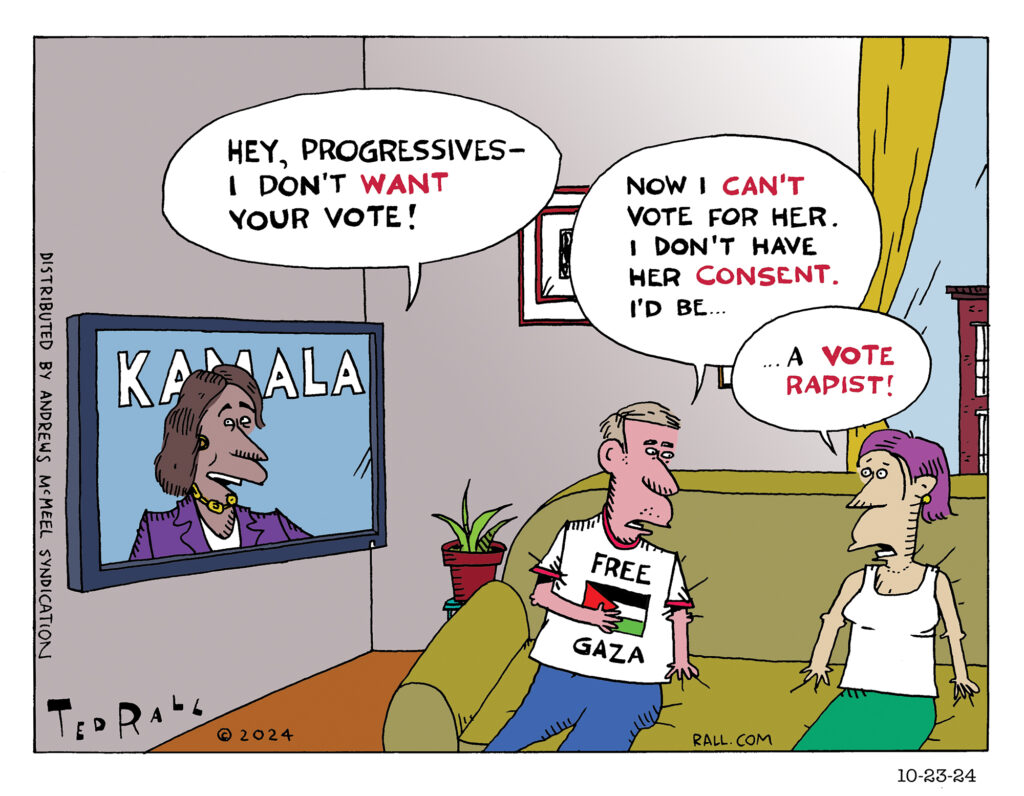
Don’t Be a Vote Rapist

Like Hillary Clinton in 2016, Kamala Harris is clear on the fact that she isn’t interested in convincing progressives to vote for her. At this point, it would be rude and invasive for progressives to vote for her anyway.

Biden/Harris, Fascist Media Censors

          Democrats centered Kamala Harris’ election campaign around the threat to American democracy posed by Donald Trump’s possible return to the presidency. The issue may not weigh on voters’ minds as heavily as the economy, but it does resonate; polls show that Americans trust Harris more to counter political extremism and preserve democracy.

When it comes to democracy, is there much difference between the two candidates? Not as far as I can see.

Yeah, Trump spews authoritarian rhetoric. “CBS should lose its license,” Trump wrote on Truth Social platform last week. “60 Minutes should be immediately taken off the air.” “We have some sick people, radical-left lunatics,” Trump said recently. “And it should be very easily handled by, if necessary, by [the] National Guard or, if really necessary, by the military, because they can’t let that happen.” Democratic vice presidential candidate Tim Walz called Trump’s comments “dangerous” and “un-American,” and of course he’s right.

But the Biden-Harris Administration is just as bad. In fact, they have already engaged in the kind of vicious censorship and suppression typically deployed by the world’s most repressive and dictatorial regimes—actions that go beyond anything Trump did or threatens to do.

The president is fascist. I know, because I’m a victim of one of his fascist actions.

On October 15 Sputnik News, where I co-hosted a radio talk show and for whom I had drawn political cartoons, was shut down. This media closure had nothing to do with market forces or funding problems. With the stroke of his pen, Herr Biden issued a set of legal and financial sanctions crafted to force the network off the air. Several dozen American journalists, consummate professionals at least as talented as many of their peers at “mainstream” outlets, are out of work. As leftists, we had been grateful to land jobs with a Russian-based company.

No American newspaper, magazine or broadcast network will consider hiring anyone among the 40% of Americans who fall to the left of the Democratic Party.

The First Amendment is supposed to protect everyone, including foreign media organizations like Sputnik, the BBC and CBC, from direct government censorship. Because the White House has frozen its bank accounts, however, Sputnik can’t hire a lawyer to fight in court.

The Administration and its media mouthpieces said that Sputnik spread propaganda. But U.S. law does not ban propaganda. Which is good, because who could define it? For my part, I have never been less censored or edited as a cartoonist or radio talker than when I was at Sputnik. And I’ve worked for scores of mainstream liberal and centrist publications and broadcast outlets.

No one, including the U.S. government, accused Sputnik of breaking American law or failing to comply with regulations. The brief against Sputnik boiled down to: Sputnik is Russian, Russia is at war with Ukraine, the U.S. supports Ukraine, Sputnik must die.

Government censorship of the news media is typically carried out by proxy. The LAPD pension fund bought controlling interest in The Los Angeles Times and ordered them to fire me as their cartoonist. Al Jazeera America, the Qatar-based news channel, was shuttered in 2016 in part because President George W. Bush had pressured major cable distributors not to carry it. Because the entities involved were private, the First Amendment didn’t apply. Trump and Biden’s persecution of Julian Assange relied on the fiction that Wikileaks was not a news media publisher.

The Democrats’ attack on Sputnik is radical and terrifying. Acting alone, the President—neither a regulatory agency like the FCC nor Congress acting as elected representatives of the voters—has shut down a news network.

Sputnik was Russian. You might not like anything it broadcast or published. (Though the few people who found it were pleasantly surprised at how little discussion there was about Russia and Ukraine, how it aired intelligent voices censored by corporate media and that it covered a lot of international news you couldn’t find elsewhere. It was by far the most prominent outlet for the real, actual, non-Democrat, U.S. Left. You can still listen to some of my old shows.)

If President Biden can close Sputnik, he can shut down CNN and The New York Times.

Censors’ first targets are always the softest targets: small, unpopular, demonized, fringe. Uptight prigs in Reagan-era America went after pornographers and edgy musicians. Politically-correct college students shout down right-wing speakers. Pro-Palestinian protesters are smeared as anti-Semites.

            As Thomas Jefferson wrote in 1789, democracy cannot function without a well-informed electorate. For nearly a quarter of a millennium, Americans have preferred to have access to a wide spectrum of opinions. Whenever politicians, clerics or academics have suggested that unpopular and “extreme” ideas should be censored and that popular discourse would improve by being curated, censorship has ultimately been rejected in favor of free speech. In 2022, for example, a proposal by President Biden’s Department of Homeland Security to create a Disinformation Governance Board to combat misinformation and disinformation, headed by a woman who had previously claimed Hunter Biden’s laptop was “a Trump campaign product” faked by Russia, was shot down in a rare moment of Congressional bipartisanship.

            Yesterday’s conspiracy theories—Hunter’s laptop, the Wuhan lab theory, negative side effects of Covid vaccines—become today’s truths. So our cultural consensus remains: Don’t censor bad/false/disagreeable/offensive speech. Respond to it. Truth will usually out.

            After the European Union banned and blocked Sputnik in response to the 2022 Russian invasion of Ukraine, European Federation of Journalists General Secretary Ricardo Gutiérrez remarked: “This act of censorship can have a totally counterproductive effect on the citizens who follow the banned media.”

            I’ve been thinking about Gutiérrez’s statement. Who wins and who loses as the result of Biden’s dictatorial move?

            The main victims are the American citizens who followed Sputnik. They will not thank the government. They will think that all that government rhetoric about democracy and free speech is empty talk—propaganda. They’ll trust the government and corporate media less than ever.

            Ex-Sputnik employees, a brave and talented group, are likely to survive and even thrive—and be even less willing to believe the government when it claims to have Americans’ best interests in mind.

            As my show went off the air for the last time at noon, I waited to hear the music signaling the beginning of the next program, “Political Misfits,” with Michelle Witte and John Kiriakou. Instead, there was dead air.

            The irony was rich. Kiriakou, a CIA whistleblower, spent nearly two years in federal prison for the “crime” of exposing the agency’s torture program. Once again, the government was trying to shut him up.

            Biden and his fellow fascists—including Vice President Kamala Harris, whose silence here speaks as loudly as her tacit support for Israel’s wars against Gaza and Lebanon—are the big winners. Shutting down Sputnik sends a chilling message to any reporter or commentator who dares to oppose official narratives. We can and will keep you quiet, First Amendment be damned.

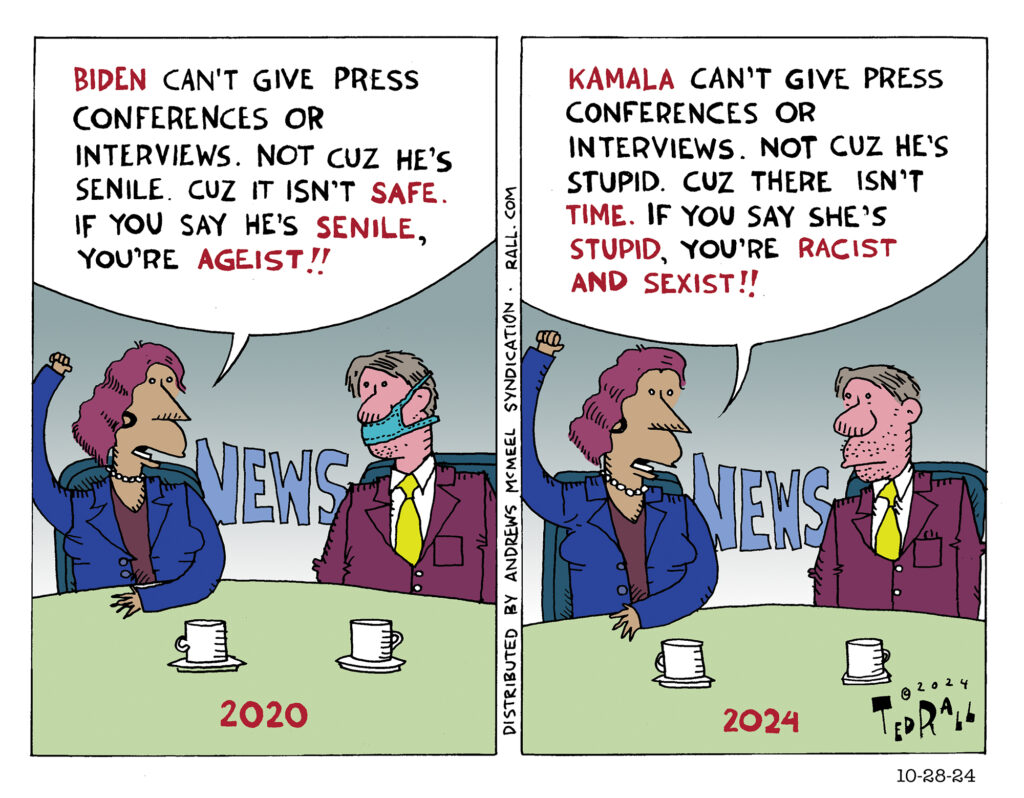
Hidin’ Like Biden

Biden and Harris have both embraced a strategy of refusing press conferences and interviews with adversarial journalists. When you bring this up, each has a ready answer.

The Strategic Voting Fallacy

         Many people who typically vote Republican but dislike Trump, and others who typically vote Democratic but dislike Harris, are wrestling with a fundamental dilemma of the voter who lives in a duopoly.
A vote is an endorsement. A vote declares to the world: “I approve of this candidate.” There is no half-vote. A vote is binary: yes or no. If your vote helps someone win who goes on to do something awful, their sins are partly your fault.

If there are only two major-party candidates, and both seem likely to commit an atrocity if they win, the moral and rational alternative is clear: vote for a third-party or independent candidate whose odds of carrying out a heinous act appear to be low, or boycott the election.

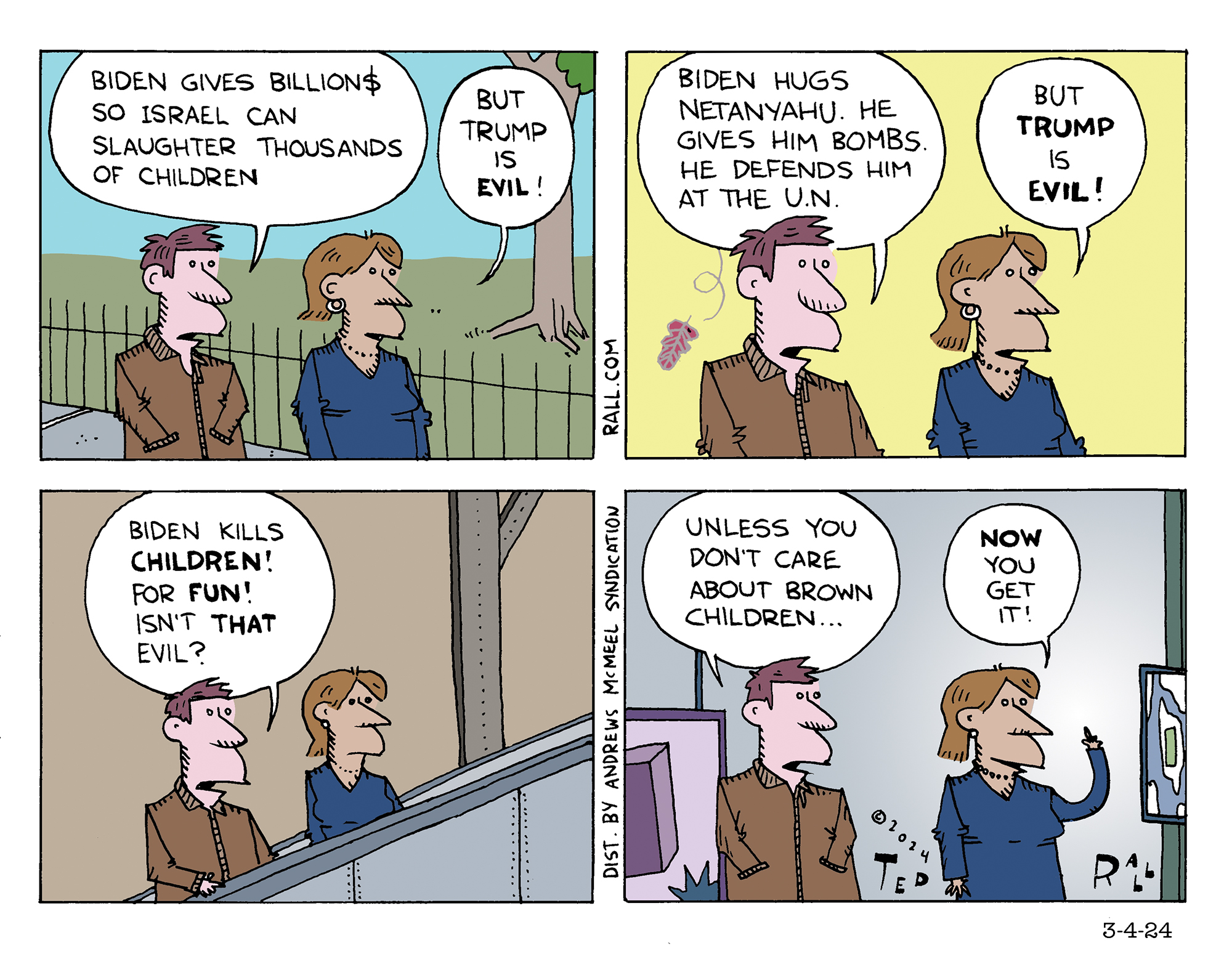
For the 61% of Americans who oppose sending more weapons to Israel, this condition has been met. Kamala Harris and Donald Trump are both enthusiastic supporters of Israel’s genocidal war against Palestinian civilians in Gaza, Lebanon and the West Bank. Both have promised to send more bombs, more missiles, more money and more intelligence to the Israelis. A vote for Harris is a vote for more genocide. So is a vote for Trump. If you vote for either the Democrat or the Republican, the blood of every Palestinian who dies or gets maimed after January 20th will be on you.

I am not saying this to make you feel guilty. I am merely stating a fact.

If they care to vote at all, pro-Palestinian voters can support Jill Stein, Cornel West, Chase Oliver or someone else. But then they must contend with the strategic voting fallacy.

Strategic voting, or “lesser of two evils” voting, is the act of casting a ballot in favor of a candidate you do not support, in order to prevent a second candidate you oppose more, from winning. By definition, because non-duopoly candidates are unlikely to win, a vote for someone other than a Democrat or a Republican is a “wasted” vote that, de facto, supports the major-party candidate you hate most. Aside from the self-alienating cognitive dissonance of consciously endorsing a politician whose policies of which you do not approve, strategic voting is deeply illogical and mathematically ridiculous.

First and foremost, it is statistically impossible—beyond the point of winning-the-Lotto odds—that your single vote could ever change the outcome of an American election at the state or national level. This is not to say that an election can’t be close. The 2000 Bush v. Gore presidential race came down to 537 votes that determined the pivotal state of Florida; the 1916 contest between Woodrow Wilson and Charles Hughes boiled down to 3,420 votes in California. But the odds that one vote can change the result of an American presidential election are so vanishingly small as not to be worthy of serious consideration by anyone with more than two IQ points to rub together.

A statistical analysis of the 2008 election published in the academic journal Economic Inquiry by Andrew Gelman, Nate Silver and Aaron Edlin proves this point. “One of the motivations for voting is that one vote can make a difference. In a presidential election, the probability that your vote is decisive is equal to the probability that your state is necessary for an electoral college win, times the probability the vote in your state is tied in that event,” the authors noted. “On average, a voter in America had a 1 in 60 million chance of being decisive in the presidential election.”

If you vote to “make a difference,” you’d get better results from playing a classic Pick-6 Lotto game; odds of winning the jackpot are 1 in 32 million. Unlike voting, it pays.

True, your vote might determine who sits in the Oval Office the next four years. It’s never happened before. It’s never even been close. Statistically, 537 votes in Florida was not close. Would you go to a job interview where your odds of getting hired were 1-in-537? It would be irrational, just as it would be crazy to avoid flying—even though the odds of dying in a plane crash (1 in 11 million) are much higher than your vote tipping a national election.

Strategic voting requires precise analysis of perfectly accurate polls capped by a completely subjective determination of whether a candidate has a viable chance of winning.

Setting aside the challenges faced by pollsters trying to sample a population’s opinions from mobile phones rather than landlines, a problem illustrated by the many polling organizations who failed to predict Trump’s 2016 victory, high-quality polls are subject to a margin of error of several percentage points. In a tight race, in which the margin of a win can be within that margin, a poll is as useful as a coin flip. Finally, strategic voters must ask themselves: assuming I can find a poll that I totally believe, where is the numerical tipping point where a race becomes so skewed in my state that I should free to vote my conscience, i.e. for a third-party or independent candidate, or not at all?

In Montana, where Trump leads Harris 56-39, it’s safe to say the former president has the state in the bag. Montana voters tempted to cast a protest vote against the Israelis’ genocide in Gaza needn’t lose much sleep by filling in the oval for Jill Stein. It’s a different affair in the battleground state of Pennsylvania, where Harris leads Trump by one point, 49-48, well within the margin of error—that is, of course, assuming these polls are right and that, if they are, they won’t change much between now and when you cast your vote.

What about a state where one candidate leads 55-45? A ten-point difference would be hard to overcome, and it wouldn’t be considered a swing state, but it’s not impossible—such things have happened before.

This is where the absurdity of strategic voting escalates even further.

What constitutes a close race? A close-enough race to believe (falsely, as Nate Silver and his friends proved in their study that your single vote could affect the outcome)? 51-49? Of course. (Though it’s not true.) 75-25. Of course not. (But that’s no less true than the 51-49 scenario.) 53-47? Maybe?

(Ted Rall (Twitter: @tedrall), the political cartoonist, columnist and graphic novelist, co-hosts the left-vs-right DMZ America podcast with fellow cartoonist Scott Stantis. His latest book, brand-new right now, is the graphic novel 2024: Revisited.)

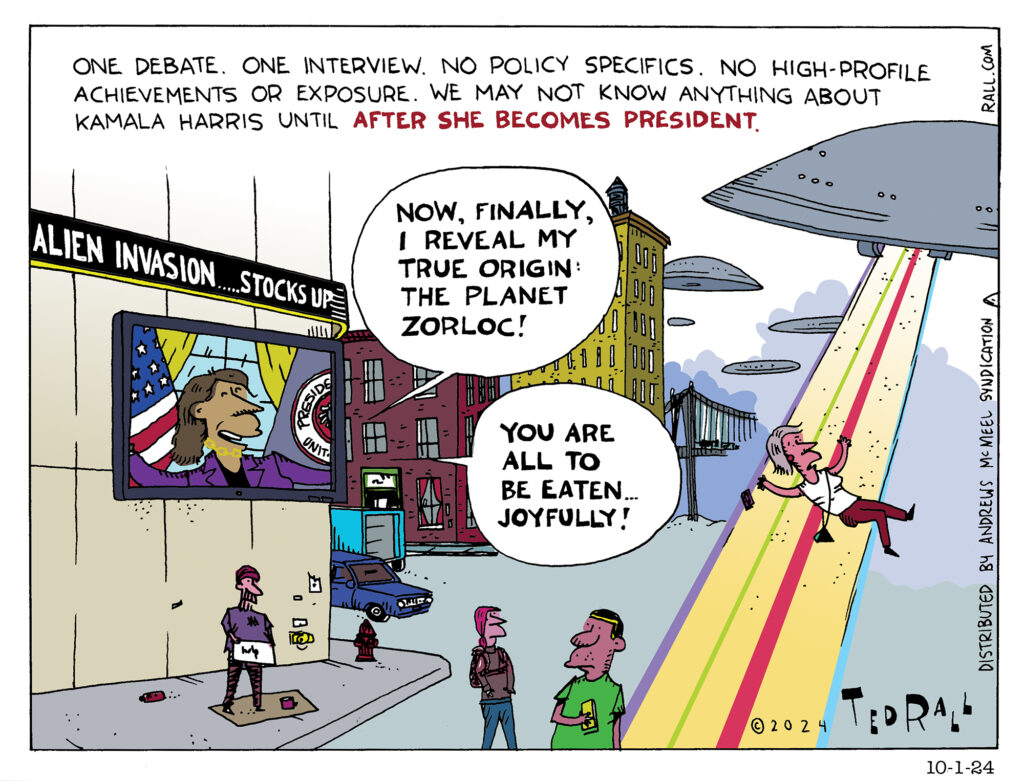
A Blank Check for Madame Vice President

One debate. One interview. No policy specifics. No high-profile achievements or exposure. We may not know anything about Kamala Harris until after she becomes president.

keyboard_arrow_up
css.php