SYNDICATED COLUMN: Teddy Roosevelt Saw This Coming

The Decline and Fall of an American Icon

Why did our political system become so corrupt and unresponsive? How did we end up with such a rigid, Old European-style class system—in which you can’t get ahead unless you were born that way? America: What Went Wrong?, a 1992 paperback by Donald L. Barlett and James B. Steele, went a long way toward answering those questions.

It may be, however, that America was doomed long before then.

The historian Edmund Morris recently published the final entry of a magisterial trilogy about the life of Theodore Roosevelt. Though frequently listed among the greatest American politicians today, TR was an “accidental president” who ascended to power thanks to the murder of William McKinley. His blustery and impolitic style—his supporters called it speaking truth to power—would never have allowed him to win a presidential election.

Roosevelt sussed out the perils of unregulated capitalism early on. “The great corporations which we have grown to speak of rather loosely as trusts are the creatures of the State, and the State not only has the right to control them wherever need of such control is shown but it is in duty bound to control them,” he said in 1901.

No president since Nixon has followed TR’s advice. The result of unbridled corporate corruption is disparity of wealth worse than much of the Third World, and 20 percent unemployment.

Morris’ book Colonel Roosevelt addresses TR’s life after leaving the presidency in 1909: his 1912 run as on the independent Bull Moose ticket, his disastrous expedition through the Amazon, and finally the decline of this legendary dynamo after the start of World War I reordered the international landscape and doomed him to political irrelevance: a career bookended by assassins’ bullets.

Few presidents are as revered by both the left and the right. Liberals love TR for his record as an environmentalist and trust-buster. Conservatives like his unapologetic imperialism: the American empire as we know it began with Roosevelt.

Although it describes events that took place a century ago, this new biography shines light on many of the systemic ills that afflict the United States today.

On the domestic front it is brutally disheartening to read that even a figure as historically transcendent and contemporaneously popular as Theodore Roosevelt found it impossible to break the lock of the two major parties on the political process. As schoolchildren learn, the Bull Moose Party marks the apex of third party attempts in presidential politics. In 1912 it was an empty farce.

Along with their allied press barons, the Republican and Democratic Party machines blocked the charismatic (albeit longwinded) ex-Rough Rider every step of the way, rendering Roosevelt’s third-party defeat as much of a foregone conclusion as Nader’s.

During the Bull Moose run Roosevelt was shot at close range as he arrived for a campaign appearance in Milwaukee. The bullet, slowed by the printed text of the 50-page speech folded over in his jacket pocket, had nevertheless “pinked” the former president.

Morris’ description of TR’s grace under fire inspires awe: “Don’t hurt him. Bring him here,” Roosevelt shouted to men restraining his would-be assassin as he hoisted himself to his feet.

“Let’s go the hospital,” urged an aide.

“You get me to that speech,” Roosevelt replied, Morris says, “with a savage rasp to his voice.”

“[The bullet wound] was a ragged, dime-sized hole, bleeding slowly, about an inch below and to the right of his right nipple. The bullet was nowhere to be seen or palpated. The whole right side of his body had turned black,” Morris writes.

TR took the podium. “It takes more than that to kill a bull moose,” he said, going on to speak for an hour and fifteen minutes.

We have lost so much. Contrast TR’s courageous performance after being shot to our so-called “leaders.” On 9/11 George W. Bush abandoned Washington, fleeing into internal exile, hopscotching the nation like a coward before slinking back to the capital half a day later.

Roosevelt spent his last years hurling scathing critiques of Woodrow Wilson’s reluctance to enter World War I on the side of Britain and France. Nearly 100 years ago, however, the bellicose Roosevelt harbored no proto-neocon-like delusions about American exceptionalism—the nauseating combination of high-blown rhetoric and gutter-rat real-world actions that characterizes foreign policy of the United States and sparks outrage around the globe.

“He scoffed at the hypocrisy of Wilson’s grand-sounding phrase ‘self-determination for all peoples’ [in Wilson’s Fourteen Points], noting that the President was in no hurry to grant liberty to Haiti or Santo Domingo.” Both were under U.S. military occupation.

Were such self-awareness in greater supply in the U.S. today, we might not be fighting wars of aggression on three fronts at the same time we’re lecturing other countries about sovereignty and human rights.

Roosevelt’s martial spirit was his blind spot.

Unlike most Americans today, he had served valiantly. His bravery was unquestioned. One of his greatest disappointments was Wilson’s refusal to allow him to fight in the Great War.

Despite his experience in battle TR shared with today’s armchair “support our troops” “U-S-A” warriors an excess of willingness to send others to face shells and poison gas—without fully internalizing the consequences.

Despite being sidelined, Roosevelt pushed his sons to enlist and get to the fighting. Then his son Quentin, a pilot, got shot down. “Quentin’s mother and I are very glad that he got to the Front and had a chance to render some service to his country, and to show the stuff there was in him before his fate befell him,” he told the press.

But the cold reality of Quentin’s permanent absence marked the beginning of the end of a man known for his vigor. “The old side of him is gone, the old exuberance, the boy in him has died,” a friend noted the day after he learned of his son’s death. “I am not what I was,” TR confessed to his sister.

Two years later Roosevelt was dead, a victim of the American militarism he extolled and symbolized.

(Ted Rall is the author of “The Anti-American Manifesto.” His website is tedrall.com.)

COPYRIGHT 2011 TED RALL
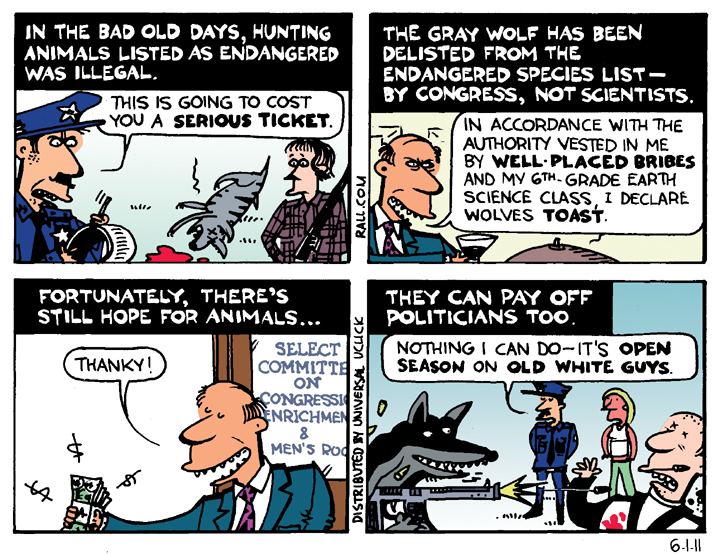
Open Season on the Gray Wolf

Gray wolves have been delisted from the Endangered Species List as the result of corrupt lobbying. This is the first time an animal has been delisted as the result of non-scientific inquiry, by bureaucrats and politicians.

SYNDICATED COLUMN: Unions? What Unions?

Labor Leaders to Blame for Workers’ Weakness

I will never understand why the people who are jealous of unionized workers who earn $50,000 a year give a pass to the incompetent bank executives who get $5,000,000. Resentment is a terrible thing to waste.

Given how terribly companies have treated workers in recent years—mass layoffs, outsourcing, stagnant wages, piling on the work, while they pay their executives seven-figure salaries—you’d think Americans would be more receptive to unions. But organized labor’s bad rep isn’t surprising. A half-century of smears by big business and their media allies and sleazy laws passed by corrupt anti-worker politicians (c.f. the Taft-Hartley Act) have established today’s image of organized labor as corrupt, selfish and marginal.

As if that propaganda colossus wasn’t enough to contend with, labor unions have responded to these attacks with a series of poorly thought-out strategies that fed into that narrative.

As a result fewer than seven percent of private-sector workers belong to a union. And the last union stronghold, public-sector employees (36 percent represented), is under siege by Republicans in states like Wisconsin and Ohio.

Where did union leaders mess up? They made so many bone-headed decisions that it’s hard to know where to start.

During the 1980s unions forgot what they were and who they represented. They abandoned their traditional oppositionalism to management on the ground that their fates were interlinked: if the plant closed, union members would lose their jobs. Embracing schemes like “quality circles” and the “team concept,” in which workers and shop stewards worked side-by-side with bosses, unions increased efficiency at their own expense, essentially crossing their own non-existing picket lines. Unions took seats on the boards of companies they were supposed to be pressuring for higher wages and benefits.

The results of hobnobbing with corporate executives were predictable: givebacks and concessions to companies so they can pay their executives more and more. In 2009, for example, the United Auto Workers agreed to freeze their salaries to help save the big three Detroit automakers. They also slashed employee benefits, including healthcare.

Did the Big Three use those savings to invest in new plants? Hell no. They continued to outsource jobs overseas. Meanwhile, as UAW members got laid off and struggled through pay freezes, Ford gave president and CEO Alan Mulally a raise in his stratospheric annual salary, to $17.9 million. GM forked over $9 million to CEO Daniel Akerson. Despite having no apparent God-like superpowers—at this pay scale the dude ought to be able to shoot flames out of his mouth—Chysler-Fiat felt it appropriate to pay $7.7 million to its CEO, Sergio Marchionne.

This “please let me sit at the jocks’ table” mentality persists. UAW President Bob King said in January that seats on the boards of each of the big three Detroit automakers are at the top of his wish list. Memo from reality: you don’t hang out with your enemy. You fight them.

What is the point of a union that sells out its members?

The byword of American labor is “solidarity.” Considering that employers have the media and government on their side, sticking together is the only way to win.

Yet all too often unions under siege during the 1980s and 1990s did the opposite. They created two classes of workers—old and grandfathered-in, versus the young and screwed. In return for protecting wages and benefits for their existing (older) membership, unions such as the International Longshoremen’s Association agreed to a drastically lower tier of wages for new hires. By looking out for their narrow short-term interests, the ILA confirmed the perception that they were less interested in workers rights than self-preservation. Ironically it mortgaged its future in the process.

John Sweeney, president of the AFL-CIO from 1995 to 2009, spearheaded a drive to organize women, minorities and low-paid workers. Though laudable, the new emphasis neglected labor’s traditional base, white males, who also happen to be politically influential “Reagan Democrats,” a.k.a. swing voters. These “angry white males” became today’s right-wing Tea Party.

Big labor’s abusive love affair with the Democratic Party has been bafflingly counterproductive. I don’t have a problem with the “forced” collection of union dues; it’s fair to require everyone who benefits from higher wages and benefits to support the union that makes them possible. But it’s ridiculous to use those dues to support one political party—the Democrats. Between 1990 and 2008 unions made more than $667 million in political campaign contributions, 92 percent to Dems.

Which might be justifiable, if unions got anything in return. NAFTA, GATT and WTO (signed by Clinton and continued by Obama) gutted American manufacturing jobs. The 2009-10 Democratic majority Congress ignored labor’s top priority, the Employee Free Choice Act. Neither Clinton nor Obama even considered repealing Taft-Hartley, which bans wildcat strikes, solidarity strikes, secondary boycotts, union shops and allows courts to break strikes arbitrarily.

A still bigger mistake has been labor’s inexplicable refusal to go after the ersatz “while collar” workplaces.

“There’s something new in the air,” UC Berkeley professor Harley Shaiken, who studies labor issues, told Reuters. “There is a sense that white-collar workers have become the blue-collar workers of the 21st century in terms of job security, wages and benefits. That’s certainly how they’re treated. And if you’re treated like a blue-collar worker, you may respond like a blue-collar worker and seek to protect benefits and maintain some job security.”

The AFL-CIO and other unions talk about organizing the white-collar ghetto. But they aren’t doing much. Few workers in the tech sector or advertising or finance or the media have ever met a union organizer. If labor had its act together, no cubicle farm in America would go a year without an attempt to unionize it.

Without the passage of a “card check” law to reduce employer retaliation, union organizing attempts might fail—but the workers who voted yes would always appreciate that they were trying to help them live better lives.

Labor is on the ropes. With the economy getting worse, however, there has never been a greater need for union leaders to get smarter and more militant—or a better opportunity to reverse their long slide.

(Ted Rall is the author of “The Anti-American Manifesto.” His website is tedrall.com.)

COPYRIGHT 2011 TED RALL

Corrupt and Unresponsive

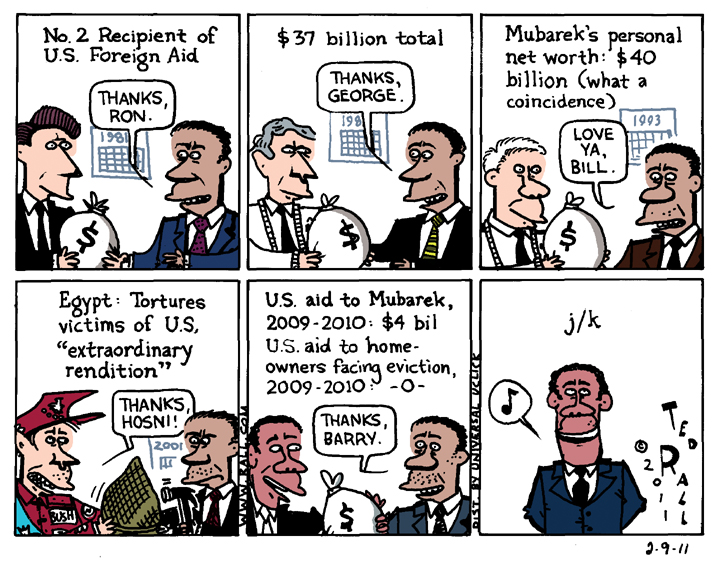
As protests shake the world, the causes–high unemployment and unresponsive government–seem awfully familiar to Americans, who have a higher unemployment rate than Tunisia or Egypt.

Just Kidding

The U.S. [aid Egyptian dictator Hosni Mubarek $37 billion since 1981. Now they want to distant themselves.

SYNDICATED COLUMN: WikiLeaks: The Devils We Know

Cables Reveal Background of Pro-Dictator U.S. Policy

After the Soviet collapse in 1991 U.S. policy toward Central Asia was transparently cynical: support the dictators, screw the people.

As the U.S. stood by and watched, corrupt autocrats looted the former Soviet republics of Turkmenistan, Uzbekistan, Kazakhstan and Tajikistan. Dissidents were jailed, massacred—even boiled.

Well, actually, the U.S. was anything but passive. They negotiated deals for oil and gas pipelines. They rented airbases after 9/11. They poured in tens of millions of American tax dollars—all of which wound up in secret bank accounts belonging to the dictators and their families. Meanwhile, average citizens lived in abject poverty.

During trips to Central Asia the locals constantly ask me: “Why doesn’t America stop supporting [insert name of corrupt dictator here] so we can kill him and free ourselves?”

Poor, naïve people. They believe our rhetoric. They think we like democracy. Actually, we’re all about the looting. Dictators are easier to deal with than parliaments. One handshake and a kickback, that’s all you need with a dictator.

Central Asia only had one democratically elected president, Askar Akayev of Kyrgyzstan. George W. Bush ordered the CIA to depose him in a coup.

Americans who care about human rights have long wondered: Is the State Department stupid and/or naïve? Or did the diplomats in Tashkent and other capitals of unspeakable misery understand the brutal and vile nature of Central Asia’s authoritarian leaders?

An examination of the WikiLeaks data dump answers that question: Yes.

Hell yes.

Like those from concerning more prominent countries, the WikiLeaks cables on the Central Asian republics can be funny. President Gurbanguly Berdimuhamedov, a U.S. “ally in the war on terror” who seized power in a palace coup following the death of Saparmurat “Turkmenbashi” Niyazov, is described as “the ‘decider’ for the state of Turkmenistan.” This is true. Turkmenistan is an absolute dictatorship in which millions starve while Berdimuhamedov’s inner circle feasts on the profits from the world’s largest reserves of natural gas.

A December 2009 cable describes America’s pet autocrat as “vain, suspicious, guarded, strict, very conservative, a practiced liar, ‘a good actor,’ and vindictive.”

According to an unnamed source, the outwardly conservative dictator has a Russian mistress named Marina, with whom he has a 14-year-old daughter. Though Berdy’s power may be limitless, his intellect is not. “Berdimuhamedov does not like people who are smarter than he is,” says the cable. “Since he’s not a very bright guy, our source offered, he is suspicious of a lot of people.”

No one’s perfect. Least of all America’s allies in Central Asia.

On the other side of the steppe in Kazakhstan, President Nursultan Nazarbayev presides over the world’s largest oil reserves with an iron fist. Among his greatest hits: the convenient “suicides” of his top two political opponents a few months before a presidential “election.” The two men apparently shot themselves in the back of the head, then bound their own hands behind their backs and dropped into a ditch outside Almaty.

Needless to say, Nazarbayev is another valuable U.S. ally in the war on terror.

But that doesn’t stop American gossip. Nazarbayev’s defense minister, says an embassy staffer in Astana, “appears to enjoy loosening up in the tried and true ‘homo sovieticus’ style—i.e., drinking oneself into a stupor.” But alcoholism isn’t illegal. Graft is—and the president is public enemy number one.

“In 2007, President Nazarbayev’s son-in-law, Timur Kulibayev, celebrated his 41st birthday in grand style,” explains an April 2008 cable. “At a small venue in Almaty, he hosted a private concert with some of Russia’s biggest pop stars. The headliner, however, was Elton John, to whom he reportedly paid one million pounds for this one-time appearance.” How did he come up with all that coin? “Timur Kulibayev is currently the favored presidential son-in-law, on the Forbes 500 list of billionaires (as is his wife separately), and the ultimate controller of 90% of the economy of Kazakhstan,” states a January 2010 missive.

Membership has its privileges. The U.S. has never spoken out against corruption or human rights abuses in Kazakhstan.

So it’s clear: American diplomats have no illusions about their brutal allies. Interestingly, Central Asia’s overlords have a dismally accurate view of corruption in the U.S. government.

“Listen, almost everyone at the top [of the Kazakh regime] is confused,” First Vice President Maksat Idenov told the U.S. ambassador to Kazakhstan early this year. “They’re confused by the corrupt excesses of capitalism. ‘If Goldman Sachs executives can make $50 million a year and then run America’s economy in Washington, what’s so different about what we do?’ they ask.”

No response was provided.

(Ted Rall is the author of “The Anti-American Manifesto.” His website is tedrall.com.)

COPYRIGHT 2010 TED RALL

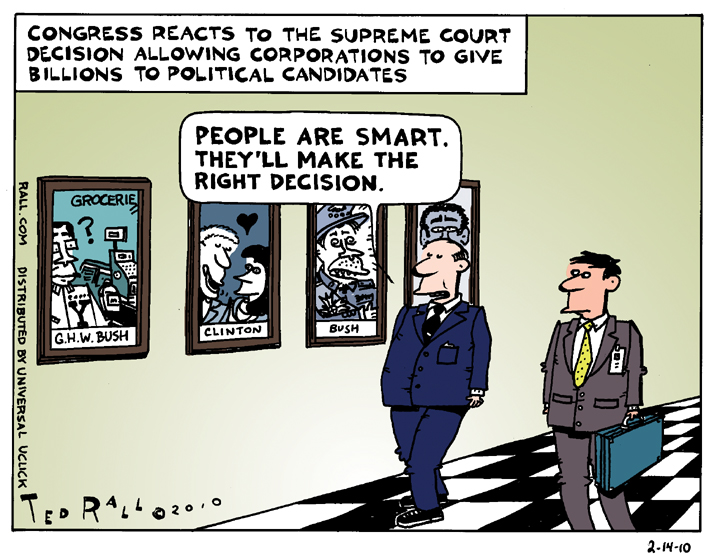
Trust the People

Don’t worry. The people always make the right choice.

And yes, I do know Bush 43 lost.

keyboard_arrow_up
css.php