Photos from the Revolution

•

I went to Quebec late last month to cover the huge, militant student protest movement that the American media has been studiously ignoring. Right now I’m working on a comics journalism project for Cartoon Movement and The Los Angeles Times about what I saw. Here are some photos I took in Montreal during the run-up to and during a huge demonstration on July 22.

[nggallery id=27]
 

SYNDICATED COLUMN: Iran – Because Two Wars Aren’t Enough

•

Why Doesn’t Anyone Call Out Romney for Warmongering?

Mitt Romney had a barnburner of a weekend in Israel. The GOP nominee apparent shared his unique combination of economic and anthropological wisdom, attributing the fact that Israel’s GDP and average income is many times higher than those of the Palestinian Occupied Territories to Israelis’ superior “culture.”

As if spewing one of the most overtly racist lines in recent presidential campaign history wasn’t enough, eschewing “containment” (read: “diplomacy”), Romney also endorsed a preemptive Israeli military strike against Iran in order to prevent the latter’s nuclear program—Israel’s own, illegal nuclear weapons stockpile is OK since it’s a U.S. ally—from moving forward.

“We have a solemn duty and a moral imperative to deny Iran’s leaders the means to follow through on their malevolent intentions,” Romney said, stating that “no option should be excluded.”

He didn’t say how he knew the intentions of Iran’s leaders. Clairvoyance? Bush had it too.

Though Mitt slightly walked back his campaign’s sabre rattling, the message was clear. If he is elected, Israel will receive a blank check to begin a war against Iran, one of the most well-equipped military powers in the Middle East—a conflagration in which the United States could easily wind up getting dragged into. (In a subsequent interview he reiterated that “we have all options on the table. Those include military options.”)

Most criticism focused on Romney’s flouting of the traditional proscription against candidates questioning a sitting president’s foreign policy while visiting foreign soil. Though, to be fair, the differences between his and President Obama’s approach to Israel and Iran are tonal and minor.

As usual with the U.S. media, what is remarkable is what is going unsaid. Here we are, with the economy in shambles and the public worried sick about it, the electorate tired of 12 years of war against Afghanistan and nine against Iraq, yet Romney—who could be president six months from now—is out ramping up tensions and increasing the odds of a brand-new, bigger-than-ever military misadventure.

Warmongering has gone mainstream. It’s a given.

In a way, Romney’s willingness to risk war against Iran is merely another example, like the car garage and dressage, of how clueless and out of touch he is. Most Americans oppose war with Iran. For that matter, so do the citizens of the country on whose behalf we’d be killing and dying, Israel. But even Romney’s Democratic opponents give him a pass for Romney’s tough-guy act on Iran.

The reason for the somnolent non-response is obvious: it’s nothing new. Year after year, on one foreign crisis after another, American presidents repeatedly state some variation on the theme that war is always an option, that the military option is always on the table. You’ve heard that line so often that you take it for granted.

But did you know that “keeping the military option on the table” is a serious violation of international law?

The United States is an original signatory of the United Nations Charter, which has the full force of U.S. law since it was ratified by the Senate in 1945. Article 51 allows military force only in self-defense, in response to an “armed attack.” As Yale law and political science professor Bruce Ackerman wrote in The Los Angeles Times in March, international law generally allows preemptive strikes only in the case of “imminent threat.” In 1842 Secretary of State Daniel Webster wrote what remains the standard definition of “imminent,” which is that the threat must be “instant, overwhelming, leaving no choice of means and no moment for deliberation.” The enemy’s troops have massed on your border. They have superior force. What must be done to stop them is evident. There’s no time for diplomacy.

Iran’s nuclear program doesn’t come close to this definition, even from Israel’s standpoint. Bruce Fein, deputy attorney general under Reagan, told Fairness and Accuracy in Reporting’s Extra! Magazine: “It is nothing short of bizarre to claim, as the Obama Administration is doing, that the mere capability to make a bomb is justification for a preemptive attack. That’s a recipe for perpetual war. Almost any country could have the capability to make a bomb. They are torturing the word ‘imminent’ to the point that it has no meaning.”

By endorsing an Israeli attack against Iran at a time when there is no proof that Iran has nuclear weapons, intends to develop them, or use them if it does, Romney is going farther than Obama, who has engaged in back-channel diplomacy.

The Allies’ main brief against the Nazi leaders tried at Nuremberg was not genocide, but that they had violated international law by waging aggressive war. Yet every American president has deployed troops in aggressive military actions.

Aggressive war hasn’t been good for America’s international image, the environment, our economy or the millions who have died, mostly for causes that are now forgotten or regretted. But unless we draw the line against reckless, irresponsible rhetoric like Romney’s, it will go on forever.

(Ted Rall’s new book is “The Book of Obama: How We Went From Hope and Change to the Age of Revolt.” His website is tedrall.com. This column originally appeared at NBCNews.com)

(C) 2012 TED RALL, ALL RIGHTS RESERVED.

LOS ANGELES TIMES CARTOON: A California Town Gets The Runaround

•

I draw cartoons for The Los Angeles Times about issues related to California and the Southland (metro Los Angeles).

This week:

I draw cartoons for The Los Angeles Times about issues related to California and the Southland (metro Los Angeles).

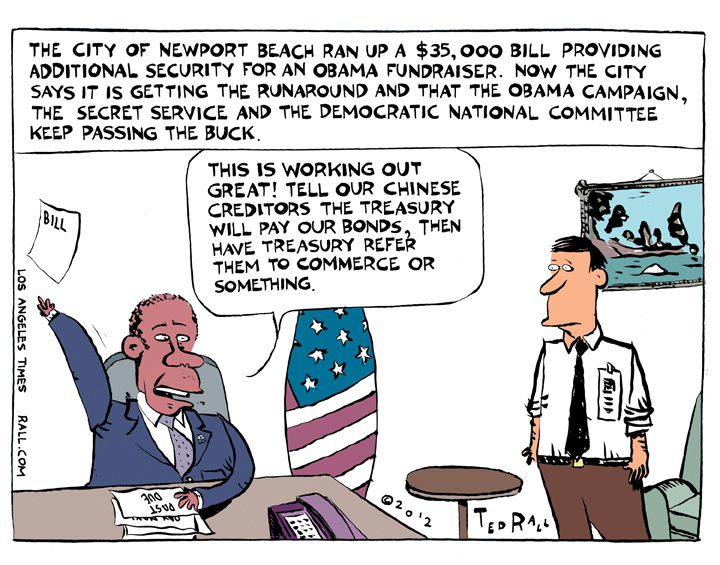
This week: The city of Newport Beach ran up a $35,000 bill providing additional security for an Obama fundraiser. Now the city says it is getting the runaround and that the Obama campaign, the U.S. Secret Service, and the Democratic National Committee keep passing the buck.

SYNDICATED COLUMN: Gun Control Talk Is Cheap. A Sane Mental Health System Is Not.

•

Guess Which Policy Prescription We Hear After Shooting Sprees?

It is, unfortunately, necessary to state the obvious after America’s latest mass shooting in Colorado. Like: we don’t know why James Holmes, the 24-year-old suspect, shot up that movie theater. We don’t know his mental state. Given the legal presumption of innocence, we shouldn’t write with certainty that it was him.

Given how the 24-hour news cycle has expanded the American media’s love of speculation, however, the Batman Bloodbath became fodder for political policy prescriptions the moment the first round left the chamber of Holmes’ (or whomever’s) AR-15.

We saw it after Columbine, when conservatives blamed goth, video games and the so-called “trenchcoat mafia.” Liberals (me included) set their sights on bullying jocks. Both sides were wrong—Eric Harris and Dylan Klebold were probably mentally ill, simply victims of one or more not-so-simple personality disorders—yet the political debate ultimately prompted schools to adopt increased security measures and zero tolerance policies against bullying. State legislatures passed minor gun control laws.

Which may have been good ideas. But they didn’t stop it from happening again.

The gun control debate took center stage after student Seung-Hui Cho shot 32 people to death at Virginia Tech in 2007. Liberals said people with a history of mental health issues shouldn’t be able to buy guns. Arguing that Cho’s victims would have been able to defend themselves had they been packing, right-wingers pushed to allow students to carry weapons on campuses.

Some commentators wondered aloud whether the United States should make it easier for people with mental health issues to seek and obtain help. But that line of discussion was quickly drowned out by the gun control debate.

Now the pattern is repeating itself. We know what happened, but we don’t know why.

We know that high-powered automatic weaponry was involved. Most of us assume that Holmes, though purportedly intelligent and educated, was deranged; why else would anyone slaughter innocent strangers in a movie theater?

Given these assumptions, which may turn out be wrong—the Fort Hood shooter, thought by some to be suffering from PTSD, was most likely “self radicalized” by U.S. foreign policy, making the killings a political act—it follows that we would try to prevent future similar tragedies by promoting policies in line with our personal ideological preconceptions, and that the political class and their media allies would promote themselves by marketing such “solutions” to us voters and consumers.

Setting aside the caveat that we still don’t know why it happened, the big guns/crazy young white guy dynamic leads to two obvious policy prescriptions: gun control and improving access to mental health care. Post-Aurora, we’re seeing a lot of the former, including calls for numerical limits on ammo sales—but relatively few of the latter. David Brooks, a conservative columnist at The New York Times, is an interesting exception. “These killers are primarily the product of psychological derangements, not sociological ones,” Brooks writes. But even he won’t call for a national War on Mental Illness: “The best way to prevent killing sprees is with relationships—when one person notices that a relative or neighbor is going off the rails and gets that person treatment before the barbarism takes control. But there also has to be a more aggressive system of treatment options, especially for men in their 20s.”

Well, yes. But not everyone has a relative or a concerned neighbor. Without a real commitment to treating, and thus destigmatizing mental illness—in other words, providing free, simple and easy access to mental health professionals for everyone—they’re empty words.

A 2008 study found that six percent of Americans suffer from serious mental illnesses, which resulted in an estimated economic loss of $200 billion annually in lost earnings. (This doesn’t include the one-quarter of the population who have less serious, diagnosable conditions.)

Sixty percent of people with mental illness seek no treatment whatsoever. It’s easy to see why: Americans with limited funds must make do with a lame hodgepodge of options when they feel themselves going off the rails: suicide prevention hotlines, support groups, and absurdly low allocations of shrink visits under group insurance plans.

Along with vision and dental care, mental health is an ugly stepsister of America’s frayed healthcare infrastructure, regarded as a supplemental luxury, and funded accordingly. If it isn’t overturned by a Romney Administration, Obama’s Affordable Care Act will help make “mental health parity”—forcing insurers to treat mental illness at the same priority level as physical ailments—a practical reality. But, failing a public option—or, what we really need, fully socialized medicine—the overall plan doesn’t go nearly far enough.

Gun control talk is cheap. A national mental healthcare system that works would be expensive.

Would either one prevent the next shooting spree? Maybe. Maybe not. Like zero tolerance for bullying, they might be a good idea no matter what—but we won’t be any closer to a solution.

(Ted Rall’s new book is “The Book of Obama: How We Went From Hope and Change to the Age of Revolt.” His website is tedrall.com. This column originally appeared at NBCNews.com)

(C) 2012 TED RALL, ALL RIGHTS RESERVED.

keyboard_arrow_up
css.php