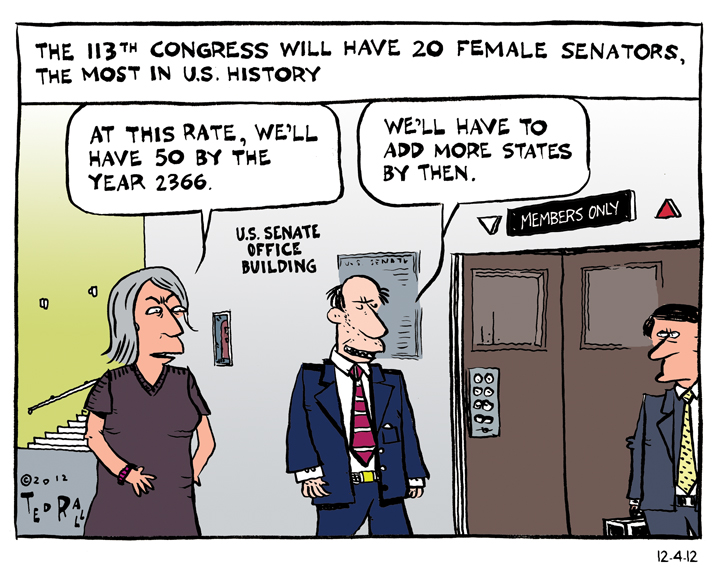
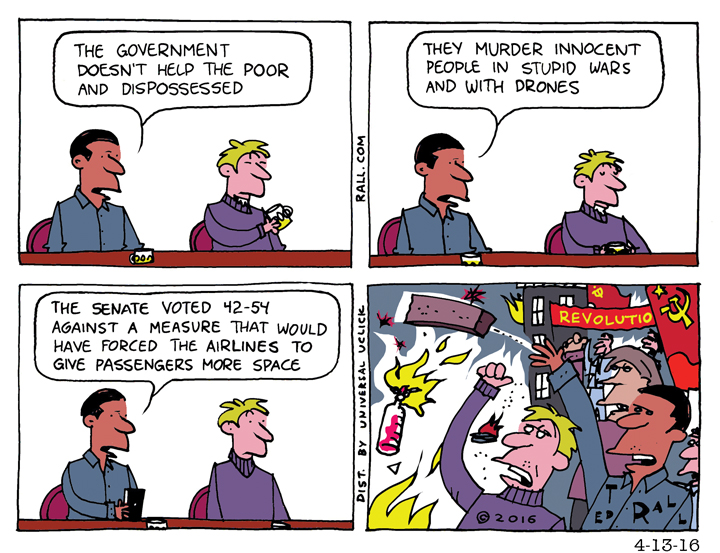
The U.S. Senate voted down an amendment that almost every American could have approved of heartily, a Chuck Schumer-sponsored measure that would have allowed the FAA to tell airlines to stop packing passengers into planes like sardines. At a time like this can anyone doubt that this isn’t a democracy?
SYNDICATED COLUMN: Empty Symbolism – Why the Freedom Act Sucks

Marketed as pro-privacy reform of the rancid Patriot Act, the USA Freedom Act is about to become law. Though nothing could be further from the truth, many Americans will believe that the NSA is being reined in, and move on another issue.
The Freedom Act has been characterized as another vindication of Edward Snowden — and, considering the fact that we wouldn’t be discussing the balance between individual privacy rights and national security if he hadn’t made the NSA’s spying against us public, it is.
We’re also being told that the Freedom Act will protect us from the NSA.
It won’t.
“This is more than symbolic,” said Georgia Tech professor Peter Swire, who worked on an Obama task force that studied NSA surveillance in the wake of the Snowden revelations.
No. It isn’t.
Symbolic is exactly what the Freedom Act is.
As The New York Times reports, most of the fascism-lite Patriot Act will remain in force under the Freedom Act: “only three provisions that temporarily expired Monday are now at issue, two of which have apparently been used only rarely.” The Freedom Act mainly affects the collection of “telephony metadata”: times of phone calls, the numbers of you called and were called from, how long you were on the phone, where you were, etc.
Telephony metadata is the tip of the iceberg.
Programs like Gumfish, through which NSA agents turn on Americans’ computer cameras to spy on them at their homes — and take photos of them nude and/or while having sex— are unaffected. So will programs like Mystic, which records and stores the voice recordings of your calls for at least five years. As I write in my upcoming biography of Snowden, so do many, many of the NSA’s Orwellian assaults on decency and personal freedoms.
Within the narrow sphere of telephony metadata, the Freedom Act creates one major reform: “it would take the government out of the business of bulk collection of telephone and Internet data like the numbers, times and duration of phone calls, leaving that information in the hands of telecommunications companies instead. But the government would still have the power to systematically gain access to the data in order to analyze indirect links between callers, just as it had under the old program.”
How exactly will the NSA “systematically gain access” to metadata under the Freedom Act? It will file a request with the FISA (Foreign Intelligence Surveillance Act) court.
Which will always say yes.
The FISA Court, which never hears from privacy advocates or a lawyer for the victim being targeted, is a rubber stamp for the government. It approves every request for spying on Americans: 1856 out of 1856 in 2012, for example. In 2011, 1674 out of 1674. In 2010, 1506 out of 1506.
You get the picture.
The NSA will still get your metadata. They’ll just have to file some paperwork to get it.
The Freedom Act sucks.
What should Congress have done instead?
If an individual were breaking as many laws as the NSA, he’d face life in prison, or execution. If a corporation — one that wasn’t politically connected — were breaking as many laws, its directors would be prosecuted and it would be shut down. The bar for government conduct should be at least as high as for you and me.
As we’ve learned from Snowden, the NSA is a rogue agency.
Here’s what would fix the problem: the NSA should be shut down. Its top officials, and those of its affiliated private contracting firms, should be imprisoned. So should every public official who approved their disgusting espionage against us.
What about the terrorists? Don’t worry; we’ll still be safe. There is no evidence — zero — that the NSA has disrupted a single plot against the United States since 9/11.
Even by the incremental standards of contemporary reform, the Freedom Act is some ridiculously weak tea.
Meaningful reform would have taken the NSA out of the spying-on-Americans business entirely. After all, that’s what their charter requires. They’re only supposed to spy on foreign “signals intelligence.” Overseas. Not here.
Significant reform would have shut down all of the programs revealed by Snowden, including Mystic and Gumfish and the like.
The Freedom Act leaves us with empty symbolism.
At bare minimum, the NSA should have to apply for a search warrant from a real federal court — as opposed to the joke that is the FISA court — when it wants the phone company to turn over your telephony metadata.
“In legislation no bread is often better than half a loaf,” the progressive Robert La Follette observed a century ago. “Half a loaf, as a rule, dulls the appetite, and destroys the keenness of interest in attaining the full loaf.” With the Freedom Act, Americans are being asked to settle for a crumb.
(Ted Rall, syndicated writer and the cartoonist for The Los Angeles Times, is the author of the new critically-acclaimed book “After We Kill You, We Will Welcome You Back As Honored Guests: Unembedded in Afghanistan.” Subscribe to Ted Rall at Beacon.)
COPYRIGHT 2015 TED RALL, DISTRIBUTED BY CREATORS.COM
Most Transparent Administration Ever
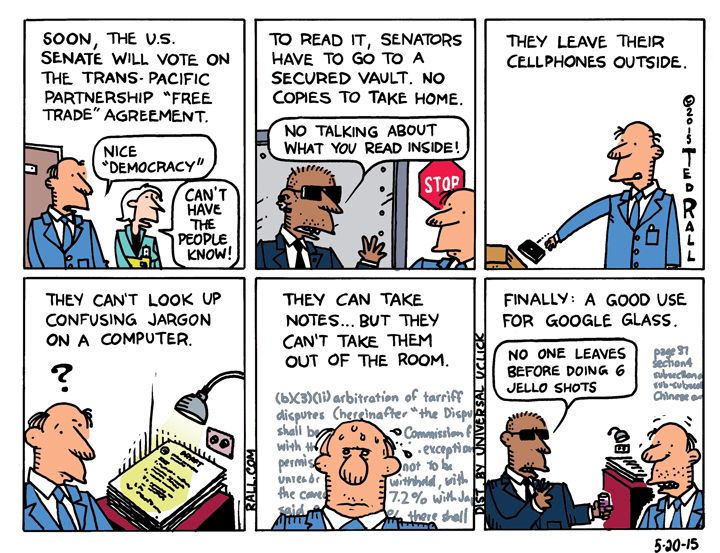
U.S. Senators who want to read the text of the Trans-Pacific Partnership trade agreement with Asian countries can’t get a copy to read. Instead, they have view the long, confusing document in a secret locked room where they can take notes, but not keep them. The only way they could credibly consider the agreement would be if they had a photographic memory.
ANewDomain.net Essay: US Torture: What’s Really New Here?
Originally published at ANewDomain.net:
A long-awaited report on torture under the Bush administration has just been released – sort of. Actually, it’s just the 600-page “executive summary.” The full 6,000 pages remains classified. Still, it’s making big news, and for good reason: it’s the first official attempt by the political class to walk back some of the most extreme American responses to the September 11, 2001 terrorist attacks. If you’re not like me, you haven’t been following the ins and outs of the torture debate since the very start. But I have, so I’m here to tell you what you need to know over the water cooler.
What’s new?
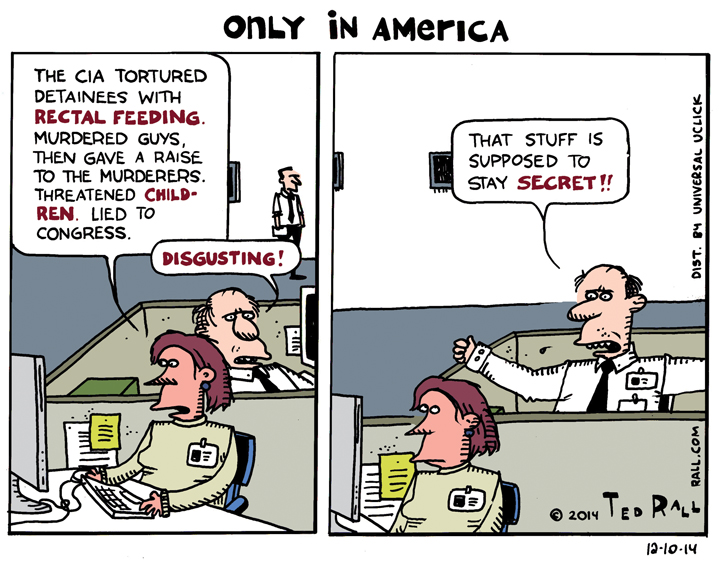
Not that much. The CIA already admitted that it had subjected three detainees – men suspected of terrorism but never formally charged under American law, kidnapped and brought to so-called “black sites” (CIA secret prisons around the world, in countries like Romania and Thailand) – to waterboarding, which is a form of simulated drowning widely considered to be torture under international law. Due to the new Senate report, we know that it happened to a lot more than just these three men. But that doesn’t come as a surprise to anyone who follows the CIA.
They’re liars. They’re spies. Same thing.
Most of the other revelations were previously leaked, including the use of threats to the lives of detainees’ wives and children, and of the use of a power drill during at least one torture session. Why is the media treating this stuff as new? After years of cuts in newsrooms, young journalists simply don’t remember this stuff or weren’t around when it happened.
What will happen as a result?
That’s hard to say, but probably nothing much.
US President Barack Obama set the tone back in early 2009, shortly after taking office, when he said that it was his inclination to look forward, not backward, by which he meant that the United States shouldn’t wallow in the past sins of the Bush administration by looking at torture and holding those responsible for it accountable. Backpedaling on that policy would open all sorts of cans of worms for him and his administration, setting the stage for unknown repercussions. Politicians rarely do this voluntarily. Don’t expect any calls for Bush-era torturers to be prosecuted, much less for the high-ranking officials, including former national security adviser Condoleezza Rice and VP Dick Cheney, to be investigated.
So torture is pretty much a thing of the past, right?
Wrong.
Although Obama says the United States no longer tortures, there is nothing that has happened under his administration that would prevent a future president from authorizing torture again. Obama has never canceled or declared null and void the shoddily worded and legally dubious legal opinions issued by the Bush White House’s Office of Legal Counsel, which means that the legal infrastructure authorizing so-called “harsh interrogation techniques” remains in place. Which is why Obama used very lawyerly, very weasely words in his 2009 statement: “after I took office, one of the first things I did was to ban some of the extraordinary interrogation techniques…” The word “some” wasn’t an accident.
Even now, many of the abuses that took place at places like Guantánamo under Bush have been moved to more discreet locations such as a new expanded post-Guantánamo detention center for detainees held at Bagram airbase north of Kabul, Afghanistan. One of the reasons that Obama moved detainees from Cuba to Afghanistan was to be able to torture them more discreetly and deny them access to their lawyers, who were far more easily able to fly to Cuba.
Also, under the Obama rules, only the US military is specifically prohibited from torturing detainees. The CIA and other agencies in the so-called intelligence community still enjoy carte blanche. And Appendix M of the Army Field Manual still allows torture under Obama.
There’s a reason the Senate report doesn’t cover the period beyond 2009.
But now that people know the truth, aren’t they going to get mad and demand action?
Maybe, but there’s no reason to believe that now. The fact is, Americans have known for 12 years through one report after another, many of them filed by this reporter, and have chosen to either ignore the issue, shrug it off as a necessary way to extract information from terrorists who mean to attack the homeland, or outright applaud it as vengeance against those who mean us harm. True, Americans are much calmer now than they were in 2001 and 2002, but once a country has accepted a behavior as normal, it’s very hard for it to reconsider that and achieve a different political consensus. Also, there’s no evidence that there is widespread disgust among the public for torture. Earlier this year, a poll found that 68% of Americans approve of torture depending on the circumstances.
Still, you cynical bastard, isn’t this report better than no report at all?
Yes. The truth is always a good thing. There’s no way for a country to begin a journey toward redemption until it starts to acknowledge its sins. Speaking of which, don’t take Sen. John McCain too seriously. He talks a good game about torture now, but when he had the votes to pass a bill that would have banned torture, he succumbed to pressure from the Bush White House to remain quiet when the president issued a “signing statement,” stating that the US government would ignore the law.
SYNDICATED COLUMN: A President Who Doesn’t Even Try
Is Obama Kowtowing to the Right? Or Is He One of Them?
The President’s progressive critics blame him for continuing and expanding upon his Republican predecessor’s policies. His supporters point to the obstructionist, Republican-controlled Congress. What can Obama do? He’s being stymied at every turn.
The first problem with the it’s-the-GOP’s-fault defense is that it asks voters to suffer short-term memory loss. In 2009, you probably recall, Democrats controlled both houses of Congress. By a sizeable majority. They even had a filibuster-proof 60-seat majority in the Senate. His approval ratings were through the roof; even many Republicans who had voted against him took a liking to him. The media, in his pocket, wondered aloud whether the Republican Party could ever recover. “Rarely, if ever, has a President entered office with so much political wind at his back,” Tim Carney wrote for the Evans-Novak Political Report shortly after the inauguration.
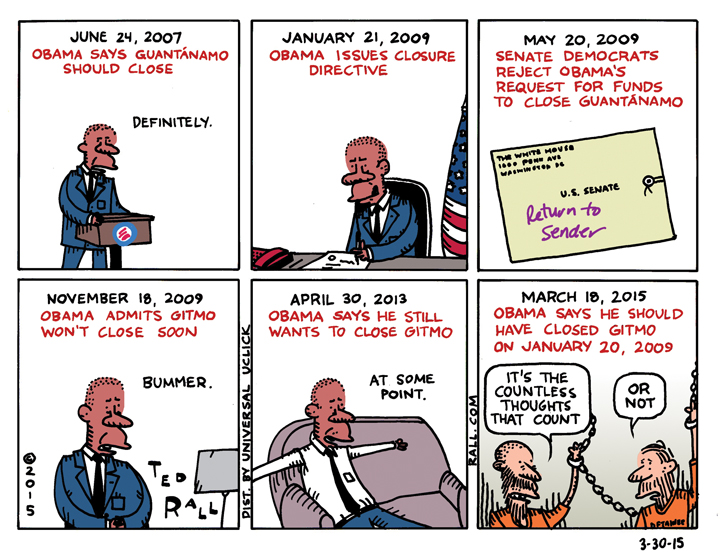
If Obama had wanted to pursue a progressive agenda—banning foreclosures, jailing bankers, closing Guantánamo, stopping the wars, pushing for the public option he promised in his healthcare plan—he could have. He had ample political capital, yet chose not to spend it.
Now that Congress is controlled by a Republican Party in thrall to its radical-right Tea Party faction, it is indeed true that Obama can’t get routine judicial appointments approved, much less navigate the passage of legislation. Oh-so-conveniently, Obama has turned into a liberal-come-lately. Where was his proposed Buffett Rule (which would require millionaires with huge investment income to pay the same percentage rate as middle-class families) in 2009, when it might have stood a chance of passage?
Team Obama’s attempt to shore up his liberal base also falls short on the facts. Progressives were shocked by the U.S. Supreme Court’s 5-4 ruling, along party lines, that legalized strip-searches and body cavity rapes by police and private security firms who detain people suspected of any crime, even minor traffic infractions.
“What virtually none of this…commentary mentioned,” reported Glenn Greenwald in Salon, “was that that the Obama DOJ [Department of Justice] formally urged Court to reach the conclusion it reached…this is yet another case, in a long line, where the Obama administration was able to have its preferred policies judicially endorsed by getting right-wing judges to embrace them.”
No wonder Obama stayed mum.
Which brings us to the biggest, yet least discussed, flaw in the attempt to pin Obama’s inaction on the heads of Congressional Republicans: the bully pulpit.
Whether Donald Trump likes it or not, Barack Obama is still president. If he calls a press conference to call attention to an issue, odds are that reporters will show up. But he’s not walking tall or even talking big.
Responding to fall 2011 polls that indicated softening support among the younger and more liberal voters who form the Democratic base, Obama’s reelection strategists began rolling out speeches inflected with Occupy-inspired rhetoric about class warfare and trying to make sure all Americans “get a fair shot.” But that’s all it is: talk. And small talk at that.
Instead of introducing major legislation, the White House plans to spend 2012 issuing presidential orders about symbolic, minor issues.
Repeating Clinton-era triangulation and micro-mini issues doesn’t look like a smart reelection strategy. The Associated Press reported: “Obama’s election year retreat from legislative fights means this term will end without significant progress on two of his 2008 campaign promises: comprehensive immigration reform and closing the military prison for terrorist suspects at Guantánamo Bay, Cuba. Piecemeal presidential directives are unlikely to make a sizeable dent in the nation’s 8.6 percent unemployment rate or lead to significant improvements in the economy, the top concern for many voters and the issue on which Republican candidates are most likely to criticize Obama. In focusing on small-bore executive actions rather than ambitious legislation, the president risks appearing to be putting election-year strategy ahead of economic action at a time when millions of Americans are still out of work.”
Of course, Obama may prevail. Romney is an extraordinarily weak opponent.
For progressives and leftists, however, the main point is that Obama never tries to move the mainstream of ideological discourse to the left.
Obama has been mostly silent on the biggest issue of our time, income inequality and the rapid growth of the American underclass. He hasn’t said much about the environment or climate change, the most serious problem we face—and one for which the U.S. bears a disproportionate share of the blame. Even on issues where he was blocked by Congress, such as when Republicans prohibited the use of public funds to transport Gitmo detainees to the U.S. for trials, he zipped his lips.
It isn’t hard to imagine a president launching media-friendly crusades against poverty or global warming. FDR and LBJ did it, touring the country, appointing high-profile commissions and inviting prominent guests to the White House to draw attention to issues they cared about.
In 2010, Venezuelan President Hugo Chávez invited flood victims to move into his presidential palace. Seven years after Katrina, Gulf Coast residents are still waiting for help. What if Obama opened up the Lincoln Bedroom to a homeless family? The media couldn’t ignore a PR stunt like that.
Obama has mostly shunned the time-honored strategy of trapping your opposition by forcing them vote against your popular ideas. In 2009, for example, it would have been smarter politics—and better governance—to push for real socialized medicine, or at least ObamaCare with the public option he promised. He would either have wound up with a dazzling triumph, or a glorious defeat.
Liberals don’t blame Obama for not winning. They blame him for not trying. When he does crazy things like authorizing the assassinations of U.S. citizens without trial, progressives have to ask themselves: Is this guy kowtowing to the Right? Or is he one of them?
(Ted Rall’s next book is “The Book of Obama: How We Went From Hope and Change to the Age of Revolt,” out May 22. His website is tedrall.com.)
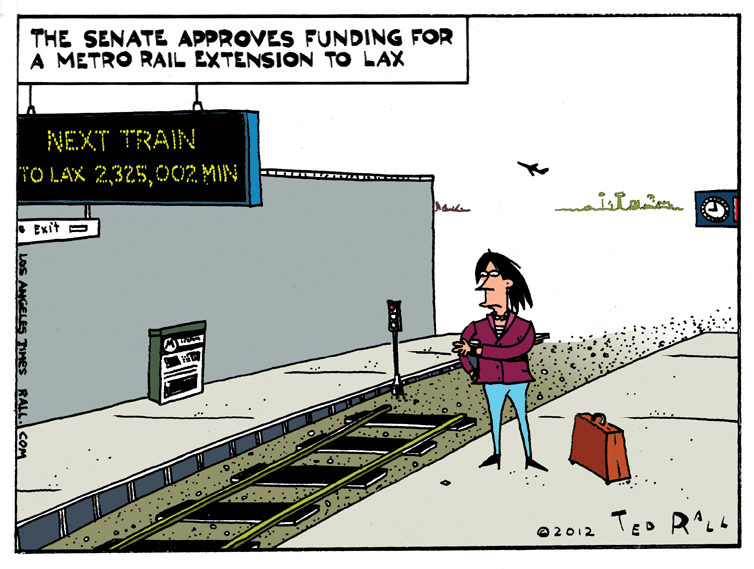
Los Angeles Times Cartoon: Waiting
I draw cartoons for The Los Angeles Times. This week we look at the possible imminent conclusion to the long wait LA commuters have endured until their Metro system finally makes it all the way to Los Angeles International Airport.
Some people I showed this to asked why I depicted a woman instead of a man because you know, the “generic human” is a white male in his 50s (perhaps, in an editorial cartoon, wearing a hat). As readers know, I try to avoid such tired tropes as much as possible. Women take trains too.