
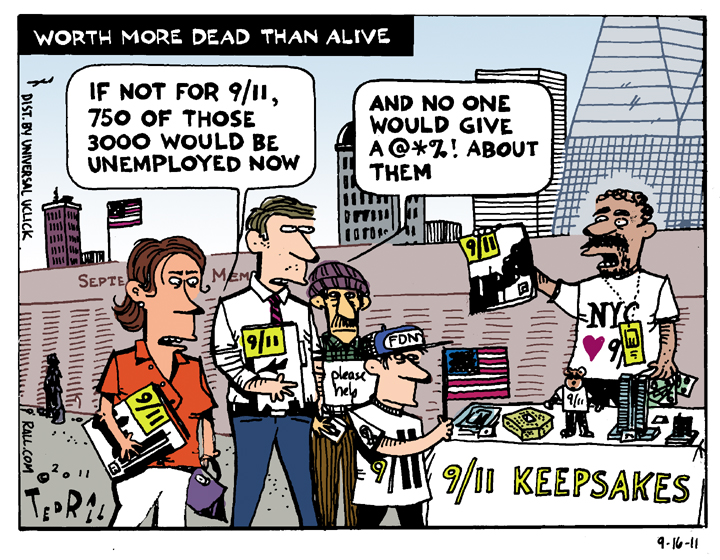
If not for 9/11, 750 of those 3000 dead would be unemployed now.
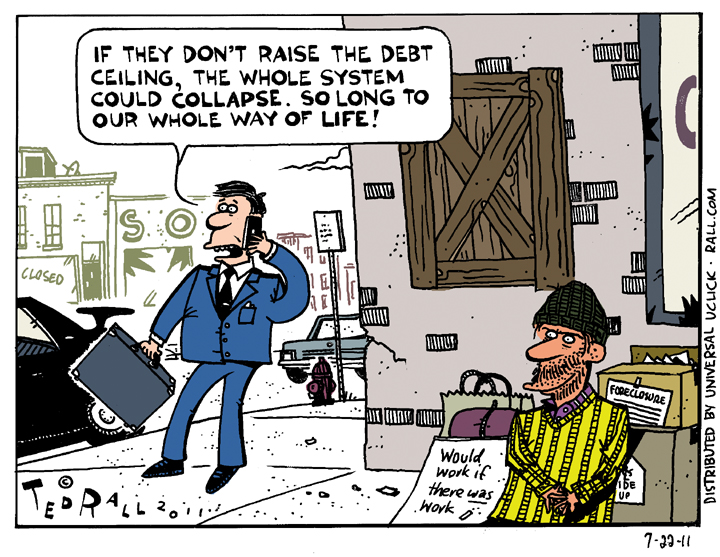
If Democrats and Republicans don’t make a deal to raise the debt ceiling, our whole way of life could come to an end!
Apocalypse Looms in Landlocked Central Asia
The earthquake and tsunami that devastated Japan last week has killed at least 10,000 people. It is terrible. It may be a sneak preview of something 100 times worse.
The next Big Flood will probably be the worst natural disaster in history. It could easily be avoided.
Yet no one is lifting a finger to save the lives of one to five million people.
Lake Sarez, in the eastern Pamir mountains of eastern Tajikistan, is known to Central Asians as the region’s “Sword of Damocles.” A mile wide and 600 feet deep, Sarez is one of the biggest high-altitude bodies of water on earth, at an elevation of 11,200 feet.
Lake Sarez was created just over 100 years ago in a remote corner of what was then czarist Russia. On February 18, 1911 a 7.4-scale earthquake, common in the Pamirs, shattered a mountain adjacent to the Murgab River. The resulting landslide formed a half-mile high natural dam that blocked the river. Today the lake is 37 miles long.
Geologists have been warning about the Sarez threat since Soviet times. Now it’s urgent. Due to climate change the clock on the Sarez time bomb runs faster every year. During the 1990s the water level was rising eight inches a year. Now it’s one or two yards.
Scientists say the dam is going to burst. Whether a quake dislodges a rockslide that creates a wave that crests the dam, or melting glaciers brings the water to the top, computer models predict a devastating inland tsunami sooner rather than later.
Seventeen cubic kilometers of water will be instantly released. A wall of water 800 feet high will cascade down a series of river valleys in four countries.
In 2007 I trekked up to Sarez in order to research a magazine article for Men’s Journal. The following is from that piece:
“The 75-mile Bartang Valley, cultural and spiritual heartland of the Ismaili Muslims, would lose 30 villages and 7,000 people. The Bartang empties into the Pyanj, a large river that marks the border with northern Afghanistan, then Uzbekistan, then Turkmenistan. Six hundred miles downstream from Lake Sarez, the flood would cross into another time zone. Even this far downstream, Scott Weber of the U.N. Department for Humanitarian Affairs told New Scientist in 1999, ‘the wall of water would still be as high as a two-story house.'”
“The city of Termiz in southern Uzbekistan is home to 140,000 people, the Uzbek-Afghan Friendship Bridge that the Soviets used to invade Afghanistan, and currently a German airbase with 3,000 NATO troops. Termiz would be obliterated. The water would keep going. The Pyanj is a tributary of the Amu Darya, which Alexander the Great knew as the Oxus. The flood path would continue along the Amu Darya, roughly marking the border between Turkmenistan and Uzbekistan, before emptying into the shrunken Aral Sea, 1,200 miles downstream of Sarez.”
“Five million people—mostly residents of landlocked deserts that routinely reach 125 degrees—would be drowned by snow melt.”
That will only be the beginning of the misery.
Most of the arable land in Central Asia will be destroyed by silt. Tens of millions of Turkmen, Uzbeks, Afghans and Tajiks could starve.
This might happen in 10 years. Or next week. It could be happening now.
We can prevent it.
The dam can be shored up. A bypass to release pressure can be tunneled through bedrock around the left flank of the natural dam. Liberal cost estimates of such an engineering project run around $2 billion.
Tajikistan is desperately poor. Over a third of its GDP comes from Tajiks who have moved to other countries and send money back home to their families. The Tajik government doesn’t have the cash.
However, $2 billion is small change to Western countries. The U.S. spends that to occupy Iraq and Afghanistan for one week.
When Men’s Journal published my piece on Lake Sarez in 2008 I hoped it would prompt the U.S. to act. Aside from preventing the worst natural disaster ever, couldn’t we use five million new best friends in the Muslim world?
I sent copies to Presidents Bush and Obama, members of Congress, the U.N., the Organization for Security and Co-operation in Europe, and other international organizations. No one replied.
Interestingly, Japan is one of the few donor countries to have taken interest in Lake Sarez, having coughed up a few million dollars for a monitoring station. But there’s still no way to evacuate people living downstream in the event of a breach.
Why don’t the U.S. and other wealthy countries care about Lake Sarez? Maybe they’re just not paying attention. Also, the Tajiks don’t have oil or natural gas.
Whatever the reason, a flood that will make the current disaster in Japan look tiny by comparison is becoming increasingly likely. And it will be mostly our fault.
(Ted Rall is the author of “The Anti-American Manifesto.” His website is tedrall.com.)
COPYRIGHT 2011 TED RALL
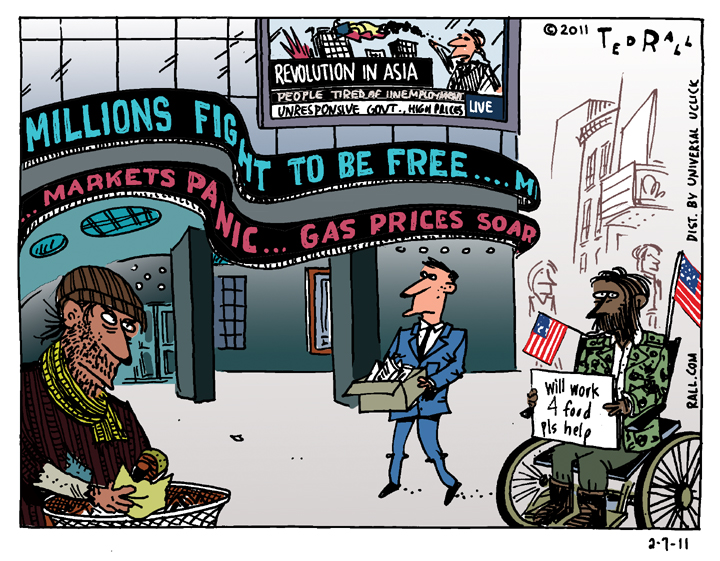
As Egyptians revolt against President Hosni Mubarek, news accounts warn that “instability” threatens stock market volatility. How much does this reveal about our economic system?
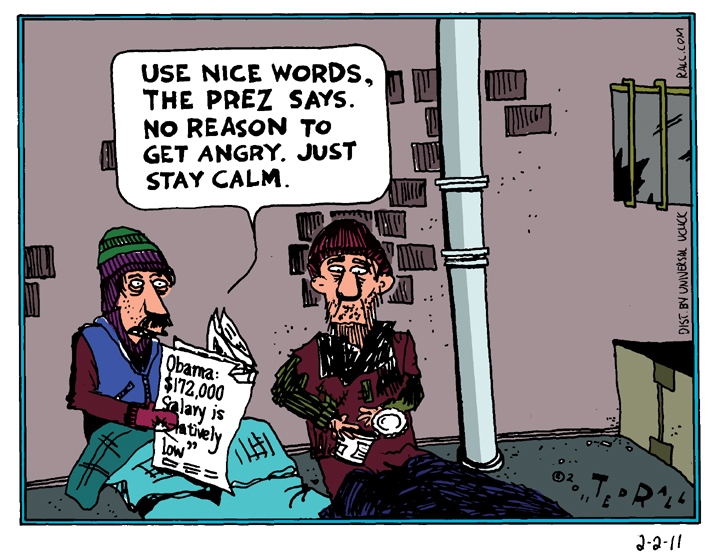
Obama urges Americans not to get angry. This, despite the fact that so many have so much good reason to be angry.
The Conspiracy to Abolish Cash
For many years figures on the political fringe, especially on the right, have claimed that the government and its corporate owners want to transform us into a cashless society. Their warnings about the conspiracy against paper money fell on deaf ears, primarily because the digitalization of financial transactions seemed more like the result of organic business trends than the manifestation of some sinister conspiracy.
Now, however, those who want to do away with liquid currency are stepping out of the shadows. They talk about increased efficiency and profit potential, but their real agenda is nothing less than enslavement of the human race.
“Physical currency is a bulky, germ-smeared, carbon-intensive, expensive medium of exchange. Let’s dump it,” argued David Wolman in Wired.
Citing a 2002 study for the Organization for Economic Development that states “money’s destiny is to become digital, ” a Defense Department-affiliated economics professor has authored an Op/Ed for The New York Times that asks: “Why not eliminate the use of physical cash worldwide?” Jonathan Lipow urges President Obama to “push for an international agreement to eliminate the largest-denomination bills” and urges the replacement of bills and coins by “smart cards with biometric security features.”
Lipow’s justification for calling for the most radical change to the fundamental nature of commerce since industrialization is, of all things, fighting terrorism. “In a cashless economy, insurgents’ and terrorists’ electronic payments would generate audit trails that could be screened by data mining software; every payment and transfer would yield a treasure trove of information about their agents, their locations and their intentions,” Lipow writes. “This would pose similar challenges for criminals.”
Terrorism is a mere fig leaf. According to the annual “Patterns of Global Terrorism” report compiled by the U.S. State Department, the highest total death toll attributed to terrorism in the last 20 years occurred in—surprise—2001. Including 9/11, only 3,547 people were killed in 346 acts of violence worldwide. Tragic. Obviously. But, in the overall scheme of things, terrorism is not a big deal.
Measured in terms of loss of life and economic disruption, terrorism is a trivial problem, hardly worth mentioning. According to the UN, 36 million people die annually from hunger and malnutrition. Over half a million die in car wrecks—but you don’t hear people like Lipow demanding that we get rid of cars. A more legitimate concern is the “loss” of taxes upon the underground economy, estimated by the IMF at 15 percent of transactions in developed nations.
What the anti-cash movement really wants is digital totalitarianism: a dystopian nightmare in which the entire human race is enslaved by international corporations and their pet governments. An anti-establishment gadfly like WikiLeaks founder Julian Assange could be instantly deprived of money—and thus freedom of movement—with a couple of keystrokes. (We saw a preview of this when PayPal and Amazon shut down WikiLeaks donation mechanism and web server, respectively.) The high-tech hell depicted by the film “Enemy of the State” would become reality.
It is true that, in a society where every good and service has to be paid for with a debit or credit card, terrorist groups would find it much harder to operate. Don’t forget, however, that today’s terrorists often become tomorrow’s liberators. Anti-British terrorists George Washington and Thomas Jefferson wouldn’t have stood a chance if the Brits had been able to intercept wire transfers from France.
Decashification would establish digital totalitarianism, a form of corporo-government control so rigid, thorough and all-encompassing that by comparison it would make Hitler and Stalin look like easygoing surfer dudes. The abolition of unregulated financial transactions would freeze the political configuration of the world, making it impossible for opposition movements—much less revolutionary ones—to challenge the status quo.
A society without dissent has no hope. Even if we lived in a perfect world where everyone was ruled by wildly popular, benevolent, scrupulously honest regimes—ha!—eliminating the slightest possibility of opposition would lead to barbarism.
We’re already more than halfway to a cashless society. In the U.S. few young adults still use checks. In many countries debit and credit card transactions now exceed those made via cash and checks combined. In 2007 the chairman of Visa Europe predicted the abolition of cash by 2012. Obviously he was wrong. But that’s where we’re headed. The U.K. plans to abolish checking accounts by 2018.
Even if you love your government, don’t want it to change, and think political opponents belong in prison, you ought to worry. As things currently stand, we know the big banks can’t be trusted. Remember when they introduced ATM cards? Banks wanted us to use them so they could lay off tellers. Then they instituted “convenience fees.” Which they have raised, and raised, to the point that taking $20 out of an out-of-town ATM could cost you $5 in fees ($2 for their bank, $3 for yours).
Imagine what your life will look like under digital totalitarianism. Your pay is direct-deposited into your bank account. You’ll pay for small purchases with your cellphone; if you owe a few bucks to a friend you’ll be able to bump your phone against your friend’s to settle up. Nowadays, some corporations allow you to control when your bills get deducted; in the future they’ll demand that you authorize them to do it automatically. What if you have a disputed charge? They’ll already have your dollars, or work credits, or whatever they’ll call them. Good luck trying to get it back from the Indian call-center guy.
As corporate ownership becomes increasingly monopolized and intertwined, your overdue phone bill might be owned by the same outfit as your bank, which would simply take what it says you owe.
The law of unintended consequences is getting a serious workout thanks to digitalization. Motorists in New York were thrilled when the EZPass system allowed them to breeze past lines at toll bridges—at a discount, no less. Then divorce lawyers began subpoenaing EZPass records to prove that a spouse was cheating. Next police set up EZPass scanners on the bridges; if you pass two of them too fast, a speeding ticket is automatically generated. The next step is to eliminate cash lanes entirely; non-EZPass tag holders will soon have their license plates scanned and receive a bill by mail—plus a $2 to $3 “handling” fee.
Think there are too many fees now? If you think you can’t trust banks now, imagine how badly they’ll gouge you when they control every single commercial transaction down to the purchase of a pack of gum. Angry about taxes? When tax agencies can take the money out of your account without asking, they will. Unlike cash, that phone bump to pay your friend will be a trackable, data mineable, fully taxable commercial transaction.
As if the post-2008 economic collapse hadn’t proven that no one is looking out for We the People but ourselves—and then barely so—the digivangelists tell us not to worry, that Big Brother, Inc. will smooth out the rough patches on the road to techno-fascist domination. From Wolman in Wired: “Opponents used to argue that killing cash would hurt low-income workers—for instance, by eliminating cash tips. But a modest increase in the minimum wage would offset that loss; government savings from not printing money could go toward lower taxes for employers.” Sure. The same way banks passed on the savings they earned by replacing tellers with ATMs to their customers.
Americans are skipping into the digital inferno wearing a smile and relishing the smell of their own burning flesh. Countless friends and acquaintances pay all their bills online. “I’m all about using my checking account in place of cash and would love to be able to eliminate cash entirely from my life,” gushed PCWorld’s Tony Bradley recently.
“Give me convenience or give me death” was the title of an album by the punk band Dead Kennedys.
We’ll get both.
(Ted Rall is the author of “The Anti-American Manifesto.” His website is tedrall.com.)
COPYRIGHT 2010 TED RALL
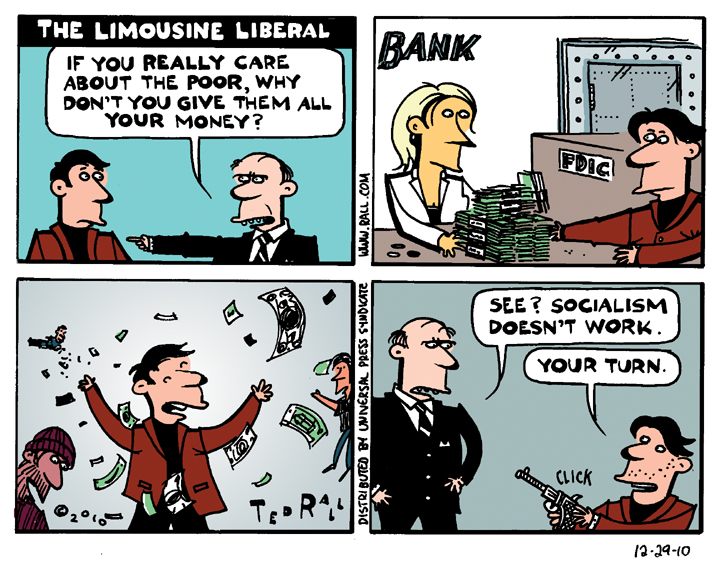
Andorra has negative unemployment. How do they do it? More importantly, how can the United States take advantage of it?
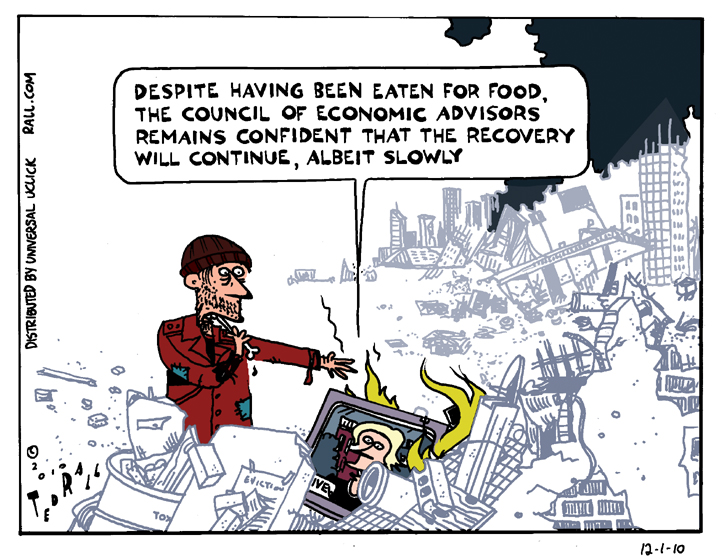
Official economists claim the recession is over. However, it wasn’t a recession to begin with, but rather a depression.
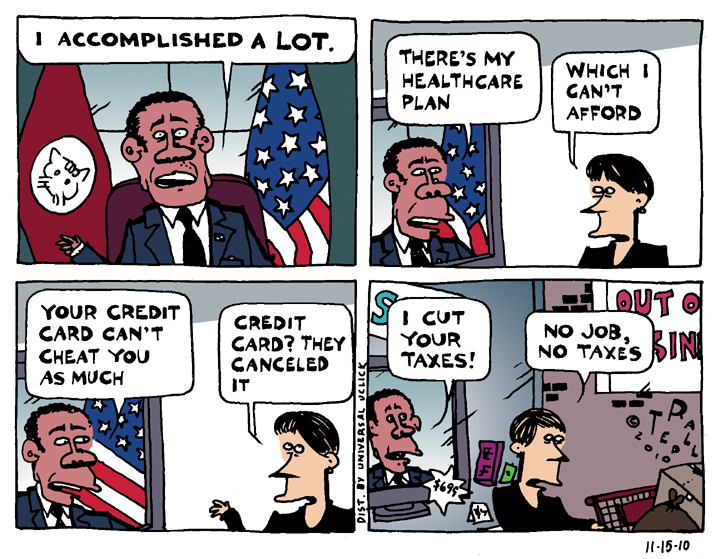
Obama points to his many accomplishments. But no one cares. Which is why he got his ass kicked in the 2010 midterm elections.

