SYNDICATED COLUMN: What’s the Matter with Obama?

•

It’s the Not Caring About the Economy, Stupid

As a pundit it’s my job to explain why politicians do the things they do. Every now and then, however, a pol behaves so irrationally that I have to throw up my arms and ask:

What the hell is this guy thinking?

That’s what Obama has me doing. For over two years. Why isn’t he worried about unemployment?

Thomas Frank wondered in “What’s the Matter with Kansas?” why Americans don’t vote their (liberal) self-interest. What I can’t figure out is why President Obama isn’t following his self-interest.

Obama says he wants a second term. I believe him. Every president wants one.

Americans vote their pocketbooks. Not exclusively—they care about a candidate’s values—but no president has ever been reelected with an unemployment rate over 7.2 percent. Right now it’s 9.1 percent. Unless there’s an unexpected reversal, it will still be way high by Election Day 2012.

Economists surveyed by USA Today predict that the jobless rate will be pretty much the same, 8.8 percent, at this time next year. Goldman Sachs is even more pessimistic. They think it will be 9.25 percent by the end of 2012—with a “meaningful downside risk” that it will be even worse.

Polls indicate that economic insecurity, specifically high unemployment, has been the biggest issue on voters’ minds since Obama took over in 2009.

77 percent of Americans tell Gallup the economy is getting worse. That’s up from 62 percent a month ago.

If Obama wants to get reelected he has to do something about jobs. Something BIG. Failing that—and that’s an epic fail—he has to at least be perceived as trying to do something about jobs. But he hasn’t done squat so far. And his job approval rating, now at an all-time low of 39 percent, reflects that.

I don’t like admitting this, but I’m mystified. Why isn’t Obama even trying to look like he cares about the one issue that could make or break his reelection chances?

What’s up? Are he and his advisors morons, or just out of touch? Do they have some secret jobs-related October Surprise that will magically reemploy the 22 percent of Americans who are out of work during the last few weeks of the election? Are they the Chicago Black Sox of politics, determined to throw the race to the Republicans? Psychologist Drew Westen can’t figure it out either, wondering aloud if Obama is sick in the head.

Some ask: Is Obama a Republican?

“Government doesn’t create jobs,” tweeted GOP candidate Herman Cain recently. “Businesses create jobs. Government needs to get out of the way.” Obama and his fellow fake Democrats never challenge this right-wing framing.

Maybe they believe it. “The White House doesn’t create jobs,” Obama press secretary Jay Carney said August 5th.

But the meme is wrong. In the real world where flesh-and-blood American workers have been living since 2000, businesses haven’t created any jobs. Instead, they’ve eliminated millions of them. And shipped millions more overseas.

Those job-killing trends—eliminating workers, increased automation and globalization—won’t change soon. “Workers are getting more expensive while equipment is getting cheaper, and the combination is encouraging companies to spend on machines rather than people,” Catherine Rampell recently reported for The New York Times.

There’s also a death-spiral effect. Elena Semuels of The Los Angeles Times sums it up: “Economists say the nation is stuck in a Catch-22 scenario: The economy won’t improve until businesses hire, but many won’t hire without consumer demand, which is weak because of the current state of the job market and concerns about the future.”

“Everyone says, ‘How can we have a recovery without jobs?’ [But] until I start seeing my competitors add jobs, I’m not going to do it,” Loren Carlson of the CEO Roundtable tells MSNBC.

Recovery won’t come from business. The scope of the post-2008 meltdown is too vast.

On the other hand, government can and does create jobs. Indirectly, it creates the veneer of law and order that permits commerce. Government can also employ people directly.

FDR orchestrated the direct hiring of 9 million Americans as government employees for the WPA and other programs. The federal government even hired writers and artists. Adjusted for population growth, that’s the same as 22 million people today. Obama could have done something like that in early 2009.

Too late now, of course. Obama’s inaction on the economy prompted a Republican sweep in the 2010 midterms. They won’t go along.

Keynes 101: the time for austerity is during a boom, when you can afford to save up for a rainy day. Governments are supposed to spend their way out of a recession or depression. The GOP-conceived debt ceiling deal is 200-proof insanity.

“An anti-Keynesian, budget-balancing immediacy imparts a constrictive noose around whatever demand remains alive and kicking,” wrote Bill Gross of the bond-trading firm Pimco in The Washington Post. “Washington hassles over debt ceilings instead of job creation in the mistaken belief that a balanced budget will produce a balanced economy. It will not.”

Rather than criticize this austerity lunacy, Obama is still going along. “Mr. Obama’s senior adviser, David Plouffe, and his chief of staff, William M. Daley, want him to maintain a pragmatic strategy of appealing to independent voters by advocating ideas that can pass Congress, even if they may not have much economic impact,” reports the New York Times.

“We’re at a loss to figure out a way to articulate the argument in a way that doesn’t get us pegged as tax-and-spenders,” admits a Democratic Congressional advisor. For God’s sake, grow a pair! Make your case to the public.

Anything that doesn’t have “much economic impact” isn’t going to have much electoral impact either. And neither are token gestures like a three-day bus tour, revamping the patent process, or another overhyped speech. (Scheduled for September. Because, why rush?)

As you read this Obama is off to Martha’s Vineyard, hanging out with millionaires.

Really—what’s going on? Can Obama really be that stupid? Can anyone?

(Ted Rall is the author of “The Anti-American Manifesto.” His website is tedrall.com.)

COPYRIGHT 2011 TED RALL

Change

•

Hope is gone, but we’re getting more change than we’d like.

Three Years Later, the Phone is Ringing

•

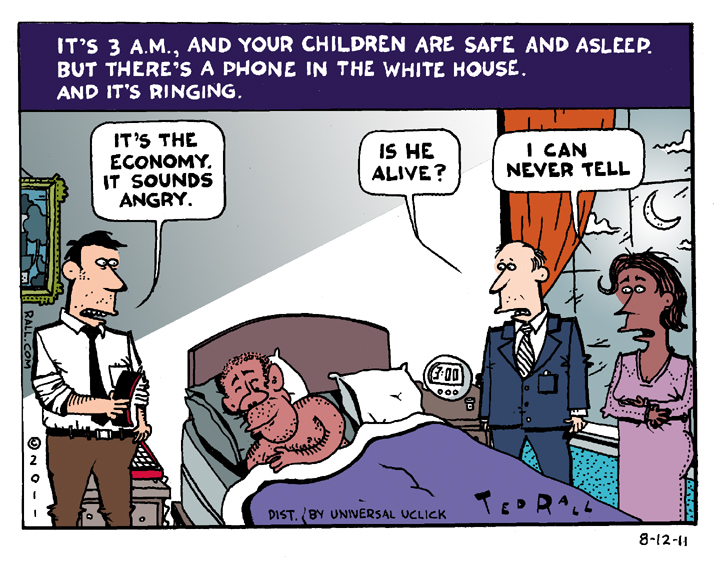
A 2008 Democratic primary ad for Hillary Clinton’s campaign questioned Obama’s ability to respond to a crisis. Now there is oneÑand that ad turns out to be prescient.

9-11-11

•

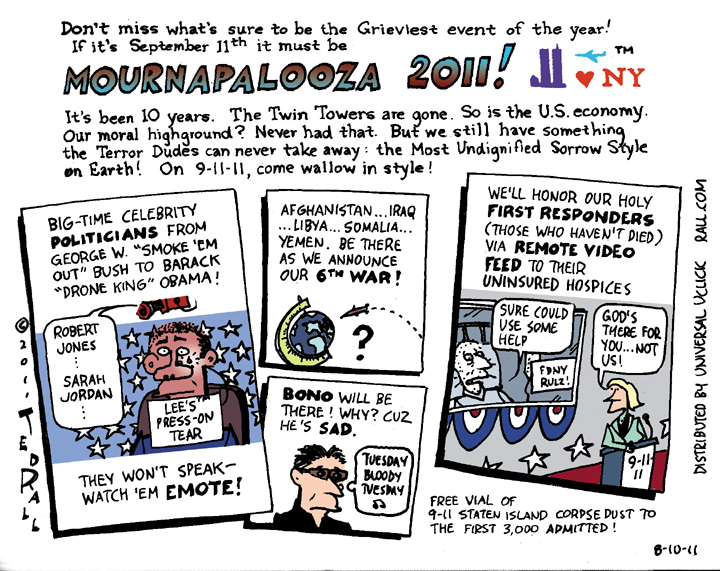
America gears up for an event that promises spectacular schmaltz: the 10th anniversary of 9/11.

SYNDICATED COLUMN: Down and Out at 1600 Pennsylvania Avenue

•

What I Would Do If I Were Obama

Jobs, jobs, jobs. Throughout the presidency of Barack Obama, Americans have been preoccupied with jobs. Unemployed people need work. The underemployed need more work. The employed want salaries that go up instead of down.

The rich are worried too. The Depression of 2008-? is killing their stock portfolios.

Most presidents struggle to find the pulse of the people. Trapped in the D.C. bubble, they try to find out what voters want. Obama was lucky. He didn’t have to do that. The U.S. was in the midst of an epic economic collapse in January 2009, and has been ever since. It’s the only issue that everyone, rich to middle to poor, cared about. It still is.

In this single-issue environment, any idiot could have been a successful president. All Obama had to do was express sympathy and understanding while announcing a bunch of jobs initiatives.

Not hard.

Weirdly, though, Obama has focused on everything else except jobs: healthcare, gays in the military, gays getting married, more war against Afghanistan, new war against Libya, secret wars against Somalia and Yemen, the dreary showdown over taxes, budget cuts and the federal debt ceiling.

According to the latest ABC News/Washington Post poll, Obama’s approval rating is down to 39 percent. The crappy economy—and Obama’s inaction—is the simple cause.

“What Happened to Obama?” Drew Westen asked in a much-passed-around New York Times op-ed. It used to be just me. Now everyone sane agrees that Obama’s presidency has failed.

This is my favorite part of Westen’s postmortem: “Those of us who were bewitched by his eloquence on the campaign trail chose to ignore some disquieting aspects of his biography: that he had accomplished very little before he ran for president, having never run a business or a state; that he had a singularly unremarkable career as a law professor, publishing nothing in 12 years at the University of Chicago other than an autobiography; and that, before joining the United States Senate, he had voted “present” (instead of “yea” or “nay”) 130 times, sometimes dodging difficult issues.”

Westen is nicer than I am. He left out the fact that Obama had an undistinguished career as a U.S. Senator.

Is Obama a secret pawn of evil plutocrats? Does he suffer a character flaw alluded to in Westen’s piece, that he doesn’t know who he is?

Maybe. But I don’t think so. I think eight years of George W. Bush caused Americans to make a mistake. Obama was calm, so they assumed he was wise.

Obama is calm. He’s calm that it’s hard to tell if he’s sentient. But that doesn’t make him smart. Based on his record before and after becoming president, there’s a better-than-even chance that he’s not very smart.

Let’s be logical. Let’s assume that appearances don’t lie—that Obama doesn’t lose a wink of sleep over the fact that he’s presiding over a disaster that makes 9/11 look like a joke.

Let us further stipulate, for the sake of argument, that Obama isn’t stupid. That he’s merely another cynical and/or corrupt politician. If nothing else, Mr. Cynical (But Intelligent) Dirtbag ought to care about getting reelected.

Right?

If I were in Obama’s shoes, and I had any brains, if I wanted to turn those lousy poll numbers around, I’d hold press conferences to talk about jobs every day. I’d talk about jobs until the media was sick of it. Then I’d do it some more.

I’d spend two or three nights every week couchsurfing with families who were suffering, cameras rolling as I pretended to care about their silly problems with mean bosses and evil health insurers.

Most importantly, I’d set up next year’s television attack ads. I wouldn’t let a single week go by without proposing some piece of legislation related to creating jobs, alleviating the problems of the jobless, and increasing wages.

I’d send Congress huge publics-works bills. I’d ask them to hire millions of unemployed people to work for federal agencies. I’d push for higher unemployment benefits, payments that don’t expire until you find a job. Tax breaks for companies that hire. Tax deductions for those that give raises. Penalties for outsourcing jobs. Keep the Bush tax cuts, but only for the poor and middle class.

Let the Republicans kill my ideas. All the better for my 2012 ad buy! “Republicans voted against new jobs for Americans 22 times. Against helping homeowners keep their houses 15 times. Republicans: They just don’t care about you.” You get the idea.

Of course, a president can accomplish a lot by executive order. Remember that story about how Apple had more ready cash than the U.S. Treasury? Since America obviously needs the money more than Steve Jobs, Obama could have nationalized it and given it to the states in order to bolster their unemployment compensation funds.

American voters are so defeated and disgusted that they no longer demand a president like FDR or LBJ who actually fights for them. They’ll settle for one who goes through the motions.

The question for Obama and his advisors is: Are they smart enough to pretend to care about the only issue that matters to voters?

(Ted Rall is the author of “The Anti-American Manifesto.” His website is tedrall.com.)

COPYRIGHT 2011 TED RALL
Rocky 2

•

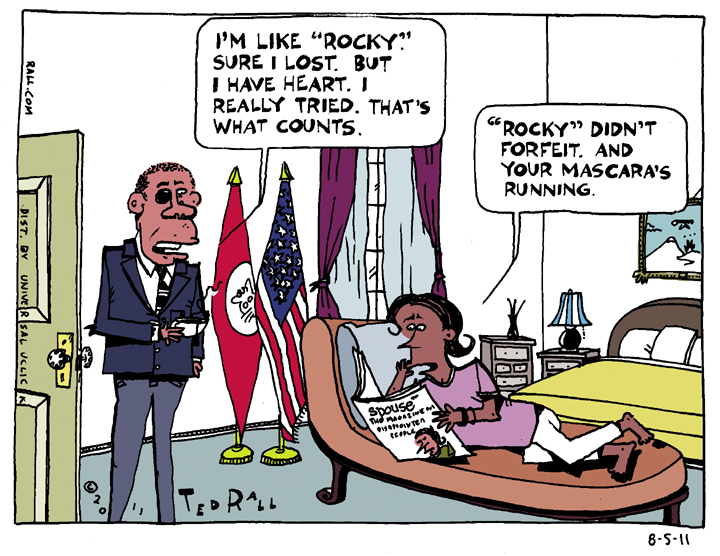
Obama caves into the Republicans on the debt ceiling deal. Now his partisans are trying to claim the defeat isn’t total.

AL JAZEERA COLUMN: Censorship of Civilian Casualties in the US

•

US mainstream media and the public’s willful ignorance is to blame for lack of knowledge about true cost of wars.

Why is it so easy for American political leaders to convince ordinary citizens to support war? How is that, after that initial enthusiasm has given away to fatigue and disgust, the reaction is mere disinterest rather than righteous rage? Even when the reasons given for taking the U.S. to war prove to have been not only wrong, but brazenly fraudulent—as in Iraq, which hadn’t possessed chemical weapons since 1991—no one is called to account.

The United States claims to be a shining beacon of democracy to the world. And many of the citizens of the world believes it. But democracy is about responsiveness and accountability—the responsiveness of political leaders to an engaged and informed electorate, which holds that leadership class accountable for its mistakes and misdeeds. How to explain Americans’ acquiescence in the face of political leaders who repeatedly lead it into illegal, geopolitically disastrous and economically devastating wars of choice?

The dynamics of U.S. public opinion have changed dramatically since the 1960s, when popular opposition to the Vietnam War coalesced into an antiestablishmentarian political and culture movement that nearly toppled the government and led to a series of sweeping social reforms whose contemporary ripples include the recent move to legalize marriage between members of the same sex.

Why the difference?

Numerous explanations have been offered for the vanishing of protesters from the streets of American cities. First and foremost, fewer people know someone who has gotten killed. The death rate for U.S. troops has fallen dramatically, from 58,000 in Vietnam to a total of 6,000 for Iraq and Afghanistan. Many point to the replacement of conscripts by volunteer soldiers, many of whom originate from the working class, which is by definition less influential. Congressman Charles Rangel, who represents the predominantly African-American neighborhood of Harlem in New York, is the chief political proponent of this theory. He has proposed legislation to restore the military draft, which ended in the 1970s, four times since 9/11. “The test for Congress, particularly for those members who support the war, is to require all who enjoy the benefits of our democracy to contribute to the defense of the country. All of America’s children should share the risk of being placed in harm’s way. The reason is that so few families have a stake in the war which is being fought by other people’s children,” Rangel said in March 2011.

War is extraordinarily costly in cash as well as in lives. By 2009 the cost of invading and occupying Iraq had exceeded $1 trillion. During the 1960s and early 1970s conservatives unmoved by the human toll in Vietnam were appalled by the cost to taxpayers. “The myth that capitalism thrives on war has never been more fallacious,” argued Time magazine on July 13, 1970. Bear in mind, Time leaned to the far right editorially. “While the Nixon Administration battles war-induced inflation, corporate profits are tumbling and unemployment runs high. Urgent civilian needs are being shunted aside to satisfy the demands of military budgets. Businessmen are virtually unanimous in their conviction that peace would be bullish, and they were generally cheered by last week’s withdrawal from Cambodia.”

Read the full article at Al Jazeera English.

SYNDICATED COLUMN: The GOP Bets on Bad Judgement

•

Voters Focus on Spending at Just the Wrong Time

Ross Douthat, the conservative columnist who elevates bland to middle-brow art for The New York Times, thinks Republicans have overreached in their showdown with Obama over the debt ceiling. “[The Republicans’] inability to make even symbolic concessions has turned a winning hand into losing one,” he says.

Advantage, according to Douthat, representing the mainstream media: Obama.

Of course, Obama had already agreed to begin dismantling Social Security and Medicare, surrenders Republicans have craved for decades. If he pulls off this “victory” Obama will have done more damage to the Democratic Party and its core values than any president in our lifetimes. How will he promote what Douthat fears will be a “victory”? I wonder.

Or, to lift a line from “Double Indemnity”: I wonder if I wonder.

Back a few pages, Times reporter Jesse MacKinley finds himself in the curious position of writing that no one really cares about a story that has dominated the headlines for weeks.

“Indeed, the drama of whether the government will raise the debt ceiling (to the chagrin of some conservatives demanding tighter financial belts) or allow it to remain as is (to the horror of the administration and economists who predict financial ruin) seemed largely lost on a populace involved in more pressing—and more pleasant—summer distractions,” asserts MacKinley.

To summarize:

No one cares about the debt ceiling.

And:

Among the few political geeks who understand what’s going on, much less have an opinion, the tide is allegedly turning in favor of Obama because he’s willing to compromise and the Tea Party-led GOP isn’t.

Conventional wisdom floggers like Douthat say that if Congress can’t strike a deal and economic consequences follow—a reduction in the ratings of U.S. government-issued securities and a panic in the securities market—voters will hold Republicans accountable in 2012. Even if things don’t turn that far south, the GOP will pay for their intransigence. Obama wins in a cakewalk.

I’m not so sure.

In the same way that generals usually refight the last war, mainstream political pundits often apply old scenarios to new situations. This is not 1995, when then-House Speaker Newt Gingrich orchestrated a shutdown of the federal government that set the stage for Bill Clinton’s reelection the following year.

Without a doubt, the Republicans’ willingness to imperil the pure platinum credit of Treasury notes and bonds is reckless and irresponsible. There is also no denying their naked hypocrisy and intellectual dishonesty. These so-called “deficit hawks” voted 19 times to raise the debt ceiling by $4 trillion.

If Republicans were serious about balancing the federal budget they’d start by slashing the military, which accounts for 54 percent of discretionary spending—and which hasn’t done anything to defend the U.S. from a real enemy since 1945. The Department of Homeland Security, a vast new bureaucracy created by Bush after 9/11 in order to make us take off our shoes, should be eliminated.

Moreover, the middle of the biggest economic meltdown since the industrial revolution is no time to be cutting debt. Read your Keynes: governments are supposed to spend their way out of downturns, and pay down debt during upswings.

Republicans, it seems, are trying to finish off an economy that is already gravely wounded.

Politically, however, I think they’re onto something. Year after year of warnings about the expanding national debt—remember Ross Perot’s charts?—the American people are finally, genuinely alarmed about the pace and scale of government spending. The current national debt of $14 trillion isn’t the magic number that flips some sort of switch in the public.

It’s simply that, at certain times, public opinion on an issue that has been around for years, divisive and apparently intractable, suddenly coalesces into widespread consensus. Climate change. Gay marriage. The war in Afghanistan, which was so popular in 2008 that Obama won by promising to expand it, but is now seen as stale and unwinnable.

Win or lose on the debt ceiling showdown, GOP strategists are betting than voters will reward them for taking an uncompromising stand on spending against a president who has increased the national debt faster than any of his predecessors. It’s not 100 percent—but I’d say it’s a pretty safe bet.

This is the worst possible time for the American people to start worrying about out-of-control federal spending. But it’s good for the GOP.

(Ted Rall is the author of “The Anti-American Manifesto.” His website is tedrall.com.)

COPYRIGHT 2011 TED RALL
AL JAZEERA COLUMN: The US Love Affair with Drones

•

A War Strategy Built Around Drone Attacks Is Not Only Unethical, But Will Hurt US Interests in the Long Run.

One of the pleasures of traveling through the developing world is that things develop. They change. There’s always something new.

Afghanistan is, depending on one’s point of view, developing, deteriorating, or doing both at once.

Example: Last August found me and two fellow Americans in a hired taxi zooming past bombed-out fuel trucks through Taliban-held Kunduz, a city in northern Afghanistan near the Tajik border. The sense of menace was palpable, but our driver seemed calm.

Then his face darkened. We were passing into the flatlands east of Mazar-i-Sharif. We saw nothing but dirt, dust and rocks, all the way to the horizon. Yet our driver was nervous. He scanned this bleak landscape. “Motorcycles,” he said. “I am looking for the motorcycles.”

The adaptable neo-Taliban increasingly rely on the classic tactics of guerilla warfare. Rather than hold territory, these postmodern Islamists-cum-gangsters rely on hit-and-run strikes using something I hadn’t seen in 2001: motorcycles. Like a scene from the Kazakh film epic about Genghis Khan updated by Quentin Tarantino, squadrons of bearded bikers are terrorizing Afghanistan’s newly/cheaply paved highways.

I call them the Talibikers.

One of the more intriguing revelations in last year’s WikiLeaks data dump was that the Pakistan’s Inter-Services Intelligence spy agency has been supplying the Taliban with thousands of Pamir dirtbikes, including a 2007 shipment of 1,000 to the Waziristan-based network led by Mawlawi Jalaludin Haqqani. Talibs ride the Pamirs and their preferred brand, the Honda 125 and its Chinese knock-offs, to assassinations. They launch attacks on highways from bases in villages 10 to 15 kilometers away.

The Talibikers speed across the desert in great clouds of dust, “Mad Max” style, to ambush and bomb fuel trucks. There they set up checkpoints where they shakedown travelers for cash. Sometimes they kidnap motorists and demand ransom payments from their families. By the time the hapless Afghan national police shows up, the resistance fighters are long gone.

An early report on the Talibikers appeared in the Telegraph in 2003. “The motorcycles have played a key role in Taliban hit-and-run operations in the south of the country where the campaign against international troops and aid workers has intensified,” the British newspaper reported in November of that year. “In the latest incident, a Frenchwoman working for the United Nations was shot dead this month by the pillion passenger on a motorcycle in the south-eastern town of Ghazni. The Taliban later claimed responsibility for the attack. In another recent attack, a group of motorcyclists opened fire on an aid convoy near Kandahar, killing four Afghans. In August, two motorcyclists threw a grenade into the Kandahar compound of the United Nations High Commissioner for Refugees, damaging the building but causing no injuries.”

ISI-funded motorbikes continue to play a vital role in the Taliban’s war to drive U.S. and NATO occupation troops out of Afghanistan. “Day and night, Taliban assassins on motorbikes hunt their victims, often taunting them over the telephone before gunning them down in the city’s streets,” Paul Watson wrote in The Star, a newspaper in Canada in February 2011. “They are working their way through lists, meticulously killing off people fingered as collaborators with the Afghan government or its foreign backers…The build-up of Afghan police and soldiers, and foreign troops, in and around Kandahar city over recent months has improved security, but agile and coldly efficient motorbike death squads remain active.”

Mass attacks continue as well. “About 100 Taliban fighters on motorcycles attacked a northern Afghan village that was working to join the government-sponsored local police program against the insurgency, killing one villager, police said Wednesday. An ensuing battle also left 17 militants dead,” the Associated Press reported in May 2011.

There are fewer than 10,000 Talibikers in Afghanistan. They could be eliminated—if the U.S. and NATO stopped focusing on assassination-by-drone and instead used the same technology to increase security.

Unmanned aerial vehicles (UAVs) date to the maiden flight of the now-familiar Predator drones in 1994. After 9/11 the United States became addicted to the Predator and its successor, the Reaper.

Today the Air Force and CIA have at least 7000 UAVs in service around the world, representing the biggest and most visible presence of the U.S. military in Pakistan, Somalia, Libya, and Yemen. This trend is likely to accelerate. As of March 2011 the U.S. Air Force was training more remote drone “pilots” than those for conventional planes. Next year the Pentagon wants $5 billion just for drones.

Drones are getting smaller and more numerous. “One of the smallest drones in use on the battlefield is the three-foot-long Raven, which troops in Afghanistan toss by hand like a model airplane to peer over the next hill,” according to The New York Times. “There are some 4,800 Ravens in operation in the Army, although plenty get lost.” More on this later.

It’s easy to see why generals and politicians are so enthusiastic. The pilotless planes, guided by operators manning a joystick at military and pseudomilitary agencies such as CIA headquarters in Langley, Virginia and armed by Xe, the private contractor formerly called Blackwater, are relatively cheap. A Predator costs $4.5 million; an F-22 Raptor fighter jet runs $150 million a unit. Peter Singer, director of the 21st Century Defense Initiative at the Brookings Institution, cites the “three Ds.” Drones are “dull” because they can patrol empty stretches of barren land 24 hours a day. They’re “dirty” because they can fly in and out of toxic clouds, including radiation. Most appealingly, they are “dangerous” because the absence of a pilot eliminates the risk that a pilot—they cost millions to train–will be killed or captured by enemy forces. UAVs exploit the element of surprise: though relatively unobtrusive, they fire supersonic armor-piercing Hellfire missiles capable of striking a target as far as five miles away.

“People who have seen an air strike live on a monitor described it as both awe-inspiring and horrifying,” The New Yorker magazine reported in 2009. “‘You could see these little figures scurrying, and the explosion going off, and when the smoke cleared there was just rubble and charred stuff,’ a former C.I.A. officer who was based in Afghanistan after September 11th says of one attack. (He watched the carnage on a small monitor in the field.) [Bleeding] human beings running for cover are such a common sight that they have inspired a slang term: ‘squirters.'”

Charming.

According to the Pentagon, drones hit their targets with 95 percent accuracy. The problematic question is: who are their targets?

Thousands of people have been rubbed out by drones since 9/11.

(Press accounts document between 1400 and 2300 extrajudicial killings by allied forces, mostly in the Tribal Areas adjacent to Pakistan’s Northwest Frontier Province. According to media reports cited by the Human Rights Commission of Pakistan, at least 957 Pakistanis were murdered by American drones in 134 airstrikes during the year 2010 alone. Since the media only learns about a fraction of these “secret” killings, the real number must be many times higher.)

Since the Pakistani government does not officially acknowledge, much less authorize, such attacks, they are illegal acts of war.

Political philosopher Michael Walzer asked in 2009: “Under what code does the CIA operate? I don’t know. There should be a limited, finite group of people who are targets, and that list should be publicly defensible and available. Instead, it’s not being publicly defended. People are being killed, and we generally require some public justification when we go about killing people.”

One would think.

Legal or not, Christine Fair of Georgetown University says the U.S. doesn’t use drone planes indiscriminately: “You have lawyers, you have targeteers, you have intelligence operatives, you actually have pilots who are manning the drones. These are not 14-year-old kids right out of basic training, playing around with a joystick,” she told National Public Radio.

In the real world, it’s often hard to tell the difference. There’s no doubt that drone operators make mistakes. In April 2011, for example, two American marines were killed by a Predator in Afghanistan.

Of course, the majority of victims are local civilians. In Afghanistan and Pakistan drone strikes have killed countless children and wiped out so many wedding parties that it’s become a sick joke. Estimates of the civilian casualty rate range from a third (by the New America Foundation) to 98 percent (terrorism expert Amir Mir). There is no evidence that a single “terrorist” has ever been killed by a drone—only the say-so of U.S. and NATO spokesmen.

Errors are inherent due to the principal feature of the technology: remoteness. Manned aerial warfare is notoriously inaccurate; pilots zooming close to the speed of sound tens of thousands of feet above the ground have little idea who or what they’re shooting at. Drone operators have even less information than old-school pilots. Like a submariner peering out of a periscope, they are supposed to decide whether people live or die based on fuzzy images through layers of glass. They call it the “soda straw.”

Nowadays, staffing is a troubling challenge: it takes 19 analysts to study images and other data from one drone. In the future, a war could eliminate unemployment entirely: it will take approximately 2000 men and women to process information from one drone equipped with “Gorgon stare” optics capable of scanning an entire city at once.

There’s also a huge gap in education, experience and culture. Virtual warriors require simple rules that don’t apply when trying to kill jihadis. At the beginning of the U.S. war against Afghanistan in 2001, for example, it was an article of faith within the Pentagon that men wearing black long-tailed turbans were Talibs. Dozens, possibly hundreds, of noncombatants were killed because of this incorrect assumption. In February 2002 a drone operator blew up a man because he was tall—as was Osama bin Laden. In fact, he and two other men killed were poor villagers gathering scrap metal. Again, this doesn’t address the broader issue of whether it’s OK to murder people simply because they are members of the Taliban.

At least as interesting as the choice of target is whom the U.S. does not try to kill: the Talibikers.

Unlike the wedding parties, houses and tribal councils that have been mistakenly incinerated by the aptly-named Hellfire missiles, Taliban bike gangs are easy to identify from the air. One or two hundred dirtbikes speeding across the desert toward a truck on an Afghan highway are unmistakable. Most Afghans, even those who oppose the U.S. occupation, fear the Talibikers and resent being robbed at impromptu checkpoints. There have been a few scattershot drone strikes, nothing more. Why don’t the CIA whiz kids make these easily identified fighters a primary target?

I posed the question to Afghan government officials. They told me that the same U.S. military that blows $1 billion a week on the war won’t lift a finger to save Afghan lives by providing basic security. “Afghan lives are worth nothing to the Americans,” a provincial governor told me.

Last week the United Nations announced that civilian casualties were up 15 percent during the first six months of 2011. If the same rate continues, this will be the worst year of the ten-year-long American occupation.

A well-placed U.S. military source confirms that Afghan security “isn’t a priority, it isn’t even much of a passing thought.” Contrary to President Obama’s claim that U.S. is in Afghanistan in order to prevent the country from becoming a base for Al Qaeda and other extremist groups and to combat opium cultivation, he says that Afghanistan isn’t about Afghanistan at all. “Afghanistan is a staging area for drone and other aerial strikes in western Pakistan,” he says. “Nothing more, nothing less. Afghanistan is Bagram [airbase].”

Under Obama the death toll has risen, worsening relations between the White House and its puppet president, Hamid Karzai. Beyond the horror of the deaths themselves, it would be impossible to overstate the contempt that ordinary people in nations like Afghanistan and Pakistan feel for the drone program. “Americans are cowards” was one refrain I heard last year. Real soldiers risk their lives. They do not send buzzing machines to kill people half a world away…people they know nothing about.

Back in 2002, former CIA general counsel Jeffrey Smith worried about blowback. “If [Taliban leaders and soldiers are] dead, they’re not talking to you, and you create more martyrs,” he noted. Ongoing drone attacks “suggest that it’s acceptable behavior to assassinate people…Assassination as a norm of international conduct exposes American leaders and Americans overseas.”

These days, the media gives little to no time or space to such concerns. Americans have moved into postmorality. Right or wrong? Who cares?

Recently international law professor Mary Ellen O’Connell of Notre Dame University said that the new reliance on drones could prompt an already militaristic superpower to fight even more wars of choice. “I think this idea that somehow this technology is allowing us to kill in more places and…aim at more targets is for me the fundamental ethical and legal problem.”

Meanwhile, adds Mary Dudziak of the University of Southern California’s Gould School of Law: “Drones are a technological step that further isolates the American people from military action, undermining political checks on…endless war.” No casualties? No problem.

Meanwhile, at a “microaviary” inside an air force base north of Dayton, Ohio, “military researchers are at work on another revolution in the air: shrinking unmanned drones, the kind that fire missiles into Pakistan and spy on insurgents in Afghanistan, to the size of insects and birds,” approvingly reports The New York Times.

Ted Rall is an American political cartoonist, columnist and author. His most recent book is The Anti-American Manifesto. His website is rall.com.

keyboard_arrow_up
css.php