The Final Countdown – 1/16/24 – Trump Triumphs: A Landslide Victory in the Iowa Caucus

On this episode of The Final Countdown, hosts Angie Wong and Ted Rall discuss news from around the world and domestically, including Trump’s victory at the Iowa Caucuses. 

Steve Hayes– Tax Attorney   
Steve Gill – Attorney 

Jeremy Kuzmarov – Managing Editor of Covert Action Magazine 
Nebojsa Malic – RT Journalist 
 
The show begins with tax attorney Steve Hayes, who weighs in on Trump’s victory in the Iowa Caucuses and Ramaswamy’s endorsement. 
 
Then, attorney Steve Gill shares his perspective on the Fani Willis scandal.  
 
The second hour starts with Jeremy Kuzmarov who discusses the rising tensions in the Middle East, including Iran’s missile strikes against sites in Iraq and Syria, the latest attacks between Yemen’s Houthis, cargo ships, and a U.S. warship in the Red Sea, and the latest out of the Israel-Hamas War. 
 
Lastly, journalist Nebojsa Malic joins the show to share his insights on Zelensky’s Peace Summit. 


Ceasefire in Gaza, An Offer Israel Can’t Refuse—Yet It Is

            The Left is doing something right.

            And it’s something that I initially disagreed with, even though I didn’t comment in a public space.

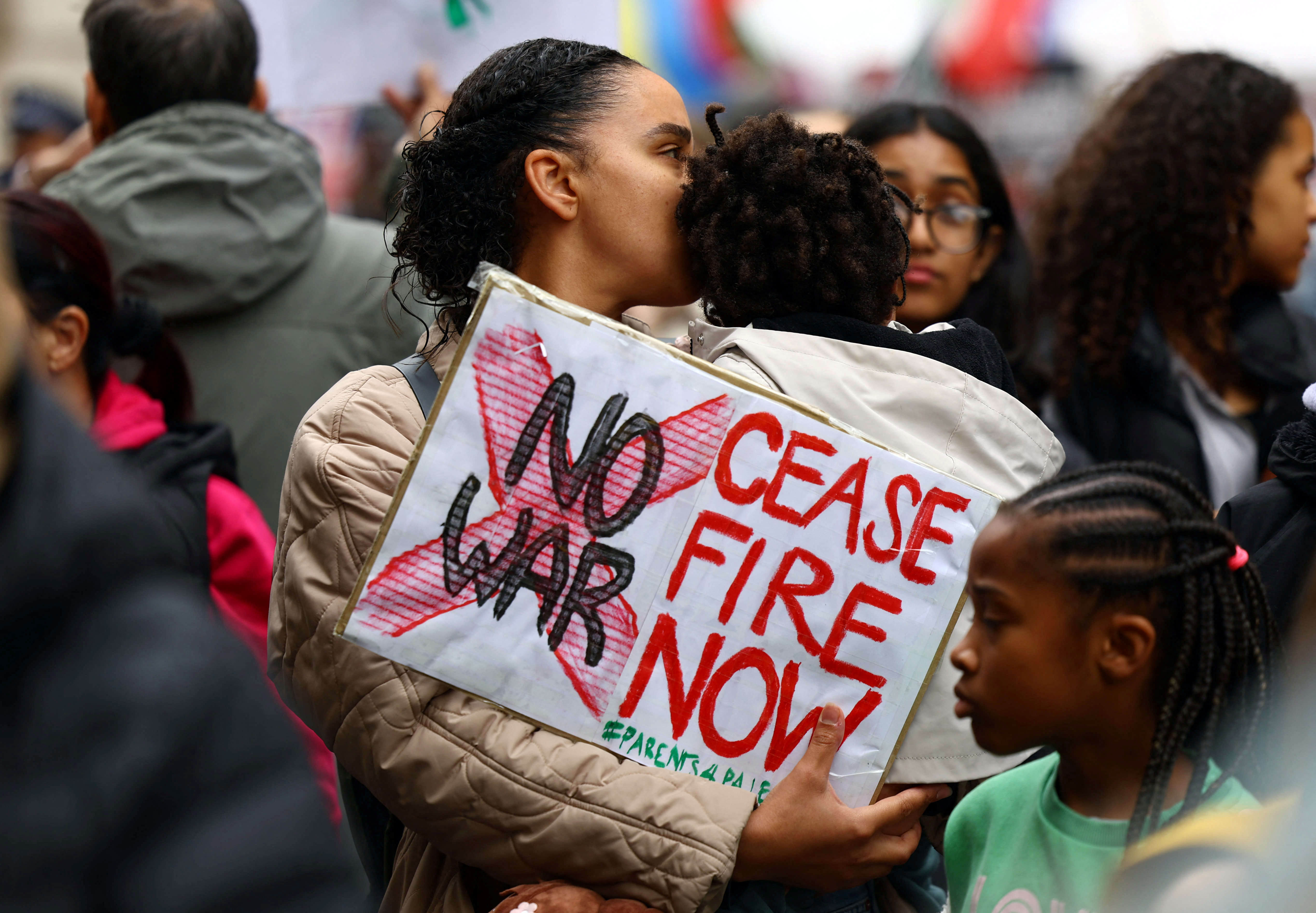
            When Israel overreacted to Hamas’ October 7th attack on western Israel with a brutal saturation bombing campaign against the Palestinian civilian population of the Gaza Strip, defenders of human rights, antiwar activists and supporters of the Palestinian liberation movement demanded a ceasefire.

            To me, that felt like yet another example of the Left settling for too little, negotiating against itself. Ask for the stars, I usually advise, and you might settle for the moon. Ask for the moon and you might wind up with nothing. A ceasefire isn’t an armistice, much less a peace agreement. It’s merely an interruption in a war. What kind of antiwar activist doesn’t ask for an end to a war?

One of the most famous examples is the Christmas Truce of 1914, when German and British troops crawled out of their trenches and met in no-man’s land to exchange presents, play soccer and celebrate the holiday together. A day or two later, however, World War I resumed. It’s a cute story that changed nothing.

            Israel owes the people of Gaza nothing less than an immediate cessation of hostilities and official acceptance that the current conflict is a war crime for which top Israeli governmental and military officials should be prosecuted. The IDF should withdraw. Israel should pay to rebuild everything it destroyed and compensate the families of dead and wounded Palestinians. It should house everyone it has displaced on Israeli territory, in Tel Aviv and Jerusalem if need be. It should recognize a free and sovereign Republic of Palestine in Gaza and the West Bank, with East Jerusalem as its capital, within 1967 borders along with a safe corridor to connect the currently non-contiguous borders. The 700,000 settler-colonists should leave the West Bank and return to Israel.

            A ceasefire seems so tiny by comparison.

            Which is why it’s proving effective as a demand.

            When people confront two parties engaged in a conflict, one of their first reactions is to try to assess which, if either, is right (or at least more right). This determination is affected by such cognitive biases as whether one side looks or acts more like the person making the assessment. In the Israeli-Palestinian conflict, some Americans have baked-in personal allegiances because they are Jewish or Muslim.

            Which leaves the other 97% of the population. Citizens of the United States are notoriously ignorant about politics and cultures beyond their borders. To the extent that they pay attention to the Middle East conflict, there has been a historical bias in favor of Israel, a fact that Israeli Prime Minister Benjamin Netanyahu and his ally President Joe Biden relied upon at the beginning of the war in Gaza. As we have seen in the past, however, Israeli overreaction has prompted the public to take a closer look and, following the usual practice, led them to a “pox on both of their houses” stance. Deputy National Security Adviser K.T. McFarland repeated that trope in 2020 when she claimed on Fox News that in “…the Middle East, they’ve been fighting for 4,000 years. It’s been an ethno-sectarian battle and psychodrama, and they’ve been killing each other for millennia. Their normal state of condition is war.” (This is not even a little bit true, but let’s leave that for another time.)

            20,000+ dead Palestinians into the latest episode of the conflict, the Gaza war has become a catastrophe too big to ignore or dismiss with glib inanities. Day after day, as Americans’ social media feeds fills with bloody images of dead Palestinian babies, initial public sympathy for Israel has given way to a feeling that the Palestinians of Gaza are victims at least as much as the Israelis of October 7th. Choosing sides is no longer easy. But one thing is clear: the carnage has gone on too long and, even if a long-term conclusion like a two-state solution is impossibly elusive, the bombing simply has to stop.

            By mid-December, three out of five American voters—with few differences between political parties—supported a ceasefire, up significantly from October. The public had caught up to the pro-Palestinian activists. By not asking for much, the Left appears moderate and reasonable.

            Meanwhile, voters keep reading headlines in which the Israeli government is refusing a ceasefire. To the contrary, Netanyahu says the war will continue for “many more months.” Israel is framing itself as rabid, overreaching and bloodthirsty.

            Because it is out of sync with public opinion, good will for Israel is ebbing like the pulse of a man bleeding to death from a gunshot wound. Although older voters still tend to support Israel, a mere 28% of voters between ages 18 and 29 told the latest New York Times/Sienna College poll that they believed Israel was seriously interested in a peaceful solution. On the other hand, half said the Palestinians do want peace.

(Ted Rall (Twitter: @tedrall), the political cartoonist, columnist and graphic novelist, co-hosts the left-vs-right DMZ America podcast with fellow cartoonist Scott Stantis. You can support Ted’s hard-hitting political cartoons and columns and see his work first by sponsoring his work on Patreon.)

Actually, That Was Me

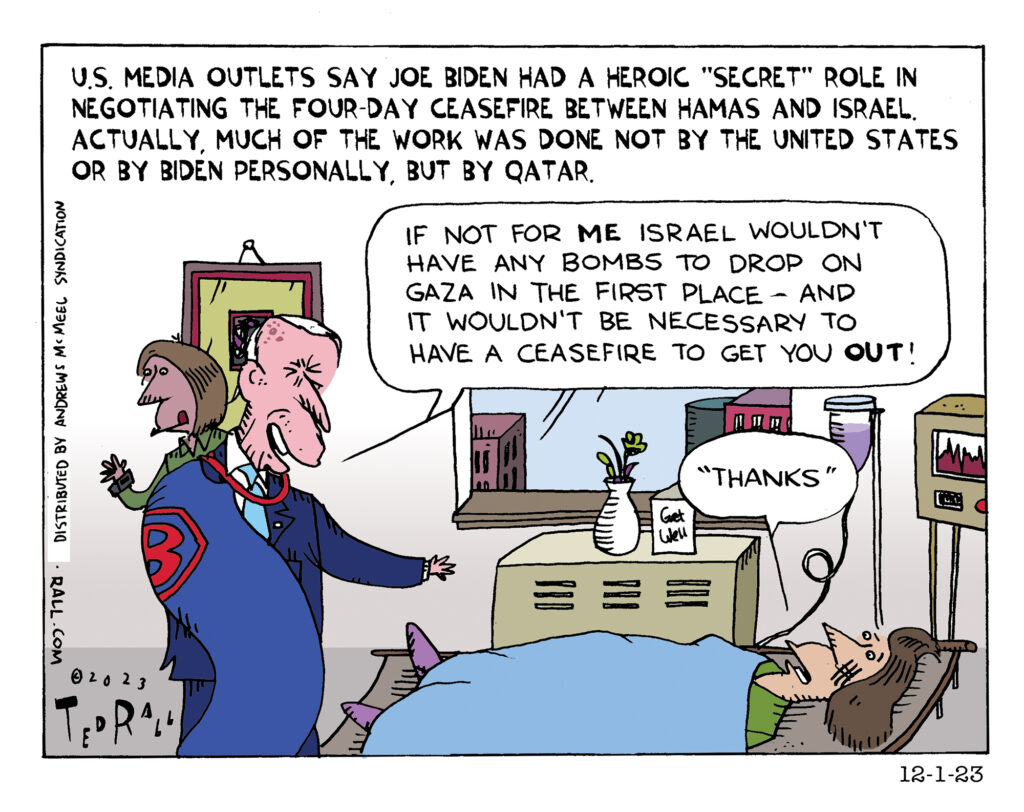
US media outlets say Joe Biden had a heroic “secret” role in negotiating the four-day ceasefire between Hamas and Israel. Actually, much of the work was done not by the United States or by Biden personally, but by Qatar.

DMZ America Podcast #120: Hamas Goes to War with Israel

Hamas fighters swarmed into Israel from the Occupied Gaza Strip, which has been subjected to a grinding economic blockade since 2007, killing Israeli civilians and soldiers and taking hostages. Political cartoonists Ted Rall (from the Left) and Scott Stantis (from the Right) debate the Israeli-Palestinian conflict and the ramifications of what Israelis are calling their 9/11. Scott, an ardent defender of Israel, tries to find common ground with Ted, who supports Palestine’s independence struggle.

Watch the Video Version of the DMZ America Podcast:

DMZ America Podcast Ep120: Hamas Goes to War with Israel

America Clutches Its Pearls, Balloon Edition

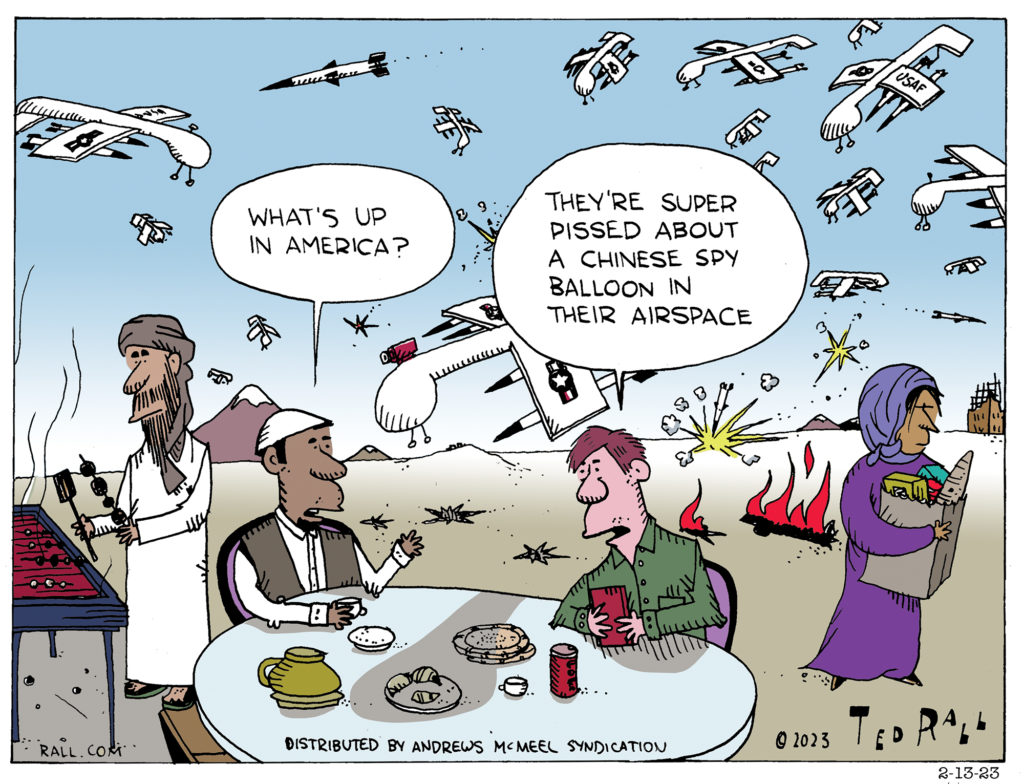
No country in the world invades the sovereign airspace of other nations as brazenly or extremely as the United States with spy drones, assassination drones, spy satellites and outright invasions. So it’s beyond rich to see U.S. officials whine so much about China’s survelliance balloon.

DMZ America Podcast #57: Cowardly Cops and the Middle East: Who Should We Cozy up with, Iran or Saudi Arabia?

Political cartoonists Scott Stantis and Ted Rall engage in a lively debate over the Middle East. Iran claims to have nuclear weapons technology, whatever the hell that means, which has Scott worried to the point that he’s contemplating bombing the country. Meanwhile Biden cozied up to Saudi Arabia’s dictator this week, prompting Ted to to go off the rails. But first, the final report is out on the police non-reaction at the mass shooting in Uvalde, Texas, and the question is: can the cops be redeemed?


Next Time Write a Letter to the Editor

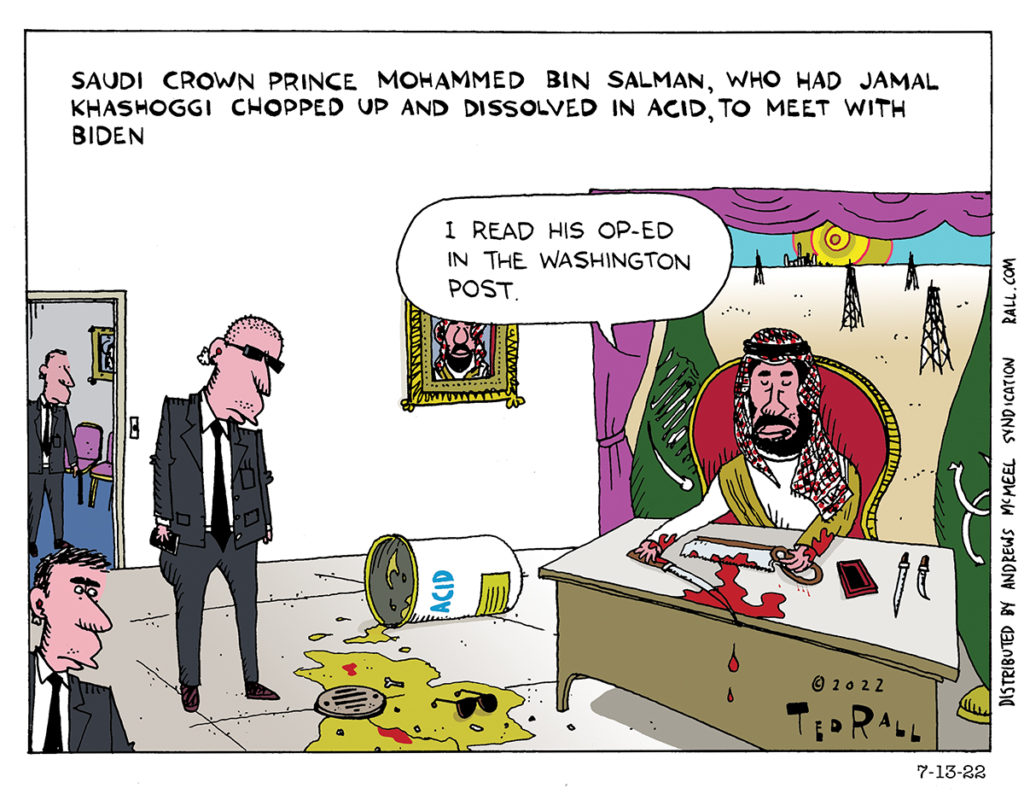
Saudi Arabian Crown Prince Mohammed bin Salman, who had Washington Post journalist Jamal Khashoggi murdered, chopped up and dissolved in acid, is scheduled to meet with President Joe Biden. Biden is visiting the Middle East in order to ask Saudi Arabia to ramp up oil production to make up for the shortage of Russian oil created by his sanctions. If I were the president, I would be nervous—especially since he just published an op-ed justifying the trip in the Washington Post.

The Electoral Trolley Problem

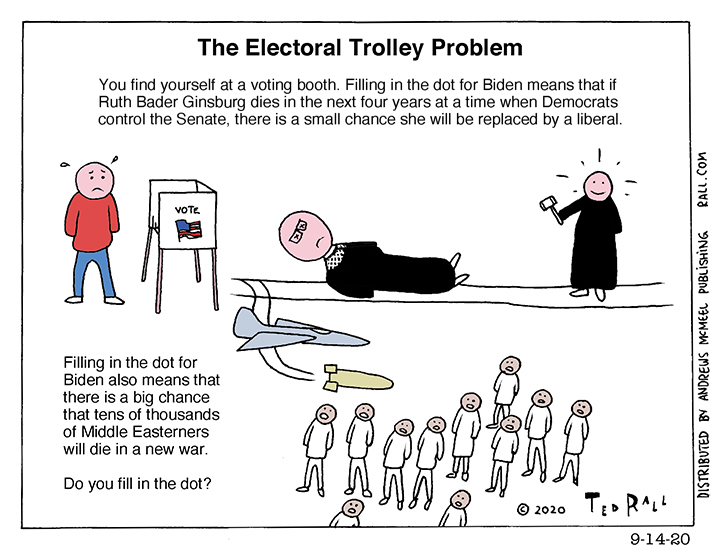
Voting is always an ethical dilemma. For people thinking about voting for Joe Biden, one of the things that they might not be thinking about as they fantasize about the somewhat remote possibility of a liberal stalwart replacement for Ruth Bader Ginsberg is the higher probability that Biden, given his history, will start another war in the Middle East.

Iran Is Not What You Think

Image result for iran manteau

            War, many people believe, often results from cultural differences and misunderstandings. President Trump’s assassination of General Qassem Suleimeni has Americans considering the possibility that we may soon add Iran to our list of unwinnable wars in the Middle East. As that calculus unfolds, no one questions the assumption that there are irreconcilable differences between our two peoples that can only be worked out via more bloodshed.

            Nothing could be further than the truth. No other people in the world are more temperamentally similar to Americans than Iranians. Certainly, the Iranians’ religion is different. So is their language. But we are a lot more like them than most Americans, and that includes members of the news media, assume.

            The problem is, very few Americans have been to Iran. The absence of diplomatic relations following the 1979 Islamic revolution and the ensuing hostage crisis that brought down Jimmy Carter’s presidency, coupled with trade sanctions that prohibit American airlines from providing direct air service make it all but impossible for the most intrepid of travelers to get inside the country and see what’s going on for themselves.

            I’m not an expert on Iran. But this seems like an appropriate time to share what I learned nine years ago when I visited that country.

            As I said, getting in wasn’t easy. I paid numerous visits to the closest thing Iran has to a consulate in New York, Iran’s Mission to the United Nations, to little avail. Ultimately I shelled out a $5700 “arrangement fee” (some would call it a bribe) to a Washington D.C.-based agency that worked through the Iranian Interests section of the Pakistani embassy there to secure visas for myself and two fellow cartoonists.

            The main purpose of our trip was travel through Afghanistan for a book I was writing. Since our itinerary through that war-torn country would end with the Afghan city of Herat near the Iranian border, we wanted to leave via Iran after some tourism and rest and relaxation.

            You can get an idea of how unusual our plan was from the incredulous reaction of the Afghan border policeman who greeted us after we crossed the border from Tajikistan. “Point of exit?” he asked. When we told him Iran, he laughed. “You are American! There is no way,” he replied. When he showed our Iranian visas to his colleagues, they couldn’t believe their eyes. “How did you get these?” they wanted to know.

            Several weeks later, we walked across the border between northwestern Afghanistan and northeastern Iran. It seemed incredibly simple. We were already stamped in and on the curb outside the customs office waiting for a taxi when three bemused agents of Iran’s feared Ettela intelligence service tapped us on our shoulders and invited us into separate interrogation rooms. They grilled us for hours. Before they released us my agent asked me: “Do you know why we questioned you so diligently?” I didn’t. “You three,” he replied, “are the first Americans to cross this border since 1979.” I don’t know if that’s true. Clearly we were rare birds.

            The first thing that struck me, especially compared to the bleak devastation of Afghanistan, was how modern Iran was, even in this remote corner of the nation. Americans have an impression of the Middle East as a bunch of dusty pockmarked ruins and sand, but Iran looked and felt like Turkey or Israel in terms of its terrain and infrastructure. The second was how nice everyone was, even/especially after learning we were American.

            As required by the government, we had arranged for a travel agent to meet us and shepherd us around. He was a nice guy even though he liked to scam our money; we kept being put up in two-star hotels after we paid him for four.

            From the start, Iran wasn’t what we assumed. On the train ride to Mashhad, our fixer disappeared for about an hour. Upon his return he apologized and explained that he had picked up a woman who had taken him to her cabin for a quickie. His promiscuity wasn’t unusual. We were repeatedly flirted with or propositioned by women. The desk clerks at our hotel asked our fixer about our long beards, which we had grown out in order to blend in in rural Afghanistan. “Are your friends fanatics?” they wanted to know. “Would they spend the night with us?”

            Along with our beards we had acquired the traditional shalwar kameez white robes worn by conservative Afghans. Our fixer suggested we had a unique opportunity to smuggle ourselves into the haram (forbidden) section of the Imam Reza shrine so we could check out the stunning Timurid architecture. If anyone talked to us, our fixer advised, pretend not to understand them. Muslims come from all over the world to pray there so we could pretend to speak a different language. Worshipers circled the tomb of the 9th century Shia martyr Ali al-Ridha seemingly in a trance but, whenever someone spent too long in the center an attendant lightly dipped a pink feather duster strung from a pole onto the offender to ask him to move on.

            Two incidents stood out for me.

            At our hotel in Tehran we overheard a European couple complaining to the desk clerks that they had been mugged or pickpocketed, I don’t remember which, the night before. They had been robbed of €1200. The clerks repeatedly entreated them to report the loss to the police but the Europeans were understandably hesitant. The next day I encountered the pair in the elevator. “You won’t believe what happened,” the wife told me. “We went to the police and they gave us €1200.” There was a law that foreign tourists had to be made whole if they suffered a financial loss due to crime. Iranians we talked to were surprised that it wasn’t the same in the West.

            We flew from Tehran to Istanbul. At our last security checkpoint in Iran airport security personnel ordered us to remove our baggage from the conveyor belt leading to the x-ray machine. Great, I thought, we’re going to be detained. “You are guests in our country,” the equivalent of the TSA guy advised us. “It would be rude to subject you to a search.” We were Americans, citizens of the Great Satan, at Ayatollah Khomeini International Airport!

            Not everything was sweetness and light.

            There was always a sense of tension that comes with knowing that law-breaking could come with grave consequences. For the most part, however, we followed the rules. Most of the people we saw obeyed them too, but just barely. Many women wore the tightfitting manteau and barely covered their hair.

            When our Turkish Airlines flight lifted up from Tehran, many of the women on board dumped their chadors, revealing skin and sexy outfits and makeup. People smiled. Flight attendants began serving beer. This is what Iran would feel like if Iran’s government, which is not popular, were to go away tomorrow.

Trump’s latest actions and America’s myopic foreign policy, however, ensure that the religious government will probably remain in place for the foreseeable future.

            So does the fact that very few Americans have gotten to know Iran.

(Ted Rall (Twitter: @tedrall), the political cartoonist, columnist and graphic novelist, is the author of “Francis: The People’s Pope.” You can support Ted’s hard-hitting political cartoons and columns and see his work first by sponsoring his work on Patreon.)


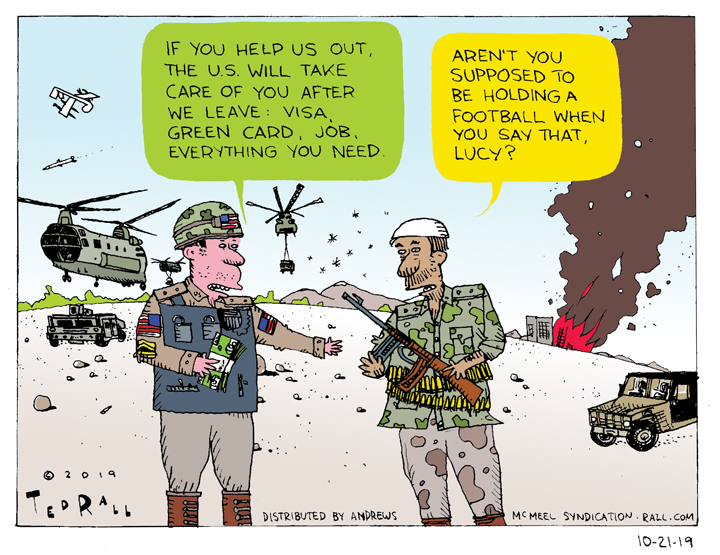
Where’s Your Football, Lucy?

President Trump’s order to withdraw American troops who created a buffer zone between Turkey and Kurdish-controlled areas of Iraq was a controversial movie seen as a betrayal of a long-time American ally. But there’s a long history of US forces making extravagant promises to local forces, then withdrawing and leaving them to the wolves.

keyboard_arrow_up
css.php