TMI Show Ep 129: “What’s Left?”

•

LIVE 10 AM Eastern time & Streaming Anytime:

On The TMI Show with Ted Rall and Manila Chan, streaming live on May 1, 2025, at 10 AM ET— it’s International Workers’ Day! This isn’t just a broadcast; it’s a battle cry for justice, airing on YouTube and Rumble, perfectly synced with the launch of Ted Rall’s groundbreaking book, “What’s Left: Radical Solutions for Radical Problems” (ISBN: 979-8-8898622-0-1). Available live or on demand, this episode is set to ignite a movement.

As the world honors workers, “The TMI Show” confronts the raw truths of a system bleeding $3.8 trillion annually on wars and billionaire tax breaks while 770,000 Americans sleep on the streets. Rall and Chan bring their razor-sharp insight to the fight, exposing a government that preaches “for the people” but serves the elite. It’s unfiltered, urgent, and loaded with the kind of truth that demands action.

Enter “What’s Left”—a fearless manifesto for a true Left rooted in socialism and dignity. Rall, the incisive cartoonist and columnist, unleashes 20 radical demands: cut Pentagon spending by 90% to fund free healthcare and education; hike the minimum wage to $60/hour; turn 15 million vacant homes into housing for the homeless. With 40% of Americans warming to socialism, this book is a wake-up call—offering a roadmap to end poverty and inequality with resources we already have. It’s a provocation that dares the powerful to refuse, exposing their greed.

This episode fuses global worker solidarity with a vision for revolution. “The TMI Show” and “What’s Left” deliver a one-two punch: bold ideas, fierce critique, and a call to rise up. Don’t miss it—tune in and join the fight for a world where everyone thrives!
A Low Bar He Can Scramble Beneath

•

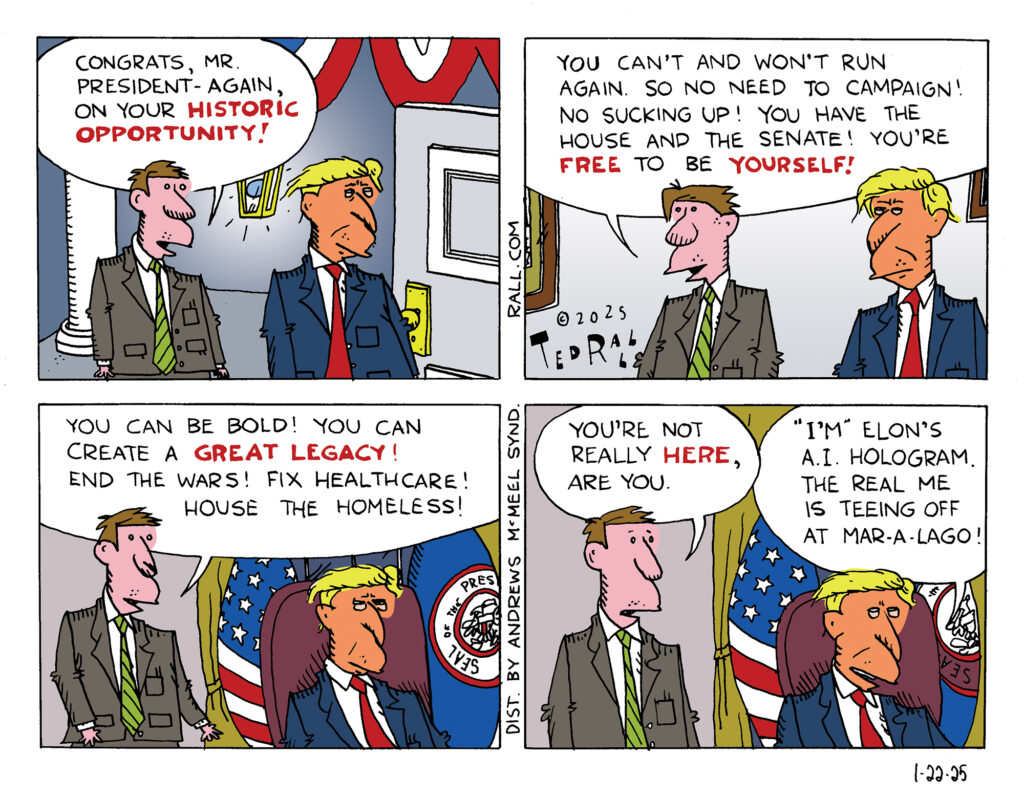
For the first time in the era of presidential term limits, we now have a president who is both a lame duck but also incredibly free to do whatever he wants to leave behind an impressive legacy by which he can be remembered. Will he avail himself of that opportunity?

TMI Show Ep 48: “Mean Streets: Can Anyone Clean Them Up?”

•

A driver runs down and kills 15 pedestrians on Bourbon Street in New Orleans. A man pushes a commuter in front of a New York subway train days after a migrant sets a homeless woman on fire, killing her, on a train in Brooklyn. The FBI says crime is down in every category, especially violent offenses. But urban areas feel lawless and out of control and the latest Gallup poll finds that a majority of Americans believe crime is extremely or very serious.

Are Americans paranoid? What effects are the migrant and homeless crises having? What can the authorities do at the local and national levels to make people feel safe?

“TMI Show” hosts Ted Rall and Manila Chan are joined by Michael Maloof, a former senior security policy analyst in the Office of the Secretary of Defense to discuss the state of a scared nation.

Born To Kill

•

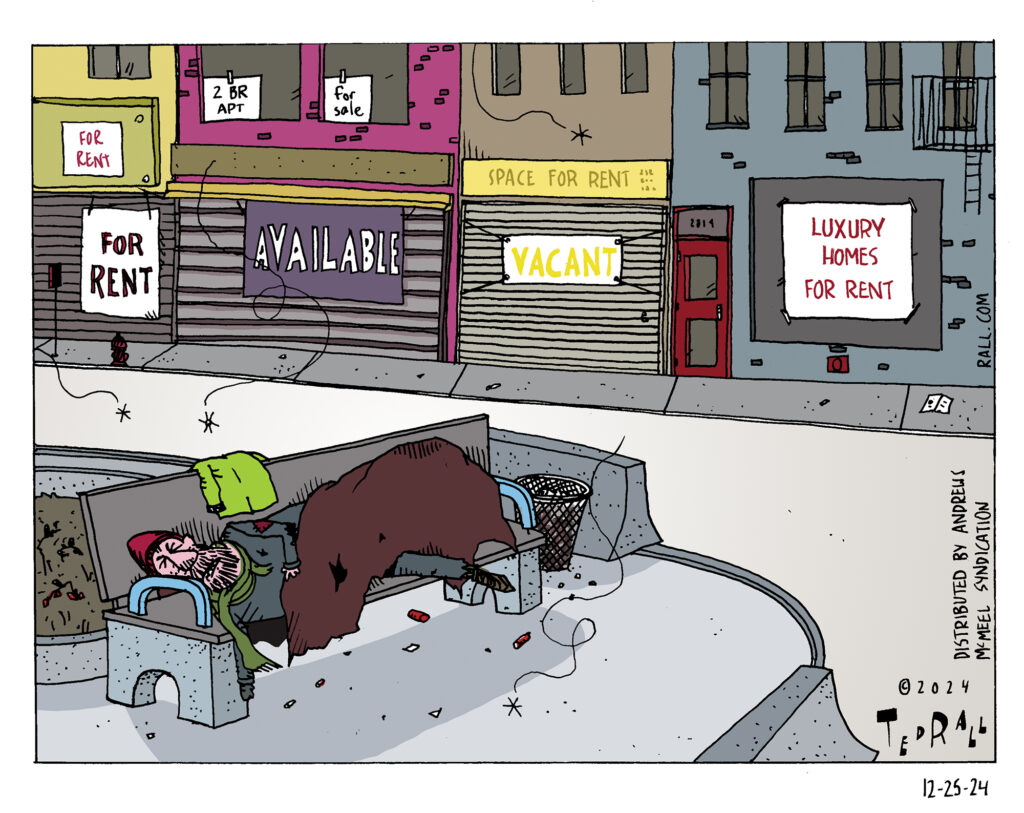
Cities have been hollowed out in the aftermath of the COVID-19 pandemic and the rise of working at home. As office buildings emptied out, urban dwellers were asking themselves why they were paying so much rent to commute to a job that no longer requires them to do so. As warm apartments and storefronts sit empty, there’s probably never been a more searing indictment of capitalism than the fact that American citizens continue to sleep outside in the cold.

And Give Up All This?

•

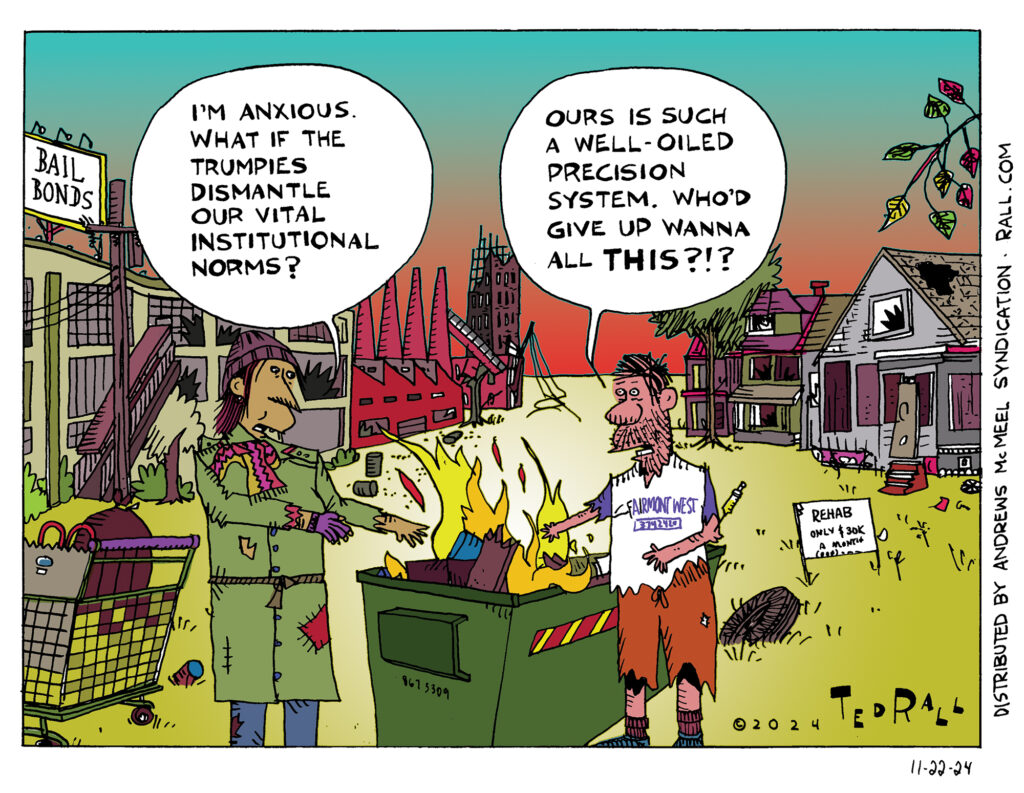
One of the assumptions of Kamala Harris’s failed presidential bid was that voters didn’t want radical change of any kind. She promised an incremental approach designed to gradually improve things without altering what she assumed were beloved American institutions like the courts. In reality, life for most Americans is pretty bleak and they don’t have much investment in those longstanding traditions.

Millions Have No Home. You Don’t Need Two.

•

           Responding to polls that show that voters are worried and angry about the high cost of housing, both major parties are floating plans to make buying a home more affordable. Harris and the Democrats want to encourage new housing construction and subsidize first-time home buyers by $25,000, which economists worry would have an inflationary effect. Trump thinks that deporting illegal immigrants would reduce demand and lower prices—a logical stretch to say the least.

            As important as it is to allow middle-class and working-class people to build wealth by investing in a house or condo, however, the real need is not those who would prefer to own than to rent their residence. The real need is those who have no housing at all.

            Roughly half a million Americans are chronically homeless and nearly four million more “hidden homeless” are imposing on friends and family for a place to stay that may or may not remain available in the future. Cities are blighted, families are shattered, children are traumatized. Homelessness is both a moral and economic crisis as well as a failure of leadership.

            Homelessness impacts us all. Every person who must be treated at the emergency room as a consequence of going unhoused not only burdens the healthcare system, they live outside the workforce who contribute to productivity, fuel consumer spending and remit payroll taxes. Their deprived physical persons, their meager possessions and their vehicles are eyesores that negatively impact property values and thus reduces municipal revenues. People experiencing homelessness and housing insecurity get arrested more often than the average citizen, only for survival offenses like stealing food and clothing. Many are or become mentally ill, especially from schizophrenia, as a result of fending off hot and freezing weather; homeless people commit about thirty times more violent crimes than average.

            According to the National Alliance to End Homelessness, it would cost about $55 billion, most of it spent once rather than recurring, to house both the visible and hidden homeless, who total about 4.5 million people. But where would we put all these people?

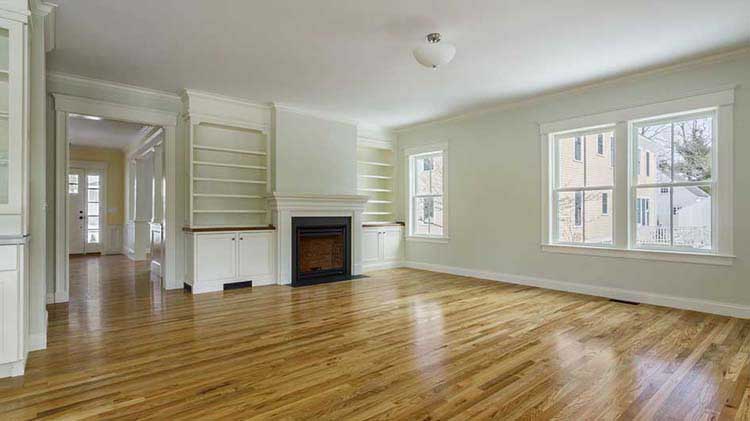
            Incredibly, that answer is easy. There’s no need to build a single new unit. We have plenty lying around completely unused.

More than 15 million homes, over 10% of the nation’s housing stock, was vacant in 2022—a record low. Three out of four are investment properties, many owned by venture-capital companies that are converting neighborhoods once comprised of local homeowners into transient rental units with algorithmically-inflated rents, particularly in middle-class areas with many people of color. Most of these are vacation homes, timeshares and hunting cabins that sit empty well over 95% of the year.

Property rights matter, but a national emergency like a war prompts the government to requisition private property in service to an important cause. During World War II, for example, the United Kingdom commandeered personal cars and paid their former owners what they determined to be fair market value, while the United States requisitioned merchant ships. U.S. occupation forces appropriated German land for military use in the late 1940s.
            Homelessness is a national emergency on par with World War II. Actually, it’s much bigger. Had the isolationists prevailed and the U.S. not joined the Allies against Japan and Germany, there is no reason to believe that the U.S. itself would ever have been invaded. For America, World War II was optional. Fighting homelessness is about saving the lives of millions of American citizens right here at home. It’s as essential as it gets.

            Florida and Hawaii, both popular vacation destinations, have more vacant second homes than other states. But the vacation-house mentality also afflicts cities with high densities—or that used to have them. In the 2005-2009 American Community Survey, 102,000 of the 845,000 apartments and houses in Manhattan were identified as vacant. One out of 25 units in the nation’s cultural, media and financial capital were occupied less than two months out of the year. “In a large swath of the East Side [of Manhattan] bounded by Fifth and Park Avenues and East 49th and 70th Streets, about 30% of the more than 5,000 apartments are routinely vacant more than ten months a year because their owners or renters have permanent homes elsewhere,” The New York Times reported in 2011. It’s worse now.

            The number of vacant units in New York City lines up almost exactly with the estimated number of homeless men, women and children: 100,000.

            Every single person who shivers on the sidewalks of the Big Apple does so within a few dozen feet of a heated, insulated, empty apartment with running water, a place that no one uses. It’s obscene. It’s piggish. And it needs to be fixed. A real estate speculator’s right to invest in a housing market is not half as important as a homeless person’s need to sleep inside. A bourgeois family’s desire to winter in Florida and summer in New York must take a back seat to the human right of a homeless person not to die.

            City and state housing authorities should be granted the right and the funding appropriations necessary to seize vacant housing units under eminent domain for conversion to housing for the homeless, with fair market compensation to be paid to those deprived of their properties.

            The United States signed the Universal Declaration of Human Rights, which recognizes housing as a basic human right, in 1948. The UDHR was codified into a treaty, the International Covenant on Economic, Social, and Cultural Rights in 1966. Because the U.S. signed the ICESCR, it is obligated to uphold its “object and purpose.” Nearly eighty years after our nation committed to ensuring that everyone has a decent and secure place to live where he or she need not fear eviction, it should make good on its commitment to international law.

            Condemn vacant investment properties and vacation homes and seize them under eminent domain.

            Until the last American citizen moves from the outdoors to the indoors, no one should be legally permitted to own more than one home.

(Ted Rall (Twitter: @tedrall), the political cartoonist, columnist and graphic novelist, co-hosts the left-vs-right DMZ America podcast with fellow cartoonist Scott Stantis. His latest book, brand-new right now, is the graphic novel 2024: Revisited.)

DMZ America Podcast #151: Canada Fears US Civil War, Many Elderly Will Die Homeless, Cartoonist Jailed in Iran

•

The DMZ America podcast is where you’ll hear civilized, spirited debate and discussion about the politics and issues of the day. Editorial cartoonists Ted Rall (Left) and Scott Stantis (Right) deliver a fast-paced look at some stories others are missing this week.

First up, a Canadian government assessment of threats to Canadian national security worries aloud about instability on their southern border: us. The worry: “U.S. ideological divisions, democratic erosion, and domestic unrest escalate, plunging the country into civil war.”

Second: People over 50 face a radically increased danger of becoming homeless and dying on the streets. What does the fact that younger generations don’t seem to care about the elderly say about American society?

Third: Cartoonist Atena Farghadani, who is on trial at Branch 26 of Tehran’s Revolutionary Court, was charged with “insulting sacred values” and “propagating against the state” for attempting to post her cartoon on the wall outside the home of the Supreme Leader. The court sentenced the cartoonist to six years in prison. 

Watch the Video Version: here.

Another Casualty of the Cashless Society

•

I live in New York City, where many homeless people rely on panhandling in order to get by. A few days ago I saw a Millennial woman turn down a request from a homeless man, saying, “I don’t carry cash.” I have long been concerned about the ramifications of our increasingly cashless society, like the ability of the government to lock down our bank accounts and ability to move freely. As usual, the poorest among us are paying the biggest price for what we’ve been told is progress.

Mr. President, Please Kill the Homeless Woman Who Lives Outside My Apartment

•

            Dear Mr. President,

            Won’t you please kill the homeless woman who lives on a bench on the median strip of the street near my apartment building?

            She doesn’t bother me. As far as I know, she doesn’t bother anyone else either. The woman who lives in the middle of the street is nice. I like her. Last week, as I was waiting for the traffic signal to change, she beckoned softly from under her pile of soiled blankets, asking for change, and I gave her a ten-dollar bill. I’m not usually that nice. She’s that sympathetic.

            I pitied her. I’ve watched her decline since spring. As six months dragged by this probably-fiftysomething-year-old woman has deteriorated from “how did someone so normal become homeless?” to talking to herself to severely sunburned to “this person will die this winter.”

It was in the high 30s last night and it will only get colder and it is not a question of when or how she’ll die—the answers are (a) this winter and (b) hypothermia—but whether the usual circle of votive candles and $5 bouquets of flowers will be placed by her bench or on the southwest corner of the intersection near the other one.

            They say that dying of cold isn’t that bad. That you feel warm, cozy, disoriented.

            I don’t believe them. Whatever the physical sensations, dying from cold a hundred feet from a couple hundred housing units so overheated that many New Yorkers keep their windows open all year long has got to be one hell of a lonesome suck of depressing. The nice woman who lives in the median deserves better than drawing her final breath while staring at the glow of a laptop screen through a frosted window pane the opposite side of which, under different circumstances, she would live inside.

            So, Mr. President, won’t you please kill this lady? You’d be doing her a favor.

            I know this isn’t your fault, sir. In a different world, you could allocate the tens of thousands of dollars needed to provide my outside neighbor with emergency shelter, transitional housing, permanent rehousing, substance abuse and/or mental health treatment. In reality, that money is tied up. The government’s budget is stretched thin. You have a massive deficit to think about.

            Plus you have big expenses. For example, you’re asking Congress for $106 billion “in funding for Israel, Ukraine, countering China in the Indo-Pacific, and operations on the southern U.S. border.” These are, obviously, all very important needs. Before she succumbed to schizophrenia, the woman who is going to die in my New York neighborhood wouldn’t dream of suggesting that her desire to live indoors ought to come ahead of countering China in the Indo-Pacific.

            I understand. If she hadn’t gone crazy, she’d understand too. Defense is one pot. A big pot. Anti-poverty is another pot. A very small pot. Like the tiniest pot in the smallest dollhouse ever. Everyone knows—you can’t “just” move money from one pot to another pot. That’s not something we even want to think about.

            All that military spending got me thinking, though. Although Ukraine and Israel and Taiwan clearly need fighter jets and tanks and drones and ships and cyber weapons and missiles and bombs and light arms and bullets in order to kill as many Russian and Palestinian and Chinese people as possible, will they really miss…one?

            Euthanizing a homeless New Yorker wouldn’t require anything as fancy as one of the MGM-140 Army Tactical Missile Systems we’re sending to Ukraine. This lady isn’t worth $1.5 million. Not to mention, one ATACM would take out a whole block or two—including my place!

            I’m thinking something more modest, along the lines of the Switchblade 300 “suicide” drone, another gizmo we’re providing to Ukraine. As I’m sure you’re aware, Mr. President, the AeroVironment Switchblade is an expandable loitering munition so small it can fit in a backpack. You launch it from a tube. Then it flies to and crashes into its target, where its explosive warhead detonates. Like the homeless, it’s expendable. And it’s only $6,000!

            Come on, Mr. President: We both know the Ukrainians and the Israelis and Taiwanese don’t need all the weapons we’re sending them. The Ukrainians don’t; they’re selling the extras we send them on the black market and the dark web. I only need one. One!

I know—“operations on the southern U.S. border” address an existential threat to America. What if an illegal terrorist migrant were to sneak past the border wall and make his way to New York and then were to kill the homeless woman on my street who would otherwise die of exposure this winter? Of course, that would be OK.

Still. It’s not like you can’t let $6,000 “accidently” fall out of your budget for “operations on the southern U.S. border.” Send that drone. Please blow up the old lady.

(Ted Rall (Twitter: @tedrall), the political cartoonist, columnist and graphic novelist, co-hosts the left-vs-right DMZ America podcast with fellow cartoonist Scott Stantis. You can support Ted’s hard-hitting political cartoons and columns and see his work first by sponsoring his work on Patreon.)

Related: Biden Sends Billions Overseas As Americans Starve (Short Video)

keyboard_arrow_up
css.php