SYNDICATED COLUMN: Lead, or Follow and Get Out of the Race

Voters Turn Against Pols’ Follow-the-Polls Strategy

In order to be a good leader, Disraeli said, “I must follow the people.”

Aided and abetted by toe-sucking pollster Dick Morris, Bill Clinton finessed the art of leading from the rear, relying on Morris’ tracking surveys to help him decide everything from whether to bomb Serbia to when and if to take a vacation.

By definition, however, leaders point where their followers should go. Americans haven’t seen much real leadership on the federal level since Reagan. Where there’s been progress, such as on gay rights, the President only stepped forward after public opinion had shifted enough to make it safe.

For the first time in 30 years, Dick Morris’ follow-the-voters strategy appears to be running out of steam. This year, the electorate seems to be hungering for presidents in the mold of TR, FDR and LBJ—old-school leaders who painted ambitious visions of where America could go and why it should, who took political gambles that the people might not be ready for what they had in mind, who anticipated crises and challenges before anyone else, and explained why we had to act sooner rather than later.

The craving for leadership is evident in the polls. Though personally popular and enjoying the advantages of incumbency, President Obama is running neck and neck against Mitt Romney, an awkward candidate from a minority religion who has trouble connecting with, and is seen as out of touch by, ordinary voters.

Democrats must be worried. Historically, Republican presidential nominees typically gain on Democrats throughout the fall. At this point in the game, Democrats need a substantial lead in order to emerge victorious in November.

What’s going wrong? Mainly, it’s the economy. It sucks. Still. Democrats say the President inherited the meltdown from Bush. But Americans blame Obama.

“The nation’s painfully slow pace of growth is now the primary threat to Mr. Obama’s bid for a second term, and some economists and political allies say the cautious response to the housing crisis was the administration’s most significant mistake,” reports The New York Times. Obama’s big screw-up: “He tried to finesse the cleanup of the housing crash, rejecting unpopular proposals for a broad bailout of homeowners facing foreclosure in favor of a limited aid program—and a bet that a recovering economy would take care of the rest.”

Recovery? What recovery?

The depressed housing market, coupled with the reduced purchasing power of tens of millions of Americans who lost their homes to eviction and/or foreclosure, makes recovery unlikely to impossible for the foreseeable future.

Many people, including yours truly, warned that the millions of Americans who were evicted under foreclosure, many of them illegally, were more “too big to fail” than Citigroup. Some, like former Congressman Jim Marshall (D-GA), voted for TARP, but urged the Obama Administration to condition the bailout on forcing the banks to refinance mortgages and write down principal to reflect the new reality of lower housing prices. “There was another way to deal with this, and that is what I supported: forcing the banks to deal with this. It would have been better for the economy and lots of different neighborhoods and people owning houses in those neighborhoods,” Marshall says.

Voters aren’t mad at Obama for not being clairvoyant. They’re pissed off because he ignored people who were smart and prescient in favor of those who were clueless and self-interested, like Tim Geitner. He may be about to pay a price for that terrible decision.

Tens of millions of Americans already have.

Speaking of leadership—the art of seeing what comes next and doing something about it—what looming problems are the political class ignoring today?

It’s too late to stop the 2008-to-2012 economic meltdown. But it’s still possible for Obama (or, theoretically, Romney) to get ahead of the economy—permanent unemployment benefits, anybody?—and other pressing issues.

Australia, for example, is taking the climate change crisis seriously.

Americans want leaders who point the way forward, to anticipate monsters we can’t yet imagine. For example, there is a huge looming crisis: pensions. In 10 to 15 years, Generation Xers will hit traditional retirement age. How will they eat?

Close to none have traditional defined-benefit pension plans. Gen Xers, who earn far less than the Baby Boomers at the same age, have been shunted into 401(k)s, which turned out to be a total ripoff: the average rate of return between 1999 and 2010 was 0.3 percent.

Total.

And much of that was withdrawn—under penalty—to subsist after layoffs.

“[Gen Xers] have no savings, and what they had was devastated by two market crashes,” said Andrew Eschtruth of the Center for Retirement Research. “They never got off the ground.”

If you’re 45 years old now and just beginning to save for retirement, financial planners say you should save 41 percent of your income annually (if you haven’t gotten laid off again). As if. Half of Gen Xers live hand to mouth; the rest save a piddling six percent a year.

The Gen X retirement crisis represents 46 million people waiting for a savior—and 46 million potential votes.

Attention Mssrs. Obama, Romney and anyone else presenting yourself as a would-be leader: Don’t just read the polls. Don’t follow us. Show that you care about, and have a credible plan to confront, the problems of the future. If you do that—and we’re not holding our breaths—we’ll pay attention to you.

(Ted Rall’s new book is “The Book of Obama: How We Went From Hope and Change to the Age of Revolt.” His website is tedrall.com. This column originally appeared at NBCNews.com’s Lean Forward blog.)

COPYRIGHT 2012 TED RALL
Corn Price Denialism

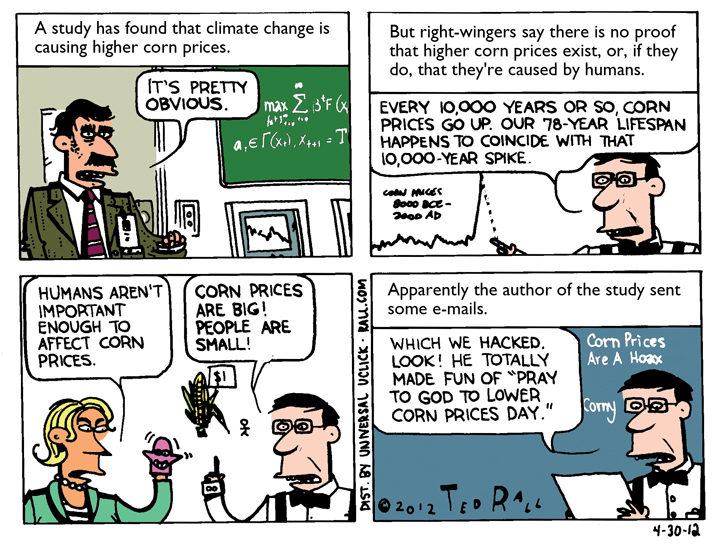
A study has found that climate change is causing higher corn prices. Let the higher-corn-prices denialists begin their wonderful dance!

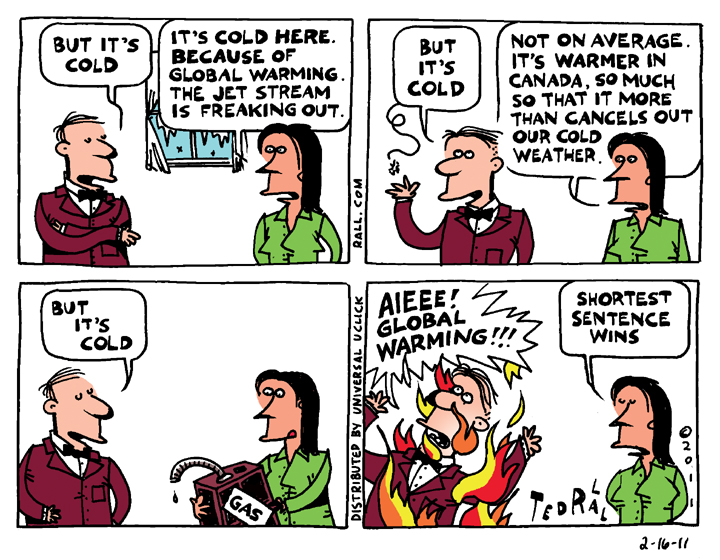
But It’s Cold

Cold weather in the United States has become a talking point for right-wing global-warming deniers.

Open Letter to Pro-Obama Liberals

At this time of the year I offer the Ted Rall Subscription
Service. For $30/year, you receive my cartoons and columns in your
in box before anyone else–sometimes days in advance of official
release. You also receive extras…for example, subscribers
received blog notices from Afghanistan and Iran last August.
Subscribers may purchase original art at heavily discounted rates,
and receive signed copies of my newest books at discounted rates as
well. To sign up, simply click
here
.

SYNDICATED COLUMN: The Death of the Moderates

Extreme Problems Require Extreme Solutions

Given his druthers, Obama will pursue the most left-leaning course that he can get away with.” So says Jennifer Rubin, a right-wing pundit at the neoconservative-leaning Washington Post. “Obama,” Rubin claims, “would have marched through his entire liberal agenda—if he had the votes.”

This, of course, assumes that Obama ever had a liberal agenda. There’s not much evidence of that. Moreover, Obama did have the votes in Congress to get almost everything that he wanted. But he chose not to even try.

It is also not true. He did have the votes. In recent years, for example, minority Republicans in the Senate have threatened filibusters on most major Democratic initiatives. When they have 60 or more votes, Democrats file a cloture motion to stop filibusters before they start. In practice, Democrats say—and the media has been repeating their meme—that it now takes 60 votes to pass a bill in the Senate.

It isn’t true. Not now. Not ever.

What Dems fail to understand is that they are depriving themselves of a big political opportunity by embracing automated parliamentary procedure. If Republicans want to filibuster, let them drag out their District of Columbia white pages and start reading on C-Span. Footage of GOP senators stonewalling popular legislation—extensions of unemployment benefits, eliminating tax breaks for individuals who earn more than $1 million a year, or healthcare benefits for 9/11 first responders—would make for awesome attack ads in 2012.

When the Bush Administration enjoyed a razor-thin 50-vote majority in the Senate, it only needed a simple majority in order to pass major bills. Even though they should have, Democrats didn’t filibuster. Democrats lack nerve. And voters hate them for it.

There’s another factor at work: self-delusion. Much liberal disappointment with Obama stems from the fact that, on several issues, he is doing exactly what he said he was going to do during the campaign. He told us that we were going to go deeper in Afghanistan. Liberals simply chose to pretend that he was lying. It’s not Obama’s fault if people are in denial. At the same time, Obama failed to realize that the world had changed dramatically between September and November of 2008.

During the summer of the 2008 campaign, there was a plausible argument to be made that the American people were fundamentally moderate. But after the economic meltdown of September 2008, a crisis of capitalism and consumer confidence that continues today with no end in sight, the electorate moved decidedly to the left. Six months into Obama’s term, most Americans told pollsters they preferred socialism to capitalism. In early 2010 one in five Republicans said they have a positive view of socialism.

Meanwhile, the right became more radical too. This is what happens during a crisis when the “mainstream” system is unresponsive. Moderation? There are no more moderates.

As we have seen time and time again in American history, compromises usually mean no solution at all. From the status of Missouri as a slave state to last week’s tax deal between Democrats and Republicans, compromise usually means kicking the can down the road for another generation of people and politicians to contend with.

Yet the myth persists: moderation equals common sense. I don’t know about my fellow lefties, but I find more common ground with Tea Party types who are angry as hell and don’t want to take it anymore than I do with squishy soft liberals who think everything is fine as long as Barack Obama gets reelected in 2012.

Nothing is fine. The unemployment rate is over 9.8 percent officially and about 20 percent unofficially. Yet neither party has lifted a finger to even talk about proposing a jobs program. Tax cuts? Unemployed people don’t pay taxes. Depression-level joblessness is fiscal poison. If we don’t create tens of millions of new jobs soon, social and political unrest will increase dramatically.

Chris Hedges recently put out a book titled “The Death of the Liberal Class.” A better title might have been “The Death of Moderation.” No one better embodied the American brand of political moderation than traditional liberals. They supported income redistribution, but only through a slightly progressive income tax: not enough to make a difference, but plenty to make right-wingers spitting mad. They consistently voted for huge defense budgets and war after war, yet were successfully framed as wimps by Republicans whose rhetoric matched their similar bellicosity.

The smug and the complacent love moderation precisely because it can’t change the status quo.

Look at ObamaCare: that’s what happens when you compromise. The insurance companies get to soak even more Americans than usual—and charge those of us who are already in the system more. Like many other issues, the “extremes” work better than the centrist, “common sense” solution. If I can’t have full-fledged socialized medicine, give me free markets.

Moderates know their time has past. New York Mayor Michael Bloomberg recently brought 1,000 people together to create a militant moderate organization called No Labels. Like Jon Stewart’s Million Moderate March, No Labels is meant “not to create a new party, but to forge a third way within the existing parties, one that permits debate on issues in an atmosphere of civility and mutual respect,” say organizers.

Sweet.

Because, you know, you should always be civil and respectful to people who think torture and concentration camps are A-OK.

For those who despair of the rise of political extremism, I ask: From multi-trillion dollar deficits to endless war to mass die-offs of species and climate change, are the problems America face so trivial that they can be resolved with more half-assed compromises?

(Ted Rall is the author of “The Anti-American Manifesto.” His website is tedrall.com.)

COPYRIGHT 2010 TED RALL

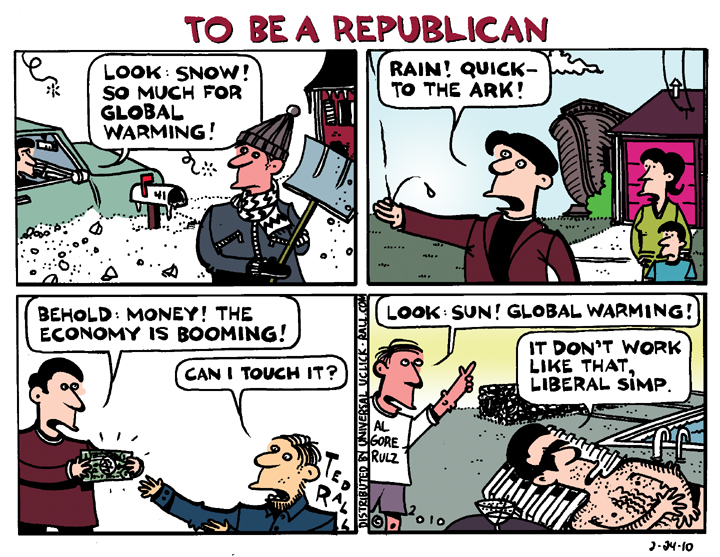
To Be a Republican

After a blizzard hit Washington, right-wing morons argued that it proved that climate change was a hoax. Why don’t they draw the opposite conclusion from a heat wave?

In The Year 2525

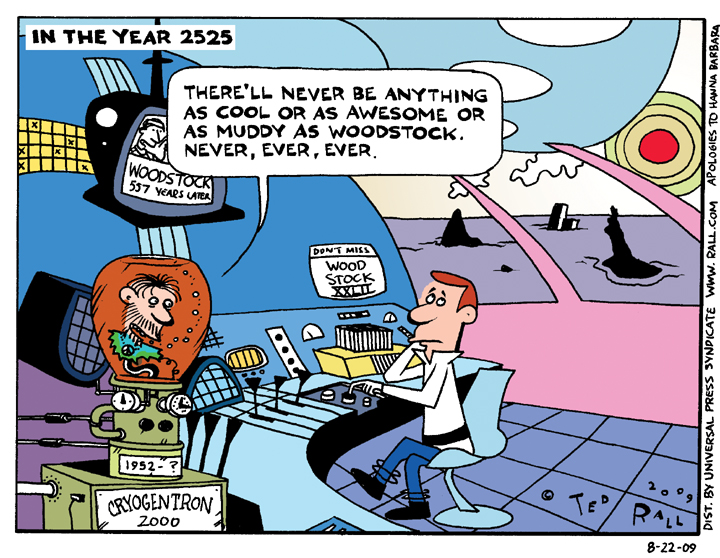
In the year 2525, as the old song goes, everyone will still be listening to endless droning on and on and on about how Woodstock and everything else Boomer was so super awesome that nothing else can or ever will approach it in its awesomeness. Which may very well be true, in which case, we REALLY don’t want to hear it anymore. For God’s sake, let us enjoy our pop culture lameness!

The Joys of Diminished Expectations

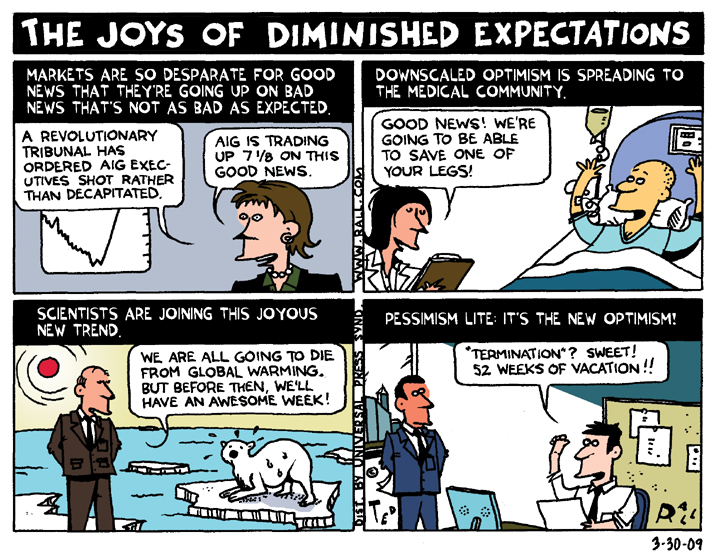
It’s true: financial markets are reacting favorably when bad news is less bad than previously forecast. If there’s a better indication of a country in despair, I don’t know what it is. We’re pathetic.

keyboard_arrow_up
css.php