SYNDICATED COLUMN: Why Isn’t Organ Donation Mandatory?

•

http://2.bp.blogspot.com/-4R_unkqDSqY/Th7AjZOQDfI/AAAAAAAAAcw/XuynXqZIEsI/s400/insidepix1.jpg


America’s Weird, Enduring Respect for Corpses

This week America’s news media obsessed over the shooting deaths of 12 people in Washington. The usual arguments over gun control seem irrelevant since there isn’t much that could have been done to prevent those particular killings. It was a navy base. Even in England, members of the military have access to automatic weapons. And even if we were inclined to start locking people up for hearing voices or feeling strange vibrations, we can’t build enough mental asylums to hold all of them.

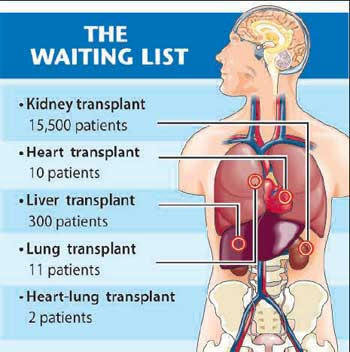
On the other hand, it is estimated that 18 people die every day due to a national shortage of organ donations. This crisis can be solved.

Don’t worry: this is not one of Those pieces calling for you to consider signing the donor section on the back of your driver’s license.

My solution is more radical. When you die, the government should take your organs.

The transplant shortage is acute. Some patients are so desperate that they travel on ethically-dubious “medical tourism” junkets to China, which implants organs from executed prisoners. Others accept D-rate organs. Patients at the University of Maryland recently accepted kidneys that had recently been operated upon for benign or malignant tumors. Better bad kidneys than none at all.

The waiting list system is widely viewed as arbitrary and unfair. In June 2013 a federal judge made news by issuing an order suspending rules that effectively blocked children under the age of 12 from receiving organs from adult donors. Several children who might have died without the procedure benefited. Unfortunately, the court’s ruling probably killed a similar number of adult patients. Like cash, life is a zero-sum game.

It is widely believed that celebrities and wealthy people, most notably Billy Martin in 1995 and Steve Jobs in 2009, are able to cut the line, moving themselves up the waiting list. Technically, this isn’t true. But practically, it is.

A major factor determining whether or not you will receive a new organ is whether you can afford the $500,000-plus cost of the procedure and its maintenance, or whether your insurance coverage is sufficiently expensive to cover it. Rich people can pay, poor people can’t. “There’s a huge triage involved in getting in,” Arthur Caplan, chair of the department of medical ethics at the University of Pennsylvania, told CNN. “If you’re a homeless alcoholic sleeping on the streets of L.A., and you’re going toe-to-toe with Steve Jobs, you’re going to lose.”

Where resources are scarce, politics get ugly. In 2012 the University of California at San Francisco kidney exchange was accused of denying a kidney to a man because of his status as an undocumented immigrant. A petition campaign changed UC officials’ minds.

This being America and anything more progressive than the collected works of Ronald Reagan being off the table, the mainstream media turns to free-market solutions: paying prospective donors, either while they are alive or after they die, for their kidneys, livers and other body parts that could be used to enhance or save someone’s life. In 2010 The Wall Street Journal published an essay urging that we adopt Iran’s approach, which guarantees a year of health care and a cash payment to donors. A June 2013 Slate piece by Sally Satel, “How to Fix the Organ Transplant Shortage,” called for “providing in-kind rewards — such as a down payment on a house, a contribution to a retirement fund, or lifetime health insurance” to donors.

These merchantilist suggestions have gotten traction. A 2012 poll found that 55% of Americans now believe that selling your organs ought to be legal.

And maybe they’re right. But it’s easy to imagine how the commodification of body parts could corrupt an already flawed system. Do we want to live in a nation where the unemployed resort to auctioning off pieces of themselves to stave off foreclosure?

There’s not much we can do to reduce demand for organs. So let’s focus on the supply side of the equation.

Efforts to guilt Americans into donating voluntarily are failing those 18 Americans a day. But not every healthy person who refuses to sign a donor card is heartless. I know because I’m one of them. I refuse to endorse a system that rewards the rich at the expense of the poor. If the system were more transparent, and treated everyone equally, there’d be more donors.

However, the system being what it is, that’s not going to happen.

Which brings us to the government’s role. I don’t understand why organ donation isn’t mandatory. Why isn’t every corpse harvested for all of its usable organs?

It isn’t a property-rights issue. You don’t own your corpse. Neither does your family. If it did, they could leave your body to rot in the backyard. Laws dictate how to properly dispose of a dead person.

There have been baby steps toward mandatory donation. In 2010 a New York assemblyman introduced a “presumed consent” bill that would have automatically enrolled all New Yorkers as organ donors unless they opted out (analogous to the federal “do not call” list for people who don’t want to get telephone solicitations). Two dozen other nations have similar laws. The bill failed.

If the government can save 18 people a day by harvesting every available organ, why doesn’t it pass a law making it so?

The blogger Stewart Lindsey expresses the most passionate, coherent and logical argument I can find against mandatory organ donation: “If I OPT to donate my liver, kidneys, heart or any other worthwhile organ at the time of my death, I will make that decision known. Don’t we have enough intrusion from the government into our personal lives already? If they can dictate whether or not you should be an organ donor, how much longer before they will be making the choices of where you can live, where you can work, go to church or school, who you can marry, what stores you can shop in and ultimately, how long should you be allowed to live, before your organs are no longer a viable option for harvesting!”

As a student of history, I am sympathetic to slippery slope arguments. And as I wrote above, I despise the way that the current health care system prioritizes wealthy Americans over the less fortunate. But when you boil it down, Lindsey’s argument is purely emotional. It’s my liver, and you can pry it out of my cold, dead carcass…or not.

Anyway, our top government officials don’t care about those concerns.

In the end, it comes down to the power of superstition.

When we die, we cease to exist in every way. Our bodies decompose. Only idiots believe in God, the Devil, Heaven, Hell, an afterlife. Whether your body is harvested for organs, eaten by cannibals, or minced to fertilize topsoil, you will never know the difference. Anyway, no major American religion teaches that what happens to your corpse affects your destiny in the hereafter.

Between our smart phones and amazing technology that allows our government to spy on our every digital moment, citizens of the United States of America feel that they live in an incredibly modern society. But not in our hearts, not in our souls, and certainly not in our brains.

About 2.5 million Americans die every year. Most are burned or planted in the ground, completely wasted. Vast numbers of them rot away, their bodies containing potentially life-saving organs, left intact — or embalmed — for only one reason: politicians are too cowardly to challenge the ancient idea that there is something sacred in a hunk of flesh.

(Ted Rall’s website is tedrall.com. Go there to join the Ted Rall Subscription Service and receive all of Ted’s cartoons and columns by email.)

COPYRIGHT 2013 TED RALL
This Cartoon is for Sale

•

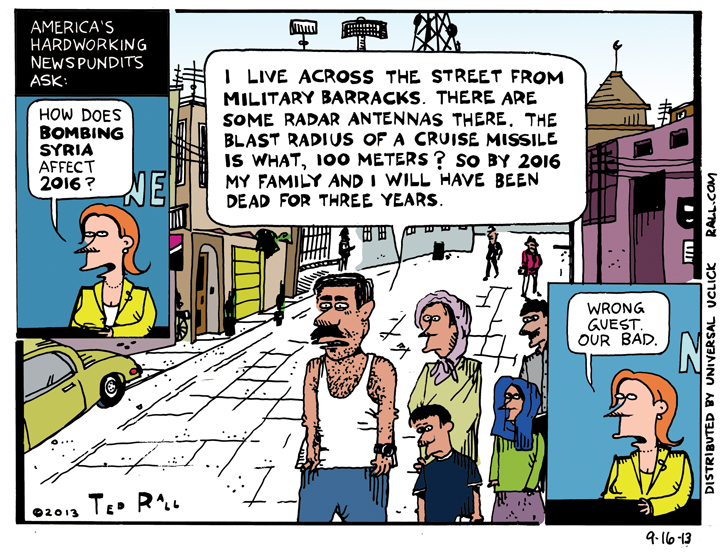
Three Years

I’m auctioning off the original artwork for this cartoon about Syria. Bid here.

Bear in mind, not only are cartoon originals a good way to support my work, they’re an excellent investment and they make great gifts (yes, I’ll dedicate it).

Cartoon Critique: Washington Massacre Edition

•

Almost as horrific as the actual deaths are the editorial cartoons that follow mass shootings. In a sane world, the shootings at the Washington Navy Yard would be a relatively apolitical affair; it isn’t surprising, after all, that a military installation has a combustible mix — unsteady personalities and lots of guns — that occasionally result in spasms of gun violence. Even a nation with strong control would leave guns in the hands of the military; even a country that did a better job tracking the mentally disabled wouldn’t put them into prison preemptively. But try telling that to the cartoonists:


Nick Anderson
Nick Anderson of The Houston Chronicle says that wow, there sure a lot of mass shootings in the United States. Which means that we know exactly as much, or as little, after reading this cartoon as we did before. Speaking of which, here’s Tony Auth of the Philadelphia Inquirer:
Tony Auth
So? And?
Steve Benson
Steve Benson of The Arizona Republic continues the reign of the obvious with the observation that Congress doesn’t plan to enact new gun legislation. Well, yeah, we knew that.
But what really gets me is schmaltz like this Steve Breen cartoon:
Steve Breen
Well, yeah, again. And guess what? It’ll happen in the future too. So? You might as well say the same thing about bad weather.
Mike Luckovich
Come on, does anyone really think the NRA is happy about mass shootings?
Jack Ohman
More obviousness. Yes, America has lots of guns. Sure does. Never mind, by the way, that the Washington shootings weren’t carried out using assault weapons. I’m betting Jack Ohman didn’t know that when this was drawn, but still.
Marshall Ramsey
Hey, did you know it’s sad when people die?

NSA Chief Designed “Star Trek Bridge” At Taxpayer Expense

•

Does anyone doubt that the NSA is so out of control that it should be shuttered? According to The Guardian, privacy-rapist-in-chief General Keith Alexander ordered architects to design him a lavish command center intentionally modeled after the captain’s bridge in “Star Trek.” Quoting a piece in Foreign Policy:

“When he was running the Army’s Intelligence and Security Command, Alexander brought many of his future allies down to Fort Belvoir for a tour of his base of operations, a facility known as the Information Dominance Center. It had been designed by a Hollywood set designer to mimic the bridge of the starship Enterprise from Star Trek, complete with chrome panels, computer stations, a huge TV monitor on the forward wall, and doors that made a ‘whoosh’ sound when they slid open and closed. Lawmakers and other important officials took turns sitting in a leather ‘captain’s chair’ in the center of the room and watched as Alexander, a lover of science-fiction movies, showed off his data tools on the big screen.

“‘Everybody wanted to sit in the chair at least once to pretend he was Jean-Luc Picard,’ says a retired officer in charge of VIP visits.”

Check this thing out:

DBI

DBI

The UN Charter Does Not Say What John Kerry Says It Does

•

Warmonger-cum-lately John Kerry says that, if President Assad refuses to comply with the chemical weapons deal, Chapter VII of the UN Charter allows cruise missile strikes to penalize his regime. In fact, it says nothing of the sort.

Article 41 of Chapter VII allows for sanctions, including economic and transport measures or the severing of diplomatic relations.

If the Security Council decides those measures are not strong enough then Article 42 states “it may take such action by air, sea, or land forces as may be necessary to maintain or restore international peace and security.

“Such action may include demonstrations, blockade, and other operations by air, sea, or land forces of members of the United Nations.”

Punitive military attacks are not authorized.

Bloomberg Bows Out

•

In an interesting sign of how far to the left New York City voters have moved after 12 years of Mayor Michael Bloomberg, the outgoing third term mayor is refusing to endorse his republican successor for fear that it would hobble his campaign among Liberal Democrats.

SYNDICATED COLUMN: We’re Not War Weary. We’re Suspicious.

•

http://www.williambowles.info/iraq/images/fallujah_phosph.jpg


Americans Aren’t “War Weary.” Obama is Just Lazy.

Americans, our pundit class has decided, aren’t going along with President Obama’s hard-on for firing cruise missiles into Syrian cities because they’re “war weary.”

Bullshit.

True, the wars have cost us. At 12 years and counting, the illegal and unjustified U.S. occupation of Afghanistan is America’s longest war. We’ve been in Iraq — following one of the most brazen acts of aggressive warfare in our blood-soaked history — for 10. Eight thousand American soldiers have gotten themselves killed; more than 50,000 have been wounded.  (To conform to the journalistic standards of U.S.-based opinion writing, I shan’t mention the hundreds of thousands of Afghans, Iraqis, Pakistanis, Yemenis, Somalis and so on slaughtered by U.S. invasion forces.)

As tragically wasteful as those casualties have been, the price we’ve paid has been low by historical standards. Roughly 700 U.S. combat deaths a year is a drop in the bucket compared to, say, Vietnam (6,000 a year), Korea (12,000) and World War II (100,000). Unlike those earlier conflicts, the post-9/11 war on terrorism has been a remote, irrelevant abstraction to most Americans.

“Our work is appreciated, of that I am certain,” General Mike Mullen, former chairman of the Joints Chief of Staff told members, told graduates at West Point. “But I fear [civilians] do not know us. I fear they do not comprehend the full weight of the burden we carry or the price we pay when we return from battle.” A 2011 Pew Research Center survey found that just a third of Americans aged 18 to 29 have a direct family member who has served in uniform since 9/11 — the lowest rate in memory.

About 2.2 million Americans have served in Afghanistan or Iraq — not much fewer than the 2.7 million who went to Vietnam. The difference is that today’s volunteer military is less broadly representative of American society.

A woman recently introduced me to her brother. “He just got back from Iraq,” she said. “Afghanistan,” he corrected her. His sister! “Thank you for your service,” a man walking told him, without waiting for a reply. The vet’s face hardened. Nobody gets it.

Civilians never did, not fully — but the disconnect was never this big.

“War-weary”? You must first notice something before you can get tired of it.

Until the Syria debate, antiwar liberals like New York Congressman Charles Rangel have been decrying the gap between civilians and the military. His proposed solution? Bring back the draft. Rangel and others reason that if more young people — not just poor, undereducated, underprivileged yokels from the sticks — had “skin in the game,” it would be harder for politicians to start one war after another. “A renewed draft will help bring a greater appreciation of the consequences of decisions to go to war,” Rangel argues. After Obama proposed bombing Syria, Rangel renewed his proposal.

The United States has been at war throughout 90% of its history. I am 50 years old, born a few months before the assassination of JFK; my only peacetime president has been Jimmy Carter. War-weary? Like Orwell’s Oceania, the United States of America is always at war. We love war. War is what America does best, war is what America does most.  War is 54% of the federal budget!

As noted above, there have been relatively few casualties in the wars against Afghanistan and Iraq. Because media coverage has been so sanitized and pro-military, these wars’ gruesome atrocities, the My Lais and napalm attacks — Mahmudiya, Panjwaii, white phosphorus that dissolved people in the battle of Fallujah — have barely been reported, so there have been few Vietnam-type images piped into our living rooms to elicit disgust or guilt. Even the fiscal effects have been deferred; the wars are officially off the books and thus aren’t tallied as part of the budget deficit.

Given how little the current wars have personally affected us, why would we be war-weary?

If Obama doesn’t get his war against Syria, he has no one to blame but himself.

The dude is just lazy.

Think of the list of American wars, just since 1990: the Gulf War, Serbia, Kosovo, Somalia, Afghanistan, Iraq, the drone wars in Pakistan and Yemen, Libya…it isn’t hard to con Americans into a war. Unlike Bush and his warmongering predecessors, however, Obama isn’t willing to do the propaganda work.

These things can’t be rushed. Bush spent a year and a half making his phony case to invade Iraq. Countless speeches, endless bullying, tons of twisted arguments and faked WMD reports.

Obama wanted to go to war four days after the chemical weapons attack outside Damascus. How many Americans were even aware of the story? Remember, this was late summer, peak vacation season. First you tear Americans away from the barbecue, then you get to barbecue the Syrians.

As has been widely noted, Obama’s messaging was all over the place, confusing a public programmed to digest its politics in bumpersticker-length slogans and talking points. Allowing yourself to be seen golfing right after calling for war hardly conveys the requisite sense of menace, much less the urgency of an imminent threat.

When JFK wanted the public to sign off on nuclear brinksmanship with the USSR, he went on television with spy plane photos of Cuba’s missiles. Despite considerable evidence that the rebels or a rogue officer were responsible, Obama says he has proof that the sarin gas attack was ordered by Syrian President Bashar Assad. Yet, unlike Kennedy, he won’t pony up the proof. Why not? As Russian President Vladimir Putin observes, that’s crazy fishy: “Claims that proof exists but is classified and cannot be shown are beneath criticism. If the U.S. says that the al-Assad regime is responsible for that attack and that they have proof, then let them submit it to the U.N. Security Council.”

Militarism is our thing, but Americans need to think their enemies threaten them directly before they’re cool with war.

Team Obama admits that Syria is not a direct or imminent danger to the U.S., but that we must attack them as a deterrent to other supposed future possible maybe enemies, namely Iran and North Korea. No dice. Only one in five Americans buys that. If Iran or North Korea is a threat, then attack those countries, not Syria.

Obama’s verbiage is telling: “I put it before Congress because I could not honestly claim that the threat posed by Assad’s use of chemical weapons on innocent civilians and women and children posed an imminent, direct threat to the United States.”

Could not honestly claim. As opposed to something like this: “Assad’s use of chemical weapons is not an imminent, direct threat, so we have time for a Congressional debate.”

Americans are good at reading between the lines. Another reason — not war-weariness — that Obama might not get his Syria war.

(Ted Rall’s website is tedrall.com. Go there to join the Ted Rall Subscription Service and receive all of Ted’s cartoons and columns by email.)

COPYRIGHT 2013 TED RALL

keyboard_arrow_up
css.php