SYNDICATED COLUMN: Fool Us Twice?

Can Obama Get Reelected?

Usually I don’t care about political horseraces. Yet I am fascinated by Obama’s reelection bid. Never mind what’s good for the country. I’m dying to hear him make his case for another four years.

I don’t pretend to be able to predict the future. But I have a rich imagination—and I still can’t begin to guess how the president can convince a majority of voters to choose him over the Republican nominee whether he be Mitt Romney or she be Michele Bachmann.

Obama is good with words. But what can he possibly say for himself after this first fiddling-while-Rome-burns term?

The president only has one major accomplishment to his credit: healthcare reform. However—assuming Republicans don’t repeal it—it doesn’t go into effect until 2014. Which, from Obama’s standpoint, actually helps him. After people find out how it transforms the First World’s worst healthcare system into something even crappier and more expensive, they’ll be burning him in effigy.

“Socialized” (if only!) healthcare has driven away the Reagan Democrat swing voters who formed half of Obama’s margin of victory in 2008. Unless the GOP nominates some total loon (hi Michele) or past-due retread (what up Newt) these ideological reeds in the wind will blow Republican.

The other major component of the Obama coalition, young and reenergized older liberals, see ObamaCare as a right-wing sellout to corporations. Nothing less than single-payer would have satisfied them. On other issues it seems that Obama has missed few opportunities to alienate the Democrats’ liberal base.

“The combination of Afghanistan and Libya could bring a bitter end to the romance between Democratic liberals and Obama,” Steve Chapman writes in Reason magazine. “Many of them were already disappointed with him for extending the Bush tax cuts, bailing out Wall Street, omitting a public option from the healthcare overhaul, offering to freeze domestic discretionary spending, and generally declining to go after Republicans hammer and tong.”

Chapman predicts a strong primary challenge to Obama’s left flank—someone like Russ Feingold.

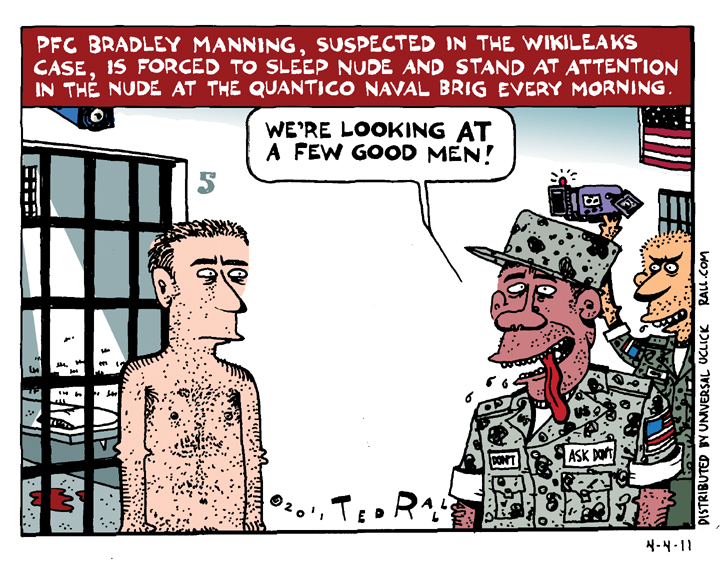
Lefties are also angry about Obama’s other lies and betrayals: keeping Gitmo open, signing off on assassinations and even the torture of U.S. soldiers (PFC Bradley Manning), redefining U.S. troops in Iraq as “support personnel.” Just this week he reneged on his promise to get rid of Bush’s kangaroo courts and put 9/11 suspects on trial.

Everyone—left, middle and right—is furious about his Herbert Hoover-like lack of concern over the economy. While the multimillionaire president blithely talks about a recovery as he heads off to golf with his wealthy friends, unemployment is rising and becoming structural. Obama will surely pay for the disconnect between reality (no jobs, shrinking paychecks, hidden inflation) and the rosy rhetoric coming out of the White House and U.S. state media.

What, exactly, will be Obama’s 2012 sales pitch? I seriously want to know. Think about it: how many other presidents have been so disappointing that they had to distribute lists of their accomplishments so their supporters would have talking points?

Among the highlights of one of these enumerations going around the Internet are:

“1. Ordered all federal agencies to undertake a study and make recommendations for ways to cut spending.

“5. Families of fallen soldiers have expenses covered to be on hand when the body arrives at Dover AFB.

“14. Removed restrictions on embryonic stem-cell research.”

I’m in favor of these things. (Although I’m not sure why, with real unemployment over 20 percent and the NSA rifling through my email, I should care about numbers 76—”appointment of first Latina to the Supreme Court”—or 86—”held first Seder in the White House.” Really?)

Will micro-mini-accomplishment lites be enough to pry liberal asses off the sofa on Election Day? I think not. On the Big Issues That Really Matter—war, the economy, civil liberties—Obama is a right-wing Republican. He’s only a Democrat on the little stuff. Liberals won’t turn out big for Obama in 2012.

That goes double for the youth vote, a big bloc for O in 2008. From student loan debt to unemployment (which hits Americans under 30 even harder than other age groups), Obama hasn’t delivered. They’ll sit on their hands.

“We’ve always known that lasting change wouldn’t come quickly or easily,” began Obama’s official campaign announcement.

“Always known”?

Remember those Soviet-style “Hope” and “Change” posters from ’08, presenting the skinny Columbia grad as a postmodern Messiah for a nation ravaged by eight years of Bush? Just guessing, but somehow I doubt Obama’s propaganda would have gone over as easily with the caption “Change That Won’t Come Quickly or Easily.”

“It begins with us,” will apparently be one of the slogans for Obama-Biden 2012.

That’s the problem Obama faces next year. In 2008 he told us it was going to begin with him.

(Ted Rall is the author of “The Anti-American Manifesto.” His website is tedrall.com.)

COPYRIGHT 2011 TED RALL
SYNDICATED COLUMN: Next: Digital Totalitarianism

The Conspiracy to Abolish Cash

For many years figures on the political fringe, especially on the right, have claimed that the government and its corporate owners want to transform us into a cashless society. Their warnings about the conspiracy against paper money fell on deaf ears, primarily because the digitalization of financial transactions seemed more like the result of organic business trends than the manifestation of some sinister conspiracy.

Now, however, those who want to do away with liquid currency are stepping out of the shadows. They talk about increased efficiency and profit potential, but their real agenda is nothing less than enslavement of the human race.

“Physical currency is a bulky, germ-smeared, carbon-intensive, expensive medium of exchange. Let’s dump it,” argued David Wolman in Wired.

Citing a 2002 study for the Organization for Economic Development that states “money’s destiny is to become digital, ” a Defense Department-affiliated economics professor has authored an Op/Ed for The New York Times that asks: “Why not eliminate the use of physical cash worldwide?” Jonathan Lipow urges President Obama to “push for an international agreement to eliminate the largest-denomination bills” and urges the replacement of bills and coins by “smart cards with biometric security features.”

Lipow’s justification for calling for the most radical change to the fundamental nature of commerce since industrialization is, of all things, fighting terrorism. “In a cashless economy, insurgents’ and terrorists’ electronic payments would generate audit trails that could be screened by data mining software; every payment and transfer would yield a treasure trove of information about their agents, their locations and their intentions,” Lipow writes. “This would pose similar challenges for criminals.”

Terrorism is a mere fig leaf. According to the annual “Patterns of Global Terrorism” report compiled by the U.S. State Department, the highest total death toll attributed to terrorism in the last 20 years occurred in—surprise—2001. Including 9/11, only 3,547 people were killed in 346 acts of violence worldwide. Tragic. Obviously. But, in the overall scheme of things, terrorism is not a big deal.

Measured in terms of loss of life and economic disruption, terrorism is a trivial problem, hardly worth mentioning. According to the UN, 36 million people die annually from hunger and malnutrition. Over half a million die in car wrecks—but you don’t hear people like Lipow demanding that we get rid of cars. A more legitimate concern is the “loss” of taxes upon the underground economy, estimated by the IMF at 15 percent of transactions in developed nations.

What the anti-cash movement really wants is digital totalitarianism: a dystopian nightmare in which the entire human race is enslaved by international corporations and their pet governments. An anti-establishment gadfly like WikiLeaks founder Julian Assange could be instantly deprived of money—and thus freedom of movement—with a couple of keystrokes. (We saw a preview of this when PayPal and Amazon shut down WikiLeaks donation mechanism and web server, respectively.) The high-tech hell depicted by the film “Enemy of the State” would become reality.

It is true that, in a society where every good and service has to be paid for with a debit or credit card, terrorist groups would find it much harder to operate. Don’t forget, however, that today’s terrorists often become tomorrow’s liberators. Anti-British terrorists George Washington and Thomas Jefferson wouldn’t have stood a chance if the Brits had been able to intercept wire transfers from France.

Decashification would establish digital totalitarianism, a form of corporo-government control so rigid, thorough and all-encompassing that by comparison it would make Hitler and Stalin look like easygoing surfer dudes. The abolition of unregulated financial transactions would freeze the political configuration of the world, making it impossible for opposition movements—much less revolutionary ones—to challenge the status quo.

A society without dissent has no hope. Even if we lived in a perfect world where everyone was ruled by wildly popular, benevolent, scrupulously honest regimes—ha!—eliminating the slightest possibility of opposition would lead to barbarism.

We’re already more than halfway to a cashless society. In the U.S. few young adults still use checks. In many countries debit and credit card transactions now exceed those made via cash and checks combined. In 2007 the chairman of Visa Europe predicted the abolition of cash by 2012. Obviously he was wrong. But that’s where we’re headed. The U.K. plans to abolish checking accounts by 2018.

Even if you love your government, don’t want it to change, and think political opponents belong in prison, you ought to worry. As things currently stand, we know the big banks can’t be trusted. Remember when they introduced ATM cards? Banks wanted us to use them so they could lay off tellers. Then they instituted “convenience fees.” Which they have raised, and raised, to the point that taking $20 out of an out-of-town ATM could cost you $5 in fees ($2 for their bank, $3 for yours).

Imagine what your life will look like under digital totalitarianism. Your pay is direct-deposited into your bank account. You’ll pay for small purchases with your cellphone; if you owe a few bucks to a friend you’ll be able to bump your phone against your friend’s to settle up. Nowadays, some corporations allow you to control when your bills get deducted; in the future they’ll demand that you authorize them to do it automatically. What if you have a disputed charge? They’ll already have your dollars, or work credits, or whatever they’ll call them. Good luck trying to get it back from the Indian call-center guy.

As corporate ownership becomes increasingly monopolized and intertwined, your overdue phone bill might be owned by the same outfit as your bank, which would simply take what it says you owe.

The law of unintended consequences is getting a serious workout thanks to digitalization. Motorists in New York were thrilled when the EZPass system allowed them to breeze past lines at toll bridges—at a discount, no less. Then divorce lawyers began subpoenaing EZPass records to prove that a spouse was cheating. Next police set up EZPass scanners on the bridges; if you pass two of them too fast, a speeding ticket is automatically generated. The next step is to eliminate cash lanes entirely; non-EZPass tag holders will soon have their license plates scanned and receive a bill by mail—plus a $2 to $3 “handling” fee.

Think there are too many fees now? If you think you can’t trust banks now, imagine how badly they’ll gouge you when they control every single commercial transaction down to the purchase of a pack of gum. Angry about taxes? When tax agencies can take the money out of your account without asking, they will. Unlike cash, that phone bump to pay your friend will be a trackable, data mineable, fully taxable commercial transaction.

As if the post-2008 economic collapse hadn’t proven that no one is looking out for We the People but ourselves—and then barely so—the digivangelists tell us not to worry, that Big Brother, Inc. will smooth out the rough patches on the road to techno-fascist domination. From Wolman in Wired: “Opponents used to argue that killing cash would hurt low-income workers—for instance, by eliminating cash tips. But a modest increase in the minimum wage would offset that loss; government savings from not printing money could go toward lower taxes for employers.” Sure. The same way banks passed on the savings they earned by replacing tellers with ATMs to their customers.

Americans are skipping into the digital inferno wearing a smile and relishing the smell of their own burning flesh. Countless friends and acquaintances pay all their bills online. “I’m all about using my checking account in place of cash and would love to be able to eliminate cash entirely from my life,” gushed PCWorld’s Tony Bradley recently.

“Give me convenience or give me death” was the title of an album by the punk band Dead Kennedys.

We’ll get both.

(Ted Rall is the author of “The Anti-American Manifesto.” His website is tedrall.com.)

COPYRIGHT 2010 TED RALL

SYNDICATED COLUMN: WikiLeaks: The Devils We Know

Cables Reveal Background of Pro-Dictator U.S. Policy

After the Soviet collapse in 1991 U.S. policy toward Central Asia was transparently cynical: support the dictators, screw the people.

As the U.S. stood by and watched, corrupt autocrats looted the former Soviet republics of Turkmenistan, Uzbekistan, Kazakhstan and Tajikistan. Dissidents were jailed, massacred—even boiled.

Well, actually, the U.S. was anything but passive. They negotiated deals for oil and gas pipelines. They rented airbases after 9/11. They poured in tens of millions of American tax dollars—all of which wound up in secret bank accounts belonging to the dictators and their families. Meanwhile, average citizens lived in abject poverty.

During trips to Central Asia the locals constantly ask me: “Why doesn’t America stop supporting [insert name of corrupt dictator here] so we can kill him and free ourselves?”

Poor, naïve people. They believe our rhetoric. They think we like democracy. Actually, we’re all about the looting. Dictators are easier to deal with than parliaments. One handshake and a kickback, that’s all you need with a dictator.

Central Asia only had one democratically elected president, Askar Akayev of Kyrgyzstan. George W. Bush ordered the CIA to depose him in a coup.

Americans who care about human rights have long wondered: Is the State Department stupid and/or naïve? Or did the diplomats in Tashkent and other capitals of unspeakable misery understand the brutal and vile nature of Central Asia’s authoritarian leaders?

An examination of the WikiLeaks data dump answers that question: Yes.

Hell yes.

Like those from concerning more prominent countries, the WikiLeaks cables on the Central Asian republics can be funny. President Gurbanguly Berdimuhamedov, a U.S. “ally in the war on terror” who seized power in a palace coup following the death of Saparmurat “Turkmenbashi” Niyazov, is described as “the ‘decider’ for the state of Turkmenistan.” This is true. Turkmenistan is an absolute dictatorship in which millions starve while Berdimuhamedov’s inner circle feasts on the profits from the world’s largest reserves of natural gas.

A December 2009 cable describes America’s pet autocrat as “vain, suspicious, guarded, strict, very conservative, a practiced liar, ‘a good actor,’ and vindictive.”

According to an unnamed source, the outwardly conservative dictator has a Russian mistress named Marina, with whom he has a 14-year-old daughter. Though Berdy’s power may be limitless, his intellect is not. “Berdimuhamedov does not like people who are smarter than he is,” says the cable. “Since he’s not a very bright guy, our source offered, he is suspicious of a lot of people.”

No one’s perfect. Least of all America’s allies in Central Asia.

On the other side of the steppe in Kazakhstan, President Nursultan Nazarbayev presides over the world’s largest oil reserves with an iron fist. Among his greatest hits: the convenient “suicides” of his top two political opponents a few months before a presidential “election.” The two men apparently shot themselves in the back of the head, then bound their own hands behind their backs and dropped into a ditch outside Almaty.

Needless to say, Nazarbayev is another valuable U.S. ally in the war on terror.

But that doesn’t stop American gossip. Nazarbayev’s defense minister, says an embassy staffer in Astana, “appears to enjoy loosening up in the tried and true ‘homo sovieticus’ style—i.e., drinking oneself into a stupor.” But alcoholism isn’t illegal. Graft is—and the president is public enemy number one.

“In 2007, President Nazarbayev’s son-in-law, Timur Kulibayev, celebrated his 41st birthday in grand style,” explains an April 2008 cable. “At a small venue in Almaty, he hosted a private concert with some of Russia’s biggest pop stars. The headliner, however, was Elton John, to whom he reportedly paid one million pounds for this one-time appearance.” How did he come up with all that coin? “Timur Kulibayev is currently the favored presidential son-in-law, on the Forbes 500 list of billionaires (as is his wife separately), and the ultimate controller of 90% of the economy of Kazakhstan,” states a January 2010 missive.

Membership has its privileges. The U.S. has never spoken out against corruption or human rights abuses in Kazakhstan.

So it’s clear: American diplomats have no illusions about their brutal allies. Interestingly, Central Asia’s overlords have a dismally accurate view of corruption in the U.S. government.

“Listen, almost everyone at the top [of the Kazakh regime] is confused,” First Vice President Maksat Idenov told the U.S. ambassador to Kazakhstan early this year. “They’re confused by the corrupt excesses of capitalism. ‘If Goldman Sachs executives can make $50 million a year and then run America’s economy in Washington, what’s so different about what we do?’ they ask.”

No response was provided.

(Ted Rall is the author of “The Anti-American Manifesto.” His website is tedrall.com.)

COPYRIGHT 2010 TED RALL

keyboard_arrow_up
css.php