
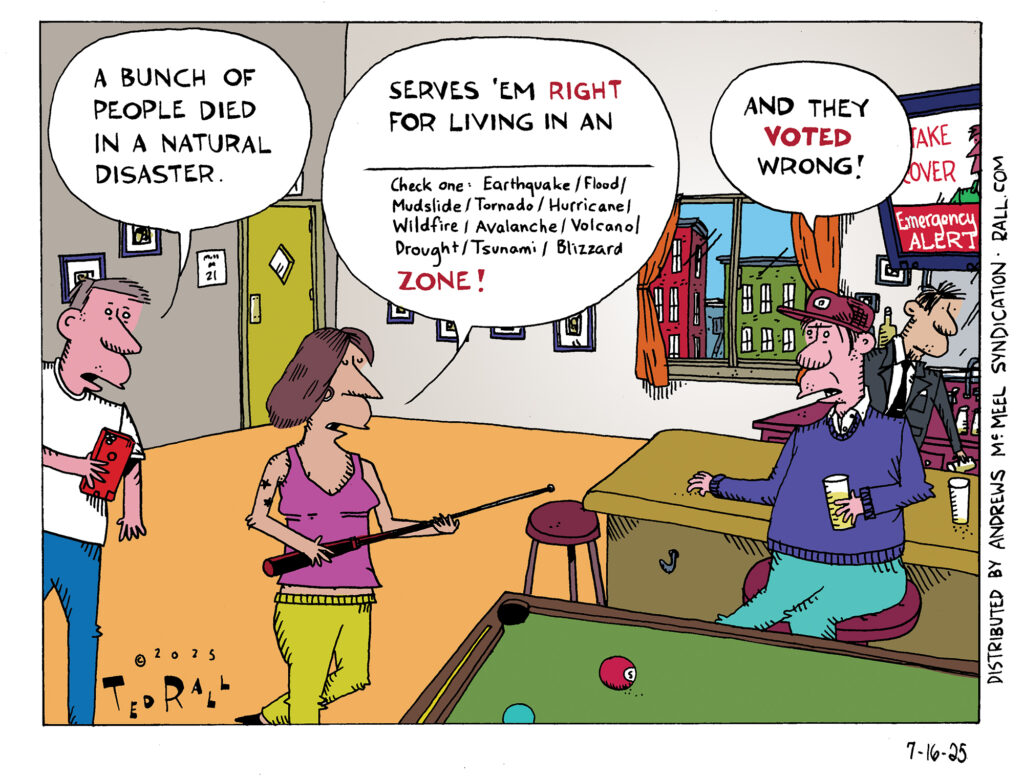
Wrong-Voting Disaster Victims

After massive floods killed more than 100 people in Texas Hill Country, some coastal progressives blamed the victims, assuming most were Trump-supporting Republicans who voted against climate change legislation and warning systems that might have reduced the death toll. Similarly, when Californians die in mudslides or earthquakes, victims are often blamed for choosing to live in such areas. Aside from being insensitive and cruel, this rhetoric is inaccurate; surely some of the flood victims in Texas were Democrats.
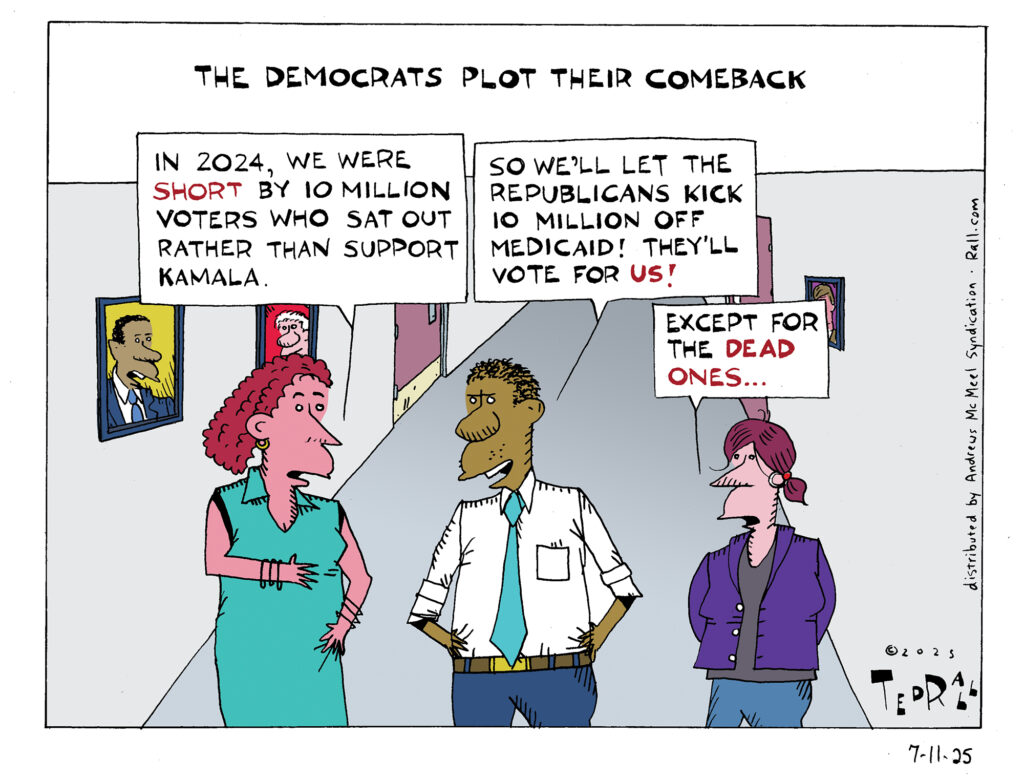
A Tax Cut a Day Keeps the Doctor Away

The Republicans’ Big Beautiful Bill Act will cause at least 10 million Americans to lose their healthcare coverage due to sweeping budget cuts to slash taxes for corporations and wealthy individuals. That’s very close to the number of 2020 Biden voters who refused to turn out for Kamala Harris in 2024. Would they turn out for a Democrat in 2028 to express their displeasure? Not if the loss of healthcare has the desired effect.

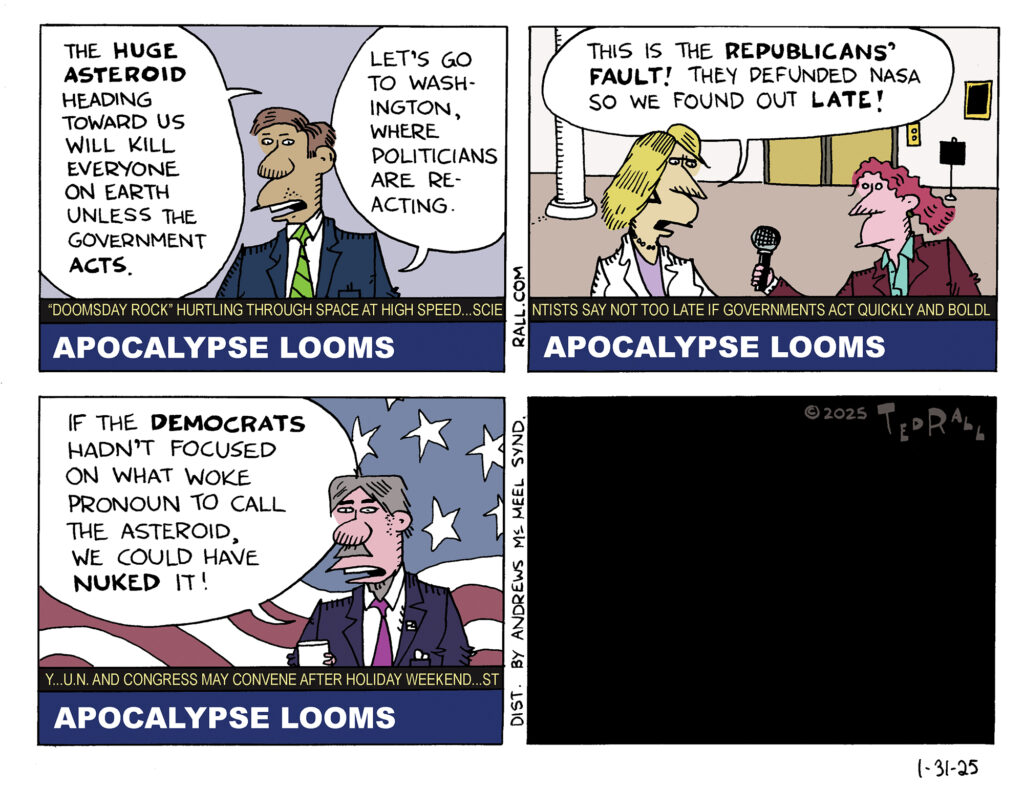
Apocalypse Looms. Who’s To Blame?

Perhaps, some day, politicians won’t waste the time they ought to be spending working to fix a problem on blaming one another for who was responsible. But that day is not today.

Democrats Want a Divorce

          When a marriage is in crisis, a point often occurs when constant bickering, arguing and fighting yields to detachment and hopelessness. The yelling stops. It’s quiet.

But it’s not peace. Exhausted, dispirited and contemptuous, one or both partners give up trying to convince the other that they’re wrong or ought to change. They accept that improvement is highly unlikely and check out emotionally.

Some psychologists call this uneasy calm a “silent divorce.” Dr. Ridha Rouabhia describes a silent divorce as “a state of being legally married but emotionally disconnected from one another, thus carrying within it a relational breakdown that is very often imperceptible but deeply damaging.” By the time you and your spouse are fighting your own personal cold war, odds of divorce are high.

Couples who fall in love and dedicate themselves to long-term committed relationships tend to fit into one of two categories. There are the soulmates who share important values and personality traits. Then there are the complementary types, a.k.a. “opposites attract,” where—hopefully—one partner’s strengths make up for the other’s weaknesses and vice versa.

Complementary couples can have successful marriages. But these relationships work only if each partner appreciates their partner’s contributions and is cognizant as well as grateful that their own failings are generously overlooked. As time builds familiarity and familiarity breeds contempt over the course of a lifetime, that can be challenging.

Years ago, I was close to a classic complementary couple. The wife, whom I met in college, was married to a man ten years older than her. A tight-cropped salt-and-brunet WASP from the Midwest, he was politically and temperamentally conservative, preppy and stuffy. A fluffy-blonde Buddhist-come-lately from the West Coast, she leaned left and was loud, bubbly and unfiltered. Everyone who met them instantly understood their mutual attraction. Wild, sexual and adventurous, my friend dragged her uptight husband out of his shell. She made his life fun and interesting. Organized and always planning for contingencies, he bailed her out and cleaned up her frequent messes. He made her feel safe. They were a cute couple.

Over the years, the mutual gratitude that drove my friends’ Lucy-and-Ricardo marriage ceded territory to sneering contempt. She got tired, and then angry, at always having to initiate sex. He grew weary of the drama from her never-ending series of crises. They fought. Then, they didn’t. They had fought to a stalemate.

Their “silent divorce” lasted a few years before giving way to the real thing.

Everyone thought it was a shame.

They needed one another.

The American political union between partisans of the two major parties is a complementary marriage. Though frequently fractious, for much of the 20th century there was a tacit understanding between Democrats and Republicans that each brought something to the union, to the country, that the other needed even if they weren’t good at verbalizing their appreciation.

Like my friend’s husband, Republicans were America’s stolid, responsible, national caretakers. Based in the countryside (and until recently in the boardroom), they were boring and hated the hippies and their rock ’n’ roll and never would have supported civil rights and other liberation movements had they not been forced upon them. But conservatives also provided and protected virtues like military strength, national pride and deficit hawkishness that, deep in their pot- and LSD-infused souls, many liberals knew were essential to the republic.

And my friend’s wild-and-loopy wife, Democrats were reckless tax-and-spenders who hung out on the coasts and in big cities and tried and failed at social engineering schemes like welfare and affirmative action. But some of those schemes, like Social Security and Medicaid, saved the country, and drove almost all the progress that improved people’s lives and thus staved off revolution. Though they didn’t like to admit it, Republicans knew in their stock-portfolios-for-hearts that liberalism saved them from their rapacious selves and forced them to admit when their wars didn’t work out.

The national marriage started to unravel under Reagan, enjoyed a rapprochement under Clinton and turned ugly under Obama. As with any failed romance, it’s hard to pinpoint a specific moment that marked the beginning of the end. I’d pick 2010, when Senate Minority Leader Mitch McConnell said that “The single most important thing we want to achieve is for President Obama to be a one-term president.” McConnell’s idea of trying to win back the White House wasn’t wild. His formulation, emboldened by the rise of the proto-MAGA Tea Party, was remarkably contemptuous of Democrats. As an opposition party, the GOP was expected to articulate its own set of policies while paying lip service to its willingness to work with the president on issues where the two parties had common ground, rather than center its messaging around pigheaded obstructionism.

            Republicans, having failed to prevent Obama’s reelection in 2012, doubled down in 2014 when McConnell pledged not only to block Democratic initiatives just because, but to threaten to shut down the federal government every time the other party tried to push through a bill.

            Now everything is going their way. White House, Congress, Supreme Court, big tech and a compliant news media—Trump and the Republicans control it all. There was scarcely an echo of the riotous protests in response to Trump’s first inaugural in 2017 in the streets of Washington for the second one last week. Democratic leaders and their allies are despondent, disorganized and silent. “Far from rising up in outrage, the opposition party’s lawmakers have taken a muted wait-and-see approach,” reports The New York Times. Liberals are actively tuning out of politics, canceling their subscriptions and turning off MSNBC, televised organ of the DNC.

            After sounding Defcon-4 at volume 11 every time Trump issued an obnoxious tweet during his first term, incessantly shrieking about the January 6th Capitol riot, unleashing ferocious partisan legal warfare against him and hysterically characterizing a Trumpian restoration as an existential threat to democracy that would bring about real and actual fascism, the post-electoral silence of the liberal lambs is deafening.

            You may feel good about all this, if you’re a Republican.

            Don’t. As the Tacitus quote currently circulating in response to Israel’s flattening of Gaza goes: “They make a desert and call it peace.” The sounds you’re not hearing—leftists marching and chanting down the block, liberals bleating in the comments section, Democratic politicians hollering about Trump’s unprecedented awfulness—are not acquiescence, much less acceptance. They are the disgust of silent divorce.

            Democratic voters (of whom I am not one, I am to their Left) have given up on the Republicans with whom they share a country. Democrats still live under the same roof as their Republican spouses—for the time being, there’s no way for them to move out—but their anger has devolved into a cold contempt from which there is rarely any way back. Those people—Republicans—can stay in their Electoral College-inflated flyover states and watch Fox and NASCAR and vote however they want, including against abortion, and we (the smart people) will keep to ourselves in our urban enclaves. They’re not worth yelling at.

            They’re not even worth talking to.

            This marriage is in trouble.

(Ted Rall (Twitter: @tedrall), the political cartoonist, columnist and graphic novelist, co-hosts the left-vs-right DMZ America podcast with fellow cartoonist Scott Stantis and The TMI Show with political analyst Manila Chan. His latest book, brand-new right now, is the graphic novel 2024: Revisited.)

Theory of the Non-Voter

           Non-voters are the biggest (potential) voting bloc in American politics. In midterm, state and local elections, more eligible voters choose not to exercise their franchise than to do so.

            Pundits and political sociologists ignore non-voters. Nobody polls them. Nobody asks them why they don’t vote. Nobody asks them what issues they care about. Nobody asks them what it would take to get them to vote, or who they would vote for if they did. Whether this lack of interest in non-voters is due to a lack of imagination or contempt based on the belief that they are lazy and apathetic, the result is that we don’t know much about the political leanings and motivations (or lack thereof) of the majority of our fellow citizens. There are tens of millions of them. They are an untapped resource and, until recently, there has been little attempt to reach out to them.

            Democratic Party strategists largely assume that there is little point dedicating precious campaign resources to an attempt to lure non-voters to the polls. From Bill Clinton in 1992 to Kamala Harris in 2024, the party has been primarily focused on trying to appeal to swing voters and moderate Republicans, even though there don’t seem to be very many of them.

            Donald Trump’s first win disproved the hypothesis that you can’t get the third or more of eligible citizens who normally sit out presidential elections to come to the polls. 15% of the people who cast a ballot in November 2016 were first-time voters, up from 9% in 2012. True, Donald Trump’s coalition included people who vote Republican no matter what as well as traditional conservatives. But the key to his takeover of the GOP was his ability to motivate people who previously weren’t even registered to vote.

            The 2016 election also highlighted the political impact of non-voting. Non-voters skewed Democratic, accounting for 55% as opposed to 41% for Republicans. Hillary Clinton lost because she wasn’t able to motivate enough of her own party’s supporters.

            The cliché of the non-voter is that they are politically disengaged. If that is true, it falls short of painting the full picture. 3.5% of those who voted for Bernie Sanders in the 2016 primaries sat out the general election; they were more than enough to cost Clinton the race. But primary voters are far more engaged than general election voters. They didn’t forget to vote for Hillary. They made an active choice to be passive because they disliked both major-party candidates.

            Non-voters were even more powerful this year. An astonishing 19 million Americans who voted for Joe Biden in 2020 considered the choice between Kamala Harris and Donald Trump and picked the couch.

She lost by 2.3 million votes.

            These 19 million people were registered to vote. We know that they know how to vote; they did it four years ago in the middle of a pandemic. And we know that they voted Democratic! More states have early voting and mail-in ballots, so it was easier to vote in 2024. Logically, a more appealing Democrat than Kamala Harris might have received their support.

            A full picture of American public opinion would include numerous thorough studies and surveys of people who sometimes vote and sit out elections at other times (this year’s Trump campaign reached out to these “irregular” and “low propensity” voters), those who never vote but are registered to vote, and those who are not registered. But the biggest factor here is obviously the defining characteristic of U.S. electoral politics: the two-party system. Democracies with two-party systems tend to have lower voter turnout than parliamentary democracies where multiple parties representing a wide range of ideological orientations are viable and active participants. The increasing percentage of Americans who self-identify as “independent” means that it is constantly less likely that a voter will agree with one of the two candidates of two polarized parties.

            In a two-party system like ours, a voter who doesn’t much care for either candidate has three choices. They can suck it up and choose “the lesser evil,” vote for a third-party candidate who almost certainly doesn’t stand a chance, or sit out the election.

A significant subset of the first category is the negative message voter, who casts a ballot for the challenger in order to indicate their displeasure with the incumbent. With only two parties to choose from, these voters flail back-and-forth. Since a vote is a vote and doesn’t come with a footnote attached to it, neither the parties nor the news media ever receives the message. As more voters realize the futility of rage and spite voting, there is a general trend toward not voting at all.

            Because they are oblivious to the left-leaning voters they are failing to motivate, Democrats have more to worry about in the short term. In the long run, however, the realization that non-voters are making an active choice not to bother with the political system is a major warning that the whole system may not be viable for much longer.

(Ted Rall (Twitter: @tedrall), the political cartoonist, columnist and graphic novelist, co-hosts the left-vs-right DMZ America podcast with fellow cartoonist Scott Stantis and The TMI Show with political analyst Manila Chan. His latest book, brand-new right now, is the graphic novel 2024: Revisited.)

TMI Show Ep 43: “Trump vs. Fiscal Hawks”

Trump 2.0 is still a month away and he’s causing chaos in Washington. After negotiating a budget deal with the Democrats, DOGE master Elon Musk (either acting alone or with Donald Trump’s backing) spazz-tweeted the deal away, spooking frightened House Republicans into reneging. Then, with Speaker Mike Johnson’s head on the chopping block, Republicans attempted to cut a new deal but Democrats refused to renegotiate. In the end, deficit hawk Republicans voted with Democrats to turn down the Trump deal because it would have abolished the debt limit for at least two years. Another government shutdown looms, mainly because there are two Republican Parties.

The TMI Show’s Ted Rall and Robby West (filling in for Manila Chan) are joined by Chicago Tribune cartoonist Scott Stantis to unravel the madness.

DMZ America Podcast Ep 185: Political Potpourri

As the Biden era yields to the second rise of Trumpism, the transition to What Happens Next is continuing with a sense of purpose as well as foreboding. Editorial cartoonists Ted Rall (from the Left) and Scott Stantis (from the Right) analyze the mood of the country, handicap Kamala Harris’ next moves and try to figure out where the Democrats go from here. Joe Biden, perhaps not strangely, has vanished from the political scene entirely. Meanwhile, victorious Republicans appear to have little standing in their way to impose their radical MAGA agenda on just about every major policy question you can think of. 


DMZ America Podcast Ep 174: Before Trump, There Was Grover Cleveland

DMZ America co-hosts Ted Rall (from the Left) and Scott Stantis (from the Right) look back at the only other president in history who returned to the White House after having served and then been defeated: Grover Cleveland, the 22nd and 24th Presidents the United States who served 1885-1889 and 1893-1897.

Cleveland was a Democrat renowned for honesty and probity, but otherwise there are some remarkable parallels between Cleveland and Donald Trump. Both were portly, had healthy libidos and a predilection for age-inappropriate wives, were skeptical of military imperialism and favored pro-business policies that prompted a reaction by labor. Listen to these two history buff’s take on a 19th century leader we’ll all be hearing more about in the years to come.

Listen to the Audio Version:

Watch the Video Version:

N.B.: There were significant tech issues in this video feed, mainly Ted’s face freezing. We think we have it fixed for the next time.


The TMI Show Ep 15: A Trump Insider Speaks

As the political world reels from Trump’s come-from-behind victory in the presidential race, The TMI Show’s Ted Rall and Manila Chan reach out to an old friend and colleague who has had a front-row seat at MAGA world and the Trump campaign to gain insights into the ups and downs of this wild campaign year.

Joining us is Angie Wong, a graduate of Columbia University’s Graduate School of Journalism. After a successful career as a news editor, reporter and columnist in the U.S. and Asia for publications such as South China Morning Post, Reuters, NY Times and WSJ; she pivoted to politics, working on numerous political races at the local and federal level.

Tomorrow: one of the nation’s top editorial cartoonists will join us to look at things from the Democratic side.

Keywords: Angie Wong, 2024 campaign, MAGA, Florida, Republicans, Trump, GOP, 2024 election

keyboard_arrow_up
css.php