
Pro-Israel “hasbara” internet warriors frequently regurgitate the same arguments to defend that country’s actions against the people of Gaza and the West Bank: there was never such a country as Palestine—not that Palestinians ever claimed that there was. Israel is merely defending itself. And so on. Chillingly, these are all arguments that have close analogies to those used by Nazi Germany during World War II to justify the Holocaust against the Jews.
The Arguments Are Timeless
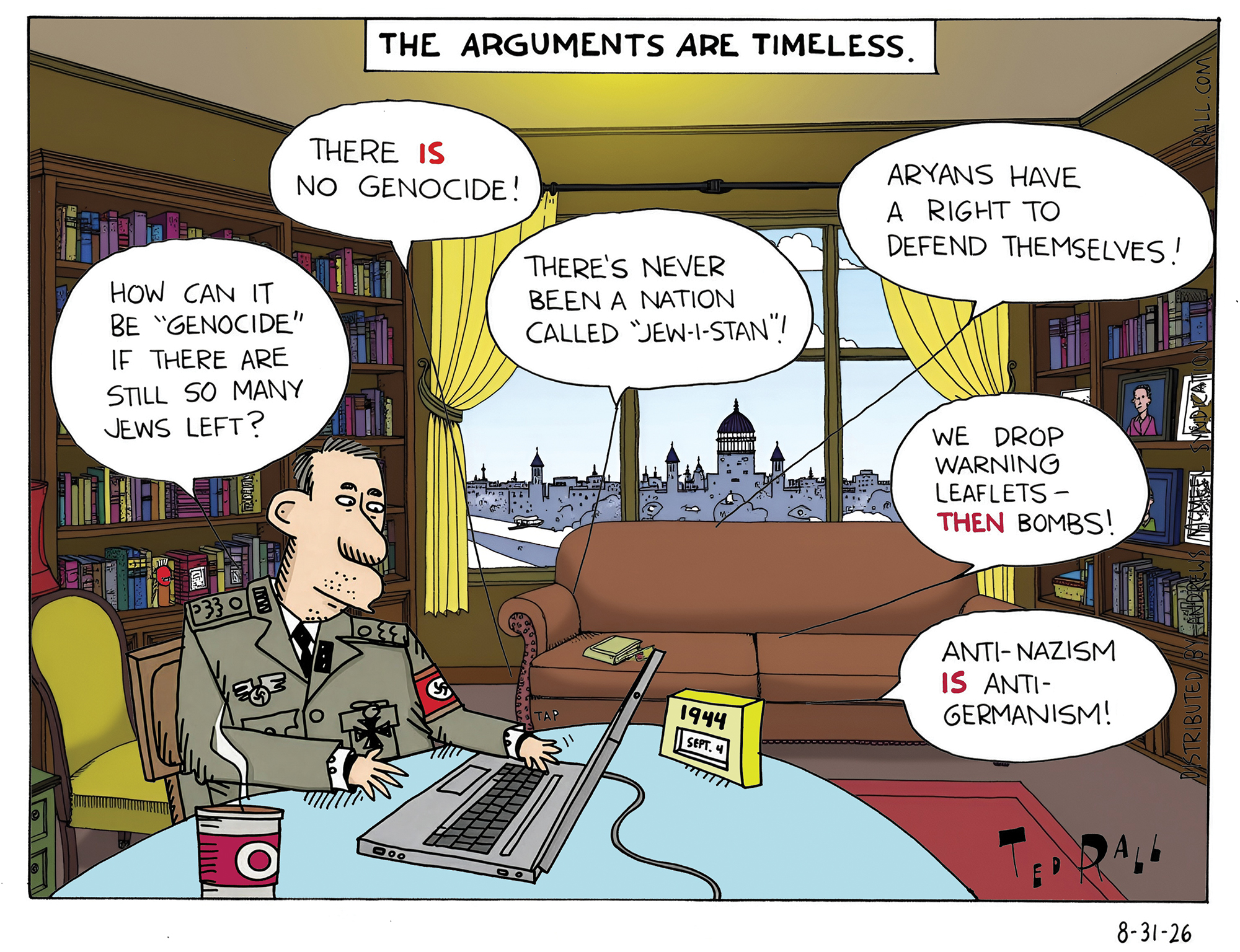

Ted Rall
Ted Rall is a syndicated political cartoonist for Andrews McMeel Syndication and WhoWhatWhy.org and Counterpoint. He is a contributor to Centerclip and co-host of "The TMI Show" talk show. He is a graphic novelist and author of many books of art and prose, and an occasional war correspondent. He is, recently, the author of the graphic novel "2024: Revisited."

6 Comments. Leave new
Also need to draw the line at kites
If that’s the propaganda being dropped by Hasbara then they are not actually pro-Israel, they are pro-Netanyahu and his policies. At the risk of going “both siderism”: those who claim to be pro-Gaza but are advocating for offensive military solutions are not actually pro-Gaza. What would be pro-Israel and pro-Gaza is working out a peace plan that involves physical and economic security for all of them.
Those who are militants benefit when we believe that they represent whom they claim to represent; don’t give it to them!
It is beyond “both-siderism” to suggest the issue of state of Israel genocide against Palestinians is limited only to Netanyahu policy.
It is and has been Zionist policy before and throughout the occupation of Palestine by European colonists.
Said policy is proudly hyper-supported by both major US political parties and lecturing about the naughtiness of militant resistance to genocide is rather a foundational pillar of the cosmic hypocrisy of the Empire of Forever War.
For illustration, below is an AI-generated list of US “interventions,” with (surely underestimated) casualty numbers, around the globe since WWII. It therefore does not include such lowlights as the late 1898 official birth of the US empire in the Philippines war nor, of course, the 300-year domestic genocide of American native peoples.
But before we begin, here is a bit of a warm up: the estimated ANNUAL death toll of economic sanctions imposed by the US and the EU on the rest of the world from 1971 to 2021 is on the order of 560,000 persons. This extrapolates to 31 million deaths from 1971 to present. Citation: The Lancet Global Health @ https://tinyurl.com/44ax5v9v
———————-
Country or theater Period U.S. role Approximate deaths associated with conflict or repression
China 1946–49 Supported the Nationalist government with troops, weapons, and advisers during the civil war Hundreds of thousands to several million
Greece 1947–49 Armed and directed counterinsurgency against the communist-led resistance Roughly 喧 80,000–150,000
Philippines 1946–54 Covert support and military assistance to the government against the Huk rebellion Tens of thousands
Korea 1950–53 Direct war alongside South Korea and large-scale bombing Roughly 2.5–4 million
Iran 1953 CIA-backed coup overthrowing Prime Minister Mohammad Mosaddegh Immediate deaths limited; later repression under the Shah caused thousands or more
Guatemala 1954–96 CIA-backed coup against Jacobo Árbenz; subsequent military regimes received U.S. support About 200,000 killed or disappeared
Vietnam 1954–75 Supported South Vietnam and later conducted a major air, naval, and ground war Roughly 2–3.5 million
Laos 1959–75 CIA proxy war, covert ground operations, and extensive bombing At least 100,000; broader estimates reach 200,000 or more
Congo/Zaire 1960s onward Supported the overthrow and assassination of Patrice Lumumba; backed Mobutu’s dictatorship Political killings and war deaths ranging from tens of thousands to hundreds of thousands
Cuba 1961 onward Bay of Pigs invasion, assassination plots, covert operations, and economic warfare Bay of Pigs: roughly 4,000–5,000 total deaths; later effects and repression are contested
Ecuador 1963 Supported the military overthrow of President Carlos Julio Arosemena’s government Deaths from the coup and subsequent repression: hundreds to thousands
Brazil 1964–85 Supported the military coup against João Goulart and the ensuing dictatorship At least hundreds killed or disappeared; tens of thousands imprisoned or tortured
Indonesia 1958–61; 1965–66 Supported Permesta rebels and then backed the army’s destruction of the PKI and Sukarno’s removal Common estimate: 500,000–1 million; some estimates reach 2–3 million
Dominican Republic 1965–66 Direct invasion to prevent the restoration of the elected constitutional government Roughly 3,000–4,000 deaths
Cambodia 1969–75 Supported Lon Nol after the 1970 coup; massive bombing and military operations U.S. bombing: tens of thousands to several hundred thousand; entire civil-war period: roughly 600,000–1 million, followed by Khmer Rouge deaths
Ghana 1966 CIA-linked support for the coup against Kwame Nkrumah Immediate deaths limited; later political violence caused additional casualties
Oman 1950s–70s Supported the sultanate’s counterinsurgency, including aid and coordination with regional forces Thousands to tens of thousands
Chile 1970–90 Covert destabilization before the 1973 coup; support for the Pinochet regime afterward About 3,000 killed or disappeared; tens of thousands tortured or imprisoned
East Timor 1975–99 Diplomatic, military, and weapons support for Indonesia’s invasion and occupation Roughly 100,000–200,000 deaths, mainly from war, famine, and forced displacement
Angola 1975–2002 Supported UNITA and anti-MPLA forces during the civil war Roughly 500,000–1 million
Lebanon 1958; 1982–84 Military deployments and support for Lebanese and Israeli operations Thousands to tens of thousands, depending on the period counted
El Salvador 1979–92 Armed, trained, and funded the government and security forces About 75,000 killed or disappeared
Nicaragua 1981–90 CIA-directed Contra war, mining of harbors, and economic pressure Roughly 30,000–50,000
Libya 1981; 1986; 2011 onward Air and naval attacks in 1986; NATO intervention that helped overthrow Muammar Qaddafi in 2011 1986: hundreds; 2011 war: roughly 10,000–30,000 or more
Iran 1980; 1987–88 Failed hostage-rescue operation; naval combat and attacks during the Iran–Iraq War Hundreds directly; USS Vincennes shot down Iran Air Flight 655, killing 290
Grenada 1983 Direct invasion and regime change About 100–200 deaths
Panama 1989–90 Direct invasion and overthrow of Manuel Noriega Officially several hundred; independent estimates roughly 1,000–4,000
Iraq 1990–2003 Gulf War, prolonged bombing, sanctions, and enforcement operations Gulf War: tens of thousands; sanctions-related deaths are disputed, with estimates ranging from tens of thousands to hundreds of thousands
Somalia 1992–95; 2007 onward Direct intervention, airstrikes, drone attacks, and support for successive governments 1992–95: thousands to tens of thousands; later war: tens of thousands or more
Haiti 1994–95; 2004 onward Intervention to restore Aristide in 1994; later support for his removal and successor governments Thousands across coups, repression, and political violence
Yugoslavia/Kosovo 1990s NATO air war and support for post-Yugoslav interventions Bosnia-wide war: roughly 100,000; Kosovo: roughly 10,000–13,000; NATO bombing: about 500–2,500 deaths
Afghanistan 1979–92; 2001–21 CIA support for the mujahideen during the Soviet war; direct invasion and occupation after 2001 Soviet-war period: roughly 1–2 million; post-2001 war: roughly 170,000–250,000 direct violent deaths, plus indirect deaths
Pakistan 2001 onward Drone campaign, special operations, and support for Pakistani military operations Several thousand direct drone-war deaths; wider conflict killed tens of thousands
Yemen 2002 onward Drone strikes, special operations, and support for the Saudi-led intervention U.S. strikes: hundreds to several thousand; wider war: hundreds of thousands, including indirect deaths
Iraq 2003–11; 2014 onward Invasion, occupation, counterinsurgency, airstrikes, and support for Iraqi and Kurdish forces Post-2003 estimates range from roughly 200,000 to over 1 million deaths, depending on methodology
Syria 2014 onward Airstrikes, special forces, and support for opposition and Kurdish-led forces U.S.-led campaign: thousands of civilian deaths according to independent monitors; wider war: hundreds of thousands
Libya 2011 onward NATO intervention and political support for regime change The 2011 intervention helped trigger prolonged civil war; total later deaths are in the tens of thousands
Israel/Palestine 1948 onward, especially 2023–present Large-scale military aid, diplomatic support, weapons transfers, and political protection for Israel Palestinian deaths over the entire conflict number in the many tens of thousands; the post-October 2023 war has produced very large civilian casualties, with totals changing over time
Ukraine 2014 onward Military aid, intelligence, training, and financial support for Ukraine This is a U.S.-backed war rather than a U.S. invasion; total Ukrainian and Russian military and civilian deaths are in the hundreds of thousands
Yes, for a long, long time there have been people who think the military approach is best in this region. My point is only that there are many in Israel, in the United States, in Gaza, in Iran, etc. who can see that this approach falls short. We want to work with these people rather than push them towards their militant leaders. Besmirching whole countries because of their militant actions is giving in to the false belief that all people of those countries are backing the militants.
Apparently you didn’t even bother to check the countries on the list. That is essentially the entire world, NOT a region. The only “military approach” is that of the US. Your espousing the blatantly false theory that ALL the countries on the list did something worse than merely refusing to meekly accept US domination and control.
> The only “military approach” is that of the US.
But I am of the US and it is not my approach. Instead of dividing up the world by nations, let’s divide us up by (1) those who think the best approach to international tensions is violence vs. (2) those who think that dialog is more effective. Then we can drive the goals of Group #2 and block the tactics of Group #1.
If, instead, we do a census of which demographic categories (nationality, religion, language, ethnicity, …) are overrepresented in Group #1, we end up tarnishing all the members of Group #2 who share those demographics. We end up in debates that are not about putting dialog before violence but that, instead, sound dangerously like US-hatred, antisemitism, Islamophobia, and other demographic-bashing ‘isms.