
After World War II, most of the world and many Holocaust survivors looked at the genocide in Europe and declared that nothing like that should ever happen again. But the country with the most Holocaust survivors today is led by people who, at least in part, viewed genocide as something to emulate and perhaps even perfect.
Same Atrocity, Different Responses

Ted Rall
Ted Rall is a syndicated political cartoonist for Andrews McMeel Syndication and WhoWhatWhy.org and Counterpoint. He is a contributor to Centerclip and co-host of "The TMI Show" talk show. He is a graphic novelist and author of many books of art and prose, and an occasional war correspondent. He is, recently, the author of the graphic novel "2024: Revisited."

3 Comments. Leave new
Ted, your latest DMZ was warmed, leftover crap, literally. You need to move on from that general motif. Scott has nothing to contribute, when it comes to global concerns. You are stuck on stupid concerning Ukraine and Russia. Interview good cartoonists.
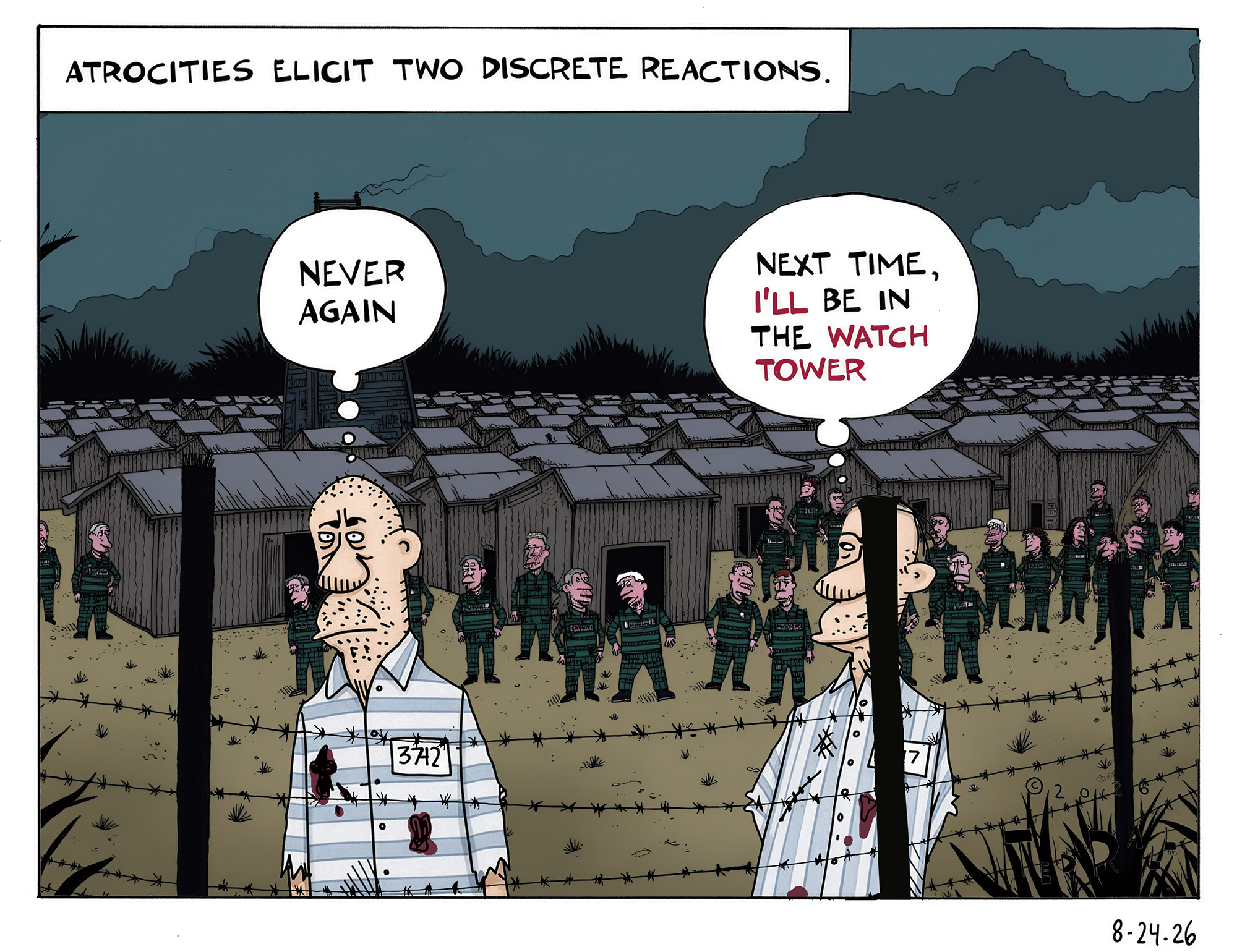
Ted, although I think it does elicit two responses, as your cartoon shows, I think the big issue here is, oddly, very similar to the situation with the fraudulent dead academic Jason Arday.
Arday’s case is — as far as I can tell — unique. No one in academia has lied as completely, has plagiarized so extensively, has lawyered up as much as Arday did. In fact, I am hard-pressed to find someone even close. Certainly, there have been many fabulists, plagiarists, and so forth, but this guy, truly, puts even Donald Trump to shame.
Similarly, with Israel, the people with the most to lose in the “debate” have carefully formulated the discussion. Any criticism of Israel is antisemitism, just as any criticism of Arday is racism. Any list of facts against Israel is “hateful” and any list for Palestine is simply the “gullible” letting themselves be tricked.
As Detective Conan points out, “one truth prevails.” Whether it’s a serial liar like Jason Arday or the current government of Israel. What the other side needs to do — and fails so often at — is to demand that the conversation remain situated on facts.
Amen to “demand that the conversation remain situated on facts”! But these days, participants in the discussions have their own sets of facts. When we try to dive deeper into which supposed facts are actually true we run into the problem that we no longer have agreement to trust experts in their own domains. Experts are now described as “elitists” who shouldn’t be trusted. These days we too often have no better factual support than “it must be true because the people in my bubble say so.” How do we unwind this mess?