
Many professional women complain that they can’t find “quality men,” which means those who are financially and professionally successful. Seventy years into feminism, however, female advancement has largely come at the expense of men, who cannot reasonably be expected to continue to be dominant providers as women advance in a zero-sum workplace.
No Love for the Defeated
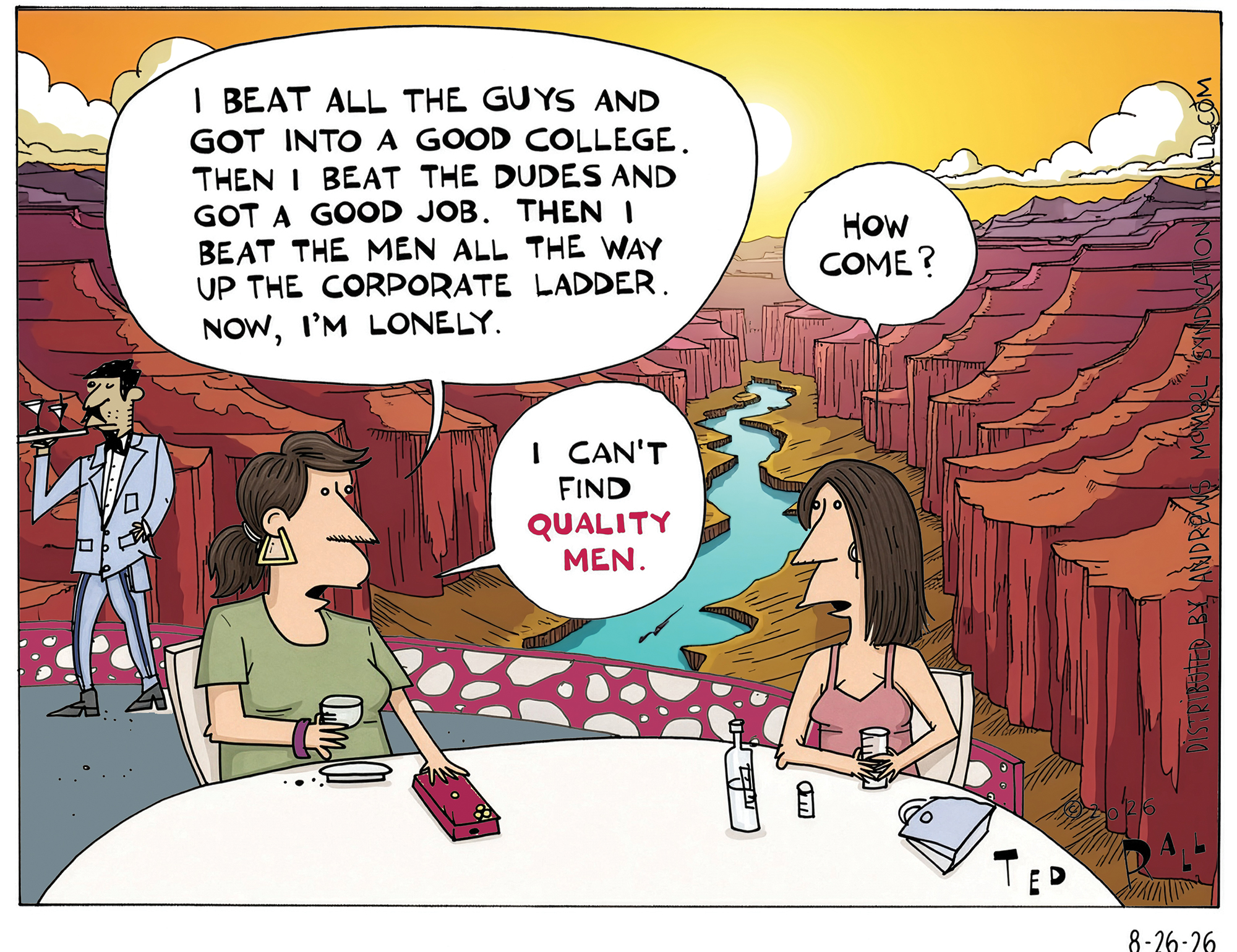

Ted Rall
Ted Rall is a syndicated political cartoonist for Andrews McMeel Syndication and WhoWhatWhy.org and Counterpoint. He is a contributor to Centerclip and co-host of "The TMI Show" talk show. He is a graphic novelist and author of many books of art and prose, and an occasional war correspondent. He is, recently, the author of the graphic novel "2024: Revisited."

4 Comments. Leave new
Some have, instead of “no love,” a profound and abiding contempt for the tiny fraction of the US population, of both genders, defeated and victorious, duped into thinking that “climbing the corporate ladder” has any legitimate, societal justification beyond attempted satisfaction of cosmic, and murderous, avarice.
It is also difficult to find financially and professionally successful women. Whichever genders you are looking for, if you define quality along only this narrow dimension you are going to have trouble. I suggest expanding one’s horizons and appreciating qualities other than the ability to climb the corporate ladder.
Zero-sum workplace??? Many of these financially and professionally successful people are part of start ups that exist because the people weren’t interested in competing for positions at status quo corporations. Progress, including our improving standard of living, is evidence that this is not a zero-sum game.
1. Barbara Leigh Smith, 1850s–60s — “Where are the men who are good?”
2. Victorian women: “For good men are scarce, but fools there are plenty, that’s why I am single at seven-and-twenty.”
Another described men as being like “three-cornered tarts”—pleasing to the eye but, on closer inspection, “hollow and stale.”
3. Lucinda Lee Dalton, a 19th-century Mormon educator and women’s-rights advocate, took the argument considerably further: if the good men were scarce, several women should be permitted to share one rather than be forced to marry inferior men.
4. Barbara Dafoe Whitehead’s 2003 book: Why There Are No Good Men Left: The Romantic Plight of the New Single Woman.
Her argument was specifically about highly educated professional women who found themselves single and increasingly frustrated with the mating pool.
It’s the same complaint, just with a different explanation every time.
When I asked our mutual friend, my mother, why she never remarried, she said “I never found a guy who was smart enough.” She wasn’t way up the corporate ladder, just an 8th grade English teacher, and just ahead of her time, as among women there is now a widespread disenchantment with marriage, much to the distress of the male population.