Jimmy Carter, Right-Wing Democrat

           You can’t understand the presidency of Jimmy Earl Carter, Jr. unless you contextualize it within the framework of the hysterical aftermath of the 1972 election. While the Republican Party brand suffered tremendous damage due to Watergate, President Richard Nixon’s decision to prolong the Vietnam War and his resignation, the GOP proved improbably resilient. Despite a deep recession and an energy crisis, to say nothing of fallout from the Nixon pardon, Gerald Ford came within two points of defeating Carter a mere two years after Nixon resigned in disgrace; the decisive counterrevolutionary fervor of the Reagan Revolution followed four years after that.

With the spotlight on these earth-shattering events, it was easy to miss the civil war within the Democratic Party, between its liberal and centrist wings, that was prompted by the landslide defeat of Senator George McGovern in 1972. (“Centrist” is used here for simplicity—that’s what they call themselves. By objective global standards, the centrist faction of the Democratic Party is corporatist and militarist, and therefore was and remains right-wing.)

In an exercise that would feel familiar to anyone observing the current struggle between progressive and corporate Democrats in the wake of the Kamala Harris debacle, party leaders and activists spent 1973 through 1976 blaming one another in ferocious fights over what went wrong and which wing of the party ought to be trusted to control the organization going forward.

            Ultimately, centrists won the power struggle and sidelined the liberals. Though he entered the race as an outsider, Governor Jimmy Carter of Georgia cemented the centrists’ victory and locked in the ideological template honed by another centrist Southern governor, Bill Clinton, and that still dominates today’s Democratic Party leadership. Old-fashioned liberals tried to stage a comeback under Walter Mondale in 1984 and Michael Dukakis in 1988; instead, their losses strengthened the centrists’ argument that Democrats needed to chase the Republicans as they migrated further right.

            It is easy to see why many Americans put Carter in the liberal box. More than any other modern president, he talked about human rights in the context of U.S. foreign policy. He was the only president who didn’t wage any wars. His manner was affable and soft-spoken.

            Whether or not they are ever successfully enacted, however, a president is defined by policies. Any objective analysis of his record must lead to a clear conclusion: Carter was a right-wing Democrat. And it mattered a lot. While his one term is typically dismissed by historians as lackluster or ineffectual, it had a dramatic impact on our politics.

Carter was our first post-liberal Democratic president. Half a century later, as Joe Biden packs his bags, the Carter model still holds. (Recognizing an ideological fellow, Biden was the first Democratic senator to endorse Carter in 1976.) There is no sign that a traditional mid-20th-century-style liberal like Hubert Humphrey, LBJ or Adlai Stevenson, who championed the poor and working class and were generally skeptical of foreign military adventurism, will have a serious shot at capturing a Democratic presidential nomination any time soon.

Inheriting a wobbly economy from Gerald Ford, Carter decided to prioritize the fight against inflation over what a liberal would have cared about more: keeping as many Americans employed as possible. He appointed Nixon’s former undersecretary of the Treasury Paul Volcker as chairman of the Federal Reserve Bank. Volker hiked interest rates to 20%, triggering huge back-to-back recessions that lingered into the 1980s. A liberal president would have turned to Congress to try to mitigate the misery. But Carter became the first Democratic president not to propose a federal anti-poverty program.

Carter’s conservatism expressed itself most fully through his cynical Cold War foreign policy. Although most Democratic voters would have been enraged had they known at the time, discredited figures on the Republican right like David Rockefeller and Henry Kissinger were on speed dial in the oval office and frequently had the president’s ear whenever there was a crisis overseas. The most pernicious influence inside the administration was national security advisor Zbigniew Brzezinski, who fell to the right of Republicans when it came to the Soviet Union.

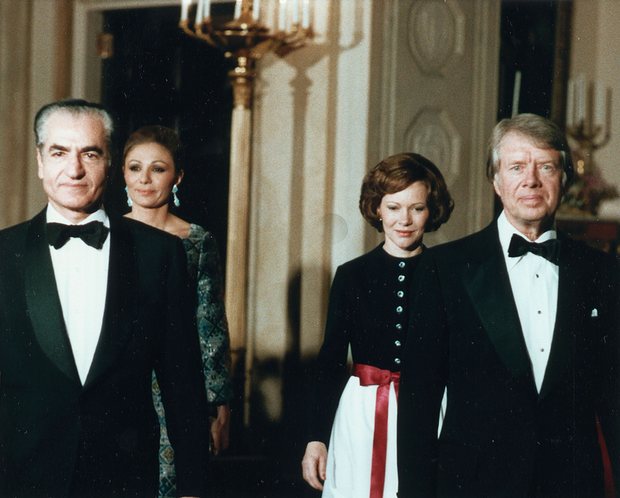
Carter’s team of foreign policy hawks convinced him to set aside his better judgment and reluctantly admit the dictatorial Shah of Iran to the United States to receive medical treatment, an unforced disaster that triggered the Iran hostage crisis and contributed to his defeat in 1980.  

Never one to stay quiet despite repeatedly being proven wrong, Brzezinski notoriously pushed for Carter to fund and arm the radical Muslim Afghan mujahedin, many of whom eventually morphed into Al Qaeda and the Taliban. There is a strong chance that 9/11 would never have happened if not for Carter’s backing of jihadi fanatics. Does anyone doubt that the world would be better off today with an Afghanistan where women wore miniskirts, as they did under the Soviet-backed socialist secular government in the 1970s, than burqas?

Brzezinski argued that Afghanistan would become the USSR’s Vietnam, a quagmire that would destroy the country morally and economically. No one knows whether the Soviet defeat in Afghanistan had the desired effect. The world clearly became more dangerous after 1991, when the United States began to enjoy the lone superpower status that it exploited to run roughshod over Afghanistan, Iraq, Libya, Syria and countless other victims of American imperialism. Without its socialist Cold War adversary offering an alternative if flawed economic model, America’s capitalists declared themselves victors at the End of History, with no need to share profits with workers or exhibit deference to other nations.

Carter needlessly politicized the Olympics by boycotting the 1980 Summer games in Moscow. The following year, one of my classmates in college was to have been on Team USA in fencing; I never forgave Carter for dashing her and her teammates’ hopes.

Carter is lionized as a pacifist. It wasn’t so when he was president. Most people think that we have Reagan to thank for the out-of-control military spending that began with his massive U.S. defense buildup in the 1980s. But the current cult of militarism really started under Carter, a fact that Reagan himself later acknowledged.

Worst of all, Carter was a liar and a hypocrite. Even while he claimed to prioritize human rights, his White House propped up vicious dictatorships. “Inaugurated 13 months after Indonesia’s December 1975 invasion of East Timor, Carter stepped up U.S. military aid to the Jakarta regime as it continued to murder Timorese civilians. By the time Carter left office, about 200,000 people had been slaughtered,” Fairness and Accuracy in Reporting’s (FAIR) Jeff Cohen recalled. “Elsewhere, despotic allies—from Ferdinand Marcos of the Philippines to the Shah of Iran—received support from President Carter. In El Salvador, the Carter administration provided key military aid to a brutal regime. In Nicaragua, contrary to myth, Carter backed dictator Anastasio Somoza almost until the end of his reign. In Guatemala—again contrary to enduring myth—major U.S. military shipments to bloody tyrants never ended.”

Carter pardoned the Vietnam-era draft dodgers only to turn around and restore draft registration the very next year. If you are a male assigned at birth, you face five years in prison, a $250,000 fine and losing your college financial aid unless you register for the next military draft in America’s next unpopular war with the Selective Service System. That was Carter. And it wasn’t liberal.

Nor was he.

(Ted Rall (Twitter: @tedrall), the political cartoonist, columnist and graphic novelist, co-hosts the left-vs-right DMZ America podcast with fellow cartoonist Scott Stantis and The TMI Show with political analyst Manila Chan. His latest book, brand-new right now, is the graphic novel 2024: Revisited.)
Make Kamala Earn Our Votes

           Democrats were relieved when President Biden finally pulled out of the presidential race. That was understandable. It was easy to see why they quickly coalesced behind Vice President Kamala Harris as Biden’s replacement: time was short, there’s no standard party process for putting on a snap second round of primaries, passing over a woman of color who has served dutifully if not impressively would have been a bad look for the party.

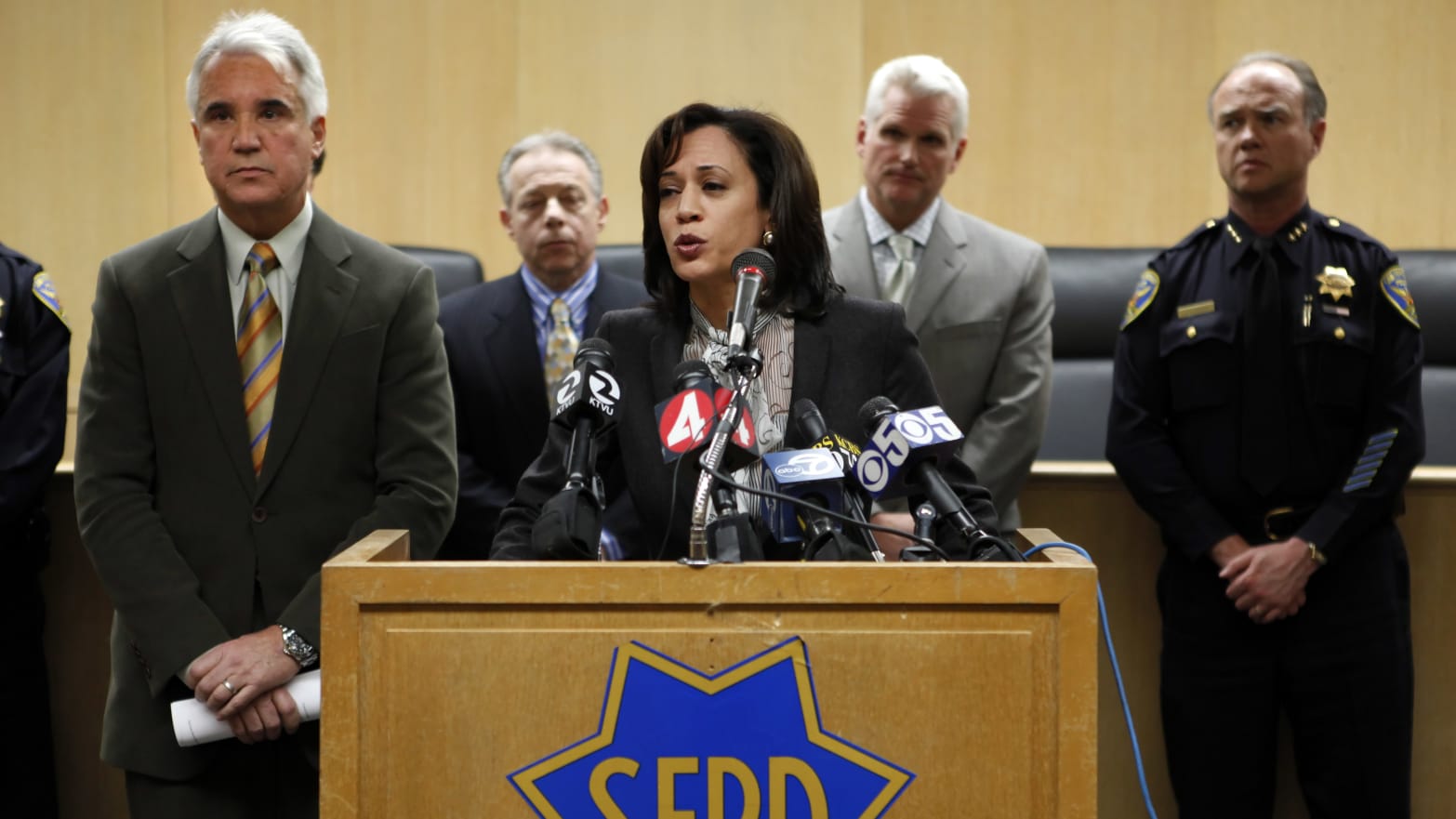
Completely inexplicable, on the other hand, is the Democrats’ immediately creating an “I’m with hercult of personality for Harris—the same slogan that helped sink Hillary Clinton in 2016 because it violated the #1 rule of politics: the politician is supposed to be with us. Why are gullible Democrats donating at record levels for a candidate who has yet to make a single campaign promise? They’re lining up to volunteer for an incumbent politician who didn’t accomplish a single thing in her current job—no new law attributable primarily to her, no policy initiative she pushed through, no big idea she championed. And they’re overlooking the prosecutor position where she did get stuff done, defending oppressive state policies and leaving behind a trail of broken lives shattered by injustice she helped perpetuate.

We know why: she’s not Trump.

That’s nowhere close to be being good enough. Mainly because it’s a faulty assumption. How do we know she’s better than Trump? Until Harris tells us what she’s for, there is no objective way to compare her to her Republican counterpart.

            If a politician wants votes, they should earn them. They must identify our problems and develop policies to address them. They must explain why their solutions are better than those proffered by their opponents. They must defend their record. They must explain their mistakes and explain why they will not repeat them.

            Kamala Harris is not doing any of this. And there’s no sign she plans to.

            A social media ad distributed July 27th by the Harris Victory Fund says it all: “I am running to be President of the United States. If that’s all you need to hear, then make a donation to fund my campaign today.” [underline hers, not mine] No. It’s not. I need to hear a lot more—and so should you.

Reagan quoted a Russian proverb: “Trust, but verify.” When a leader asks you to trust her without offering any reason to do so, when she asks for a blank check, when citizens willingly suspend skepticism, when those who wish to wait-and-see are shouted down as party poopers in service to evildoers (in this case, Trump), you are observing a key democracy, votes, elections, Kamala Harris, record, promises, policies, Ronald Reagan, Hillary Clinton, blank checkcomponent of fascism: blind trust in The Leader. Jason Stanley, a Yale philosopher, noted: “Truth is required to act freely. Freedom requires knowledge, and in order to act freely in the world, you need to know what the world is and know what you’re doing. You only know what you’re doing if you have access to the truth.”

What is the truth about Kamala Harris? No matter what, her supporters say, she’ll be better than Trump. To which I ask, citing the Boston punk band The Lyres, “How Do You Know?”

This is a tough question to answer.

Which is outrageous.

In a democracy, a citizen should not have to resort to Cold War-style Kremlinology to guess how a candidate for president would govern the country. Yet here we are, casting our votes blindly.

Whatever you think of Project 2025, the Heritage Foundation’s ambitious right-wing wish list for a second Trump Administration, or whether you believe Trump’s claim that he has nothing to do with it, you have to give Republicans credit for having a plan. Voters can read Project 2025 and watch Trump’s rallies and read the GOP platform and decide, as informed free citizens, whether or not they want to vote for a candidate who, more likely than not, would carry out those policies were he to be reelected. We know who Trump is. We know what he’s for.

The same cannot be said of Kamala Harris, a sidelined vice president whose record in the White House is startlingly sparse. New York magazine described the veep last year as “a minor character who has little role in the administration’s domestic and foreign policy.” She only served part of a single term as senator, the highlight of which was her grilling of Supreme Court nominee Brett Kavanaugh. No bill that she co-sponsored ever made it into law.

If anyone owes voters a detailed policy agenda, it’s Harris. Would she be Biden 2.0? Is she a progressive or a corporatist? She’s run as both. Democrats should issue their own version of Project 2025 so we know who and what we’re voting for—or against.

Unless we hold politicians’ feet to the fire, representative democracy is unaccountable and therefore worthless. When we give our votes away without any promises in return, we are reduced to speculation about what they might or may not do. Once elected, they do whatever they want.

They’ve promised us nothing. So they owe us nothing. We are worse, and our system is worse, than people in a corrupt autocracy who sell their votes for money or, as in some countries, kitchen tools. As voters, we are worse than whores. We are sluts of democracy—we give it away for free.

Without specific policy promises, our analysis of Harris must, by necessity, ignore the dictum that past performance is no guarantee of future returns. People change. But if Harris has evolved since her days as a prosecutor—the only period of her career that documents her own actions, in a position where she had wide discretion—we have no way to know that. Is she better than Trump? The only hard data we have is her record as a DA and AG.

That record is pretty bleak. Hers is the portrait of ambitious careerist who marketed herself as a tough-on-crime prosecutor with a view toward setting herself up for a situation like the one in which she finds herself now, running for high office at a time when people are freaked out about street crime. (Bonus! Trump is a convicted felon!) Trouble is, like most self-styled crime fighters, she committed a lot of crimes herself. She violated due process, cheated the rules of evidence, fought to preserve flawed convictions, refused to pay wrongfully-convicted defendants and worked overtime to keep the innocent behind bars by denying DNA tests.

A different kind of evil than Trump’s—but not a smaller kind. What could be more disgusting than using your position as an officer of the court to oppose the interest of justice?

Fortunately for Harris, she can easily lay these skeletons in her closet to rest. She can apologize, say that she has seen the light, and write up a credible plan for criminal justice report that shows she has changed her views.

Hopefully we’ll see something before Election Day.

(Ted Rall (Twitter: @tedrall), the political cartoonist, columnist and graphic novelist, co-hosts the left-vs-right DMZ America podcast with fellow cartoonist Scott Stantis. His latest book, brand-new right now, is the graphic novel 2024: Revisited.)

Trump, the UAW and the Next Realignment

Bipartisanship is dead. But job-killing trade agreements like NAFTA were promoted by politicians of both major parties alike—until Donald Trump. “Our politicians have aggressively pursued a policy of globalization, moving our jobs, our wealth and our factories to Mexico and overseas. Globalization has made the financial elite, who donate to politicians, very, very wealthy. I used to be one of them,” he told an audience in Pennsylvania in 2016. “Many of these areas have never recovered and never will unless I become president. Then, they’re going to recover fast.”

They didn’t. The Rust Belt continues to disintegrate.

Trump didn’t deliver. But his message proved to be an effective vote generator. It turned Ohio, the ultimate bellwether swing state, red. Formerly Democratic Pennsylvania now swings. So it’s no surprise that Trump is repeating his message to workers: deindustrialization sucks, no one sees your pain but me, and I’ll make it go away.

This year, Dr. Trump is going even further than any previous Republican president has gone before, reaching out to big labor, long a bête noire for Republicans. September 27th  finds the once-and-possibly-future president skipping the second GOP presidential debate and speaking instead to striking autoworkers.

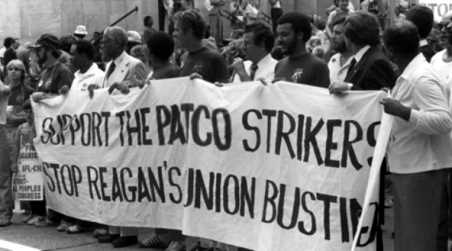
Symbolically, Trump’s outreach represents a radical contrast for a party with a long and consistent history of antagonism to workers’ right to bargain collectively. Congressional Republicans rammed through the Taft-Hartley Act, Reagan fired the air traffic controllers, Republican-controlled legislators created union-gutting “right to work” states and, as a result, union campaign contributions overwhelmingly flowed to Democratic candidates. This is the first time in memory—possibly ever—that a major Republican presidential contender has thought of campaigning to union members, during a walkout no less.

Meanwhile “Union Joe” Biden, who likes to emphasize his working-class Scranton background and has collected numerous union endorsements, has been publicly silent about the UAW strike—a stance made starker when he jammed a contract down the throats of freight train workers when they threatened to walk off the job. The President hasn’t expressed any desire to meet with striking workers, whether at one of the big three automakers, the SAG-AFTRA writers in Hollywood, or Amazon warehouses. Biden’s support for unions has been performative and rhetorical.

What about Trump’s?

At this date, Trump is the better talker. Nothing new here, when compared to Biden. The question is, might the Republican Party assume policy positions that credibly allow it to argue that it has become an ally of workers, after decades of being their enemy in service of their corporate masters?

If anyone can and will spearhead such a pivot, it will be Trump, the man who pulled off the neat trick of running against the Iraq War in the den of bloodthirsty militarism that is a Republican primary, and winning, and going on to become the first president in two decades to seriously negotiate with the Taliban, signing a deal to withdraw from Afghanistan, yet remaining a hero of the right.

Should Trump construct a pro-labor Republicanism, we may be at the dawn of the biggest political realignment election since 1932. Roosevelt’s victory at the depth of the Great Depression and the subsequent enactment of his New Deal reversed the basic duopolistic structure in place since 1860. For three-quarters of a century the Party of Lincoln had represented progressivism and the struggle for equal rights while Democrats had embraced reactionary and racist policies with the occasional interruption of white-aligned populists like William Jennings Bryan; in rough terms, the parties switched places as Democrats embraced liberalism as we know it and Republicans took on conservatism.

We are currently experiencing a realignment-in-waiting, a 1932-scale ideological reversal that is taking hold in some arenas, tentative in others and will live or die depending on what party leaders do about two or three key issue categories.

On foreign policy, realignment is nearly complete. America’s current project in interventionism, the proxy war in Ukraine, enjoys full-throated support from Biden and Congressional Democrats while the antiwar voices are found not in the supposedly democratic-socialist “Squad” but the far-right Freedom Caucus. Culturally, the Democratic Party has become the home of well-educated coastal elites while the GOP increasingly draws in voters with high school educations and lower incomes in flyover country.

Realignment remains stillborn without an analogous reversal in domestic affairs, however. This is where Republicans have yet to demonstrate an appetite to reverse course.

A 180° switcheroo would see a genuine attempt by Republicans to address long-standing economic problems that traditionally have been Democratic Party projects if and when they have been discussed at all: soaring healthcare costs, high college tuition, poverty, homelessness, unaffordable housing, low real wages. In Alcoholics Anonymous the first step is admitting you have a problem; in politics the first step is talking about a problem in a way that shows that you acknowledge its existence. Some Republicans are finally starting to address some of these issues. But that’s a far cry from proposing meaningful solutions, much less legislation.

Trump’s hostile takeover of the Republican Party put him on a collision course with the neoconservatives who started two forever wars. He prevailed in that fight. Should Trump choose to chart a path for Republicans that includes an appeal to ordinary workers, he will have to defeat the traditional Republicans who created the status quo like rival presidential candidate Senator Tim Scott of South Carolina, who suggests that the appropriate response to striking auto workers is to replicate the way Reagan handled PATCO: “He said, you strike, you’re fired. Simple concept to me to the extent that we can use that once again.” Similarly, Governor Brian Kemp dismisses the UAW as a blue-state nuisance: “We just haven’t been dealing with it in Georgia, because we’re a right-to-work state.”

Trump’s outreach to labor could, and most likely will prove to be, nothing more than an empty gesture designed to extract votes ahead of an election, no follow up forthcoming, no actual leaning on management to cough up higher wages and better conditions for workers. Or it might be the beginning of something big, like his America First foreign policy, which overturns the balance of power inside his party and changes the way we think about what both major parties stand for.

 (Ted Rall (Twitter: @tedrall), the political cartoonist, columnist and graphic novelist, co-hosts the left-vs-right DMZ America podcast with fellow cartoonist Scott Stantis. You can support Ted’s hard-hitting political cartoons and columns and see his work first by sponsoring his work on Patreon.)


Do As I Say, Not As I Did

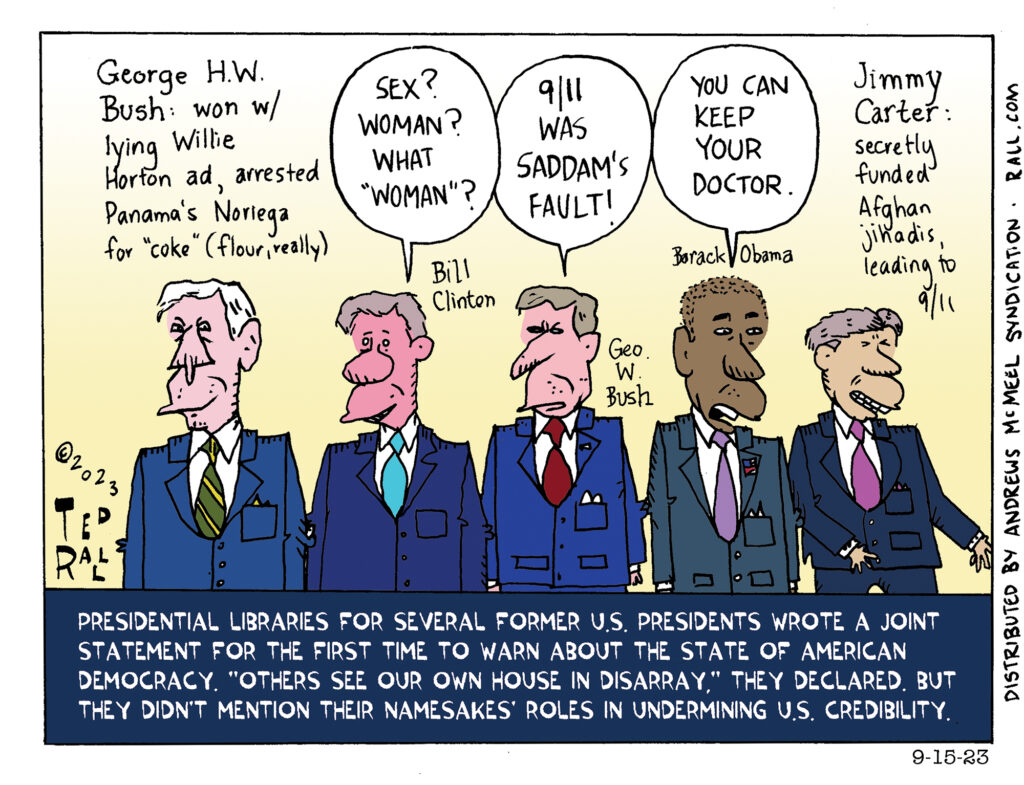
Presidential libraries for several former U.S. Presidents wrote a joint statement for the first time to warn about the state of American democracy. “Others see our own house in disarray,” they declared. But they didn’t mention their namesakes’ roles in undermining U.S. credibility.

No Donald Trump Is Above the Law

            In the United States, no man is above the law, not even the President—if his name is Donald J. Trump.

            A decade before 1884, when he was elected to his first term, Grover Cleveland fathered a child with Maria Halpin, a widow. Thing is, she testified under oath that Cleveland had raped her. Ambitious and wealthy, Cleveland did what any rich mean 19th century dude would do: he arranged to have the baby sent off to an orphanage and the mother committed to an insane asylum. (It didn’t take. They let her go.) For good measure, he had her smeared in the press as an alcoholic slut. As it happened, Halpin turned out to be an upstanding churchgoer with a good reputation.

            No charges were ever filed against Cleveland.

            Ronald Reagan’s best-known scandal was Iran-Contra, in which his Administration violated its own sanctions and sold weapons to Iran and broke federal law by spending the proceeds on right-wing death squads in Central America. He wasn’t new to this sort of thing.

            Worried that the American embassy personnel who were seized as hostages by Iran might get released before the 1980 election, thus allowing Jimmy Carter to win reelection, three top Reagan officials—campaign manager and future CIA director James Casey, former Texas governor John Connally and Connally’s protégé Ben Barnes—promised the Iranians to sell them arms in exchange for their promise not to release the hostages until after the election. True to their side of the deal, Iran sent them home a few hours after Reagan took the inaugural oath. Reagan reneged on the weapons.

            Reagan was never charged.

            The Gipper may have been inspired by the Chennault Affair, then-GOP candidate Richard Nixon’s scheme to undermine incumbent Lyndon Johnson’s efforts to achieve peace in Vietnam and thus deny the White House to Hubert Humphrey.

            Two weeks before the 1968 election, things were looking up for the Democrats. Worried about a Nixon victory because we was rabidly anti-communist, the USSR ordered North Vietnam, its client state, to agree to a peace deal. LBJ agreed to stop bombing the North. All that remained was getting South Vietnam—America’s client—on board.

            So Nixon used back channels (Mrs. Chennault) to ask South Vietnam’s president to boycott the peace talks, promising continued military and economic support after he won. The South Vietnamese leader scuttled the deal, Nixon won and the war ground on seven more years, killing hundreds of thousands more people. “This is treason,” LBJ said when FBI wiretaps revealed the plot.

            Nixon wasn’t charged.

            Executive Order 12333, signed by Reagan, states: “No person employed by or acting on behalf of the United States Government shall engage in, or conspire to engage in, assassination.” It’s still the law of the land.

            Reagan didn’t follow his own rule. He ordered a hit on Lebanese cleric Mohammed Hussein Fadlallah in 1984; Fadlallah escaped unscathed but 80 innocent bystanders were killed. In 1986 he bombed Moammar Gaddafi’s home, killing the Libyan ruler’s infant daughter.

            No charges there.

            George W. Bush, Barack Obama, Donald Trump and Joe Biden murdered thousands of people in drone strikes—each and every one of them by definition a political assassination (a person killed “for what he represents politically”). Obama ordered the murder of Osama bin Laden and Trump murdered Qasem Soleimani, a top Iranian general.

            No charges.

            Actress Heather Lind accused George H.W. Bush of groping her at a 2014 photo-op. Juanita Broaddrick says Bill Clinton raped her in 1978, when he was Arkansas attorney general. Tara Reade claims Joe Biden sexually assaulted her in 1993.

            No charges have been filed in any of these cases.

            Richard Nixon received a presidential pardon from his successor, Gerald Ford, whom he had appointed. So he was immune from prosecution for Watergate.

            Bill Clinton paid $25,000 in order to avoid being prosecuted for perjury in the Paula Jones case.

            From Andrew Jackson, who killed a guy in a duel in 1806—dueling was already illegal at the time—to Bush, Obama and Trump, who all presided over Guantánamo torture camp—the U.S. is a signatory of the Convention Against Torture, which makes it a treaty obligation and thus carries the full weight of federal law—no president or former president has ever faced criminal charges.

            Until now.

            Merciful and easygoing by nature, the American people can easily turn a blind eye to a run-of-the-mill political assassination—or a thousand of them. Who of us can say we haven’t killed a man in a duel? Rape is unpleasant for the victim, but think how much worse it would be for the rapist if that rapist were a president or former president—better to move on.

            Conspiring with a foreign country to manipulate a presidential election strikes one as gauche, even tacky—especially when they mean extra-long wars or extra time spent for a hostage. But going after a president or former president over such things seems excessive. Best not to think about such matters, much less act upon them.

            Even in America, this most permissive of countries if you’re rich and white and powerful, there are limits. And that limit is: falsifying business records in order to violate federal campaign finance laws in the course of paying a former mistress to shut up. Donald J. Trump has crossed that hard line.

            And he must pay.

            If Trump, the worst president America has ever had and ever could have, and the worst person the human race has ever produced, doesn’t go to prison for the maximum five years over paying hush money to Stormy Daniels, it will send an awful message:

            Anything goes.

            Can’t have that!

(Ted Rall (Twitter: @tedrall), the political cartoonist, columnist and graphic novelist, co-hosts the left-vs-right DMZ America podcast with fellow cartoonist Scott Stantis. You can support Ted’s hard-hitting political cartoons and columns and see his work first by sponsoring his work on Patreon.)


Invasions Are Only Bad When Russia Does Them

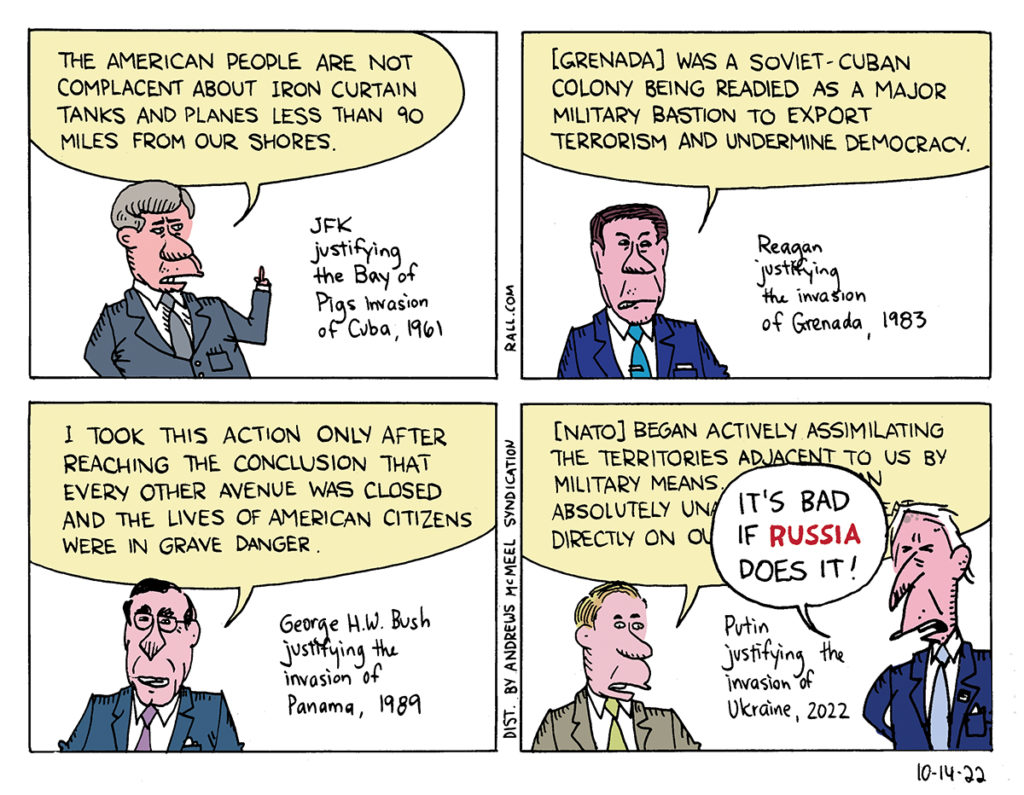
From the Monroe Doctrine to the ongoing blockade of Cuba, the United States has repeatedly exerted and exercised its prerogative to invade any country in its immediate region, up to and including the entire Western hemisphere, if it perceives a threat of any kind, whether real or imagined. So it’s a bit baffling that so many Americans violently deplore Russia’s invasion of Ukraine, which is right along its border, after Ukraine threatened to join NATO, an anti-Russian military alliance.

Don’t Hate Rush Limbaugh. Copy Him.

Rush Limbaugh died from lung cancer after denying smoking's risk. Why'd he believe his lie?

           My death will make some people giddy with joy. That’s cool. I like to make people happy.

            In the unlikely event that I’m  somehow able to witness the gleeful grins and chortles of those who savor the sweet news of my demise, I hope that whatever is left of me on the astral whatever will remain sufficiently objective to recognize the fundamental fairness of the celebrants’ reaction.

After all, criticizing the dead is one of my things. Rejecting the traditional maudlin obituary cartoon format that depicts every boldface name showing up at the pearly gates to check in with Saint Peter — why are American political cartoonists so certain that the next world will be configured in accordance with Christianity? — I have occasionally acquired notoriety by publishing critical observations about such dearly departed figures as Ronald Reagan, Jerry Garcia and other politicians and celebrities whose life stories I believed to have benefited from grade inflation.

I have my take on Jimmy Carter ready to go. Let everyone else dwell on Habitat for Humanity; I’ll remind mourning lefties of draft registration, Afghanistan, the Moscow Olympics and setting the stage for the 1980s defense buildup. Also, he was the first Democratic president not to propose an anti-poverty program because apparently no one is poor anymore.

I didn’t know Rush Limbaugh but I used to do talk radio so I know some people who did. Based on what I heard I have to think he would have held an analogous opinion on the clinking of champagne glasses in Berkeley and the Upper West Side that followed news of his passing. He would have been pleased. What he wanted, what we who express opinions for a living all want, was to be heard and reacted to.

They say Limbaugh was actually pretty sweet. He just said mean things on the radio. “What is sad is that such an imbecile and such an ignoramus ends up as a prominent cartoonist in major newspapers,” he said about me, and who knows? Maybe he was right. Perhaps he would have been courteous in person. I’m just happy he noticed my work.

            I speak ill of humans who are no longer breathing, famously and infamously so. The typical response to body-still-warm criticism is that it’s too soon, let the family and friends mourn, cold-blooded assessments of a life well-lived or not so much should await some unspecified future moment. That’s dumb. There will never be a more perfect time to judge a person’s achievements and failings than the hours following a man or woman’s demise. Years later, when it’s appropriate, who will care?

            Limbaugh gave as good as he got, usually better, and if anyone is above criticism it’s not him. But much of the ding-dong-the-witch-is-dead rhetoric on Twitter and various op-ed pages goes beyond celebrating the death of a formidable adversary, which Limbaugh surely was to anyone on the left. It conflates political disagreement with moral judgment.

            Declaring someone to be immoral because you don’t like their opinions is intellectually dishonest. Hate Limbaugh, hate Hillary Clinton, hate me, but judge our moral lives by the way we lived, not whether or not you agree with us. I hate it when readers tell me that I drew a good cartoon simply because they agree with its point of view; some of the best cartoons I have ever read expressed politics that I despise.

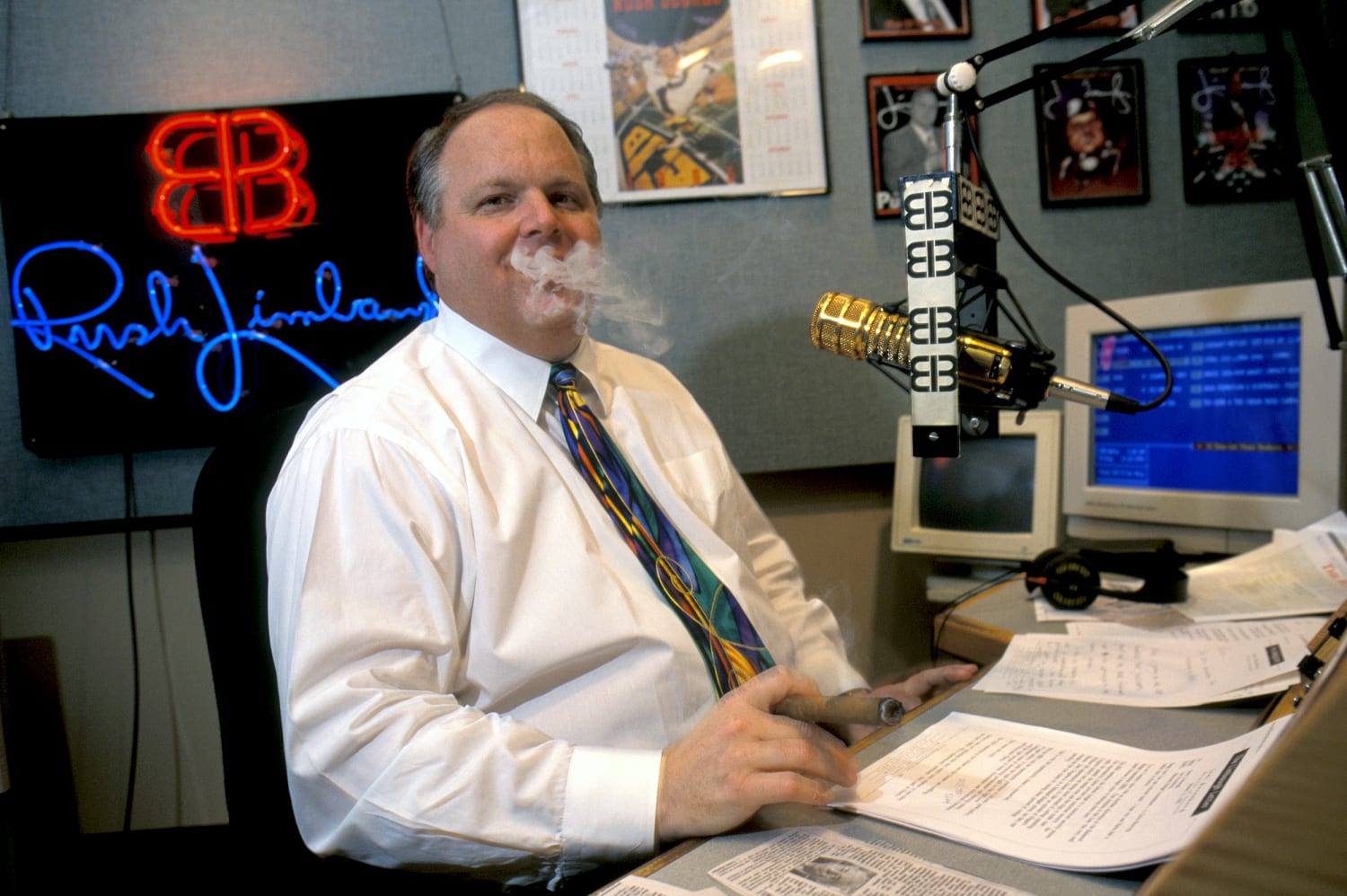
            What really galled liberals about Limbaugh was his success, his incredible effectiveness. Imagine, though it’s scarcely possible, the progressive analog of the man who singlehandedly revolutionized talk radio. You could drive hundreds of miles across highways where Limbaugh’s voice was the only one on the dial, only to reappear on the next local station as the old one faded out. He brilliantly exploited dead air and an unusual-for-radio voice with hilarious bombast with tongue planted firmly in cheek whether his dittoheads knew it or not.

Though he wound up his career as a fairly rote Trump Republican, Limbaugh first made his mark as a conservative who criticized the GOP for failing to live up to the right-wing values he articulated and held them to account. He mobilized an army. As much as Buchanan, Reagan and Trump, he defined the ideological and attitudinal contours of today’s emboldened Republican Party. Had Al Franken managed to guide the benighted Air America — take a sec to Google it — to similar heights, Democrats would have a filibuster-proof majority in the Senate and Bernie Sanders would be beginning his second term. Who knows how many economic sectors would be nationalized by now?

            What if Al Franken or Rachel Maddow (who got her start on Air America) dominated 15 hours a week of top-rated radio in every single market, and hundreds and hundreds of stations, for decades before succumbing to lung cancer? What if they had succeeded in pushing the 50-yard line of politics as far left as Limbaugh did to the right? It is a safe bet that, if such criticism could credibly apply, no Democrat would take note of Franken or Maddow’s marital problems, substance abuse, intemperate language, cigar danger denialism or alleged egotism. They might even pick up, as Limbaugh did from Trump in an episode that enraged liberals, a Presidential Medal of Freedom from President Biden.

            About Limbaugh’s supposed egotism: I am endlessly amazed by Americans’ inability to recognize humor expressed by a partisan expressing an opposing political point of view. Limbaugh “once introduced himself with a pomposity and self-aggrandizement that, to this day, takes the breath away,” Colbert I. King writes in the Washington Post: “This is Rush Limbaugh, the most dangerous man in America, with the largest hypothalamus in North America, serving humanity simply by opening my mouth, destined for my own wing in the Museum of American Broadcasting, executing everything I do flawlessly with zero mistakes, doing this show with half my brain tied behind my back just to make it fair, because I have talent on loan from God.”

Note to King: this is a joke. It’s so much of a joke that even if he meant every single word, it transcended the artist’s original meaning to become a joke he never intended. Seriously, though, take it from this leftist. It’s like that time Donald Trump asked the Russians to look for Hillary Clinton’s missing emails. It was a joke, everyone knew it was a joke, and Democrats looked stupid for pretending it wasn’t or, worse, not recognizing it.

            Go ahead, hate Rush. But it would be smarter for lefties to copy him.

(Ted Rall (Twitter: @tedrall), the political cartoonist, columnist and graphic novelist, is the author of “Political Suicide: The Fight for the Soul of the Democratic Party.” You can support Ted’s hard-hitting political cartoons and columns and see his work first by sponsoring his work on Patreon.)


The Data Is Clear: Progressives Should Boycott Biden

Good thing that he was surrounded by Secret Service': Joe Biden ...

            Once again the Democratic Party is asking progressives to vote for a presidential nominee who says he disagrees with them about every major issue. This is presented as an offer they cannot refuse. If they cast a protest vote for a third-party candidate like the unionist and environmentalist Howie Hawkins of the Greens or stay home on that key Tuesday in November, Donald Trump will win a second term—which would be worse than Biden’s first.

            Which is better for the progressive movement? Fall into the “two party trap” and vote for Biden, or refuse to be coopted and possibly increase Trump’s reelection chances?

            My new book Political Suicide: The Fight for the Soul of the Democratic Party documents the last half-century of struggle between the party’s left-leaning voters and its right-leaning leadership class. History is clear. When progressive voters compromised their values by supporting corporatist candidates, they were ignored after the election. Only when they boycotted a general election did the DNC start to take them seriously.

            Throughout the 1980s party bigwigs manipulated the primaries in favor of establishment corporatist candidates over insurgent progressives: Jimmy Carter over Ted Kennedy in 1980, Walter Mondale and Michael Dukakis over Jesse Jackson in 1984 and 1988. Democrats were united but unenthused; all three lost.

            Jimmy Carter won once, and Bill Clinton and Barack Obama each won two terms, all three with progressive support. Democratic victories didn’t help progressives.

Most people have forgotten that Carter was the first of a string of conservative Democratic presidents. He brought back draft registration. The “Reagan” defense buildup actually began under Carter, as Reagan himself acknowledged. Carter provoked the Tehran hostage crisis by admitting the despotic Shah to the U.S., boycotted the Moscow Olympics and armed the Afghan mujahdeen who morphed into Al Qaeda.

            Carter became the first president since FDR not to propose an anti-poverty program. Instead, he pushed a right-wing idea, “workfare.”

            Progressives got nothing in return for their votes for Jimmy Carter.

            Like Carter, Clinton and Obama governed as foreign policy hawks while ignoring pressing domestic issues like rising income and wealth inequality. Clinton pushed through the now-disgraced 1994 crime bill that accelerated mass incarceration of people of color, signed the North American Free Trade Agreement that gutted the Rust Belt and sent hundreds of thousands of jobs overseas, and ended “welfare as we know it,” massively increasing homelessness. Obama bailed out Wall Street while ignoring Main Street, smashed the Occupy Wall Street movement and supported Al Qaeda affiliates that destroyed Libya and Syria.

            There was only one arguably progressive policy achievement over those 16 years: the Affordable Care Act, which originated in the bowels of the conservative Heritage Foundation think tank.

            Progressives kept holding their noses and voting for Democrats. Democrats took them for granted. Democrats didn’t push to increase the minimum wage. They watched silently as generation after generation succumbed to student loan debt. As the earth kept burning, they hardly lifted a finger to help the environment except for symbolic actions like Obama’s fuel efficiency regulations, which required less than automakers were doing by themselves.

            Personnel, they say in D.C., is policy. Clinton had one progressive in his cabinet for his first term, Labor Secretary Robert Reich. Obama had none. Citigroup chose his cabinet.

            After the defeat of Bernie Sanders in 2016, progressives tried something new. Millions of disgruntled Sanders primary voters either stayed home, voted for Trump or cast votes for third-party candidates like Jill Stein. Hillary Clinton, who was so sure she could take progressives for granted that she put Sanders at 39th on her list of vice presidential picks, was denied her presumptive shoo-in victory. (Don’t blame Stein. Adding all of her votes to the Hillary Clinton column would not have changed the result.)

            Three years later, something remarkable happened. Most presidential hopefuls in the 2020 Democratic primary campaign emerged from the centrist corporatist wing of the Democratic Party yet felt pressured to endorse important progressive policy ideas. Kamala Harris, Cory Booker, Amy Klobuchar, Pete Buttigieg and even Michael Bloomberg came out in favor of a $15-an-hour minimum wage. Most of the mainstream candidates proposed some sort of student loan forgiveness and Medicare For All. Nearly all support a Green New Deal.

            What forced the Democratic Party to shift left after decades of moving to the right? Fear that progressives will withhold their votes this coming November. After years of empty threats from progressives, the November 2016 voter boycott proved they wouldn’t sell their votes without getting something in return.

            The answer to the question, what should progressives do, is easy in the long term. Progressives should boycott Democratic candidates who don’t credibly pledge to support progressive policies. Biden says he would veto Medicare For All. He opposes a Green New Deal as well as student loan forgiveness. He is hawkish on Russia and Venezuela. He doesn’t want your vote. Why give it to him for free?

            The trouble is, every election is also about the short term. Progressive voters have to game out the next four years.

            If Trump wins, he may have the opportunity to appoint another Supreme Court justice. He will certainly appoint more federal judges. He will continue to coddle hate groups and spew lies. Many of the weak and vulnerable will suffer. On the other hand, activism will be sustained. Resistance and possibly even revolutionary change may emerge. Trump will be a lame duck likely wallowing in scandal; very few presidents get much if anything done during their second terms.

            If Biden wins, his Supreme Court picks may not be significantly more to the left then Trump’s. He is likelier than Trump, who shows restraint on interventionism and ended the occupation of Afghanistan, to start a new war. Big problems will get small solutions or none at all. Streets will be quiet. If there are any demonstrations, for instance by Black Lives Matter, his Department of Homeland Security will suppress it as Obama did to Occupy. As under Bill Clinton and Barack Obama, the left will go back to sleep. Progressives will watch Biden appoint one corporatist cabinet member after another as their dreams of making the country a better place fade away.

            And in 2024, we will again face a choice between a rabid right-wing Republican and a wimpy sell-out Democrat. This election, Democrats will say as they always do, is too important for ideological purity. Progressives should wait until some future election when less hangs in the balance. Perhaps in 2028? Maybe 2032? 2036?

(Ted Rall (Twitter: @tedrall), the political cartoonist, columnist and graphic novelist, is the author of the biography “Political Suicide: The Fight for the Soul of the Democratic Party.” You can support Ted’s hard-hitting political cartoons and columns and see his work first by sponsoring his work on Patreon.)


Our Politics Need a Culture of Atonement

George Clooney v Daily Mail, round 3 - SubScribe14

            Culturally informed by Roman Catholicism’s expectation that regret must prompt an apology as well as penance, Western European tradition calls for a rhetorical journey by politicians who claim to have changed course. A chastened leader should explain why and how he came to his previous belief, explain the circumstances that changed his mind and make the case for his new, different policy. He must expend political capital in order to get changes enacted.

Charles de Gaulle, who wanted France to retain control of Algeria, had observed the popularity and ferocity of the Algerian independence movement during his frequent visits to Algiers. In 1960 the French president admitted that he’d long been mistaken. “The Algerians will have the free choice of their destiny,” he informed a nation stunned by his dramatic reversal. Speaking of political capital, some military officers felt so betrayed they tried to assassinate him. But he brought the Algerian crisis in for a soft landing and regained support.

A rare American example occurred in 1987. President Ronald Reagan first denied negotiating with Iranian hostage takers. Then he apologized to the public for Iran-Contra. Taking “full responsibility for my own actions and for those of my administration,” Reagan then admitted to misleading the public. “A few months ago I told the American people I did not trade arms for hostages. My heart and my best intentions still tell me that’s true, but the facts and the evidence tell me it is not.” Reagan’s admission was a low point for his presidency but bolstered his reputation in the long run.

            Atonement doesn’t play a frequent role in American politics.

Yet it works. After JFK accepted responsibility for the attempted overthrow of the Cuban government at the Bay of Pigs—he could have schluffed the fiasco off on Eisenhower, whose administration planned it—his popularity soared.

But it might not have worked for Ike. A study undertaken in 2017 in nine nations including the U.S. found that—especially in the U.S.—conservatives are less willing than liberals to apologize and that they’re less likely to accept an apology when one is offered.

            Conservatives mocked Bill Clinton and Barack Obama for “apology tours” expressing regret over America’s role in the slave trade and Middle East interventionism, respectively. Being Republican means never having to say you’re sorry.

            The fertile soil for a culture of atonement occurs on the left.

            Joe Biden needs to unify the Democratic Party. He has the center-left Hillary Clinton wing in the bag. He leads in the polls but has an enthusiasm gap in progressives who supported Sanders and Warren. Neither Black Lives Matter nor progressives have forgiven the former vice president for supporting the police-group-written 1994 crime bill, which contributed to mass incarceration. They’re angry that he voted for war against Iraq. A fulsome apology followed by substantial atonement—the way Sanders now says he shouldn’t have voted for the war against Afghanistan—could help Biden with activists.

So far, so tepid.

Biden hasn’t expressed regret, apologized or explained his change of heart, much less promised to do better when contemplating issues of law and order or wars of choice in the future. Why should the left forgive a man who hasn’t asked for it?

            Kamala Harris is on the short list for the vice presidency. Her prospects are clouded by her history as a pro-cop prosecutor. She might consider that confession is good for the soul as well as the polls—especially among the progressive Democrats Biden needs. Harris could renounce her “lock them up and throw away the key” past as a attorney general. She could urge the release of Kevin Cooper, now serving on death row for murders that he may not have committed because she opposed DNA testing. Harris said she felt “awful about this.” Never mind the pabulum. Write a check to the Innocence Project.

            Empty talk won’t save organizations either.

The NFL is trying to pivot away from its long-standing prohibitions against players expressing opposition to racism and police violence, a policy symbolized by blackballing Colin Kaepernick. “We, the National Football League, admit we were wrong for not listening to NFL players earlier and encourage all to speak out and peacefully protest,” commissioner Roger Goodell said.

Goodell’s statement “has rightfully been met with skepticism from the masses,” Vincent Frank wrote at Forbes. “But if [Colin] Kaepernick remains unemployed once the 2020 NFL season starts in September, it will have been proven that Goodell’s words were nothing more than an attempt to appease the masses through a well thought out PR stunt.”

Biden, Harris and the NFL need to atone for their sins. We don’t want their words. We need action.

 (Ted Rall (Twitter: @tedrall), the political cartoonist, columnist and graphic novelist, is the author of the biography “Bernie,” updated and expanded for 2020. You can support Ted’s hard-hitting political cartoons and columns and see his work first by sponsoring his work on Patreon.)


Every Single Time, Centrists Say They’ll Win. And They Never Do.

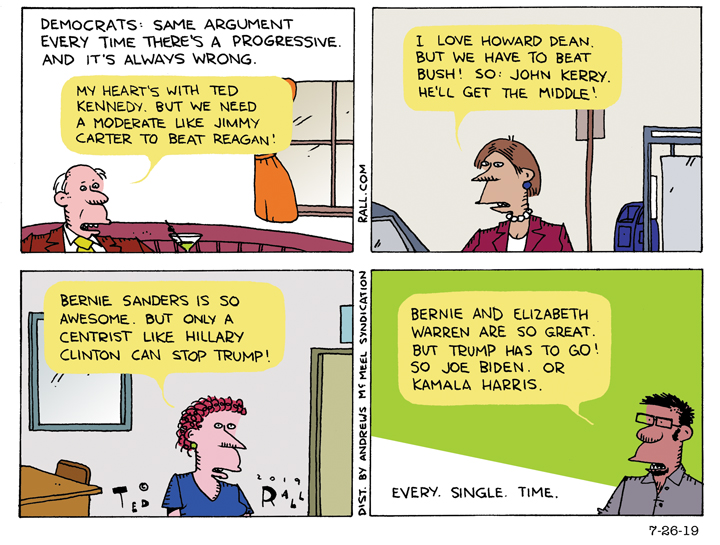
It’s the oldest debate within the Democratic Party: what to do about a progressive insurgent candidate? Whether it’s Ted Kennedy’s challenge against Jimmy Carter in 1980, Howard Dean against John Kerry in 2004 or Bernie Sanders against Hillary Clinton, moderates and centrists always say the same thing: in order to win, you need those swing voters. That means you have to pick the moderate choice. The problem with that argument is that it never really works out in the general election. Kennedy and Dean’s voters stayed home in November. 3 to 4,000,000 Bernie Sanders primary voters never showed up for Hillary Clinton. Now the same argument is being floated again, this time in favor of Joe Biden.

keyboard_arrow_up
css.php